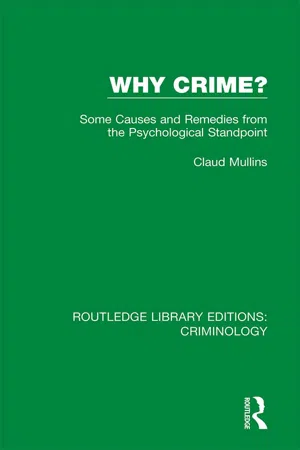
Originally published in 1945. This book presents the developing opinions contemporary to the post-war period, of the social and psychological roots of criminal actions as seen through the viewpoint of a practising magistrate. Looking at the psychological treatment of delinquents in particular, using actual case experiences, various causes are illustrated, and future preventative interventions are suggested and categorised. Early childhood developmental effects leading to characteristic criminality are distinguished from those societal factors with later and lesser influence, in the opinion of the author. The book discusses the court systems for judging family disputes and divorce in comparison to criminal cases amongst its investigation into the cause of criminality. The author's ground-breaking work led to much reform in the UK judicial system and this book is a fascinating insight to the history of psychology, law and criminology.
- 138 pages
- English
- ePUB (mobile friendly)
- Available on iOS & Android
eBook - ePub
About this book
Information
CHAPTER I
THE INHERITANCE
A man of a certain constitution put in a certain environment will be a criminal.
PROFESSOR J. B. S. HALDANE1
How can a community hurt a criminal it has created, which it has borne as truly as a mother bears a child?
MARGARET WILSON2
THE above quotations illustrate the muddle in people’s minds about the causes of crime. The popular view among those interested in the subject is that criminals are what they are because society has made them so. This view accords with modern political tendencies and is based upon the assumption that if society had provided for all a satisfactory social and economic environment, there would be few criminals. Those holding this view find that it generates soothing feelings of anger against the scheme of things. They would demand, if they were logical, that instead of criminal prosecutions being termed, as they are, Rex v. Smith (in the United States of America The People v. Smith), they should be termed Smith v. Rex (Smith v. the People), for they believe that the delinquent, rather than his victims or society, is really the aggrieved party. A good example of such reasoning is the ‘Reservation’ that Mr. Dan Griffiths wrote to the report of the Departmental Committee on Persistent Offenders (1932). There was much that was sound in Mr. Griffiths’s expressed opinions, but he also wrote that ‘three-quarters of all crime is due to sheer poverty, poverty of the means of a decent, civilized life, or, what is worse, destitution of the elementary requirements of physical existence’.
1 In a Foreword to Crime as Destiny, by Dr. Johannes Lange.
2 In a book with the somewhat fantastic title, The Crime of Punishment, p. 309. ‘Margaret Wilson’s’ opinions may have been the result of her many years spent by prison walls; her husband was a prison governor.
This popular theme that crime is caused by poverty, while it undoubtedly contains an element of truth, could not be upheld during the grim years of the war of 1939. Practical work then in dealing with delinquents provided constant evidence in support of the hackneyed dictum of Carlyle that ‘adversity is sometimes hard upon a man, but for one man who can stand prosperity there are a hundred that will stand adversity’. Soon after the war began wages for those who were not in the fighting services increased greatly, and in plenty of cases became high in comparison with pre-war times; yet stealing continued, even by many of those who were by comparison well off. Much of this stealing was of luxury articles. In November 1941, several chairmen of juvenile courts wrote a letter to The Times protesting that the high wages earned by youths, sometimes higher than the wages of their fathers, were direct causes of crime. Magistrates in adult courts also had much experience of the effect of high wages on those with insufficient ability to make good use of their money and of what leisure they had.
Superficial views about the causes of crime, such as placing crime at the door of poverty, are not often held by those who have much experience in the handling of delinquents. It is always good that those without much, or even any, experience of our criminal courts should interest themselves in delinquency, but much hard study, both in court and outside, is essential to the formation of sound opinions about crime, especially about the causes of crime. Uninstructed generalizations are easy, particularly when strong political opinions influence their making. But there are many authorities whose work has to be studied before worth-while generalizations can be made.
Of these authorities on the causes of crime one of the greatest was Dr. Charles Goring, a medical officer in the English prison service. About his time a great Italian, Cesare Lombroso, had propounded the theory that there is an absolute difference in physical build between criminals and others. (In later life Lombroso modified this opinion.) This theory was a challenge to Goring. With the approval of the Prison Commissioners, a large-scale investigation of some 3,000 inmates of English prisons was made in the years 1902 to 1908. Goring examined more than half of these prisoners and later tabulated all the material yielded by the investigation. His conclusion that ‘there is no such thing as a physical criminal type’, guarded though it was by other statements, has ever since given immense encouragement to environmentalists. But just as Lombroso never received adequate credit for the real merit of his achievements, so Goring’s work has been remembered mainly because he refuted the early opinion of Lombroso. But what did Goring discover? His negative conclusions were but a small part of his work. An abridged edition of his report was published in 1919,1 and a reading of this shows that Goring clearly realized the importance of the inheritance. Professor Karl Pearson, who had collaborated in the investigation, wrote an introduction to this edition, wherein he stated that it came as a surprise to Goring that the results of the investigation forced him to the conclusion that there was ‘found relatively small influence of environment’. Goring was quite candid: ‘We may dogmatically assert that recidivism, in its most pronounced form, is certainly not a product of any of the social and economic inequalities we have been examining.’2 Further he wrote:
Relatively to its origin in the constitution of the malefactor, and especially in his mentally defective constitution, crime in this country is only to a trifling extent (if to any) the product of social inequality, of adverse environment, or of other manifestations of what may be comprehensively termed ‘the force of circumstances’.3
1 Published under the title The English Convict, by H.M. Stationery Office.
2 p. 211.
3 pp. 211–12.
Goring summed up thus: ‘Our correlations tell us that, despite of education, heritable constitutional conditions prevail in the making of criminals.’1
Among more recent authorities is Professor Cyril Burt of London University, who was formerly psychologist to the education department of the London County Council, a post offering vast opportunities for experience of delinquent and other children. For the purposes of his book, The Young Delinquent, Professor Burt investigated 200 delinquent children and 400 non-delinquents of similar ages. This experience convinced Professor Burt that ‘if our inquiry is to begin at the very beginning, it must go back to influences that were operative long before the child himself was born. We must review not only his birth and early life, but his ancestry also’.2 This is surely common sense. Yet many of those interested in criminals are reluctant to accept this necessity, or to recognize that human inheritance, whether physical or psychological, bears any relation to problems of crime.
In individual cases any research into ancestry is difficult. In court we usually have to be content with inquiring into the parentage of our younger delinquents. But in the study of crime research has to be made into the ancestry of criminals; otherwise statements about the causes of criminal conduct are mere guesswork. If ancestry is ignored, we are back in the times before the discovery of the continuity of the germ plasm; till 1883 people could reasonably believe that inheritance had no importance, since science taught that the cells from the parents, which by uniting formed a new life, were used up in the process. Weismann put an end to such beliefs, but some superficial students of criminology do not seem to have realized the consequences.
For knowledge about the inheritance it is best first to inquire from a biologist. Professor H. S. Jennings of Johns Hopkins University, a leading light in this field, wrote a most useful book, The Biological Basis of Human Nature. Not only is this book easy to read for laymen in the science, but it inspires confidence because the author obviously set out to present the facts fairly and without any bias against the environmentalists.
1 The English Convict, p. 274. It is worthy of note that Havelock Ellis was convinced by his own investigations that sexual inversion ‘may be inborn’; Psychology of Sex, p. 198.
2 Third edition, p. 29.
Observation and experiment [wrote Professor Jennings] have shown that the original cell contains a great number of distinct and separable substances existing as minute particles. The development of an individual is brought about by the interaction of these thousand substances—their interaction with each other, with other parts of the cell, and with material taken from outside…. These many diverse substances present at the beginning of development are called the genes.
What is the importance of these genes? Again we should turn to Professor Jennings:
It is known that different individuals start with diverse sets of these substances and that the way a given individual develops, what he becomes, what characteristics he gets, what peculiarities he shows, depend, other things being equal, on what set of these substances he starts with…. Some combinations of them give imperfect individuals, feeble-minded, deformed, monstrous. Others give normal individuals, others superior individuals. There are combinations giving every intermediate type, some yielding slightly imperfect individuals, lazy, stupid or silly; and there are combinations that produce genius.1
This may appear a somewhat drastic start for our inquiry, for if we accept this, and we must, a new-born child is in a sense already an aged being. But this is precisely what every new-born child is. He is ‘heir of all the ages ‘both in body and mind.
No inquiry into the problem of heredity in its relation to criminal conduct should ignore the remarkable opinions expressed by Dr. Louis Berman of New York in two thought-provoking books, The Glands Regulating Personality and The Personal Equation, books which have to be used with care because they give the impression, unlike the book of Professor Jennings, that their author wished to prove a case and set out to belittle both the environmental and the psychological approaches to abnormal conduct. Dr. Berman’s principal theme was that the inherited endocrine glands, also called the ductless glands or the glands of internal secretion, are all-important in the human inheritance. Thus:
1 Both quotations come from pp. 1–3.
A man resembles his parents because he gets from them the original chemical materials, placed differently in time and space amid varying conditions, which commence to react and interact and so immediately to acquire a biography, a history.1
Knowledge of the influence and importance of these endocrine glands has increased in recent years, but unfortunately it is still true that ‘there is as yet little understanding of the factors needed for the normal functioning of the various glands and for their normal integration’.2 According to Dr. Berman these glands are ‘the fundamentals in the personality’,3 and I believe that this will one day be generally recognized among physicians. I have personal experience to justify this belief. For six years I struggled with ill-health and had several breakdowns, and only when these glands received the attention of an expert did hope return. In future years intensive research into the working of these glands will be required, for even Dr. Berman with all his confidence admitted that ‘our knowledge of the glands of internal secretion as an interlocking directorate presiding over all the functions of the organism is still exceedingly meager’.4 Even present knowledge about these glands may, as we shall see, have its use in connexion with delinquency.
1 The Personal Equation, p. 31.
2 Medicine and Mankind, by Dr. Arnold Sorsby, p. 144.
3 The Personal Equation, p. 43.
4 The Glands Regulating Personality, p. 145.
The inheritance is not, of course, limited to physical traits. Our minds are also endowed at conception with a psychological inheritance. On the whole medical psychologists have tended in their work to belittle the importance of heredity, but an increasing number among them are studying psychological inheritance. A pioneer among these was Professor Ernst Kretschmer, who in pre-Nazi days was a famous professor of psychiatry and neurology in German universities. In his book The Psychology of Men of Genius he wrote: ‘That inherited dispositions, and not environmental factors, are the essential causes of highly talented performances can be regarded as proven, according to the present position of research.’1 Also: ‘Genius is born as such, and it must perfect itself according to the laws which caused it to appear.’2 The reverse side of the picture was also made clear by Professor Kretschmer. Referring to a case of schizophrenia, by now a well-known psychological disorder, often called ‘split mind’, he wrote that ‘a rich schizoid basis spreads pertinaciously down both branches of the family like a creeping evil’.3
A psycho-therapist who was well known in New York, Dr. Ira Wile of the Mount Sinai hospital, showed in his book The Challenge of Childhood his full conviction on the subject of psychological inheritance. Heredity, he wrote, ‘transmits widely variant mental potentials, which determine the limits within which intellectual development is possible…. The created mind has its ultimate future powers at birth as truly as the germinal cells have...
Table of contents
- Cover
- Half Title
- Title Page
- Copyright Page
- Original Title Page
- Dedication
- Original Copyright Page
- Preface
- Contents
- Chapter 1 The Inheritance
- Chapter 2 Parents and Children
- Chapter 3 Breaking Homes
- Chapter 4 Illegitimate Children
- Postscript
- Index
Trusted by 375,005 students
Access to over 1.5 million titles for a fair monthly price.
Study more efficiently using our study tools.
Frequently asked questions
Yes, you can cancel anytime from the Subscription tab in your account settings on the Perlego website. Your subscription will stay active until the end of your current billing period. Learn how to cancel your subscription
No, books cannot be downloaded as external files, such as PDFs, for use outside of Perlego. However, you can download books within the Perlego app for offline reading on mobile or tablet. Learn how to download books offline
Perlego offers two plans: Essential and Complete
- Essential is ideal for learners and professionals who enjoy exploring a wide range of subjects. Access the Essential Library with 800,000+ trusted titles and best-sellers across business, personal growth, and the humanities. Includes unlimited reading time and Standard Read Aloud voice.
- Complete: Perfect for advanced learners and researchers needing full, unrestricted access. Unlock 1.5M+ books across hundreds of subjects, including academic and specialized titles. The Complete Plan also includes advanced features like Premium Read Aloud and Research Assistant.
We are an online textbook subscription service, where you can get access to an entire online library for less than the price of a single book per month. With over 1.5 million books across 990+ topics, we’ve got you covered! Learn about our mission
Look out for the read-aloud symbol on your next book to see if you can listen to it. The read-aloud tool reads text aloud for you, highlighting the text as it is being read. You can pause it, speed it up and slow it down. Learn more about Read Aloud
Yes! You can use the Perlego app on both iOS and Android devices to read anytime, anywhere — even offline. Perfect for commutes or when you’re on the go.
Please note we cannot support devices running on iOS 13 and Android 7 or earlier. Learn more about using the app
Please note we cannot support devices running on iOS 13 and Android 7 or earlier. Learn more about using the app
Yes, you can access Why Crime? by Claud Mullins in PDF and/or ePUB format, as well as other popular books in Social Sciences & Criminology. We have over 1.5 million books available in our catalogue for you to explore.