Originally published in 1938, A History of Europe 911-1198 is a comprehensive and scholarly history of Europe from the revival of the Empire under the German kings to the great religious and political conflicts of the late twelfth century. This book will be of interest to students and scholars of medieval history.
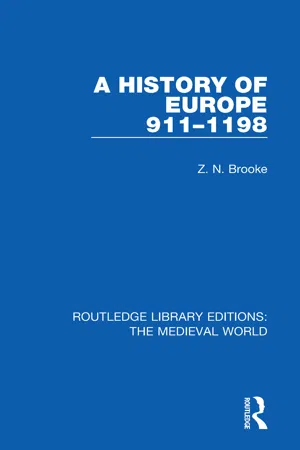
- 574 pages
- English
- ePUB (mobile friendly)
- Available on iOS & Android
eBook - ePub
A History of Europe 911-1198
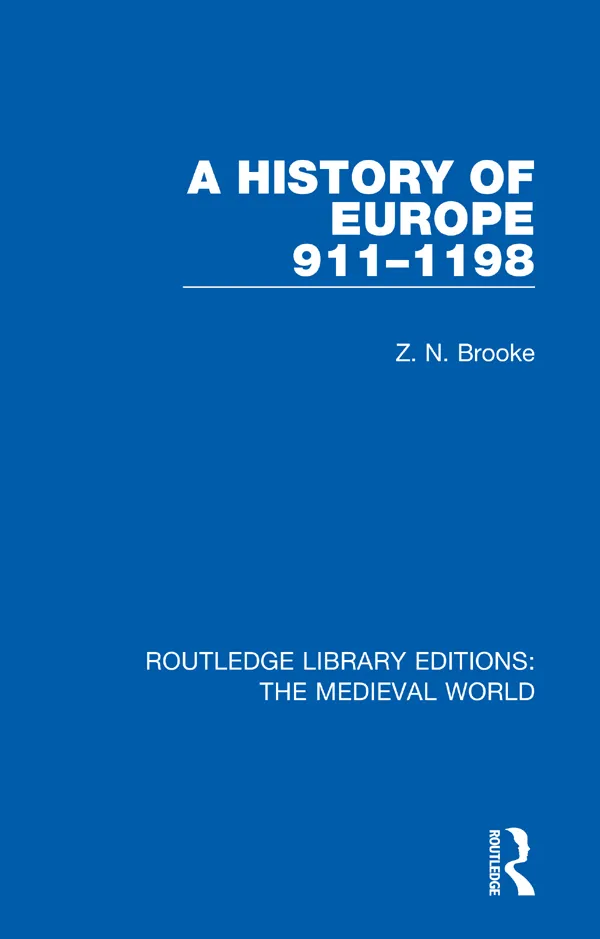
ROUTLEDGE LIBRARY EDITIONS: THE MEDIEVAL WORLD
Volume 6
A HISTORY OF EUROPE 911–1198
A HISTORY OF EUROPE 911–1198
Z. N. BROOKE

First published in November 1938
Second edition July 1947
Third edition 1951
Reprinted with minor corrections 1956
Reprinted 1960, 1962 and 1969
This edition first published in 2020
by Routledge
2 Park Square, Milton Park, Abingdon, Oxon OX14 4RN
and by Routledge
52 Vanderbilt Avenue, New York, NY 10017
Routledge is an imprint of the Taylor & Francis Group, an informa business
© 1938 Z. N. Brooke
All rights reserved. No part of this book may be reprinted or reproduced or utilised in any form or by any electronic, mechanical, or other means, now known or hereafter invented, including photocopying and recording, or in any information storage or retrieval system, without permission in writing from the publishers.
Trademark notice: Product or corporate names may be trademarks or registered trademarks, and are used only for identification and explanation without intent to infringe.
British Library Cataloguing in Publication Data
A catalogue record for this book is available from the British Library
ISBN: 978-0-367-22090-7 (Set)
ISBN: 978-0-429-27322-3 (Set) (ebk)
ISBN: 978-0-367-17273-2 (Volume 6) (hbk)
ISBN: 978-0-429-05594-2 (Volume 6) (ebk)
Publisher’s Note
The publisher has gone to great lengths to ensure the quality of this reprint but points out that some imperfections in the original copies may be apparent.
Disclaimer
The publisher has made every effort to trace copyright holders and would welcome correspondence from those they have been unable to trace.
A History of Europe
FROM 911 TO 1198


First published November 1938
Second edition July 1947
Third edition 1951
Reprinted with minor corrections 1956
Reprinted 1960, 1962 and 1969
3.5
SBN 416 43510 6
First published as a University Paperback 1969
1.1
SBN 416 29640 8
Printed in Great Britain by
Butler & Tanner Ltd, Frome and London
This book is available in both hardboard and paperback editions. The paperback edition is sold subject to the condition that it shall not, by way of trade or otherwise, be lent, resold, hired out, or otherwise circulated without the publisher’s prior consent in any form of binding or cover other than that in which it is published and without a similar condition including this condition being imposed on the subsequent purchaser.
Distributed in the USA by Barnes & Noble Inc.
Distributed in the USA by Barnes & Noble Inc.
PREFACE
THE arrangement of this volume needs, perhaps, some explanation. It is no easy matter to describe the history of numerous European States (for only the internal history of the British Isles is omitted from the scheme of the series), and at the same time to preserve some unity in the telling. I have attempted this by developing three main themes—the Empire (later, Empire and Papacy), Christianity and Islam (or, alternatively, East and West), and France, which if subsidiary at first develops into a main theme later on. Each of these I have traced in four stages: up to the middle of the eleventh century, in the second half of that century, and in the two halves of the twelfth century. In the first two periods the other topics have been dealt with as subordinate parts of the greater themes, but they have been given a more detailed and individual description in general chapters inserted in the middle of the twelfth century.
The question of nomenclature raises a further problem. I have adhered, with a few exceptions, to the system adopted in the Cambridge Medieval History, though with some misgivings. In a book written for English readers it is obviously right to speak of Rome, Venice, Milan, and even Cologne, but I am not very happy about writing Mayence for Mainz and Trèves for Trier. A difficulty arises for the reader, to distinguish the numerous Conrads, Henrys, Ottos, &c., from each other. Here I hope that the guidance given in the Index, supplemented by the genealogical tables, will be sufficient.
In one respect this volume differs from its predecessors in the series, in the absence (apart from an introductory outline of Europe) of sketch maps. This was found necessary, owing to the recent heavy rise in the costs of book-production, in order to avoid the greater evil of an increase in the price of the book. Though I had prepared other maps, I was only too glad to jettison them. I have never found small-scale uncoloured maps to be of any value; an historical student must equip himself with an historical atlas containing coloured maps. My attitude to the bibliographies, which may invite some criticism, I have explained in a preliminary note.
This book has occupied my spare time during the past seven years, and I can only hope that it does not betray too many signs of having been written thus, unavoidably, piecemeal. I have certain, most grateful, acknowledgements to make. Firstly, to my wife, who undertook the typing of the whole manuscript. Secondly, to my colleague, Mr. Philip Grierson, who read through the typed manuscript and enabled me to make a number of important and necessary corrections before the book was in proof. Lastly, to my wife again, and also to my three sons, who rendered me invaluable assistance throughout the reading of the proofs and in the laborious task of compiling the Index.
Z. N. B.
September, 1938
PUBLISHER’S NOTE TO REPRINTS
No changes have been made in the text; but the bibliographies were revised for the 1951 edition by Dr. Janet Matthews (Mrs. Sondheimer), and for the 1956 and 1969 impressions by the author’s son, Professor Christopher Brooke.
CONTENTS
BIBLIOGRAPHICAL NOTE
INTRODUCTION. EUROPE IN THE NINTH CENTURY
The Empire of Charlemagne; its disruption; division into kingdoms; the ninth-century invasions; feebleness of royal authority; the beginnings of feudalism; contrast of theory and practice; Germany much less feudalised than France; the division into kingdoms after 887; the disintegration of France; greater cohesion in Germany; the tribal duchies; the Church in France and Germany; the Italian kingdom; the Papacy: its rise and decline; potentialities in the papal office; map of Europe at the beginning of the tenth century; perilous condition of Western Christendom; the Vikings; the Slavs; the sphere of the Eastern Empire; the Moslems in Spain; importance of sea-power; dawn of a brighter outlook
PART I
TO THE MIDDLE OF THE ELEVENTH CENTURY
TO THE MIDDLE OF THE ELEVENTH CENTURY
I. THE NEW MONARCHY IN GERMANY
The new German monarchy; the practice of election; the character of royal government; the policy of the dukes; election of Conrad I (911–18); his incapacity; the Church as the ally of monarchy; missionary character of the German Church; its five provinces; the synod of Hohenaltheim (916); the election of Henry I (919–36); his mastery of the dukes; truce with the Magyars; the military reorganisation of Saxony; expeditions against the Slavs; defeat of the Magyars; expedition against the Danes; the achievement of Henry I; Otto I (936–73); his imperial ambition; ecclesiastical coronation at Aix; the difficulties confronting the new king; Bohemia; the northern Slavs; the Magyars; the revolt of the dukes; the king of France and Lorraine; the mastery of Otto; his plan of government; the Italian kingdom; Hugh of Arles; Rome dominated by Theophylact; the career of his daughter Marozia; her son Alberic supersedes her; Burgundy and Provence united into one kingdom; Hugh of Arles expelled from Italy; the appeal to Otto I; Otto’s control in the Burgundian kingdom; Otto’s first Italian expedition; feud of the dukes of Suabia and Lorraine with the duke of Bavaria; civil war in Germany; submission of the rebels; defeat of the Magyars on the Lechfeld (955); effects of Otto’s victory; his new scheme of government; the duchies; check on ducal authority not provided by counts-palatine; Otto’s reliance on the bishops; his control of appointments; the ultimate ill-effects of the system; its immediate advantages
II. THE EMPIRE OF THE OTTOS
Otto I’s second expedition to Italy; his coronation as Emperor (962); the Empire of Otto the Great compared with that of Charlemagne; the government of the Italian kingdom; the immediate and the ultimate effects of the union of Italy and Germany; Otto’s contest with the Roman nobles for the control of the Papacy; his policy in South Italy; Otto II crowned co-Emperor (967); marriage of Otto II with the Byzantine princess Theophano (972); death of Otto the Great; Otto II (973–83); the difficulties of Otto II’s early years: (1) the revolt of duke Henry of Bavaria; (2) the French king and Lorraine; (3) Denmark; protracted contest with Henry of Bavaria and his allies; invasion of Lorraine by the French king and counter...
Table of contents
- Cover
Trusted by 375,005 students
Access to over 1.5 million titles for a fair monthly price.
Study more efficiently using our study tools.
Frequently asked questions
Yes, you can cancel anytime from the Subscription tab in your account settings on the Perlego website. Your subscription will stay active until the end of your current billing period. Learn how to cancel your subscription
No, books cannot be downloaded as external files, such as PDFs, for use outside of Perlego. However, you can download books within the Perlego app for offline reading on mobile or tablet. Learn how to download books offline
Perlego offers two plans: Essential and Complete
- Essential is ideal for learners and professionals who enjoy exploring a wide range of subjects. Access the Essential Library with 800,000+ trusted titles and best-sellers across business, personal growth, and the humanities. Includes unlimited reading time and Standard Read Aloud voice.
- Complete: Perfect for advanced learners and researchers needing full, unrestricted access. Unlock 1.5M+ books across hundreds of subjects, including academic and specialized titles. The Complete Plan also includes advanced features like Premium Read Aloud and Research Assistant.
We are an online textbook subscription service, where you can get access to an entire online library for less than the price of a single book per month. With over 1.5 million books across 990+ topics, we’ve got you covered! Learn about our mission
Look out for the read-aloud symbol on your next book to see if you can listen to it. The read-aloud tool reads text aloud for you, highlighting the text as it is being read. You can pause it, speed it up and slow it down. Learn more about Read Aloud
Yes! You can use the Perlego app on both iOS and Android devices to read anytime, anywhere — even offline. Perfect for commutes or when you’re on the go.
Please note we cannot support devices running on iOS 13 and Android 7 or earlier. Learn more about using the app
Please note we cannot support devices running on iOS 13 and Android 7 or earlier. Learn more about using the app
Yes, you can access A History of Europe 911-1198 by Z.N. Brooke in PDF and/or ePUB format, as well as other popular books in History & European History. We have over 1.5 million books available in our catalogue for you to explore.