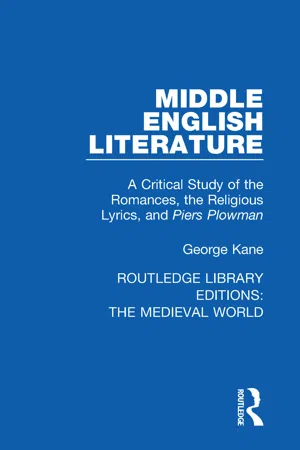
Originally published in 1951 Middle English Literature applies methods of literary evaluation to certain Middle English works. Arguing that previous literary criticism has largely focused on the commentary of their historical, social, philological and religious content, the book suggests that it has led to a thinking that Middle English literature is without artistic value and therefore cannot be compared effectively with later works of the fourteenth and fifteenth century. While traditional analysis has been beneficial to scientific and historical findings, this text seeks to look deeper into the artistic merits of the works and the authors that wrote them, arguing that the authors of these Middle English texts, wrote with the same motivations and experiences of these later authors which in turn informed the artistic basis of these Middle English works. The book looks at Middle English texts through three main areas: the Metrical Romances, the Religious Lyrics and Piers Plowman.
eBook - ePub
Middle English Literature
A Critical Study of the Romances, the Religious Lyrics, and Piers Plowman
- 268 pages
- English
- ePUB (mobile friendly)
- Available on iOS & Android
eBook - ePub
Middle English Literature
A Critical Study of the Romances, the Religious Lyrics, and Piers Plowman
About this book
Information
PART I
THE MIDDLE ENGLISH METRICAL ROMANCES
WHILE it is self-evident that the study of the Middle English verse romances must begin with relating them to the historical and social circumstances in which they originated, it is less obvious but equally true that preoccupation with their backgrounds interferes with an evaluation of the romances themselves; for if we make sufficient allowances of a historical and social kind we explain away and excuse every one of their shortcomings and find them all equally interesting as illustrations of the past while we remain little the wiser about their relative literary value. As my purpose in this study is to renew literary interest in them I propose to consider them, in the second instance, not so much out of their historical context as without primary reference to it. By this means I hope to show that there are in many of the romances permanent qualities of the kind to be found in good narrative art of any age which can reduce to their proper relative unimportance those external conventions of the romance kind by which the surviving specimens can most readily be classed together and separated from other genres. I believe that this consideration will result in a more just appreciation of their significance in the history of English literature than can be reached by considering them principally as documents from which to define the word ‘mediæval’, a method inclined to form in the critic the habit of excusing rather than evaluating.
1 The best discussion of this point was published twenty years ago by Dorothy Everett: ‘A Characterization of the English Medieval Romances’, Essays and Studies by Members of the English Association xv (1929), 98 fi. I do not think that she has closed the subject; that the discussion has not been resumed indicates a lack of interest in what she properly fixed on as a most important point rather than that there is nothing more to be said. N. E. Griffin, in ‘The Definition of Romance’, Publications of the Modern Language Association of America, xxxviii (1923), 50–70, is concerned with a distinction between ‘epic’ and ‘romance’ which hardly bears upon the Middle English specimens.
It seems to me most important to distinguish the external qualities by which the romances are classified from possible essential characteristics. In so far as the surviving romances can be said to have a common definable nature,1 this seems to consist first, in a very general purpose of entertainment by narrative, second, in this narrative being concerned with some one of a very wide range of subjects,1 and third, in the frequent occurrence of certain characteristics of treatment, some of which are fundamental, and others more properly classified as accidents rather than essentials of the genre. The essential characteristics are that the story should be treated in terms of chivalry, and that it should not be naturalistic, but that instead its setting, characters and action should be heightened to enable the escape from the limitations of actuality which the romances were designed to afford.2 I detect four principal accidents of treatment. First, whatever the subject of a romance, this was translated into a contemporary setting by a process almost inevitable in the Middle Ages and, therefore, not so much characteristic of the romances as of the times in which they were written. Second, the boundaries of probability in the romances extend much more widely than they would in modern fiction; the marvellous in all its forms is common fare in them. This again is a feature not of the romances but of their age. What Jeanroy described as a characteristic of mediaeval taste is more deep-seated than he allowed; it is not merely the literary appetite of a public avide de sensations rares et fortes3 but a capability of belief unhampered by modern scientific notions of physical probability, and a concept of a world in which supernatural agencies could readily, and for the smallest reasons, interfere in the course of Nature.1 The third accidental characteristic, a specifically literary form of the second, occurs when, in the hands of inferior artists, the essential quality of heightening is replaced by exaggeration beyond the point of artistic usefulness. Finally, most romances have a happy ending, but a number of exceptions, notably the Morte Arthurs and The Knight of Courtesy, show that this feature is not essential to the kind.
1 These comprise not only the Matters of France, Britain and Rome the Great but also the additional material discussed by Laura Hibbard in Mediæval Romance in England (New York 1924), especially iii–v. The point made here by Miss Hibbard is not sufficiently emphasized in A. C. Baugh’s A Literary History of England (New York 1948), 174–5 and ff.
2 This heightening should actually render them unsatisfactory as evidence of mediaeval mores.
3 A. Jeanroy, Les Origines de la Poésie Lyrique en France au Moyen Age (Paris 1904), II. ‘Au moyen âge il y a … un abîme entre le monde réel et celui de la poésie’, etc.
In terms of this distinction between essential and accidental characteristics the question arises whether, having once accounted for the accidental qualities of the romances by historical and social means, and having made ‘excuses’ less for those qualities than for the forms they took in the hands of inferior users, we should not regard them as a common factor which, once recognized, may be cancelled out, and whether such a simplification would not facilitate the examination of the romances in terms of their common, essential purpose of entertainment. May we accept the historical approach as indeed indispensable to a full understanding of the romances, but having made it, may we take it for granted and get on with the task of evaluation?
1 The importance of the growth of scientific knowledge in the decay of the romance genre was recognized as long ago as 1810 by Weber in his Metrical Romances of the Thirteenth, Fourteenth and Fifteenth Centuries, I (Edinburgh 1810), xiii.
2 See below, 54–6.
Such a step is proper if it is safe to assume first, that the discriminating contemporary reader or hearer of the romances would have had anything like the same preferences, or would have made anything like the same criticisms as we do; second, that the importance of the accidental characteristics of the romances to their contemporary success has been overstated; and third, that the public of the romances was not so simple in its tastes as is generally assumed. The first assumption is supported by our knowledge that certain artistic qualities make a permanent appeal to the mind and the imagination, and that certain inartistic features could give offence to persons with highly developed taste in the days of the romances.2 The second and the third find support in the romances themselves. There the existence of two extremes of taste is at once evident: the one with which it was practically impossible to fail as long as a story contained enough dragons, giants, marvels, quests, tournaments, reversals, discoveries and such like; the other discriminating and exacting, with a highly developed faculty for distinguishing the bad and appreciating the good. To the first extreme of taste the accidental qualities, especially that of exaggeration, might be important; the opinion of the other is implied in Sir Thopas. But in addition to the two extremes there must in the nature of things have been a great middle group the existence of which can be confirmed by a posteriori argument from the quality of many of the romances. It seems altogether probable that the volume of relatively educated taste, and the correspondingly discriminating public, were larger than is generally recognized. Every romance in which there is any evidence of sensitivity of treatment, of an awareness of significant form, of a desire to make the marvellous credible, or of any striving after ideas of structure and expression, rules out the notion that it was composed by someone simple in the literary sense.
A hearer or reader for his part would have preferred the better romances by so much as he had intelligence and literary experience. The good romances contained the same elements as the bad; they conformed generally to the same social and literary conventions, were founded on the same principles of chivalry, indulged in the same lavish description and the same heightening of effects, cultivated the same modernity and were made fantastic by the same marvels. At the same time they possessed other qualities by which, we may assume, the common material would have been enhanced. They were better presented, better constructed, with due emphasis applied to those features and qualities which would increase the effect of the traditional subjects, or else they had special merits likely to capture and hold the imagination; above all they appealed to more universal impulses of the mind and spirit. To me it seems probable for these reasons that, while there would certainly be a section of the public to whom the extremes of exaggeration and improbability, however baldly presented, would appeal for their sensational quality as gratifying ‘the multitude in its wandering and irregular thoughts’, nevertheless those romances distinguished by signs of genuine creative activity reflect and correspond to a variety of combinations of understanding and literary education all distinctly above the lowest level of taste in author and public. The better romances would be beyond the understanding of this lowest level; a member of the more intelligent public might not, unless he had exceptional literary experience, actually find fault with the worst specimens, but he would certainly prefer something better, and be conscious of differences in quality even though he might not use our terms to identify and describe them.
It seems necessary, then, even after having allowed for the greater readiness with which the public of the thirteenth to fifteenth centuries would surrender to the kind of fictional experience afforded by the romances, and for a great many stylistic features connected with the manner of publication and transmission,1 to infer that the same difference between contemporary popularity and literary quality which exists, for instance, at the present day, applied in the case of the romances. What was eagerly received then was no more necessarily good at the moment of its popularity than it is now that the historical circumstances have changed; the good qualities of the romances were and are the permanent ones which, if we take the trouble to find them out, require to be justified by no historical allowance.
1 These are fully discussed in Dr. H. J. Chaytor’s From Script to Print (Cambridge 1945), a book which ...
Table of contents
- Cover
- Half Title
- Title Page
- Copyright Page
- Introduction to the Reissue
- Original Title Page
- Original Copyright Page
- Preface
- Table of Contents
- Note
- I. The Middle English Metrical Romances
- II. The Middle English Religious Lyrics
- III. ‘The Vision of Piers Plowman’
- Index
Trusted by 375,005 students
Access to over 1.5 million titles for a fair monthly price.
Study more efficiently using our study tools.
Frequently asked questions
Yes, you can cancel anytime from the Subscription tab in your account settings on the Perlego website. Your subscription will stay active until the end of your current billing period. Learn how to cancel your subscription
No, books cannot be downloaded as external files, such as PDFs, for use outside of Perlego. However, you can download books within the Perlego app for offline reading on mobile or tablet. Learn how to download books offline
Perlego offers two plans: Essential and Complete
- Essential is ideal for learners and professionals who enjoy exploring a wide range of subjects. Access the Essential Library with 800,000+ trusted titles and best-sellers across business, personal growth, and the humanities. Includes unlimited reading time and Standard Read Aloud voice.
- Complete: Perfect for advanced learners and researchers needing full, unrestricted access. Unlock 1.5M+ books across hundreds of subjects, including academic and specialized titles. The Complete Plan also includes advanced features like Premium Read Aloud and Research Assistant.
We are an online textbook subscription service, where you can get access to an entire online library for less than the price of a single book per month. With over 1.5 million books across 990+ topics, we’ve got you covered! Learn about our mission
Look out for the read-aloud symbol on your next book to see if you can listen to it. The read-aloud tool reads text aloud for you, highlighting the text as it is being read. You can pause it, speed it up and slow it down. Learn more about Read Aloud
Yes! You can use the Perlego app on both iOS and Android devices to read anytime, anywhere — even offline. Perfect for commutes or when you’re on the go.
Please note we cannot support devices running on iOS 13 and Android 7 or earlier. Learn more about using the app
Please note we cannot support devices running on iOS 13 and Android 7 or earlier. Learn more about using the app
Yes, you can access Middle English Literature by George Kane in PDF and/or ePUB format, as well as other popular books in Literature & Literary Criticism. We have over 1.5 million books available in our catalogue for you to explore.