
- 608 pages
- English
- ePUB (mobile friendly)
- Available on iOS & Android
eBook - ePub
Statistical Computing
About this book
In this book the authors have assembled the "best techniques from a great variety of sources, establishing a benchmark for the field of statistical computing." ---Mathematics of Computation ." The text is highly readable and well illustrated with examples. The reader who intends to take a hand in designing his own regression and multivariate packages will find a storehouse of information and a valuable resource in the field of statistical computing.
Information
1 / INTRODUCTION
1.1 Orientation
During the past few years a tremendous amount of computer software has been developed to support statistical computing requirements. One significant feature of the software which has evolved over the years is its ever-improving quality in terms of capability, efficiency, and reliability. Much of this improvement can be traced to the development of better numerical methods, algorithms, and programming techniques along with an awareness of the characteristics of computer floating-point arithmetic.
Top-quality computer software for statistical applications is not easily produced. Development begins with a careful choice of the best among competing numerical methods. Selected methods are then specified in detail, with an eye toward computer implementation, in the form of algorithms. Each algorithm must subsequently be carefully coded in a computer language to form the nucleus of the finished software package. Additional considerations such as ease of use and flexibility are important to the overall makeup of the software. Decisions in this area will usually lead to the use of other methods and associated algorithms, many of which may be semi- or nonnumerical in nature. These latter algorithms must also be carefully coded to insure optimal performance of the final product. Thus both numerical and nonnumerical methods and associated algorithms form a basis for computer software, and careful implementation of selected algorithms is a vitally important aspect of the developmental process.
The need for new and improved methods and algorithms is never-ending. Research workers in statistics and related sciences are continually producing new results which require computational support. In many cases an algorithm to support a new computing requirement can be formed by modifying and/or specializing some existing algorithms. In other cases an extension of some numerical method may lead to a desirable algorithm. The most difficult situation is one in which a totally new numerical method must be derived to satisfy the computing requirement. Fortunately, this is not the usual case.
1.2 Purpose
The purpose of this book is to present selected computational methods, algorithms, and other subject matter which is important to the effective use of the given methods and algorithms in the computer. Most of the computational methods and algorithms contained in this book have been used in one or more software systems. There is usually more than one “good” method, and possibly several algorithms for each method, for handling a given problem, and the reader will find this fact reflected frequently in the chapters of this book.
Since the literature in statistical computing is extensive, and since it is not possible in the space of this text to treat every subject area and all important aspects within the area, the references listed at the end of each chapter are an important part of the chapter. The authors have attempted to include an extensive list of publications (including many that are not cited in the body of the chapter) which will allow the reader to move quickly to an in-depth study in any of the major areas defined in this text. The literature in statistical computing is to be found primarily in journals on statistics, computer science, and numerical analysis. A list of the most frequently referenced journals in the field and the abbreviations used for each is given in Table 1.1. Proceedings of conferences on statistical computing also contain many relevant articles. The annual Symposium on the Interface of Statistics and Computer Science, the proceedings of which are published, has been a major factor in determining the growth of the field of statistical computing. The Statistical Computing Section of the American Statistical Association sponsors sessions at the annual meetings of the ASA, and the proceedings of these sessions are also published.
Table 1.1 Journal Titles and Abbreviations
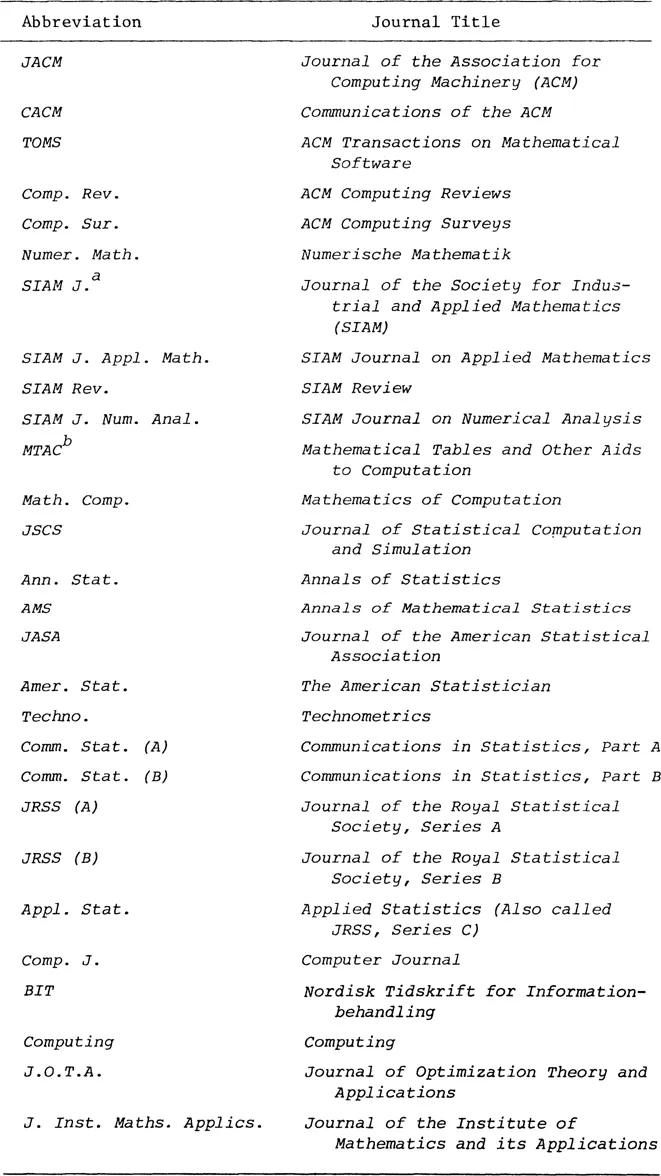
a The journal title SIAM Journal was used until 1966 when the name was changed to SIAM Journal on Applied Mathematics.
b This title was used from 1943 through 1959. In 1960 the title Mathematics of Computation was adopted.
Exercises are given at the end of most chapters. The purpose of each exercise will be either to reinforce or to extend the material given in the chapter. None of the exercises is intended to be extremely difficult to solve.
1.3 Prerequisites
This book is designed for use by readers who have background in statistics equivalent to undergraduate training in statistical methods and theory; mathematical training in elementary calculus, matrix algebra, and numerical analysis; and a familiarity with the FORTRAN computer-programming language.
A complete discussion of an algorithm and its implementation on the computer often requires consideration of details which are dependent on computer hardware characteristics, the computer language used, and in some cases the language compiler. In situations in which computer hardware specifications are pertinent to the discussion, this text assumes use of the IBM 370 series computer. Needed hardware specifications for this machine are given in Chapter 2. This reduces what would otherwise be a much larger prerequisite in applied computer science, and it gives the user of machines other than the IBM 370 (or equivalents) a basis for translating the text material to another machine-compatible form. There are only a few cases where the discussion is affected by the specific machine, the major ones being pseudorandom number generation and error analysis.
1.4 Presentation of Algorithms
Many different computational methods will be described and discussed in succeeding chapters. In some instances an algorithm associated with some given computational method will be provided. When such is the case, and the algorithm is not stated in the form of a FORTRAN program, then the general form of the statement of the algorithm will be as follows. The first line will contain the word “ALGORITHM” followed by the name given to the algorithm and a FORTRAN-like argument list, enclosed in parentheses, containing input and output quantities. For example, a first line might be
- ALGORITHM RAND(I,J,X)
Following the first line, in some cases, will be a short set of comments designed to facilitate overall understanding of the algorithm. Then one or more numbered steps will be given along with a description of the operations to be performed in each step. These will take the form
Step |
Description |
1. |
Set I = I*J |
⋮ |
⋮ |
Comments will also appear between the steps in the algorithm as often as they are needed to explain the process.
When algorithms are stated in a programming language, such as FORTRAN, the meaning of the “=” symbol as an assignment of value is clear. However, there is some possibility of confusion when the “=” sign is used in the statement of algorithms using other than a programming language. The question may arise, in a specific situation, as to whether the symbol is specifying an assignment of value or whether a statement of equality is intended. Sometimes the symbol” or is used to denote assignment of value. This will not be done in this text. The context in which the symbol “=” is used will serve to define whether an assignment of value or a statement of equality is intended. If there is room for doubt, a comment will be made to clarify the situation.
2 / Computer Organization
2.1 Introduction
The purpose of this chapter is to describe the computer in general terms and consider some of the internal computer operations which are of special interest to the user in scientific applications. The computer is a tool to be used in performing calculations, and a basic understanding of how this tool operates is essential.
2.2 Components of The Digital Computer System
The computer system may be thought of as being made up of five components: (1) the main storage, (2) a control component, (3) an arithmetic and logic component, (4) an input component, and (5) an output component. Figure 2.1 depicts the way in which these components are interconnected.
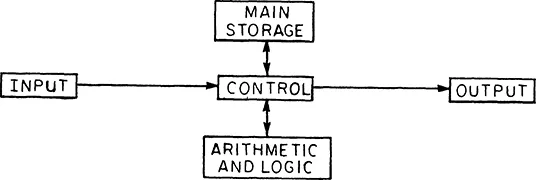
Figure 2.1 Components of the computer system.
The main storage of the computer is sometimes called the memory of the machine. This main storage component is used to hold information relative to the computational task (job) being performed at the moment. Stored information typically consists of program instructions, numeric constants, input data, intermediate results, and final results of computations.
The main storage is a hardware device made up of small elements,...
Table of contents
- Cover
- Half Title
- Title Page
- Copyright Page
- Dedication Page
- Preface
- Contents
- 1/ Introduction
- 2/ Computer Organization
- 3/ Error in Floating-Point Computation
- 4/ Programming and Statistical Software
- 5/ Approximating Probabilities and Percentage Points in Selected Probability Distributions
- 6/ Random Numbers: Generation, Tests and Applications
- 7/ Selected Computational Methods in Linear Algebra
- 8/ Computational Methods for Multiple Linear Regression Analysis
- 9/ Computational Methods for Classification Models
- 10/ Unconstrained Optimization and Nonlinear Regression
- 11/ Model Fitting Based on Criteria Other Than Least Squares
- 12/ Selected Multivariate Methods
- Index
Trusted by 375,005 students
Access to over 1.5 million titles for a fair monthly price.
Study more efficiently using our study tools.
Frequently asked questions
Yes, you can cancel anytime from the Subscription tab in your account settings on the Perlego website. Your subscription will stay active until the end of your current billing period. Learn how to cancel your subscription
No, books cannot be downloaded as external files, such as PDFs, for use outside of Perlego. However, you can download books within the Perlego app for offline reading on mobile or tablet. Learn how to download books offline
Perlego offers two plans: Essential and Complete
- Essential is ideal for learners and professionals who enjoy exploring a wide range of subjects. Access the Essential Library with 800,000+ trusted titles and best-sellers across business, personal growth, and the humanities. Includes unlimited reading time and Standard Read Aloud voice.
- Complete: Perfect for advanced learners and researchers needing full, unrestricted access. Unlock 1.5M+ books across hundreds of subjects, including academic and specialized titles. The Complete Plan also includes advanced features like Premium Read Aloud and Research Assistant.
We are an online textbook subscription service, where you can get access to an entire online library for less than the price of a single book per month. With over 1.5 million books across 990+ topics, we’ve got you covered! Learn about our mission
Look out for the read-aloud symbol on your next book to see if you can listen to it. The read-aloud tool reads text aloud for you, highlighting the text as it is being read. You can pause it, speed it up and slow it down. Learn more about Read Aloud
Yes! You can use the Perlego app on both iOS and Android devices to read anytime, anywhere — even offline. Perfect for commutes or when you’re on the go.
Please note we cannot support devices running on iOS 13 and Android 7 or earlier. Learn more about using the app
Please note we cannot support devices running on iOS 13 and Android 7 or earlier. Learn more about using the app
Yes, you can access Statistical Computing by William J. Kennedy,WIlliam J. Kennedy,James E. Gentle,Kennedy in PDF and/or ePUB format, as well as other popular books in Mathematics & Computer Science General. We have over 1.5 million books available in our catalogue for you to explore.