Originally published in 1971, The Royal Demesne in English History shows how Norman and Angevin kings were able to regard the whole of their English kingdom as their royal demesne in the continental medieval sense. The book argues that only through the later loss of their continental possessions were they compelled to show interest in creating special royal estates within their English kingdom, and then only for the members of their families. The power of medieval English kings as landowners provides a constant theme of the highest political importance in the dispensation of royal patronage, but not in the history of government finance. The book discusses how in the later stages of the cumulative creation of the royal family estates, did the idea gain currency in England, that an endowed and inalienable royal landed estate ought to form the basis of monarchical stability and financial solvency. This book forms an interesting and detailed look at the development of the medieval monarchy in terms of land and ownership.
eBook - ePub
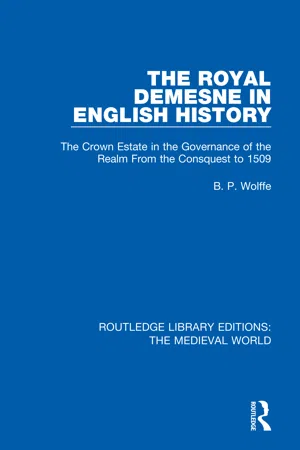
The Royal Demesne in English History
The Crown Estate in the Governance of the Realm From the Conquest to 1509
- 320 pages
- English
- ePUB (mobile friendly)
- Available on iOS & Android
eBook - ePub
The Royal Demesne in English History
The Crown Estate in the Governance of the Realm From the Conquest to 1509
INDEX
- Abergavenny, 183, 188, 191, 205, 296, 304
- Abbots Langley, 256
- Agard, John, 166, 201, 294
- Ailward, Thomas, 272
- Aldbourn, 233
- Alderton, 231, 239
- Aldenham, Thomas, 268
- Aleyn, Thomas, 160, 165, 183, 201, 205, 267–8, 274, 298, 302, 303
- Alfegh (Alseth), John, 202, 297
- Alien priories, 61, 92, 95, 106, 125, 127, 132, 242, 246, 258
- and
- All Soul’s College, Oxford, 106, 126
- Alton, 230, 231
- Alverthorpe, 242
- Ambleside, 252, 253
- Amersham, 297
- Amesbury, 286
- Amounderness, 252
- Ancient demesne, 17, 21, 22, 23, 24–6, 28, 29
- and
- Andover, 231
- Anglesey, 76, 241
- Anne, queen of England, 30
- Anne, queen of Richard 11, 56, 58, 60, 64, 65, 66, 98
- Anne (Neville), queen of Richard III, 188, 191, 304
- Annesley, Willia...
Table of contents
- Cover
- Half Title
- Title Page
- Copyright Page
- Half Title
- Series Page
- Dedication
- Preface
- Table of Contents
- Abbreviations
- I. The Royal Demesne in Norman and Angevin Government
- II. A New Royal Patrimony. The Plantagenet Family Estate 1227–1399
- III. Patronage, Politics and Finance, 1399–1437
- IV. The Background to the Resumptions of 1450–6
- V. The Resumptions of 1450–6
- VI. The Crown Estate of the Yorkist Kings
- VII. Henry VII’s Land Revenues and Chamber Finance
- VIII. Conclusion
- Appendix
- Index
Trusted by 375,005 students
Access to over 1.5 million titles for a fair monthly price.
Study more efficiently using our study tools.
Frequently asked questions
Yes, you can cancel anytime from the Subscription tab in your account settings on the Perlego website. Your subscription will stay active until the end of your current billing period. Learn how to cancel your subscription
No, books cannot be downloaded as external files, such as PDFs, for use outside of Perlego. However, you can download books within the Perlego app for offline reading on mobile or tablet. Learn how to download books offline
Perlego offers two plans: Essential and Complete
- Essential is ideal for learners and professionals who enjoy exploring a wide range of subjects. Access the Essential Library with 800,000+ trusted titles and best-sellers across business, personal growth, and the humanities. Includes unlimited reading time and Standard Read Aloud voice.
- Complete: Perfect for advanced learners and researchers needing full, unrestricted access. Unlock 1.5M+ books across hundreds of subjects, including academic and specialized titles. The Complete Plan also includes advanced features like Premium Read Aloud and Research Assistant.
We are an online textbook subscription service, where you can get access to an entire online library for less than the price of a single book per month. With over 1.5 million books across 990+ topics, we’ve got you covered! Learn about our mission
Look out for the read-aloud symbol on your next book to see if you can listen to it. The read-aloud tool reads text aloud for you, highlighting the text as it is being read. You can pause it, speed it up and slow it down. Learn more about Read Aloud
Yes! You can use the Perlego app on both iOS and Android devices to read anytime, anywhere — even offline. Perfect for commutes or when you’re on the go.
Please note we cannot support devices running on iOS 13 and Android 7 or earlier. Learn more about using the app
Please note we cannot support devices running on iOS 13 and Android 7 or earlier. Learn more about using the app
Yes, you can access The Royal Demesne in English History by B.P. Wolffe in PDF and/or ePUB format, as well as other popular books in Economics & Public Finance. We have over 1.5 million books available in our catalogue for you to explore.