- 250 pages
- English
- ePUB (mobile friendly)
- Available on iOS & Android
eBook - ePub
Palaeoecology of Africa and the Surrounding Islands - Volume 26
About this book
This volume offers comprehensive and up-to-date information on research in many different disciplines which give an overall insight into the environmental history of Africa.
Information
Quaternary and recent palynology
Marine-terrestrial interaction of climate changes in West Equatorial Africa of the last 190,000 years
ABSTRACT
Palynological investigation of a marine piston core GeoB 1008-3 (6°35′S/10°19′E) from the highly productive area off the Congo fan provides a dinoflagellate cyst record reflecting marine surface water conditions during the last 190 ka and a pollen record of the vegetation changes in Central Africa induced by climatic fluctuations for the same period. The freshwater discharge of the Congo river is related to the intensity of the West African monsoon. During warmer and more humid phases, dinoflagellate cyst flux decreased in relation to lower productivity and increased freshwater input in the eastern South Atlantic. At the same time on the continent, the rain forest expanded. During the cooler interstadials of Stage 5, the Afromontane forest represented by Podocarpus pollen expanded to lower altitudes and occupied former areas of rain forest during periods showing intermediate levels for sea surface temperatures and river discharge. During the colder and more arid phases of glacial Stages 6 and 2, when freshwater run-off into the Gulf of Guinea decreased, dinoflagellate cysts were much more abundant. However, Stage 4 shows high levels of river discharge and a moderate dinoflagellate cyst flux coupled to low sea-surface temperatures of the eastern South Atlantic, while Stage 3 shows moderately high pollen percentages of the rain forest during phases with fluctuating fresh-water discharge and very low sea-surface temperatures. High sea levels at the beginning of the Last Interglacial and the Holocene favoured the expansion of mangroves.
INTRODUCTION
Trade winds and monsoon circulation control the climate of West Africa. The surface wind field over the Angola Basin and the Gulf of Guinea is dominated by the SE-trade winds, that change their direction from SE to SW thereby becoming the SW-monsoon that penetrates far into the continent during boreal summer. In boreal winter, atmospheric circulation reverses over the continent when NE trade-winds blow over Africa and the adjacent subtropical Atlantic and reach the Gulf of Guinea (Leroux, 1983; Hastenrath, 1992).
Monsoon circulation results from the differing heat capacities of land and water: Sensible heating warms land surfaces much more rapidly man the ocean mixed layer. Over West Africa, summer heating over central North Africa during boreal summer drives the inflow of moisture-laden air from the adjacent eastern equatorial Atlantic. Strong trade winds of the Southern Hemisphere cross the equator and penetrate into central Africa. The monsoon delivers precipitation deep into central subtropical Africa. Variations of the monsoon, however, are strongly coupled to sea surface temperature fluctuations of the Indian Ocean (Kutzbach & Street-Perrot, 1985; Kutzbach, 1987; Prell & Kutzbach, 1987).
Additional influence on the West African monsoon is from the North Atlantic Ocean. General circulation model experiments of DeMenocal & Rind (1993) indicate that cooler North Atlantic sea surface temperatures (SST’s) reduce the monsoonal inflow into North Africa and decrease surface air temperature by 2 to 4°C and precipitation up to 1 mm/day. Summer southwest African monsoon winds are reduced by the same high-pressure cell over the North Atlantic strengthening the winter NE trade-wind circulation over northwestern Africa. The precipitation decreases over Africa can be related to increased surface air outflow from the region owing to the thermal effects of the cooler North Atlantic SST’s (DeMenocal & Rind, 1993).
Because of the influence of different oceanic regions on the strength of the monsoon, its response to climatic variation is highly complicated. On the one hand, there is the influence of the SST’s of the North Atlantic in response to glacial-interglacial variation and obliquity, while, on the other hand, there is the direct response of continental heating to insolation and the precessional controlled SST’s of the eastern equatorial Atlantic (McIntyre et al., 1989; Schneider et al., 1995; Mix & Morey, 1996; Schneider et al., 1996) and of the Indian Ocean. Glacial-interglacial high latitude variation intermingles with the response to low-latitude precessional insolation (DeMenocal, 1995).
By comparing terrestrial and oceanographic proxy data from a core off the mouth of the Congo river, we try to identify the direct influence of the SST of the eastern equatorial Atlantic on the climate of west equatorial Africa (Congo basin and surroundings) for the last 190 ka. To this purpose, a new dinoflagellate cyst diagram is presented from the Congo fan (core station GeoB 1008) and compared with a pollen diagram from the same locality (Jahns, 1996). The present study continues and extends investigations about the vegetation changes in western equatorial Africa to the south. Changes in palaeoprecipitation can be inferred from shifts in vegetation zones. The dinoflagellate cyst record holds information about marine surface production and salinity variation as a result of river induced upwelling and oceanic/coastal upwelling as well as oscillations of the Congo freshwater discharge. A firm land-sea correlation is established by the combined records of dinoflagellate cysts and terrestrial palynomorphs from the same samples. Additional information is provided by alkenone-derived palaeo-SST’s (Schneider et al., 1995) and by Al/K-ratios indicating chemical wheathering conditions on the continent (Schneider et al., 1997).
Laboratory cultures of the coccolithorid species Emiliania huxleyi as well as studies of modern plankton, sediment-trap material, and surface sediments established a relationship between the saturation index of C37-alkenones produced by coccolithophorids and the temperature of the water in which the coc-colithophorids were growing (Prahl et al., 1988; Brassell, 1993). Biological studies show that coccolithophorids bloom in offshore surface waters off SW Africa above a well developed thermocline (Giraudeau et al., 1993). Sediment-trap experiments on the Walvis Ridge revealed that alkenones were exported from the surface waters throughout the years, with two prominent maxima during austral spring and fall. Alkenone-derived palaeo-SST’s, therefore, most likely reflect annual average temperatures of the mixed layer (Schneider et al., 1995).
Fluctuations in the ratios of Al/K and kaolinite/feldspar are attributed to changes in the composition of the Congo river particulate sediment load, assuming the river outfall to be the major source for kaolinite in the Angola Basin sediments (Eisma et al., 1978; Sholkovitz et al., 1978). Because kaolinite and feldspar strongly differ in their aluminium content, most of the variation in the Al/K-ratio reflects variation in the kaolinite/feldspar-ratio with which it generally covaries. Changes in the Al/K-ratio in Congo fan sediments can be considered in terms of weathering of the central African hinterland, whereby high Al/K-ratios correspond to intensified chemical weathering (Schneider et al., 1997).
PRESENT OCEANOGRAPHIC SETTING
The surface waters off the Congo mourn are dominated by southward flowing warm surface and sub-surface currents: Angola current and South Equatorial Counter-Current. The Angola Dome and the cyclonic-gyre circulation of the SE Atlantic, which transports warm equatorial waters southward through the Angola Current, influence the region. A small amount of northward flowing cold sub-surface waters from the Benguela Coastal Current also reaches the core station. However, the main front between the warm surface waters of the Angola Current from the north and the cold surface waters of the Benguela Coastal Current from the south — called the Angola-Benguela Front — is situated farther south, between 12 and 14°S (Fig. 1). The area is charaterized by high productivity caused by oceanic, river-induced, and coastal seasonal upwelling, (van Bennekom & Berger, 1984; Berger et al., 1989; Stramma & Peterson, 1989; Peterson & Stramma, 1991).
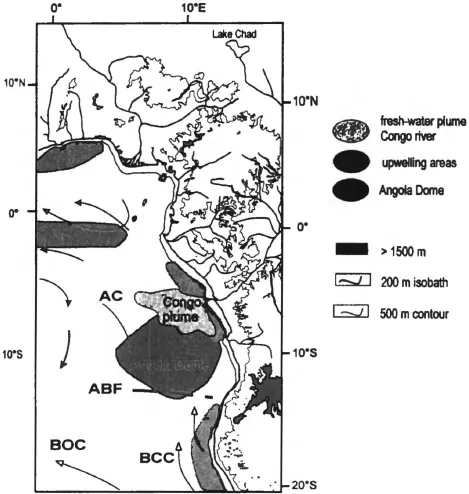
Table of contents
- Cover Page
- Halftitle Page
- Title Page
- Copyright Page
- Contents
- Forword
- Preface
- Obituary
- Palaeopalynology
- Quaternary and recent Palynology
- Pollen morphology
- Book reviews
- List of authors
Trusted by 375,005 students
Access to over 1.5 million titles for a fair monthly price.
Study more efficiently using our study tools.
Frequently asked questions
Yes, you can cancel anytime from the Subscription tab in your account settings on the Perlego website. Your subscription will stay active until the end of your current billing period. Learn how to cancel your subscription
No, books cannot be downloaded as external files, such as PDFs, for use outside of Perlego. However, you can download books within the Perlego app for offline reading on mobile or tablet. Learn how to download books offline
Perlego offers two plans: Essential and Complete
- Essential is ideal for learners and professionals who enjoy exploring a wide range of subjects. Access the Essential Library with 800,000+ trusted titles and best-sellers across business, personal growth, and the humanities. Includes unlimited reading time and Standard Read Aloud voice.
- Complete: Perfect for advanced learners and researchers needing full, unrestricted access. Unlock 1.5M+ books across hundreds of subjects, including academic and specialized titles. The Complete Plan also includes advanced features like Premium Read Aloud and Research Assistant.
We are an online textbook subscription service, where you can get access to an entire online library for less than the price of a single book per month. With over 1.5 million books across 990+ topics, we’ve got you covered! Learn about our mission
Look out for the read-aloud symbol on your next book to see if you can listen to it. The read-aloud tool reads text aloud for you, highlighting the text as it is being read. You can pause it, speed it up and slow it down. Learn more about Read Aloud
Yes! You can use the Perlego app on both iOS and Android devices to read anytime, anywhere — even offline. Perfect for commutes or when you’re on the go.
Please note we cannot support devices running on iOS 13 and Android 7 or earlier. Learn more about using the app
Please note we cannot support devices running on iOS 13 and Android 7 or earlier. Learn more about using the app
Yes, you can access Palaeoecology of Africa and the Surrounding Islands - Volume 26 by Heine Klaus in PDF and/or ePUB format, as well as other popular books in Biological Sciences & Ecology. We have over 1.5 million books available in our catalogue for you to explore.