Major Infrastructure links across water represent large investments. The structures and systems must be optimised to keep costs in control. Optimisation needs and the tendancy to more slender and light structures imply that engineering disciplines like Bridge Aerodynamics and Ship Collision Analysis have an increasing impact on the overall design of links. Also the attention to life cycle costs implies Operation and Maintenance must to investigated and planned in parallel to the design and construction of the links. The 1998 International Symposium aims at presenting state-of-the-art and future development within the three mentioned engineering disciplines. Exploring the many facets of major infrastructure projects, this symposium concentrated on developments within organisational, strategic and policy areas and both traffic and o & m management. Contributors to the papers include operators, consultants and international, experienced owners.
- 236 pages
- English
- ePUB (mobile friendly)
- Available on iOS & Android
eBook - ePub
Operation and Maintenance of Large Infrastructure Projects
About this book
Information
Strategies andpolicies for operation andmaintenance
Management system for O&M based on the European Model for ‘Business Excellence’
ABSTRACT: Management systems are becoming more and more complex. It is no longer enough to focus on the financial results. Today, the customer and society require a commitment from the companies which often goes far beyond the activities in the individual company.
This is a fact which will become more apparent in the coming years. Therefore a broader management system like the Model for Business Excellence is a tool for future leaders.
This paper describes how the European Model for Business Excellence, together with the well-known management system standards for quality (ISO 9001), environment (ISO 14001) and occupational health and safety (BS 8800), can be implemented as an integrated management system for operation and maintenance.
1 FROM CONSTRUCTION TO OPERATION AND MAINTENANCE
When operation and maintenance begin, focus on problems during construction related to delays, overrun on costs and contractual disputes will fade out and attention will turn to the quality of the infrastructure.
The quality is defined in general at an early stage by the client, reworded by the consultants in drawings and technical specifications, transformed into the physical structures via the methods and materials used by the contractor and finally handed over to the operator together with instructions on operation and maintenance.
Quality of the infrastructure handed over after completion of construction will in fact not only be assessed by the client but to a high degree also by the users, the operator, the authorities and the public in general. They will deliver the real judgement.
The better the quality assurance is performed during design and construction, the more quality during operation will fulfil all expectations, provided that operation and maintenance are carried out as planned.
During the last decade, quality assurance has consequently occupied an increasing part of the design and construction management.
In the same decade risk management has become a general tool when designing the overall layout of infrastructure projects, for planning of construction and for setting up procedures to be used during operation. The risk analysis work is based on experience and statistics which date many years back in order to predict or forecast future events or accidents. If risks are identified and found too great (either because of major consequences or because of high probability) risk reducing measures are introduced. But are the results of the risk analyses still reliable when the real operation starts? This has to be monitored and taken care of by the O&M organisation.
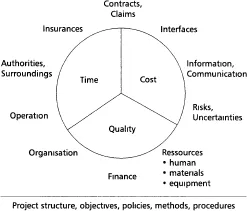
During the design and construction of large infrastructure projects use of the expertise and the technology available worldwide is a decisive necessity as this is the only way for the technology to develop further. Knowledge management is consequently an important factor in order to ensure progress and quality. Use of the best consultants for design and the best experts for design reviews is an insurance against bad quality. When moving at the edge of earlier experience, new effects will occur which must be predicted by the experts in order to achieve reliable solutions. This could be wind induced movements or ship collisions against bridge structures. If sufficient knowledge is not available tests or simulations will have to be performed. However, test facilities cannot fully reflect nature. In the operation phase the moment of truth will show up.
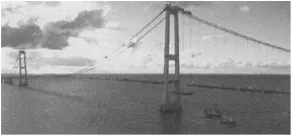
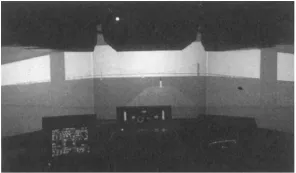
Environmental considerations play an increasing role in the design and construction of infrastructure projects. Today, often expenditure of 5 to 10% of the total costs is involved to improve the environmental impact of the structures. However, it is observed afterwards that sometimes the money could have been spent more efficiently on other areas, as nature often finds its own new balance in harmony with the structures. Mussels, eider ducks and algae blooms are often used as change indicators for the environmental conditions close to bridges. Some years after construction it is often seen that they are back to an even higher extent than before the start of construction. It is therefore important that the O&M organisation monitors the environmental conditions and provides the necessary feed back to the experts on the developments.
The construction phase will result in a physical structure with a built-in quality which must stand the test during operation. The procedures handed over to the operator together with expectations and assumptions regarding how to use the infrastructure during operation are the first tools for proper operation. But they must not be a pretext for doing nothing. Constant improvements are required to keep pace with the changes in society, the environment, the technology and the traffic volume.
2 MANAGEMENT SYSTEM FOR THE OPERATION PHASE
Operating a large infrastructure system it is of vital importance to bring into focus the results from operation that create most value for the interested parties which are the owner, the customers, society and the employees (people).
It is important for the management not only to look at the economic results (the owner’s perspective), but to a higher degree also to turn its eye towards the customer - the road user. With the increasing awareness of environment and safety and with the increasing social importance of effective infrastructures the results of operation and maintenance must also be seen in a social perspective. Last but not least, it is evident that good service and excellent results are created only through motivated and satisfied employees. Consequently the people’s (employees) satisfaction must be another cornerstone of the management.
Excellent results are created via effective leadership, leading the way with clear objectives and strategies and continuously focusing on possible improvements based on measurement of facts and systematic evaluation of results obtained.
The resources forming the basis for good results are not only the employees but also external personnel, technology, material and equipment and information available.
The European Model for Business Excellence is a model for leadership which focuses on the essential enablers and which determinedly works to create a balanced success for all interested parties. This value-based management model has been taken into use in more than 30 countries and forms the basis for the Danish quality award and the European quality award for excellent business. It systematizes the aforementioned enablers and results.
Organisations using the model are not looking for short-term economic gains, but focus to a higher degree on the satisfaction of customers and people and on the impact on society. The conviction is that in the long perspective this gives the desired economic results. The management model is not only to be used by the operator of an infrastructure system, but is also of value to the consulting engineers during design of the infrastructure as they create essential parts of the basis for operation.
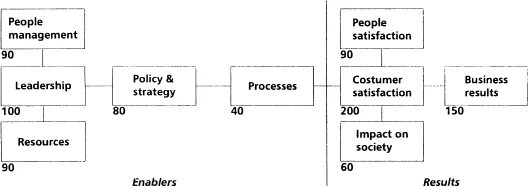
The management model implies that within each result area clear objectives - which the interested parties of course find relevant and essential - are defined with operational measurement points, from which objective data can be collected and trends evaluated.
A performance scorecard based on this will show the factors which in the long term create value for the organisation, contrary to economic accounts which only measure costs and the economic value created.
The balanced performance scorecard must at all times be tailored to the situation for the individual organisation. It is a continuing process of improvement.
For the O&M organisation of a large infrastructure system it is important at the strategic level to identify six to eight key figures within each group of interested parties, which can be regarded as the critical success factors and which look sufficiently ahead (3–4 years).
These key figures are compared every month/year in order to follow the trend and to implement improvements in due course where necessary.
An organisation’s business results presented on a performance scorecard can be compared with other organisations’ scorecards. It becomes more and more common to perform national and international benchmarking among organisations in order to find how the performance is evaluated and classified compared to other organisations.
One could ask what the difference is between the Total Quality Management (as described in the Model for Business Excellence) and Quality Management based on ISO 9001?
The latter is often based on management of the processes in the organisation through preventive and corrective actions and through assessment from quality audits performed. Thus quality management based on ISO focuses more on the enablers than on the results.
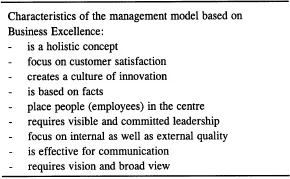
Even though an organisation has an effective certified quality management system based on ISO 9001 it may be far from obtaining a high score according to the business excellence model.
The contents of the environmental management system (ie based on ISO 14001) and the quality management system (ie based on ISO 9001) are shared with regard to 60–70%. Consequentl...
Table of contents
- Cover Page
- Half Title Page
- Title Page
- Copyright Page
- Table of Contents
- Preface
- Organization
- Strategies and policies for operation and maintenance
- Operation optimisation — Traffic management and toll collection
- Operation and maintenance management
- Operation and maintenance assessment and requalification of structures and equipment
- Organization
- Author index
Trusted by 375,005 students
Access to over 1.5 million titles for a fair monthly price.
Study more efficiently using our study tools.
Frequently asked questions
Yes, you can cancel anytime from the Subscription tab in your account settings on the Perlego website. Your subscription will stay active until the end of your current billing period. Learn how to cancel your subscription
No, books cannot be downloaded as external files, such as PDFs, for use outside of Perlego. However, you can download books within the Perlego app for offline reading on mobile or tablet. Learn how to download books offline
Perlego offers two plans: Essential and Complete
- Essential is ideal for learners and professionals who enjoy exploring a wide range of subjects. Access the Essential Library with 800,000+ trusted titles and best-sellers across business, personal growth, and the humanities. Includes unlimited reading time and Standard Read Aloud voice.
- Complete: Perfect for advanced learners and researchers needing full, unrestricted access. Unlock 1.5M+ books across hundreds of subjects, including academic and specialized titles. The Complete Plan also includes advanced features like Premium Read Aloud and Research Assistant.
We are an online textbook subscription service, where you can get access to an entire online library for less than the price of a single book per month. With over 1.5 million books across 990+ topics, we’ve got you covered! Learn about our mission
Look out for the read-aloud symbol on your next book to see if you can listen to it. The read-aloud tool reads text aloud for you, highlighting the text as it is being read. You can pause it, speed it up and slow it down. Learn more about Read Aloud
Yes! You can use the Perlego app on both iOS and Android devices to read anytime, anywhere — even offline. Perfect for commutes or when you’re on the go.
Please note we cannot support devices running on iOS 13 and Android 7 or earlier. Learn more about using the app
Please note we cannot support devices running on iOS 13 and Android 7 or earlier. Learn more about using the app
Yes, you can access Operation and Maintenance of Large Infrastructure Projects by J.S. Jensen,L.J. Vincentsen in PDF and/or ePUB format, as well as other popular books in Technology & Engineering & Civil Engineering. We have over 1.5 million books available in our catalogue for you to explore.