eBook - ePub
Northern Forested Wetlands Ecology and Management
- 512 pages
- English
- ePUB (mobile friendly)
- Available on iOS & Android
eBook - ePub
Northern Forested Wetlands Ecology and Management
About this book
Forested wetlands are a major component of northern landscapes, important both for their ecological functions and their socioeconomic values. Historically, these lands have been used for timber and fiber products, hunting, fishing, trapping, food gathering, and recreation. There are many questions about the use and management of these lands in the future, particularly with respect to forest products, hydrology and water quality, plant and wildlife ecology, landscape dynamics, and wetland restoration. Northern Forested Wetlands: Ecology and Management provides a synthesis of current research and literature. It examines the status, distribution, and use of these wetland resources. The book focuses on understanding the role of wetlands in the landscape and on how to manage these wetlands and sustain their important functions. This is a primary reference text for the study and management of northern forested wetlands, providing a forum for information discovered by researchers and managers from many nations.
Information
Wetland Resources
CHAPTER 1
Forested Northern Wetlands of North America
CONTENTS
Introduction
Historical Extent of Northern Wetland Forests
Historical Trends and Current Status of the Wet Boreal Conifers
Alaska and Western Canada
Southern Canada and the Conterminous United States
Clearing of Hardwoods in the Northern Swamp Forests
Present and Future Impacts
Summary
References
INTRODUCTION
Wetlands in the United States are defined as areas that are transitional between terrestrial and aquatic systems, where the water table is usually at or near the surface or the land is covered by shallow water (Cowardin et al., 1979). The definition of wetlands in Canada expresses a similar concept: wetlands are lands that have the water table at, near, or above the land surface or that are saturated for a long enough period to promote wetland or aquatic processes, as indicated by hydric soils, hydrophytic vegetation, and various kinds of biological activity that are adapted to the wet environment (Tarnocai, 1980).
A great variety of wetlands are formed under different hydrological, water quality, climatic, or edaphic conditions, each with its distinctive vegetation and biota. In this chapter, we are considering forested wetlands only, where a closed-canopy tree cover (>5 m) forms the dominant vegetation, or if immature, the trees have the potential of becoming closed-canopy forests. The hydraulic conditions are generally not severe, and a seasonally aerated rooting zone permits the growth of trees that are adapted to growing under wet conditions. The moderate severity of waterlogging also makes these wetlands ready targets for conversion to non-wetland uses through human intervention.
HISTORICAL EXTENT OF NORTHERN WETLAND FORESTS
Prior to European settlement, forested wetlands may have composed as much as 65 to 70 percent of the total wetland area in the northern United States, including Alaska, and southern Canada. Two distinct types of wet forests were found to dominate the land area: boreal conifer swamps (Zoltai et al., 1988) and mixed hardwood swamps.
The boreal conifers, primarily black spruce (Picea mariana) and tamarack (Larix laricina), as well as northern white cedar (Thuja occidentalis) and balsam fir (Abies balsamea) in the east, occupied the glaciated lowland portions of the North American continent. This area extended from the interior of Alaska southeast in an arc across the Canadian provinces. It included the continental (subhumid) and humid high and mid-boreal wetland regions, and the low and northern Atlantic boreal wetland regions of Canada (National Wetlands Working Group, 1986). Elements of the boreal coniferous wetlands also extended into the eastern temperate zones of the St. Lawrence Lowlands of southern Ontario, Quebec, and New Brunswick, as well as the Laurentian Mixed Forest Province as it bisects the upper states of the Great Lakes and New England. Soils in these wet boreal forests are typically histosols (Bailey, 1980), called organic soils in Canada (Canada Soil Survey Committee, 1978). Peat deposits are common, and surface flooding or ponding of water is rare, as the organic substrates tend to remain saturated for much of the growing season.
In Alaska the coniferous forested wetlands are dominated, by black spruce. Tamarack is found in association with black spruce in wet lowland sites. A smaller concentration of forested wetlands is found along Alaska’s Pacific coast. These areas are dominated by western hemlock (Tsuga heterophylla) and Alaskan cedar (Chamaecyparis nootkatenis).
The boreal forested wetlands in the subhumid portion of Canada (approximately west of the Manitoba/Ontario border) are composed of black spruce occurring in dense stands, with a carpet of feathermosses. White birch (Betula papyrifera) may become established following fires, but they seldom persist into the next generation. In the more humid climate of eastern Canada, black spruce dominates the wetland forests, sometimes in association with balsam fir. These black spruce swamps are the backbone of the pulp and paper industry of northern Ontario and Quebec. Eastern white cedar forms dense forests on the margins of many peatlands in the southern parts of Canada. Tamarack, being a shade-intolerant species, seldom occurs in large numbers in the forested wetlands of this
Table 1 Wet Forest Species Associations in the Northern United States
| Forest associations | Predominant state occurrences |
| Northern spruce — fir forest (Picea — Abies) | Maine, New Hampshire, New York, Vermont |
| Northern hardwoods (Acer — Betula — Fagus — Tsuga) | Maine, New Hampshire, NewYork, Michigan, Wisconsin |
| Northern hardwoods — spruce forest (Acer — Betula — Fagus — Picea — Tsuga) Beech — maple forest (Fagus — Acer) | Maine, New Hampshire, New York, Vermont New York, Ohio, Michigan |
| Elm — ash forest (Ulmus — Fraxinus) | Ohio, Wisconsin |
| Conifer bog (Larix — Picea — Thuja) | Michigan, Wisconsin, Minnesota |
| Northern hardwoods — fir forest (Acer — Betula — Abies — Tsuga) | Michigan, Wisconsin |
| Maple — basswood forest (Acer — Tilia) | Wisconsin, Minnesota |
| Black spruce — fir forest (Picea — Abies) | Minnesota, Wisconsin |
From Küchler, A. W., Potential Natural Vegetation of the Conterminous United States, Special Publication No. 36, American Geographical Society, New York, 1964. With permission.
In the northern conterminous United States, wet boreal conifers are dominated by black spruce, tamarack, northern white cedar, and balsam fir. The boreal forest is not known for towering stands of trees. Typical black spruce may be as much as 20 m tall and 23 cm in diameter (breast height) on a good site (Van Hees, 1990).
In contrast with the boreal conifer swamps, the other major northern forested wetland type is the mixed hardwood swamp forest that is characterized by a mix of both hardwood and conifer species (Table 1). In the past this region occupied portions of southern Canada and extended as far south as the state of Ohio. Figure 1 illustrates the region where northern wet forests may have existed prior to European settlement. Historical data indicate that the southern extent of the northern wet forest was close to 40° north latitude. This area approximates the southernmost point of the Wisconsin glaciation and can be distinguished from other forest types by containing species unique to the northern forest community (Gordon, 1969). It encompasses an area in Canada mostly within the eastern temperate region of the St. Lawrence Lowlands, extending from southwestern Ontario to the eastern portions of Quebec. In the United States the demarcation is not quite so clear. Here the deciduous swamp forests intermix with wet conifers in a transition within the Laurentian Mixed Forest Province. Historically, northern hardwood swamps also occurred within the Eastern Deciduous Forest Province as it exists throughout central Minnesota, southern Wisconsin, southern Michigan, northeastern Indiana, and northern Ohio.
In general terms the mixed hardwood swamp forests of the eastern temperate wetland region are typified by maple-ash (Acer spp. –Fraxinus spp.) associations. These swamps require reasonably warm temperatures during the growing season, moderately high rainfall, and relatively mild winters (Glooschenko and Grondin, 1988). Unlike the boreal conifer swamp forests, which generally occur on peat soils, the mixed hardwood swamp forests of the region are generally flooded by surface water seasonally (or for longer periods) and occur primarily on mineral soils or clays. In both the northern United States and southeastern Canada these wetlands are dominated by hardwood species including maple (Acer spp.), beech (Fagus grandifolia), elm (Ulmus americana), ash (Fraxinus spp.), and birch (Betula spp.).
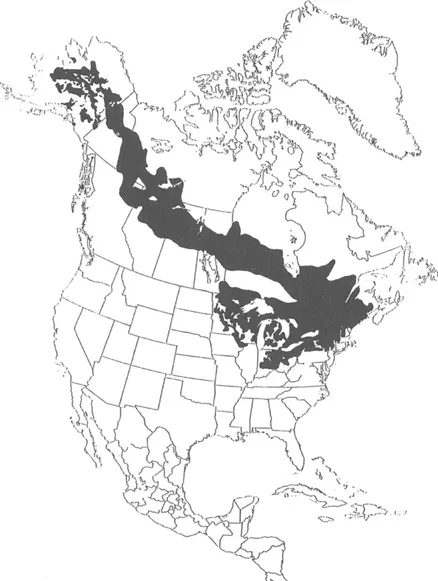
Figure 1 Region of northern wet forests in the United States and Canada prior to European settlement. (Adapted from Küchler, A. W., Potential Natural Vegetation of the Conterminous United States, Special Publication No. 36, American Geographical Society, New York, 1964 (map scale 1:3,168,000). With permission; from National Wetlands Working Group, Canada wetland regions (map), The National Atlas of Canada, 5th ed., Energy, Mines and Resources Canada, Geographical Services Division, Surveys and Mapping Branch, Ottawa, Ontario, 1986. With permission; and from Viereck, L. A. and Little, E. L., Atlas of United States Trees, Volume 2 — Alaska Trees and Common Shrubs, Miscellaneous Publication No. 1293, U.S. Department of Agriculture, Forest Service, Washington, D.C., 1975. With permission.)
Although northern forested wetlands were extensive in the past, the great majority of them supported only scattered, stunted trees of black spruce and tamarack. Here the water table was too high to allow vigorous tree growth. In addition, the high precipitation in the eastern a...
Table of contents
- Cover
- Half Title
- Title Page
- Copyright Page
- Preface
- Acknowledgments
- Editors
- Contributors
- Table of Contents
- Section 1 — Wetland Resources
- Section 2 — Ecology and Vegetation
- Section 3 — Hydrology and Biogeochemistry
- Section 4 — Wetland Management
- Index
Trusted by 375,005 students
Access to over 1.5 million titles for a fair monthly price.
Study more efficiently using our study tools.
Frequently asked questions
Yes, you can cancel anytime from the Subscription tab in your account settings on the Perlego website. Your subscription will stay active until the end of your current billing period. Learn how to cancel your subscription
No, books cannot be downloaded as external files, such as PDFs, for use outside of Perlego. However, you can download books within the Perlego app for offline reading on mobile or tablet. Learn how to download books offline
Perlego offers two plans: Essential and Complete
- Essential is ideal for learners and professionals who enjoy exploring a wide range of subjects. Access the Essential Library with 800,000+ trusted titles and best-sellers across business, personal growth, and the humanities. Includes unlimited reading time and Standard Read Aloud voice.
- Complete: Perfect for advanced learners and researchers needing full, unrestricted access. Unlock 1.5M+ books across hundreds of subjects, including academic and specialized titles. The Complete Plan also includes advanced features like Premium Read Aloud and Research Assistant.
We are an online textbook subscription service, where you can get access to an entire online library for less than the price of a single book per month. With over 1.5 million books across 990+ topics, we’ve got you covered! Learn about our mission
Look out for the read-aloud symbol on your next book to see if you can listen to it. The read-aloud tool reads text aloud for you, highlighting the text as it is being read. You can pause it, speed it up and slow it down. Learn more about Read Aloud
Yes! You can use the Perlego app on both iOS and Android devices to read anytime, anywhere — even offline. Perfect for commutes or when you’re on the go.
Please note we cannot support devices running on iOS 13 and Android 7 or earlier. Learn more about using the app
Please note we cannot support devices running on iOS 13 and Android 7 or earlier. Learn more about using the app
Yes, you can access Northern Forested Wetlands Ecology and Management by Carl C. Trettin,Martin F. Jurgensen,David F. Grigal,Margaret R. Gale,John R. Jeglum in PDF and/or ePUB format, as well as other popular books in Biological Sciences & Ecology. We have over 1.5 million books available in our catalogue for you to explore.