eBook - ePub
Naturally Occurring Radioactive Materials
Principles and Practices
- 160 pages
- English
- ePUB (mobile friendly)
- Available on iOS & Android
eBook - ePub
About this book
Management of Naturally Occurring Radioactive Materials - known in the industry as NORM -has become an important part of the regular training required for workers in oil and gas production, refinery and petrochemical manufacturing, and in certain types of mining. Proper handling of NORM-contaminated wastes and use of appropriate radiation detection and protective equipment are now understood to be important components of good worker safety programs. Until now, no practical, easy-to-read, book was available to supplement worker training courses on NORM management. Naturally Occurring Radioactive Materials: Principles and Practices fills this void by providing, in a single publication, an ideal reference for industry managers, supervisors and line personnel. The book stresses the proper handling and management of NORM contaminated wastes and provides a firm understanding of the chemical properties of radioactive agents, their toxicological effects, and the appropriate containerization and disposal methods for these materials.
Information
1 |
Introduction |
Study Objectives
This chapter will enable the student to:
- Define the terms NORM and TENR.
- Discuss the origins of NORM in the oil industry and state where it is most often encountered.
- Name the three NORM radionuclides of primary concern in the oil and gas industry.
- Name the parent nuclides of radium and radon.
1.1 The Origins of NORM
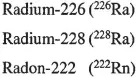
NORM is an acronym that stands for Naturally Occurring Radioactive Material. The radioactive elements from which NORM originates were incorporated into the earth’s crust when the earth was created. There are many different types of radioactive material found in nature, but the oil and gas industry is only concerned with three particular radionuclides. They are:
Radium is of primary concern not only because it is radioactive, but also because it is chemically toxic. Radium may be almost as toxic as plutonium, the most toxic element known to man. (It is estimated that one teaspoon of plutonium could kill 100,000 people, due to its chemical toxicity alone.) Due to its chemical properties, radium is termed a “bone seeker.” This means that when radium is ingested, it tends to collect in the bones of the body, where it stays for a very long time. It is for this reason that radium has been directly linked to leukemia and bone cancer.
Radon is somewhat different from radium. Radon is actually a radioactive gas. It is produced when radium undergoes radioactive decay. When it is in the gaseous state and is breathed in, 75 to 80% of the radon is exhaled with the next breath. However, the portion that remains in the lungs or in the bloodstream may undergo radioactive decay and change back into a non-gaseous form. This transformation allows it to remain in the lungs or elsewhere in the body for a long period of time. Radon is believed to be the leading cause of lung cancer after smoking.
Radium and radon are the parent nuclides of decay chains that contain up to 20 radioactive daughters. This means that radium and radon decay into products that are also radioactive, which in turn decay, etc. Radium and radon are therefore an even more significant hazard because their daughters will continue to irradiate body tissue even after the radium or radon has decayed.
1.1.1 Where Do Radium and Radon Come From?
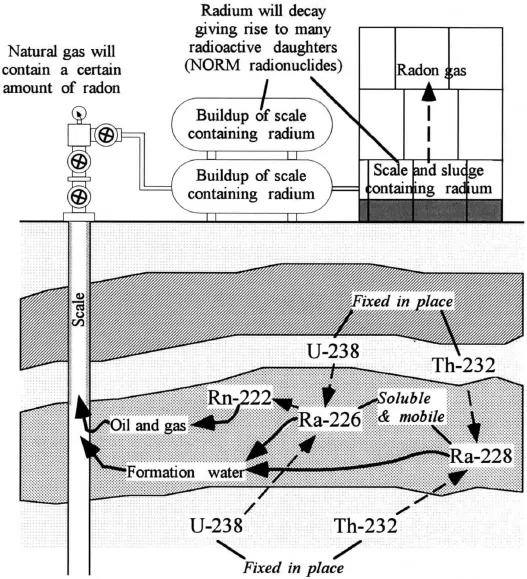
The origins of radium and radon are not immediately apparent (Figure 1.1). They are created as the result of the radioactive decay of other elements.
We refer to these elements as the parents of NORM or the hidden cause of NORM; they are:
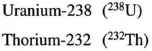
Uranium and thorium are the naturally occurring radioactive elements from which radium and radon are formed. They are known as primordial elements because they have always been present on earth. They were incorporated into the earth’s crust at the time of its creation, more than 4.5 billion years ago, and they are slowly but continually decaying to radium and radon. There are surprisingly large amounts of these elements present on earth. If a 1-mile-by-1-mile square of soil, 1 foot thick, was processed and all the uranium and thorium were removed from it, an average of about 2.2 tons of uranium and 4.4 tons of thorium would be found. Because uranium and thorium are so plentiful, they produce large amounts of radium and radon.
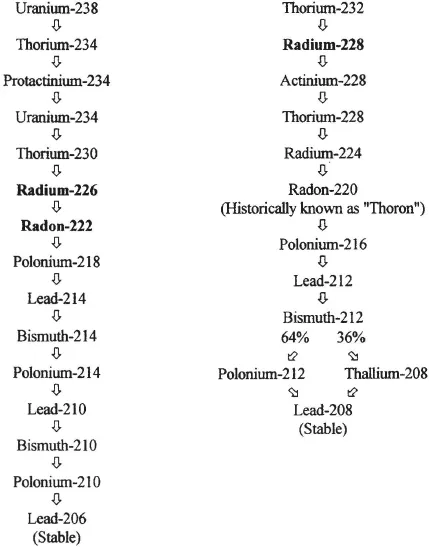
Uranium-238 and thorium-232 each decay in a series of unique steps, known as their decay schemes, passing through a number of transformations until a stable or non-radioactive isotope is reached. The decay schemes for uranium-238 and thorium-232 are shown in Figure 1.2.
1.2 Production of NORM
From a regulatory standpoint, NORM is not being controlled unless it has been “technologically enhanced.” Indeed, the acronym TENR (Technologically Enhanced Natural Radioactive material) is preferred by some people who (correctly) point out that any naturally occurring radioactive material, instead of just material which has been concentrated to the point where it becomes of regulatory concern, is NORM. Technological enhancement is considered to be the concentration of natural sources of radiation through some technical process which is not intended to produce radiation. This is the case with NORM in the oil and gas industry. The oil and gas production, refining, and storage processes which result in NORM are considered to be enhancements.
NORM becomes a problem when it is incorporated into the scale and sludge that are deposited inside equipment associated with oil and gas production. The deposition of NORM is usually associated with produced water. The reason for this is that radium comes out of the ground, dissolved in water.
The parents of radium-226 and radium-228, uranium and thorium, are found distributed throughout underground formations. The largest amounts are found in rock formations known to petroleum geologists as shales and other formations that contain some shale. Uranium and thorium are part of the matrix of the rock and as such are bound in place, being essentially insoluble in the reservoir fluids, which may be fresh water, salt water, oil, gas, or condensate. However, radium is somewhat soluble in water and is therefore mobile. Consequently, radium may be produced along with any water. The concentration of radium which may be present in produced water will depend upon the amount and nature of shale in the formation and the physical and chemical conditions, such as pressure, temperature, and acidity (pH). Radium will be mixed (in very small proportions) with calcium, barium, and some strontium, which are much more abundant and possess similar chemical properties.
As produced fluids move from the reservoir to production facilities at the surface and then through various treatment processes, culminating at a petroleum refinery, the physical and chemical conditions change. This results in significant changes in the ability of the fluids to dissolve radium. If this ability decreases, then radium and the other elements with similar chemistry will come out of solution and will tend to be deposited as part of any scale or sludge.
Not all oil and gas wells produce NORM. NORM is rarely found without water production and, as a rule of thumb, NORM deposition is usually associated with significant volumes of water production. Unfortunately, because there are exceptions, this is not an absolute rule, but when consideration is given to the production history of a well which may have seen episodes of water production followed by the production of dry oil or gas, the rule of thumb usually holds true.
Not all NORM deposition is due to radium. Radon gas will be produced as a result of the decay of radium, either at the surface or in the formation. Radon can be produced either dissolved in produced fluids or mixed with natural gas. Gas plants can have very high radiation levels, especially where large volumes of gas are stored or compressed. Radon also poses a problem during the gas separation process at petroleum refineries as it all tends to come out of solution at once, when the lighter fluids such as ethane and propane are taken off the production stream.
There are a number of other NORM radionuclides, including uranium-235 (235U) and its radioactive daughters and radioactive isotopes of potassium. However, these forms of NORM are either not normally encountered in the oil and gas industry or are generally in low concentrations relative to radium-226 and radium-228 and their daughters. An exception is potassium-40 (40K), which is often found in elevated quantities. Potassium-40 poses a far smaller health risk than radium and consequently has a much higher exemption limit. It is rarely significant in NORM deposits, although it can be found in shale cuttings.
2 | Fundamentals |
Study Objectives
This chapter will enable the student to:
- Describe the standard model of the atom and name its constituent particles.
- Describe the proton, neutron, and electron.
- Define atomic number and atomic mass number and how they relate to the physical, chemical, and radioactive properties of atoms.
- Understand the terms isotope and nuclide.
- Explain what the nuclear and coulomb forces are and the role their interaction plays in radioactive decay.
2.1 Introduction to the Atom
Everything in the world around us is composed of atoms. There are now 112 different elemental types of atoms known to man. Of these, 92 are naturally occurring. The remainder can only be produced on earth by artificial means and are therefore referred to as “man-made.” Each ...
Table of contents
- Cover Page
- Half Title
- Title Page
- Copyright Page
- Table of Contents
- Preface
- Authors
- 1 Introduction to NORM
- 2 Fundamentals of Radioactivity and Radioactive Materials
- 3 Origin and Classification of Radiation
- 4 Biological and Health Effects of Radiation
- 5 Radiation in the World Around Us
- 6 Measurement of Radiation
- 7 Surveying and Sampling NORM
- 8 Personnel Protection from Radiation and Contamination
- 9 Regulation of NORM
- 10 Glossary of Terms
- Index
Trusted by 375,005 students
Access to over 1.5 million titles for a fair monthly price.
Study more efficiently using our study tools.
Frequently asked questions
Yes, you can cancel anytime from the Subscription tab in your account settings on the Perlego website. Your subscription will stay active until the end of your current billing period. Learn how to cancel your subscription
No, books cannot be downloaded as external files, such as PDFs, for use outside of Perlego. However, you can download books within the Perlego app for offline reading on mobile or tablet. Learn how to download books offline
We are an online textbook subscription service, where you can get access to an entire online library for less than the price of a single book per month. With over 1.5 million books across 990+ topics, we’ve got you covered! Learn about our mission
Look out for the read-aloud symbol on your next book to see if you can listen to it. The read-aloud tool reads text aloud for you, highlighting the text as it is being read. You can pause it, speed it up and slow it down. Learn more about Read Aloud
Yes! You can use the Perlego app on both iOS and Android devices to read anytime, anywhere — even offline. Perfect for commutes or when you’re on the go.
Please note we cannot support devices running on iOS 13 and Android 7 or earlier. Learn more about using the app
Please note we cannot support devices running on iOS 13 and Android 7 or earlier. Learn more about using the app
Yes, you can access Naturally Occurring Radioactive Materials by T.Rick Irvin,T. Rick Irvin in PDF and/or ePUB format, as well as other popular books in Technology & Engineering & Environmental Science. We have over 1.5 million books available in our catalogue for you to explore.