- 512 pages
- English
- ePUB (mobile friendly)
- Available on iOS & Android
eBook - ePub
About this book
Advanced Molecular Biology emphasises the unifying principles and mechanisms of molecular biology, with frequent use of tables and boxes to summarise experimental data and gene and protein functions. Extensive cross-referencing between chapters is used to reinforce and broaden the understanding of core concepts. This is the ideal source of comprehensive, authoritative and up-to-date information for all those whose work is in the field of molecular biology. This book emphasises the unifying principles and mechanisms of molecular biology, with frequent use of tables and boxes to summarise experimental data and gene and protein functions.
Information
Chapter 1
Biological Heredity and Variation
Fundamental concepts and definitions
- In genetics, a character or characteristic is any biological property of a living organism which can be described or measured. Within a given population of organisms, characters display two important properties: heredity and variation. These properties may be simple or complex. The nature of most characters is determined by the combined influence of genes and the environment.
- Simple characters display discontinuous variation, i.e. phenotypes can be placed into discrete categories, termed traits. Such characters are inherited according to simple, predictable rules because genotype can be inferred from phenotype, either directly or by analysis of crosses or pedigrees (see Table 1.1 for definitions of commonly used terms in transmission genetics). For the simplest characters, the phenotype depends upon the genotype at a single gene locus. Such characters are not solely controlled by that locus, but different genotypes generate discrete, contrasting phenotypes in a particular genetic background and normal environment. When associated with the nuclear genome of sexually reproducing eukaryotes, such characters are described as Mendelian — they follow distinctive patterns of inheritance first studied systematically by Gregor Mendel. Not all simple characters are Mendelian. In eukaryotes, non-Mendelian characters are controlled by organelle genes and follow different (although no less simple) rules of inheritance (see Organelle Genomes). The characters of, for example, bacteria and viruses are also nonMendelian because these organisms are not diploid and do not reproduce sexually.
- Complex characters often display continuous variation, i.e. phenotypes vary smoothly between two extremes and are determined quantitatively. The inheritance of such characters is not predictable in Mendelian terms and is studied using statistical methods (biometrics). Complex characters may be controlled by many loci (polygenic theory), but the fact which distinguishes them from the simple characters is usually not simply the number of interacting genes, but the influence of the environment upon phenotypic variance, which blurs the distinction between different phenotypic trait categories and makes it impossible to infer genotype from phenotype.
1.1 Mendelian inheritance
Principles of Mendelian inheritance. For genetically amenable organisms (i.e. those which can be kept and bred easily in large numbers), the principles of inheritance can be studied by setting up large-scale crosses (directed matings) and scoring (determining the phenotype of) many progeny. Mendel derived his rules of heredity and variation from the results of crosses between pure breeding, contrasting varieties of the garden pea Visum savitum and crosses involving hybrid plants. Although he worked exclusively with one plant species, his conclusions are applicable to all sexually reproducing eukaryotes, including those (e.g. humans) which cannot be studied in the same manner. For these unamenable organisms, heredity and variation are studied by the analysis of pedigrees (Box 1.1). Mendel’s principles of inheritance can be summarized as follows.
(1)The heredity and variation of characters are controlled by factors, now called genes, which occur in pairs. Mendel called these factors Formbildungelementen (form-building elements).
(2)Contrasting traits are specified by different forms of each gene (different alleles).
(3)When two dissimilar alleles are present in the same individual (i.e. in a heterozygote), one trait displays dominance over the other: the phenotype associated with one allele (the dominant allele) is expressed at the expense of that of the other (the recessive allele).
Table 1.1: Definitions of some common terms used in transmission genetics
| Term | Definition |
|---|---|
| Allele | Broadly, a variant form of a gene specifying a particular trait. At the molecular level, a sequence variant of a gene (q.v. wild-type allele, mutant allele, polymorphism) |
| Character | A biological property of an organism which can be detected or measured |
| Character mode | A general type of character, e.g. eye color |
| Character trait, trait, variant | A specific type of character, e.g. blue eye color |
| Gene | Broadly, a hereditary factor controlling or contributing to the control of a particular character. At the molecular level, a segment of DNA (or RNA in some viruses) which is expressed, i.e. used to synthesize one or more products with particular functions in the cell (q.v. gene, cistron, gene expression) |
| (Gene) locus | The position of a gene (or other marker or landmark) on a chromosome or physical or genetic map. A useful term because it allows discussion of genes irrespective of genotype or zygosity |
| Genetic | Pertaining to genes. Of characters, heredity and variation arising from the nucleotide sequence of the gene (cf. epigenetic, environmental) |
| Genotype | The genetic nature of an individual, often used to refer to the particular combination of alleles at a given locus |
| Hemizygous | Containing one allele in a diploid cell, often used to refer to sex-linked genes (q.v.) |
| Hereditary | Passed from parent to offspring. Has a wider scope than the term genetic: includes genetic inheritance (inheritance of nucleotide sequence) as well as epigenetic inheritance (the inheritance of information in DNA structure) and the inheritance of cytoplasmic or membrane components of the cell at division |
| Heterozygous | Containing different alleles at a particular locus |
| Homozygous | Containing identical alleles at a particular locus |
| Phenotype | The outward nature of an individual, often used to refer to the nature of particular characters |
| Pleiotropic | Affecting more than one character simultaneously |
| Variation | The diversity of a particular character in a given population. Variation can be continuous or discontinuous |
| Zygosity | The nature of alleles at a locus — homozygous, heterozygous or hemizygous |
For a more precise structural and functional definition of genes and alleles, see The Gene, and Mutation and Selection.
(4)Genes do not blend, but remain discrete (particulate) as they are transmitted.
(5)During meiosis, pairs of alleles segregate equally so that equivalent numbers of gametes carrying each allele are formed.
(6)The segregation of each pair of alleles is independent from that of any other pair.
1.2 Segregation at one locus
Crosses at one locus. Five of Mendel’s principles can be inferred from the one-point cross (one-factor cross), where a single gene locus is isolated for study. A cross between contrasting pure lines produces hybrid progeny and establishes the principle of dominance (Figure 1.1). A pure line breeds true for a particular trait when self-crossed or inbred, and from this it can be established that the pure line contains only one type of allele, i.e. all individuals are homozygous at the locus of interest. A cross between contrasting pure lines thus produces a generation of uniform hybrids, where each individual is heterozygous, carrying one allele from each pure line. This is the first filial generation (F1 generation). In each of his crosses, Mendel showed that the phenotype of the F1 hybrids was identical to one of the parents, i.e. one of the traits was dominant to the other.
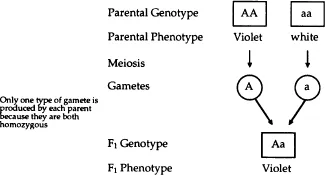
A backcross (a cross involving a filial generation and one of its parents), can confirm that the F1 generation is heterozygous. If the F1 generation is crossed to the homozygous parent carrying the recessive allele, the 1:1 ratio of phenotypes in the first backcross generation confirms the F1 genotype (Figure 1.2). This type of analysis demonstrates the power of genetic crosses involving a test stock (which carries recessive alleles at all loci under study) to determine unknown genotypes, and a similar principle can be used in genetic mapping (q.v.). The reappearance of the recessive phenotype (i.e. white flowers) in the F2 generation confirms that pairs of alleles remain particulate during transmission and are neither displaced nor blended in the hybrid to generate the phenotype.
An F1 self-cross (self-fer...
Table of contents
- Cover Page
- Halftitle Page
- Dedication
- Title Page
- Copyright Page
- Contents
- Abbreviations
- How to use this book
- Preface
- 1. Biological Heredity and Variation
- 2. The Cell Cycle
- 3. Chromatin
- 4. Chromosome Mutation
- 5. Chromosome Structure and Function
- 6. Development, Molecular Aspects
- 7. DNA Methylation and Epigenetic Regulation
- 8. The Gene
- 9. Gene Expression and Regulation
- 10. Gene Transfer in Bacteria
- 11. The Genetic Code
- 12. Genomes and Mapping
- 13. Mobile Genetic Elements
- 14. Mutagenesis and DNA Repair
- 15. Mutation and Selection
- 16. Nucleic Acid Structure
- 17. Nucleic Acid-Binding Properties
- 18. Oncogenes and Cancer
- 19. Organelle Genomes
- 20. Plasmids
- 21. The Polymerase Chain Reaction (PCR)
- 22. Proteins: Structure, Function and Evolution
- 23. Protein Synthesis
- 24. Recombinant DNA and Molecular Cloning
- 25. Recombination
- 26. Replication
- 27. RNA Processing
- 28. Signal Transduction
- 29. Transcription
- 30. Viruses and Subviral Agents
- Index
Trusted by 375,005 students
Access to over 1.5 million titles for a fair monthly price.
Study more efficiently using our study tools.
Frequently asked questions
Yes, you can cancel anytime from the Subscription tab in your account settings on the Perlego website. Your subscription will stay active until the end of your current billing period. Learn how to cancel your subscription
No, books cannot be downloaded as external files, such as PDFs, for use outside of Perlego. However, you can download books within the Perlego app for offline reading on mobile or tablet. Learn how to download books offline
Perlego offers two plans: Essential and Complete
- Essential is ideal for learners and professionals who enjoy exploring a wide range of subjects. Access the Essential Library with 800,000+ trusted titles and best-sellers across business, personal growth, and the humanities. Includes unlimited reading time and Standard Read Aloud voice.
- Complete: Perfect for advanced learners and researchers needing full, unrestricted access. Unlock 1.5M+ books across hundreds of subjects, including academic and specialized titles. The Complete Plan also includes advanced features like Premium Read Aloud and Research Assistant.
We are an online textbook subscription service, where you can get access to an entire online library for less than the price of a single book per month. With over 1.5 million books across 990+ topics, we’ve got you covered! Learn about our mission
Look out for the read-aloud symbol on your next book to see if you can listen to it. The read-aloud tool reads text aloud for you, highlighting the text as it is being read. You can pause it, speed it up and slow it down. Learn more about Read Aloud
Yes! You can use the Perlego app on both iOS and Android devices to read anytime, anywhere — even offline. Perfect for commutes or when you’re on the go.
Please note we cannot support devices running on iOS 13 and Android 7 or earlier. Learn more about using the app
Please note we cannot support devices running on iOS 13 and Android 7 or earlier. Learn more about using the app
Yes, you can access Advanced Molecular Biology by Richard Twyman in PDF and/or ePUB format, as well as other popular books in Biological Sciences & Biology. We have over 1.5 million books available in our catalogue for you to explore.