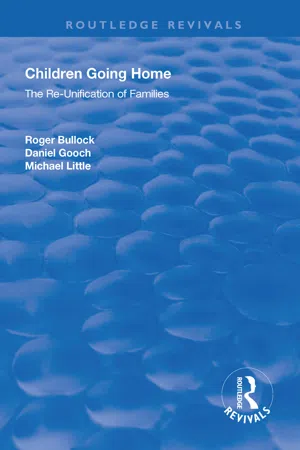
First published in 1998, this Darlington child care study looks at the return experiences of children looked after by local authorities. It shows that although the great majority of children go back to their families and home communities, little is known about the process. How can professionals and carers make the transition as easy as possible? The book takes forward ideas first reported in the Dartmouth publication, going home: The return of children separated from their families and tested in subsequent research. It charts patterns of separation and return, considers the experiences of those involved and highlights factors associated with the likelihood of return and its success. Because the factors described in the earlier research have since been confirmed in a blind prospective study they are among the most robust indicators available.
eBook - ePub
Children Going Home
The Re-unification of Families
- 262 pages
- English
- ePUB (mobile friendly)
- Available on iOS & Android
eBook - ePub
About this book
Information
1 Introduction
Since the Second World War, one of the most cogent issues to preoccupy those concerned with the care of children has been the best way to manage involuntary rifts between parents and children. Many previous studies have charted the effects of separation on children and the difficulties parents and wider family have in maintaining contact, particularly when the absence is long and stressful. Yet, despite this knowledge, there has been relatively little interest in the corollary of separation: return. As is so often the case with social systems, more emphasis has been given to entry than to exit.
Nonetheless, despite the paucity of research interest in return, getting children back home has long been an integral part of child-care. Fifty years ago, the evacuation of children from cities during the Blitz aroused great anxiety. The maintenance of links between families and absent loved-ones was very difficult. Telephones were few, letters often went astray and visits were almost impossible. Separation was also difficult to manage at an administrative level. Many of those who were subsequently to take key roles in the children’s departments of local authorities, created in 1948 as a consequence of the Curtis Report (HMSO, 1946), began their child-care careers coping with the tearful city children who arrived brown-labelled in the shire counties, Welsh valleys and sleepy West Country. These experts, along with a posse of wireless gurus whose broadcast chats enlivened many a damp evening in the Anderson shelter, all shared the pervading gloom that children evacuated to the countryside would soon lose touch with home and become rootless. Winnicott, Priestley and the Brains’ Trust joined with Lord Haw-Haw in a chorus of doom. For example, Winnicott (1984) warned mothers in a broadcast talk in 1945 that returning evacuees would be extremely difficult to manage.
What I want to say now is that when children come home they are not necessarily going to fall into and fit nicely into the holes that they made when they went away, for the simple reason that the hole has disappeared. Mother and child will have become able to manage without each other and when they meet they will have to start from scratch to get to know each other. This process must take time and time must be allowed. It’s no use mother rushing up to the child and throwing her arms around his neck without looking to see whether he is going to be able to respond sincerely.
In a subsequent talk he emphasised that,
their return means that your life will be richer, but less your own. There will be few immediate rewards. At times, you will wish all of them back again in billets. Indeed, some children will have been so hurt by evacuation that it is beyond the power of parents to manage them.
This can hardly have been a welcome prospect for mothers also awaiting the return of husbands.
But like the maelstrom from which the children were rescued, so the consequences of evacuation seemed at first to be different from those first feared. Return was achieved by the vast majority. The widespread unease generated by separation was dismissed with official hindsight as an over-dramatisation from the well publicised behaviour of a few children entering Winnicott’s clinic. Indeed, in the euphoria of peace it was emphasised that some children had the time of their lives and were much better cared for. Neither was there a catalogue of abuse and neglect inflicted by their frequently grudging hosts.
It is possible that the effects of the evacuation upon the children involved were mitigated because both separation and return were group experiences. Both were undertaken with school friends and supervised and organised by teachers who themselves were sharing the pains of upheaval. The Jewish experience at the ‘return’ to Israel of children surviving the holocaust likewise suggests that the pains of separation and loss were reduced because it was a group experience and because a shared ideology gave it purpose and direction. Yitzhak Kashti, a survivor of the holocaust, described to us how,
normality was confirmed by the group, particularly for young children, in that they found it difficult to envisage any alternative and were swallowed up by the daily demands of coping. I cannot remember being acutely distressed at being separated, I was just numb and busy keeping afloat.
These may be among the reasons why the return of evacuated children caused fewer administrative problems than expected and why the apprehensions that many children would find themselves abandoned or the victims of dual loyalties were not borne out. Thus, the problems of separation remained seared into the administrative memory, mainly because it was very difficult to organise, while return, which was, after all, going back to normal, caused little lasting concern (Titmuss, 1976). Separation also touched a sad chord in group consciousness, amply orchestrated by Vera Lynn, Gracie Fields and other hardy annuals, while the difficulties of return did not. Coming home was obviously a rapturous experience, the stuff of which made many ‘B’ movies. The fact that return might contain as many private griefs as separation had to wait for returning servicemen, prisoners of war and residual evacuees to highlight the issues (Johnson, 1968).
In the past decade, interest in the return of children from long separations and the problems faced by families on reunion has been revived, due to a variety of pressures. First, there has been increasing exploration of the outcomes of welfare interventions. Profound questions have been raised concerning the State’s ability to parent. Particularly influential in raising the issue of return has been the emphasis on the need for hard criteria to evaluate the success or otherwise of various aspects of child welfare. Sadly, numerous studies of children in state care have revealed the drift and insecurity many experience while away from home. In addition, there has been a growing awareness that the majority of children and adolescents return home after separation in spite of lengthy absences and cogent reasons for the initial rift. Whether professionals like it or not, good substitute care is difficult to provide and most children’s families shoulder the burden of support for their offspring when the State’s interventions falter. The Children Act 1989 rightly emphasises that an attitude towards planning of let’s wait and see’ is unlikely to be compatible with the best interests of children looked after.
A second reason for the increased interest in return has been an awareness that not only do children eventually go home but that both children and families also find the process extremely stressful. For example, Pill (1979) highlights how difficult children coming home from hospital are likely to be.
Return is likely to be stressful for the whole family not only for the returning child and the degree of upset is not necessarily related to the length of time spent away.
The stress that return places on children and families has once more become of interest to social workers because much work demonstrates not only that return is difficult but that the problems generated by reunion can also be sufficient to cause breakdown and further separations. In Little’s study of Young Men in Prison (1990) a young man comments
banged up in here is bad enough but going home isn’t likely to be a bed of roses either.
A third explanation for an increased concern about the return of children looked after has been the gathering emphasis on the need for family participation in welfare processes in order to ensure the continuities of care essential for satisfactory child development. This means that return as well as separation have to be managed and going home no longer represents the close of the episode. Indeed, the multi-disciplinary teams now obligatory in the approach to child abuse and delinquency are constant reminders that the difficulties families face are usually complex and of long standing. Problems may be inter-generational and have long careers of their own in which the children’s current difficulties play but a small part. Thus, return and separation are again being viewed as part of a process in which roles, territory and family relationships are continuously under negotiation.
These theoretical and practical concerns should excite more than academic curiosity. Research findings now consistently stress the complicated careers of children looked after and the potentially adverse consequences of many apparently benign interventions. However, in contrast to other groups of separated children, such as those in hospital or boarding schools, the returns of children looked after are difficult to predict. Sometimes the child’s natural family will have dissolved and reconstituted during the child’s absence and, as a consequence, key family members will be scattered across different households, the memberships of which may be fluid and volatile. In addition to these changes in personnel, families may relocate geographically while the child is away. When these probabilities are linked to the changes of placement and social worker experienced by many children whilst looked after, the potential complexity surrounding the child’s return home becomes apparent. Return for many a child looked after is more than just fitting back into a niche previously left; it is re-negotiating a set of roles, adapting to new faces and re-mastering unfamiliar school and community territories. All of these occur in a context where family structures and memberships may have changed and where the links between children and families may also have become tenuous. Return home is by no means the end of the story. Moreover, as will be seen, re-admission to substitute care after return is not uncommon.
Nonetheless, for most children looked after, a swift, enduring rehabilitation to their family is the central goal of care planning during separation. The successful management of a child’s return home and his or her subsequent adjustment to family, neighbourhood and school should, therefore, be among the indicators of a satisfactory social services’ intervention and the willingness or ability of the family to change. Unfortunately, not only is there a dearth of information both in terms of established concepts and research explanation but there are also few practical guide-lines for social workers faced with the management of a child’s reunion with his or her family. The need to scrutinise the cluster of decisions surrounding a child’s return home from substitute care and to suggest ways in which reunion might be effectively managed should be seen against this background. The aim has been to gather insights into the social work process and to develop an understanding of the adaptations of individual family members during the return period. In addition, attempts have been made to develop clear guide-lines for social workers faced with return decisions and considerable care has been taken in defining when a reunion can be said to be successful. How, then, has this scrutiny of return been approached?
Fashioning a research design
Return as a process
The study Lost in Care (Millham et al., 1986) focused on the child-care process, exploring the decisions made by social workers about separated children over time. Two other child-care studies subsequently confirmed the benefits of this perspective and the importance of return as a research issue. Rowe, Hundleby and Garnett’s (1989) study of child-care placement patterns and outcomes, for example, indicated that the large majority of children who cease to be looked after, go home. However, Farmer and Parker (1991) showed that returns did not always endure, and nor were children’s needs always met once back at home. The social work profession has long been anxious for more information on and guides to good practice in returning children home. However, child-care practitioners also thought that it would be helpful in viewing children’s return to weigh the implications of particular factors, such as family reconstitution or elements of ‘risk’, in the social work management of individual cases.
Thus, a broad view of return was encouraged. For example, could return be viewed as the state re-investing or sharing parenting duties with the child’s natural family? As will be seen, it is noticeable that whereas the divesting of parental power on a child’s separation is marked by elaborate symbols and rituals, the reinvestment of parental power appears to have fewer rites of passage, legal safeguards or accountability. Indeed, if parents were able to give up parenting responsibilities as easily as the State, they would probably be viewed as deficient. On the other hand, few parents of looked after children would qualify as suitable foster parents, although many have their children living with them.
It was decided, therefore, that the research should cover a wide range of looked after children, including those separated under voluntary arrangements and in emergencies. Scrutiny has also fallen upon oscillators or ‘yo-yo’ children as they were previously known, that is, children who frequently move in and out of substitute care. However, it should be stressed that return should not be equated with the legal process of ceasing to be looked after nor necessarily be viewed as a successful resolution to a child’s difficulties. Return home should be perceived as a placement, which like others, has positive and negative aspects and should be viewed in the context of children’s longer term looked after ‘careers’. Indeed, a child may experience a number of reunions and have to manage return to a wider variety of situations, of which the family is only one.
Children’s looked after careers
Several previous studies have highlighted the difficulties experienced by children and adolescents in making transitions. Many of these moves involve not only changes of role and status but also geographical separation and subsequent return home. These issues have been explored in follow-up studies of young offenders, those leaving residential care and children moving from school to employment. It was found that at each transition, the options open to children were often limited by what had gone before. These inter-connections were best understood by using the concept of a care ‘career as this incorporated a developmental perspective on children’s experiences.
Naturally, the ways that different children and parents cope with return will vary but it seems from these previous studies that leaving any situation that is alternative to their home will engender difficulty, even for those children whose separation has been short. Children’s subsequent careers can also be complex. It will be noted later that many older adolescents moving to live in the community stay intermittently with relatives. Although existing theoretical perspectives on children’s careers concern the experiences of individual children, many children return home from care or accommodation accompanied by siblings and have to re-negotiate entry into households radically changed in membership and location.
Definitions of return
Although going home after an absence may appear straightforward, return is a concept requiring considerable clarification. For example, at what point does frequent access between parents, family and child become return? When does len...
Table of contents
- Cover
- Half Title
- Title Page
- Copyright Page
- Table of Contents
- Index of tables and figures
- Acknowledgements
- Preface
- 1 Introduction
- 2 Return in child-care policy and law
- 3 The return experience identified in child-care research
- 4 Return in other contexts
- 5 Designing the study
- 6 The intensive study
- 7 General themes from the intensive study
- 8 Separation from home
- 9 Return becomes an issue
- 10 The child back at home
- 11 Long-term outcomes
- 12 Children’s return to contexts outside the family
- 13 General patterns of return
- 14 Children for whom return issues are relatively straightforward
- 15 Children for whom issues of return are more complex
- 16 Predicting return outcomes
- 17 The revised checklists
- 18 Conclusions
- A The statistical analysis used to predict return outcomes
- B Making assessments of the quality of relationships between the members of the families of children in care
- C The old and revised checklists compared
- References
- Index
Trusted by 375,005 students
Access to over 1.5 million titles for a fair monthly price.
Study more efficiently using our study tools.
Frequently asked questions
Yes, you can cancel anytime from the Subscription tab in your account settings on the Perlego website. Your subscription will stay active until the end of your current billing period. Learn how to cancel your subscription
No, books cannot be downloaded as external files, such as PDFs, for use outside of Perlego. However, you can download books within the Perlego app for offline reading on mobile or tablet. Learn how to download books offline
Perlego offers two plans: Essential and Complete
- Essential is ideal for learners and professionals who enjoy exploring a wide range of subjects. Access the Essential Library with 800,000+ trusted titles and best-sellers across business, personal growth, and the humanities. Includes unlimited reading time and Standard Read Aloud voice.
- Complete: Perfect for advanced learners and researchers needing full, unrestricted access. Unlock 1.5M+ books across hundreds of subjects, including academic and specialized titles. The Complete Plan also includes advanced features like Premium Read Aloud and Research Assistant.
We are an online textbook subscription service, where you can get access to an entire online library for less than the price of a single book per month. With over 1.5 million books across 990+ topics, we’ve got you covered! Learn about our mission
Look out for the read-aloud symbol on your next book to see if you can listen to it. The read-aloud tool reads text aloud for you, highlighting the text as it is being read. You can pause it, speed it up and slow it down. Learn more about Read Aloud
Yes! You can use the Perlego app on both iOS and Android devices to read anytime, anywhere — even offline. Perfect for commutes or when you’re on the go.
Please note we cannot support devices running on iOS 13 and Android 7 or earlier. Learn more about using the app
Please note we cannot support devices running on iOS 13 and Android 7 or earlier. Learn more about using the app
Yes, you can access Children Going Home by Roger Bullock,Daniel Gooch,Michael Little in PDF and/or ePUB format, as well as other popular books in Sozialwissenschaften & Soziologie. We have over 1.5 million books available in our catalogue for you to explore.