- 182 pages
- English
- ePUB (mobile friendly)
- Available on iOS & Android
eBook - ePub
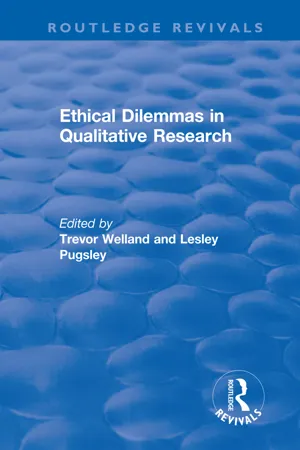
Ethical Dilemmas in Qualitative Research
About this book
This title was first published in 2002.The connectedness and degree of intimacy that forms between researcher and the researched in qualitative inquiry generates a range of ethical issues. Many professional associations have produced their own sets of ethical guidelines for members as a result of these issues. This edited collection explores and critically reviews the range of ethical dilemmas and issues that confront qualitative researchers in the field including: respect for privacy, establishing honesty and openness in the relationship formed, and guarding against misrepresentation. The contributors offer reflexive and confessional accounts of the process of negotiating the inevitable tensions that arise when applying the ethical principles expressed in the statements of professional and research bodies to the material situations encountered in the field. The diversity of settings and projects explored in this book testify to the fact that prescriptive templates often provide an inadequate picture of the ethical dilemmas encountered in researching the social and life worlds of the participants. The volume reflects the diversity of qualitative research currently being undertaken and provides a text which deals with the ethical realities of doing such research. The book will be an important resource for students, teachers and researchers.
Information
1
Is action research good for you?
We have long become accustomed to thinking of social theories as being or belonging to approach paradigms that have some of the characteristics of social or even religious movements (Gouldner, 1970; Bernstein, 1975). They are not only ‘about’ things but also ‘for’ and ‘against’ them. Models of society and human action employ language and ideas that are irremediably morally tinged. They speak necessity to believers and constitute danger, even an anathema, to those of alternative persuasion. Little wonder, then, that their procedures for self-renewal, their criteria and practices for evoking new knowledge, their ‘methodologies’, should provoke both pride and passion. Each has, at any given point of time and place, its guardians of more or less arcane practice whose last word is always final, until their next.
As with all specialised discourses, the inventions of those who produce new knowledge necessarily become recontextualised (Bernstein, 1996) and disseminated by lesser mortals, bearing the mutations of discipleship and use. How far the journey can be from wisdom to the intellectual wilderness is well exemplified by the often execrable debate about research paradigms in sociology and education. Since the timid landing of Chicagoan interactionism in the sixties (greeted by small indigenous bands of British Weberians and others of anthropological bent) provided respectable alternative to measurement and the survey, several generations of students have been treated to the crassest of versions of ‘debate’ over ‘quantitative’ and ‘qualitative’ methods, aka the ‘virtues’ of positivism and interpretivism. In it, methodological imputations of villainy and claims to saintliness have come as easily from the lips of street credibilitarians as from the daughters of ANOVA. Allegiance to ‘positivism’ has been claimed to give the blessing of objectivity, hypothesis testing and verification, careful operationalisation of concepts, testing and measurement pictured as leading to even-handed versions of truth. Becoming interpretivist was, in contrast, to affirm the place of understanding others and their purposes, privileging meaning and the subjective, though very few have appeared to want to accept the logic of Blum’s (1971) contention that the alternative to positivism is, indeed, poetry. Those in sociology who privilege meaning invariably claim to pursue understanding in objective ways. However, in the matter of whether or not they are ‘positivists’, if it does not count that they do not measure. In constructing their ‘accounts’ out of observation or interview material, they are typically merely substituting adjectival register for numbers.
There has never been any doubting the value-laden import of the positions taken on either side of the divide. The literature has abounded with death by a thousand cutting remarks visited by ‘science’ oriented methodologists upon the ‘subjectivity’, in effect, the wilful trading in ambiguity and even potential falsehood, of those who abjure the culture of conventional measurement procedures. In turn, puncturing the pretensions and uncovering the bad company kept by positivism assumed major forms of social and moral critique, for example, as in the world of the Frankfurt School from Horkheimer to Habermas (Frisby, 1974). American apostates, such as Cicourel (1964) and Garfmkel (1967) have provided critiques of measurement assumptions and the fragility of our understanding of the everyday base upon which the superstructures of grand theory are constructed that ought to bring smiles to the face even of those in the whitest of coats. And that the joke is permanent has become the postmodernist message inherited from the French lot who said that language always said what they meant, or vice versa.
As with social and religious movements, an increasingly respectable methodological position is the fence where, ever the toolmakers, eclectics enjoin the use of research methods in forms of paradigmatic pastiche where, usually, it is any attempt to operate experimentally that disappears fastest with the bathwater. On grounds very often presented as no stronger than an audit of pros and cons, the produce of different methods are seen to strengthen and ripen in the reflected glow of several paradigmatic suns. After all, after Marxist ethnography, anything was possible. And all the while, the mass of the ‘research’ population, under- and postgraduate students, drift into under-explicated eclecticism and/or relativism. It is not so much that methodological polytheism is wrong - the gods were made in our image to serve us - but that it tends to make us too satisfied too easily with mere juxtaposition. Triangulation may sometimes be beside the point and play, end in itself though it is, it does not necessarily do the work of analysis.
To all of this, I want to put Oakley’s (1999:252) question ‘what are research methods forV, expecting an answer, even in our era of multiple meanings, that ‘the aim of research methods is to provide some sort of approximation to what is ‘really going on’ expressing concern ‘about the extent to which different research methods offer protection against bias, the possibility that we will end up with misleading answers’, meeting the requirement that ‘all methods must be open, consistently applied and replicable by others’. Oakley’s trajectory from a developed reputation for, to a worried frown about, ‘qualitative’ research would, in terms of this criterion, find echo with many of us. In my own attempts to ‘do research’ over the past forty years, means and morals have always appeared elaborately intertwined. ‘Methods’ seemed to be as much answers to the problems of keeping researchers and their objects/subjects/collaborators/victims apart or ‘square’ as they were designed to bring them together. Research as truth made public (yes, even ‘whose truth?’ and ‘what truth?’) carried licence to expose, granted by? My own origin among the only too well aware proletariat imbued me with a deep and, I think, healthy distrust of those carrying warrants to interrogate. I remain the world’s stroppiest research respondent, insatiably curious as to the ends to which my words may be put. Those same origins, as with work itself, even when carrying the privileges of academia, have inclined me always to disbelief that anyone should actually like either. An it has long struck me that the small change of research ethics - asking people nicely, not getting in the way, promising no names, keeping secrets, not interfering - buys only the sweeties and light snacks in what can be a devouring relation of power, knowledge and ownership that critical theorists pointed to and Foucault (1970) inscribed on recent social science consciousness.
The issue, as ever, is living with the paradox. Things can be both good and bad for you. Just as the profit motive is touched by irremediable immorality (just as Mam and Marx always insisted), so in the terms of one of my earliest doctoral students (jointly supervised with Mark Blaug), it was also evident that ‘modern capitalism is in general terms a brilliant civilisation, based on the individual decision maker’, having ‘extraordinaiy power of socialisation’, establishing ‘deep internalised frames on the citizenry, as the condition of the dissolution of external, often coercive frames’ (O’Keeffe, 1980:83). Just as market and class codes coexist in (post) capitalist society so, in the same sort of way, the old story about who knows better or best has always seemed to me to be partly a matter of context and voice - no-one knows me better or worse than myself, though many different others may say truly of me what I neither assent to or know (or may even be capable of knowing) - and of ideology, defining me not in my own but others’ interests. The sixties, seventies and eighties had no shortage of those who ‘knew best’, crazy egalitarians, common sense freaks and weak professionals, while the nineties has revealed how easily our dominant new middle classes sign up to the advantages of the inegalitarianism of the performative educational state.
It was my earliest encounters as a teacher with school organisational and classrooms that impelled me toward seeking mainly sociological answers to such puzzles. Why were schools and schooling dominated by ideas and practices that enshrined hierarchic pupil ability? Why did teachers, even when they knew a great deal about subject matter, know so little and share even less about why and how they taught? While, for me, these questions altered their focus and emphases over the years, not least under the influence of Basil Bernstein. It always seemed to be the case that teachers’ missing mystery, what I initially saw as their weak technology that gave them, as characteristically put-upon practitioners, little scope, in Crozier’s (1972) terms, for solving crises, let alone causing them in the first place, was what Bernstein called pedagogy’s ‘missing voice’. Its processes, pedagogic discourse, seemed destined to act only as a relay for others (Bernstein, 1995). Teachers researching their own or local practices, almost certainly weakly socialised into discourses outside of their subject or stage-truncated versions of psychological developmentalism seemed, more than most, to require sight of a world of discourse outside of their own in order to go round other than in circles.
It is for these sorts of reasons that I contend that the past thirty years has seen an equally serious assault on methodological standards and meanings from those devoted to a variety of ‘action research’ approaches. Much of it that one sees at the level of student projects and dissertations at undergraduate or Masters’ level is merely ignocent, a mixture of ignorance and innocence licensed by higher education teachers and texts against whom our anger ought to be directed. What the student is encouraged or even required to do is to examine ‘own practice’. The activity of describing some limited state of affairs, very often in their own classroom, or among a group of colleagues, or at the institutional level, is regarded as its own justification: it is ‘action research’ and may lucky-dip into the method box in assembling information. Its end is declared to be ‘improvement’, though the enormities of establishing criteria and evidence for this, outside of personal perception of one’s own performance, are usually neither adduced nor dealt with. Nearer the frontier of this research production mode, things are not necessarily much better. Most versions refer to a cyclical process of searching for improvement in personal or collective practice. Sometimes, the individual is enjoined to record experience and reflection. At others, a group involvement is regarded as essential and a quasi-therapeutic, truth-telling engagement encouraged. In most versions there is a celebration of the need for open and co-operative collegial relations in achieving improvement or change, although commitment to them, as in Wallace (1986), is no guarantee of their achievement. Records and measures of progress, particularly as available from students’ work and opinions, are regarded as relevant evidence. But the question is ‘of what? What is educational action research a case of?’
In his brief review of education and research, 1960–75 Nisbet (2000) argues that the unprecedented expansion of funding in the 1960s (albeit from subventing two men and a dog to a small herd of young bulls, the odd maverick and a flock of sheep) rapidly gave way to government control and attacks on its autonomy. In an essentially technocratic climate ‘(N)ew styles of research (such as action research and case study) challenged traditional patterns of experimental design and statistical analysis’ (p.410). Though Nisbet says nothing more about the purchase of these ‘new styles on British action research’, there is a well established view that they were tied together as a ‘movement’ originating in the problems encountered by Stenhouse in framing and running the Schools’ Council Humanities Curriculum Project from 1967 and those with whom he collaborated and influenced, including Elliott, McDonald, Walker, Adelman and Ruddock. In the main, then, it grew out of particular attempts to modify and accommodate traditional notions of standards and culture to the uncharted territory of curricular forms and teaching practices that might make mass secondary education less divisive and more inclusive.
The ‘teacher as researcher’ (Stenhouse, 1975) was born out of the ruckus engendered over the HCP’s employment of them as ‘neutral chairmen’. Having hit the rocks of established educational discourse, as ever capable only of speaking with the voice of dominant others, means were sought to avoid future, unwinnable confrontation, to make progress. A spate of publications, initially arising from the Ford Teaching Project, characterised the mid-seventies (e.g. Elliott, 1976; Elliot and Adelman, 1976; McDonald, 1976; Walker and Adelman, 1977). The construction of the Eat Anglican redoubt has continued ever since, careful of its alliances, drawn toward networking, keen on publicisation, not least because of the tenuousness of its connections with conventional bases of research power and privilege though, indicatively, well placed in the British Educational Research Association.
Action research is now not one but several things, with a substantial mainstream commentative literature in Britain, ranging from the hagiographie to post-modern playful and including funded research work on the life histories of a selection of its own main protagonists (e.g. Nixon, 1981; McNiff, 1988; Hustler, Cassidy and Cuff, 1986; Elliott and Sarland, 1995; Stonach and Maclure, 1997; and Winter, 1989). There is a wider ‘researching teaching’ literature, some of which privileges ‘action research’ and ‘reflective practice’, as represented by Loughran’s (1999) collection, in which van Manen (1999:26) notes that, qua Freire, Apple and Giroux, for ‘many North Americans, pedagogy automatically means critical pedagogy, and its agenda is more dedication to social change than to the educational lives of young people’. A distinctive US variation is represented in the Bumaford, Fischer and Hobson (1996:xi) volume ‘intended for classroom and apprentice teachers who are interested in knowing more about ways to participate with students in classroom research’. An equally characteristic British variation in terms of ‘problem-based action research … derived from the philosophy of Karl Popper’ is outlined by Swann and Ecclestone (1999:92). In the same volume, research hunter-general, Tooley (1999:176), OFSTED licensed, Woodhead inspired rejecter of all relativisms, reassures us that, in terms of evolutionary epistemology, such as that of Ruse (1996), ‘scientific method … is built into our genes, and this is why it works and is shared by all humanity’ (p. 176). Our most accomplished tool users in educational research, the US managers, administrators and improvers have been known to regard action research as ‘the process of systematically evaluating the consequences of educational decisions and adjusting practice to maximise effectiveness’ (McLean, 1995:3) while. Britain’s Crawford, Kydd and Parker (1994) Educational Management in Action contains nothing, in this respect, more practitioner oriented than SWOT analysis in the twenty case study investigations reported. Finally, Middlewood, Coleman and Lumby (1999:19) endorse action research qua Elliott (1991) and Schön (1984), despite noting ‘a number of potential paradoxes in practitioner research’, quoting, without approving, Cochran-Smith and Lytle (1998:31) in believing that the latter amounts to ‘a new paradigm that aims to frontally transform rather than describe a school or classroom setting’.
Amidst these complications and voices, the target that I wish to address is the fate of perfectly ordinary teacher folk who seek more or less guided choices on how to deepen their understanding of their w...
Table of contents
- Cover
- Half Title
- Title
- Copyright
- Contents
- List of figures
- Notes on contributors
- Introduction
- 1 Is action research good for you?
- 2 Putting your oar in: moulding, muddling or meddling?
- 3 They told me I couldn’t do that: ethical issues of intervention in careers education and guidance research
- 4 Telling tales on technology: the ethical dilemmas of critically researching educational computing
- 5 Sex in the field: intimacy and intimidation
- 6 Roles and responsibilities in researching poor women in Brazil
- 7 Your place or mine? Ethics, the researcher and the Internet
- 8 Reflections on fieldwork in criminal justice institutions
- 9 Privacies and private: making ethical dilemmas public when researching sexuality in the primary school
- 10 Research and the ‘fate of idealism’: ethical tales and ethnography in a theological college
- 11 Whose side are we on? Revisiting Becker’s classic ethical question at the fin de siecle’
- Endword
- Index
Trusted by 375,005 students
Access to over 1.5 million titles for a fair monthly price.
Study more efficiently using our study tools.
Frequently asked questions
Yes, you can cancel anytime from the Subscription tab in your account settings on the Perlego website. Your subscription will stay active until the end of your current billing period. Learn how to cancel your subscription
No, books cannot be downloaded as external files, such as PDFs, for use outside of Perlego. However, you can download books within the Perlego app for offline reading on mobile or tablet. Learn how to download books offline
Perlego offers two plans: Essential and Complete
- Essential is ideal for learners and professionals who enjoy exploring a wide range of subjects. Access the Essential Library with 800,000+ trusted titles and best-sellers across business, personal growth, and the humanities. Includes unlimited reading time and Standard Read Aloud voice.
- Complete: Perfect for advanced learners and researchers needing full, unrestricted access. Unlock 1.5M+ books across hundreds of subjects, including academic and specialized titles. The Complete Plan also includes advanced features like Premium Read Aloud and Research Assistant.
We are an online textbook subscription service, where you can get access to an entire online library for less than the price of a single book per month. With over 1.5 million books across 990+ topics, we’ve got you covered! Learn about our mission
Look out for the read-aloud symbol on your next book to see if you can listen to it. The read-aloud tool reads text aloud for you, highlighting the text as it is being read. You can pause it, speed it up and slow it down. Learn more about Read Aloud
Yes! You can use the Perlego app on both iOS and Android devices to read anytime, anywhere — even offline. Perfect for commutes or when you’re on the go.
Please note we cannot support devices running on iOS 13 and Android 7 or earlier. Learn more about using the app
Please note we cannot support devices running on iOS 13 and Android 7 or earlier. Learn more about using the app
Yes, you can access Ethical Dilemmas in Qualitative Research by Trevor Welland,Lesley Pugsley in PDF and/or ePUB format, as well as other popular books in Social Sciences & Sociology. We have over 1.5 million books available in our catalogue for you to explore.