This title was first published in 2002: The purpose of "Chaucer's Church" is to provide clear, concise and reliable explanations of every term Chaucer uses that has a religious, liturgical, or ecclesiastical meaning. It uses a dictionary format, arranged according to Chaucer's spellings, to make information readily accessible for students, teachers, critics, and the general reader. The shorter entries present brief definitions which are more lively and illuminating than those in standard dictionaries or glossaries; the longer entries are in fact short essays, with suggestions for further reading, on broader or more complex topics. In all cases the entries concentrate on lucid and accurate presentation of the meanings that the terms had or could have had for Chaucer and a 14th-century audience. The book is a compact but precise reference for readers of all levels of experience on the vocabulary of fourteenth-century religion, which is often unfamiliar or only hazily understood.
eBook - ePub
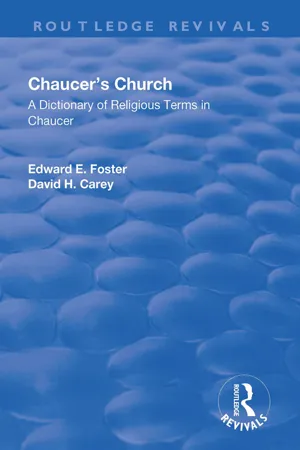
Chaucer's Church: A Dictionary of Religious Terms in Chaucer
A Dictionary of Religious Terms in Chaucer
- 162 pages
- English
- ePUB (mobile friendly)
- Available on iOS & Android
eBook - ePub
Chaucer's Church: A Dictionary of Religious Terms in Chaucer
A Dictionary of Religious Terms in Chaucer
About this book
Information
Entries
abbay, abbey(e). A monastery, ordinarily housing not fewer than twelve religious of either sex. An abbey was different from a priory, which was the name for the residence of an autonomous religious foundation (one not connected with other "houses" under the same rule) and presided over by a prior or prioress. (See monk.)
abbesse. The female superior in a religious community of twelve or more nuns (nonne). Originally the title applied to Benedictine foundations, but it was extended to the Second Order of St. Francis (Poor Clares) and gradually to communities living under other rules. Although an abbess had no spiritual jurisdiction and she could not perform priestly functions, she was the supreme domestic authority within her monastery. Abbesses were elected by the nuns of the community, but ordinarily they were women from privileged backgrounds, from powerful or distinguished families, and were likely, therefore, despite their cloistered vocation, to be present at important national and religious events from coronations to synods. (See monk.)
abbot. The chief officer of a monastery, especially Benedictine. The abbot, like the other monks, was celibate but not necessarily in Holy Orders. As the difficulty of hearing Mass at the more isolated monasteries became a problem, abbots tended to become priests. They were normally chosen by the monks of the abbey from their own number and confirmed by the bishop. When the monasteries gained freedom from episcopal jurisdiction, the confirmation came directly from the Pope. Abbots were chosen on the basis of their learning and humility so as to be model instructors in doctrine and obedience. By the second half of the fourteenth century, there are stories of abbots living and dressing sumptuously and hunting, an activity repeatedly proscribed for those in the religious life. Thus when the narrator of the General Prologue says the pilgrim monk is "A manly man, to been an abbot able" (I, 167), there is irony with regard to the pilgrim, who sees the rule of St. Benedict as outdated, and satire of the reputed behavior of some real abbots. Indeed, the whole portrait of the pilgrim monk (I, 165-207) may be a catalogue of contemporary abuses including violations of the monastic vows of poverty, stability, and even chastity. (See monk.)
Abraham. The first of the great Jewish patriarchs (Gen. 11-25). God promised Abraham that he would be the father of a great and numerous progeny. Although his wife Sarah did not conceive until late in life, Abraham remained faithful. After the birth of his son Isaac, God again tested Abraham by commanding him to sacrifice his only son. God, however, interrupted the sacrifice as reward for Abraham's staunch fidelity. Thus Abraham's absolute trust in God became the basis for the first covenant between Jehovah and His "chosen people", and Abraham became the "father" of his people and the source of Hebrew religion. His designation as "Father of the Jews" was, however, not always a title of honor when used in the anti-Semitic context of the fourteenth century.
Absalon, Absolon. The third son of Kind David, Absolom was renowned for his flowing hair and almost feminine beauty. He rebelled against his father, largely because of David's preferment of his first-bom, Amnon. Absolom killed Amnon, fled, and led an unsuccessful insurrection. Fleeing in a rout, Absolom caught his hair in a tree and was slain by David's general, Joab, leading to David's pathetic lament for his wayward, but beloved, son. (2 Sam. 13-18) (See scripture.)
absolucio(u)n. The remission of sin or the punishment due to sin in the sacrament of Penance administered by a priest. There was a long controversy, including much commentary by the scholastic philosophers, about the power of a priest to forgive sin. The issue was resolved, for the later Middle Ages, by Thomas Aquinas's conclusion that God in fact forgives the sin through the necessary ministration of the priest as His vicar or representative. Absolution is, however, conditional upon the penitent's confession of his sins, true sorrow for them, purpose of amendment, and satisfaction through prayer, almsgiving, and other penitential acts. (See sacrement.)
abstinence, abstynence (also Abstinaunce, Abstynaunce as a personification). In a general sense, abstinence is the refraining from any sinful activity or from lawful activity for penitential purposes. More specifically, however, it refers to dietary prohibitions on specified days or during specified seasons, usually from the eating of meat. Dietary restrictions were familiar from the Hebrew practice, e.g. on the Day of Atonement (Lev, 16:29 ff.), and fasting and abstinence were common in the early Church in imitation of Christ's forty days in the desert (Matt. 4:1-11; Luke 4:1-13) and to appease God's justice as a consequence of the Fall of Adam and Eve.
Abstinence proper, the refraining from meat, was imposed on all Fridays according to repeated papal decrees as early as Nicholas I (858-867) and Innocent III (1198-1216). In addition, abstinence was required as early as the seventh century by Gregory I on weekdays in the seasons of Lent and Advent as well as other specified days, such as the days preceding religious feasts. Abstinence was, then, not only the rule of life for monastics, but a familiar fact of life for all Christians.
accidie. The deadly sin of sloth. It is more of a disposition than a specific action, an aversion to the difficulty of living an upright life, a kind of spiritual laziness in the face of the obligations of the Christian life, and is therefore directly opposed to the active virtue of charity, which enjoins good works. Derived from the Latin "acedia", it is perhaps best described as a lack of will or commitment and, as such, can be the source of serious sins. (See deedly synnes.)
Achitofel. The haughty counselor of Absolom (Absalon) in his rebellion against his father King David. When the insurrection was routed, Achitophel committed suicide. (See scripture.)
Adam. The first man and the father of the human race. In Genesis the name can refer to mankind in general, but was ordinarily applied to the individual first man. His fall from original innocence and righteousness changed the terms of human existence. The guilt of his sin, original sin, was imputed to all his progeny and could be removed only by Baptism (Baptesme). His sin, and Eve's, separated the human race from salvation until Redemption by Christ, and thus accounts for the fallen and weakened moral state in which mankind lives as well as the adversities that flesh is heir to. (Gen. 1-2) (See scripture.)
Aleyn. Alanus de Insulis (c. 1120-1202/3). Also called Alan of Lille and Alain de Lille, renowned as the "doctor universalis" for his mastery of the liberal arts and sometimes considered the father of systematic theology. His major works, De Planctu Naturae (The Pleynt of Kind, 1160-75) and the Anticlandianus (1182-3), emphasize the connection that Nature provides between God and man, but still insist upon the necessity of redemptive grace for man's salvation. Although the De Planctu, a Boethian (Boece) dialogue between the poet and nature, was more broadly known and cited in the fourteenth century, the Anticlandianus is a longer, more systematic, though allegorical, account of how Reason and Prudence use Theology as a guide to Faith and the reconstruction of the Golden Age. Most significant is Aleyn's insistence that Nature must be elevated by Grace to be efficacious.
Alma Redemptoris. A musical composition in praise of Mary (Marie, Seinte) as the mother of the Redeemer by Hermanus Contractus (1013-54) It was first sung as one of the Marian antiphons at the end of the office of Compline from the beginning of the liturgical season of Advent, beginning roughly four weeks before Christmas, until the Feast of the Purification on February 2, Later it was sung as an independent hymn and became associated with the Feast of the Assumption of Mary on August 15.
almes, almesse, alinus(-dede). In the Hebrew Scriptures alms were substantive aid given to the poor, required by the Law, and bringing God's favor on the giver. In the Christian Scriptures, alms are foundational in that they spring from Christian love and compassion. From the Greek word for "pity", they are enjoined from John the Baptist (Luke 3:11) through St. Paul (Rom. 15:25-28; 1 Cor. 16:1; 2 Cor. 8-9). Fundamentally related to our stewardship of material goods, they are a central Christian duty as well as a penitential act. Thomas Aquinas saw almsgiving as the principal work of mercy. Although alms are material in nature, theologians emphasized the primacy of the charitable intention and the enhancement of the unity of Christians. Mendicant orders had the right, with proper approval, to solicit alms and depended upon them for survival. (See frere.)
Ambrose, Seint. St. Ambrose (339-397), Father and Doctor of the Church and Bishop of Milan (374), came from a wealthy family and was well educated in Rome. He was a man of public affairs as well as a theologian, insisting on the subjection of Emperors to the moral law of the Church. He was a scriptural scholar, an early devotee of allegorical interpretation of Scripture and a formidable opponent of contemporary heretics, especially Arians. (See heresye.)
amendement. Although there is a general meaning of reform, in a religious sense amendment is the correction of the spiritual life, a turning away from sin and the things of this world towards God and salvation Along with confession, contrition, and satisfaction for sins committed, it is an essential condition for the granting of absolution in the sacrament of Penance.
angel, aungel(l). Pure spirits whose role is to serve and praise God. The term comes from the Greek word for messenger, and their function was frequently seen to be intermediary between God and man. Although spiritual creatures, they are reported in the Christian Scriptures as taking human form in their dealings with man. From Gregory the Great (c. 540-604) to Bernard of Clairvaux (d. 1153) there was a tendency toward a cult of angels, St. Bernard especially noting the idea of the "guardian angel" for individual Christians. Medieval Christianity developed an elaborate angelology furthering the philosophical speculations of the scholastic philosophers, who were more interested in their nature than in the cult. The Fourth Lateran Council (1215) decreed that angels were pure spirits created before the material world. There emerged descriptions of elaborate duties and hierarchies based on traditions that had persisted from at least the fourth century. Thus, there were nine "choirs" of angels: five from St. Paul (virtues, powers, principalities, dominations, and thrones) plus angels, archangels, cherubim and seraphim.
Satan (Sathan) was the leader of the fallen angels who, before the creation of man, rebelled against God and were expelled from heaven and condemned to eternal damnation.
Angelus ad Virginem. A religious song based on the Annunciation to Mary by the angel Gabriel that she would be the mother of Christ (Luke 1:26-38). It is listed as part of Nicholas's repertoire in the "Miller's Tale", and identifies him more certainly with learning than with religion since the song was often sung in collegiate institutions after Compline; it did not achieve liturgical status as a hymn until the fifteenth century. Nevertheless, it is difficult to escape the irony of associating this praise of the Virgin with Nicholas, who will soon seduce the willing Alison. The song is also thematically related to the "Magnificat", Mary's speech to her cousin Elizabeth regarding the angel's message, a motif common in the later Middle Ages, which predicts the destruction of the powerful and the exaltation of the humble. If we are expected to call this to mind, the association with Nicholas is, once again, ironic, (See Marie, Seinte.)
anger, angre. One of the seven deadly sins, anger is a disposition towards ill will or indignation which can become seriously sinful when not kept under control. Of course, anger can be righteous when its object is sin or injustice, but when it is unfounded, or exceeds rational proportions, or is directed against an undeserving recipient, it is contrary to moral law as a sin of excess. (See deedly synnes.)
Anne, Seint. The mother of the Blessed Virgin Mary and husband of St Joachim, St. Anne is not actually a Scriptural figure. Her story derives from the Protoevangelium of James and other apocryphal writing of the late second century. The cult of Anne grew as devotion to Mary increased and, although churches were erected in her honor from the sixth century, she did not really become popular in Europe until the height of devotion to Mary in the fourteenth century.
annueleer. A priest (prest), ordinarily associated with a religious establishment called a chaunterie (therefore, sometimes called a "chantry priest"), who celebrated commemorative masses for the dead, usually on an annual basis. The chaunterie was supported by gifts, usually in the form of endowments, from relatives or patrons of the deceased. Such masses of remembrance and petition for the soul of the departed might be offered more frequently, for example the "month's mind" mass. Especially among the aristocracy and the more privileged classes endowments were provided to support annual observation in perpetuity.
anoynt(en). To rub or pour oil for religious or ceremonial purposes. Anointing is associated with the coronation of kings and the consecration of bishops, though it could be used in more generalized secular contexts. Anointing was part of the administration of the sacraments of Baptism (Baptesme), Confirmation, and Holy Orders. The most specific kind of anointing was of the five senses in the sacrament of Extreme Unction, which was believed to restore spiritual, and sometimes physical, health to those in danger of death. Its sacramentality was only rigorously defined at the Council of Trent (1545), but it had long been the practice of the Church: the earliest reference to it is in the Venerable Bede (73...
Table of contents
- Cover
- Half Title
- Title
- Copyright
- Contents
- Preface
- Acknowledgements
- Entries
- Appendix
- Bibliography
Trusted by 375,005 students
Access to over 1.5 million titles for a fair monthly price.
Study more efficiently using our study tools.
Frequently asked questions
Yes, you can cancel anytime from the Subscription tab in your account settings on the Perlego website. Your subscription will stay active until the end of your current billing period. Learn how to cancel your subscription
No, books cannot be downloaded as external files, such as PDFs, for use outside of Perlego. However, you can download books within the Perlego app for offline reading on mobile or tablet. Learn how to download books offline
Perlego offers two plans: Essential and Complete
- Essential is ideal for learners and professionals who enjoy exploring a wide range of subjects. Access the Essential Library with 800,000+ trusted titles and best-sellers across business, personal growth, and the humanities. Includes unlimited reading time and Standard Read Aloud voice.
- Complete: Perfect for advanced learners and researchers needing full, unrestricted access. Unlock 1.5M+ books across hundreds of subjects, including academic and specialized titles. The Complete Plan also includes advanced features like Premium Read Aloud and Research Assistant.
We are an online textbook subscription service, where you can get access to an entire online library for less than the price of a single book per month. With over 1.5 million books across 990+ topics, we’ve got you covered! Learn about our mission
Look out for the read-aloud symbol on your next book to see if you can listen to it. The read-aloud tool reads text aloud for you, highlighting the text as it is being read. You can pause it, speed it up and slow it down. Learn more about Read Aloud
Yes! You can use the Perlego app on both iOS and Android devices to read anytime, anywhere — even offline. Perfect for commutes or when you’re on the go.
Please note we cannot support devices running on iOS 13 and Android 7 or earlier. Learn more about using the app
Please note we cannot support devices running on iOS 13 and Android 7 or earlier. Learn more about using the app
Yes, you can access Chaucer's Church: A Dictionary of Religious Terms in Chaucer by Edward Foster in PDF and/or ePUB format, as well as other popular books in Social Sciences & Sociology. We have over 1.5 million books available in our catalogue for you to explore.