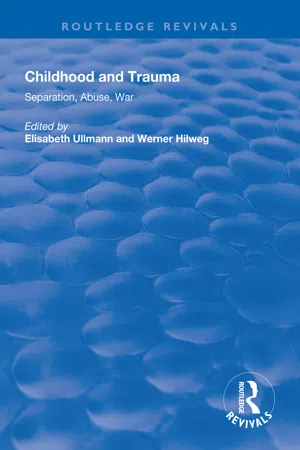
First published 1999, this book attempts to answer these questions and takes a broad approach to the subject of "Childhood and Trauma". It examines in detail separation, sexual abuse and war, all of which are particularly traumatizing to children, and how they are dealt with in different cultures. In addition to describing the causes and impacts of trauma, the book also gives special attention to healing and helping traumatized children. One chapter deals solely with how to support professional caregivers who live and work with affected children. Another aim of the book is to use the practical experience of SOS Children's Villages to illustrate the possibilities and limits of professional care and therapy for traumatized children. The Book comprises a total of 17 articles provided by authors from eight different countries and pursues both a practical and theoretical approach to the problems mentioned above. "Children and Trauma" is intended for psychologists, psychotherapists, educators, social workers as well as a broader audience of professional caregivers and anyone interested in the subject.
- 228 pages
- English
- ePUB (mobile friendly)
- Available on iOS & Android
eBook - ePub
About this book
Information
TRAUMA
The Rights of the Child and the State of the World’s Children
HELMUT WINTERSBERGER
Childhood Compared Between Industrialized and Developing Countries
The 1996 UNICEF Report, “The State of the World’s Children”,1 states that in 1994 there were 1.881 billion children under the age of 16 worldwide. Of these, approximately 9% (169 million) lived in the Western, industrialized nations, around 5.5% (105 million) lived in the former Soviet countries, and over 85% (1.607 billion) children lived in the Third World. Resource distribution follows the opposite path. Developing nations, where over 85% of the world’s children live, have at their disposal only around 15% of the world’s income, while in the developed countries, where only 9% of the children live, over 80% of the global income is squandered. Thus, while the majority of children in the richer nations live in affluence, most of the children in the impoverished nations suffer from destitution, hunger, war, and a lack of health care. (The fact that it has not even been possible for the richest countries to overcome the problem of child poverty should also make us pause for thought).
The divergencies in living conditions between industrialized and developing countries are even more extreme for children than for adults. For example, child mortality rates (for children under 5 years of age) in 1994 ranged from 5 per thousand in Sweden to almost 320 per thousand in Niger, which corresponds to a ratio of 1:64. Additional quantitative and qualitative indicators can be used to highlight the gravest differences: For instance, the life expectancy of a child born in Sierra Leone is 39, while that of a child born in Japan is 79.
In developed nations, almost all children between the ages of 7 and 14 attend school. In the poorest countries, only a minority are able to receive an education. In 1994, a mere 24% of the school-age children in Afghanistan actually attended school. In Niger, the literacy rate of the general population for that same year was around 12%.
While in the industrialized nations, classical child labor has for the most part been eliminated, a glance at publications provided by the International Labor Organization (ILO) shows that child labor remains a wide-spread problem throughout the Third World.
In addition to the differences between rich and poor nations, there are ever-growing economic inequalities inside the countries themselves. In Brazil, for instance, 40% of the poorest households had access to only 7% of the national income in 1994, while the 20% that make up the richer families commanded 68%.
In general, the observation must be made that the polarization between the richest and poorest nations is not lessening but, instead, continues to grow. This fact is supported by a child-oriented analysis of progression indicators for the poorest and richest countries, such as child mortality rates, economic development and population growth.
The broad gap between the conditions for children in industrialized and developing countries has not made it easy to formulate the text of the Convention on the Rights of the Child, which takes both realities into consideration. Nevertheless, there are numerous problems common to children all over the world. Structural disadvantages exist for children in poor as well as rich countries, for example, and children all over the world suffer from abuse and maltreatment. Even though there are significant disparities here as well, the street children of Lisbon, Portugal and São Paolo, Brazil have more in common than not.
Furthermore, over the course of the past several years, there have been developments which can only be explained by the very disparate living conditions in both the Third and First Worlds. An example is provided by international trade in children. This phenomenon is yet another emphasizing the need for global regulation of children’s rights.
The United Nations’ Convention on the Rights of the Child represents an effort to strengthen the legal foundation needed to improve the state of children worldwide. There is also the need to regulate specific areas (such as international adoption) by means of special agreements at the global and/or regional level. The following discussion is a critical analysis of the Convention and its effects.
The UN Convention on the Rights of the Child and its Implementation
There have been ongoing discussions of an international convention on children’s rights within the United Nations for almost 40 years now. In 1959, a UN Declaration on Children’s Rights was passed. Then in 1978, the government of Poland, utilizing the upcoming International Year of the Child as an appropriate setting, recommended the formulation of a Convention on the Rights of the Child. In 1979, the International Year of the Child, a working group was created within the UN Human Rights Commission. Ten years later, after extensive and arduous negotiations, the work of this sub-committee was completed, and on November 20, 1989, the Convention was passed by the 44th General Assembly of the United Nations in New York.
How can we assess the significance of this UN Convention, particularly in terms of its effects on children? Two aspects need consideration within the scope of such an evaluation: first, the actual content of the Convention, and second, the implementation process.
Never in the history of the United Nations has there been another human rights convention that has found such wide-spread acceptance among the Member States as the Convention on the Rights of the Child. Only two months after the vote by the General Assembly, the document was signed by 61 Member States in a ceremony at United Nations Headquarters in New York on January 26, 1990. On September 2, 1990, the twentieth nation ratified the Convention as a prerequisite for it to take effect in accordance with Article 49 of the Convention on Children’s Rights.
Then, on September 29 and 30, 1990, a World Summit on the State of the World’s Children was held in New York. The Summit passed a “World Declaration for the Survival, Protection and Development of Children”,2 in which the Convention plays an important role. Events that took place the following years proved that these efforts did not merely represent “a flash in the pan”. By the summer of 1996, 185 Member States had already signed the Convention. As was to be expected, the dynamics of this process were generally interpreted in an extremely positive manner. Nevertheless, the show of support must also be taken with the proverbial grain of salt. It is also possible that the governments so readily agreed to the Convention because they believed they were not assuming any major responsibility. It therefore remains to be seen over the next years how the Convention is implemented at the local, national and international levels.
The Contents of the Convention - Convergencies, Tensions and Contradictions
At least as ambiguous as the evaluation of the Convention’s implementation, is that of its contents. It ranges from emphatic praise to extremely critical positions. In my opinion, an analysis of the contents of the Convention must proceed on two levels: On the one hand, the Convention must be appraised for convergencies (similarities), as well as for tensions and contradictions. On the other hand, various articles of the Convention need to be analyzed.
To the Fundamental Question of Discrimination against Children
The UN Charter on Human Rights forbids various forms of discrimination. Member States are therefore required to guarantee all persons within their sovereignty their inherent rights without discrimination, i.e. regardless of race, skin color, gender, language, religion, political or other views, national, ethnic or social origin. From today’s perspective, it is remarkable that age was not included in these forms of discrimination. Consequently, in terms of human rights it is very possible indeed to discriminate against children merely because they are children.
One could have assumed that the UN Convention on the Rights of the Child addressed the question of whether children may be discriminated against based on their status as children. This has, however, not occurred, for which reason the discrimination of children as compared to adults was not explicitly treated. Article 2 of the Convention does, however, state that the forms of discrimination forbidden in the human rights convention apply specially to children. This means that it would not be prohibited to discriminate against children in general as compared to adults; on the other hand, it would be forbidden to place girls at a disadvantage with regard to boys, or black children with regard to white children.
Several authors3 are of the opinion that it would have been better to pass an amendment to include age among the discrimination clauses included in the UN Charter on Human Rights than to have created the existing Convention on the Rights of the Child. On the other hand, every legally binding international document must be coupled with the consciousness of the international community as well as with the particular situation in the individual Member States in order to gain acceptance and be implemented. The Convention undoubtedly represents progress in this sense.
Balance between the Principles of Survival Development, Protection, Provision, and Participation
The Convention is essentially based on five principles: survival, development, protection, provision, and participation. Here I see a parallel to the social and psycho-historical discussions by DEMAUSE, according to which society’s attitude toward childhood has throughout the course of history developed from a standpoint which accorded childhood an extremely low value, as characterized by child murder and abandonment, through a stage of ambivalence to an ever more nurturing relationship with children by means of intrusion, socialization and support.
In global statements, which also include the reality of childhood in Third World countries, the principles of survival and development are very important. It is for this reason that many of the UNICEF programs and those sponsored by non-governmental organizations (NGOs) deal with child survival, in particular in the areas of basic medical care, combating poverty and rescuing children in war- and disaster-stricken areas.
The term development can be interpreted on two levels: on the one hand, as the right of children to grow up in a society with positive developmental perspectives, and thus as an additional argument for the more equal distribution of resources between poor and rich countries, and, on the other hand, as the right of children to be able to develop and blossom optimally within this society.
In the industrialized countries, the three rights protection, provision and participation are placed in the foreground. The concept of child protection already established itself in society during the 19th century due to the catastrophic conditions for children, particularly among the working classes. The pedagogic movement of the last century, supported by the nascent labor movement, undoubtedly represented a significant step forward. Protecting children from early economic exploitation and unhealthy working conditions as well as the introduction of the general public school system were components of a comprehensive program that radically changed conditions for children in modern society. Most of these changes were positive, although several were also problematic. While in traditional rural families as well as in the early days of industrialization children were still part of the active and productive population, academic performance by children in schools is no longer viewed as a productive contribution on their part, but rather is interpreted as an investment by society in its children.
The provision of resources by society is largely associated with conditions during childhood and with the development of welfare state services in the 20th century. Such resources include the transfer of financial means as well as social services. It is clear that such resources are not available to children alone but to other generations as well. Only recently has a discussion emerged as to how evenly welfare-state resources are distributed among the generations. For the industrialized nations, such authors as CORNIA, PRESTON, SGRITTA, and THOMSON conclude that children have profited least, and senior citizens most, from developments over that past thirty years.
While the first two principles mentioned, namely protection of the child and provision of resources, are already firmly anchored in the discussion as well as the implementation of children’s policies, the concept of participation by children is relatively new. According to the French judge JEAN-PIERRE ROSENCVEIG,4 Articles 12-16 of the Convention, which deal with participation by children, anticipate the 21st century. It is therefore not surprising that the majority of those opposing the Convention do so because of its participatory provisions (freedom of speech, freedom of thought, conscience and religion, the right to assemble, as well as the protection of the child’s privacy). Resistance grows even greater when efforts are made to expand these rights to the political sector (voting rights for children), as is sometimes the case.
More important and simultaneously also more difficult than the demand for maximum rights in a single dimension is the establishment and maintenance of the delicate balance between the diverse fundamental rights - survival, development, protection, provision, and participation. With regard to child labor, for example, it should be possible to distribute a society’s resources in such a way that children need not work. The abstract ban on child labor must not, however, be abused in the interim period in order to avoid proper compensation for work indeed done by children, to not officially regulate or control it, and to prevent working children from organizing themselves in unions. This standpoint also corresponds approximately to that of the International Labor Organization.
Reciprocity Between Society, Family, Parents, and Children
Nor is the relationship between the interests of society, parents and children free of discord. In a traditional society, the costs of raising a child are incurred within the family, and the fruits of children’s work (contributing to work around the home and farm), are also reaped by the household. The Generation Contract is based on reciprocity within the family and the household. The introduction of systems providing social security in the modern welfare state, particularly pensions and retirement insurance, have replaced this system of simple reciprocity with a far more complex one. Reciprocity between the generations occurs no longer at the family level but, instead, at the society level. It is no longer one’s own children, but rather the subsequent generation, the one currently in the workforce, that must support the older retired generation in the form of a transfer process. For this reason the question of transfer systems is posed, which would ensure the just distribution of burdens between households with different numbers of children. This topic too has again become quite explosive due to the widespread child povert...
Table of contents
- Cover
- Title Page
- Copyright Page
- Table of Contents
- List of Figures
- List of Contributors
- Foreword
- Preface
- PART I: TRAUMA
- PART II: SEPARATION
- PART III: SEXUAL ABUSE
- PART IV: WAR
- PART V: PROFESSIONAL HELPERS
- Index
Trusted by 375,005 students
Access to over 1.5 million titles for a fair monthly price.
Study more efficiently using our study tools.
Frequently asked questions
Yes, you can cancel anytime from the Subscription tab in your account settings on the Perlego website. Your subscription will stay active until the end of your current billing period. Learn how to cancel your subscription
No, books cannot be downloaded as external files, such as PDFs, for use outside of Perlego. However, you can download books within the Perlego app for offline reading on mobile or tablet. Learn how to download books offline
Perlego offers two plans: Essential and Complete
- Essential is ideal for learners and professionals who enjoy exploring a wide range of subjects. Access the Essential Library with 800,000+ trusted titles and best-sellers across business, personal growth, and the humanities. Includes unlimited reading time and Standard Read Aloud voice.
- Complete: Perfect for advanced learners and researchers needing full, unrestricted access. Unlock 1.5M+ books across hundreds of subjects, including academic and specialized titles. The Complete Plan also includes advanced features like Premium Read Aloud and Research Assistant.
We are an online textbook subscription service, where you can get access to an entire online library for less than the price of a single book per month. With over 1.5 million books across 990+ topics, we’ve got you covered! Learn about our mission
Look out for the read-aloud symbol on your next book to see if you can listen to it. The read-aloud tool reads text aloud for you, highlighting the text as it is being read. You can pause it, speed it up and slow it down. Learn more about Read Aloud
Yes! You can use the Perlego app on both iOS and Android devices to read anytime, anywhere — even offline. Perfect for commutes or when you’re on the go.
Please note we cannot support devices running on iOS 13 and Android 7 or earlier. Learn more about using the app
Please note we cannot support devices running on iOS 13 and Android 7 or earlier. Learn more about using the app
Yes, you can access Childhood and Trauma by Elisabeth Ullmann,Werner Hilweg in PDF and/or ePUB format, as well as other popular books in Social Sciences & Sociology. We have over 1.5 million books available in our catalogue for you to explore.