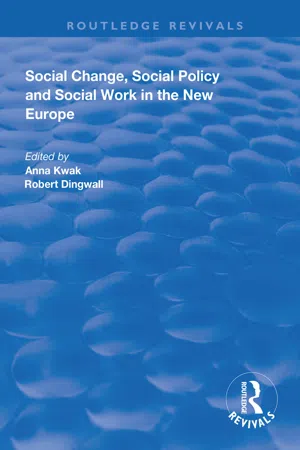
First published in 1998, this edited volume reflected on the role of universities and aimed to improve the preparation of social welfare professionals by the University of Warsaw for employment in the new market-oriented society that was being created in Poland after the end of 'real socialism' in 1989. Many of its articles were previously published in Polish and were published, revised and updated, in English for the first time in this collection. The contributors discuss two key issues. First, should universities worry about the employment of their graduates and the skills that are needed by the wider economy and society or just focus on transmitting advanced learning? Second, they considered the modernisation of the welfare state. The Polish experience, and the Western partners' reaction to it, has proved an excellent case study for these issues.
eBook - ePub
Social Change, Social Policy and Social Work in the New Europe
- 259 pages
- English
- ePUB (mobile friendly)
- Available on iOS & Android
eBook - ePub
Social Change, Social Policy and Social Work in the New Europe
About this book
Information
PART I
SOCIAL POLICY AND SOCIAL CHANGE
1 From Socialist to Liberal Utopia: Changes in Poland’s Social Policy since 1989
Józefina Hrynkiewicz
Polish Social Policy 1945-89 - The Utopia of Socialism
After 1945, Polish social policy took its inspiration from the communist social utopia where everyone is entitled to everything and the state is the exclusive distributor of goods and services in accordance with needs of citizens. Equality, elevated to the status of a constitutional principle, was the basic expressed value of social policy. The 1952 Constitution guaranteed everyone equal access to all goods and services and obliged the state to provide them as needed. This concept of social policy defines the state as a philanthropist with unlimited ability to meet constantly growing needs.
The implementation of this principle was obviously impossible. The obligations contained in the Constitution could not be fulfilled even by the richest country. From 1945-89, the ideal was acknowledged but its full implementation was postponed into an indefinite future. In the meantime, access to social goods was distributed in relation to the value attached to different groups within the society.1 In principle, everyone was entitled to everything: in practice, those who were thought to be most important for the preservation of the communist political and economic order had priority claims on goods and services.
The result was the development of a culture where it was assumed that the state gave everything, including a job, income, vacations, education, lodging, retirement pensions, benefits, scholarships, cheap books, medical care, etc. The state decided arbitrarily about what and how much, when and under which conditions it might give. Thereby, the state controlled citizens, since it not only decided the principles of distribution, but itself carried them out. The control of citizens went even deeper, as most goods and services were available almost exclusively within the state controlled (rationed) distribution system. During the 1980s (the years of martial law and after) strict control was imposed upon distribution of all goods (‘coupon sale’).
Access to goods and services was closely connected to employment, since work was not only a right, but also an obligation of a citizen. Apart from their economic or administrative functions, state workplaces - the only kind which existed - organized social services and distributed social goods and benefits. They built houses and allocated them; organized, and controlled access to, vacation facilities for employees and their families. They built stadiums and physical recreation centres (sports fields and halls) and organized services in the fields of health protection and care, education and child care, recreation, leisure, and culture. They engaged themselves in social welfare activities. Workplaces shared out the most desired goods and services, which were permanently in short supply - dwellings, cars, household equipment, opportunities for tourism and so on. This mechanism for distribution was essential, since wages were low and the production or supply of all goods and services was nationalized. For more than 45 years wages were merely a supplement to goods, benefits and social services allocated by the state. A long-term low-wage policy tied the living standards of citizens to the benefits allocated by the state and deprived them of any opportunity to prosper from their own activity, far-sightedness and providence. It also denied them responsibility for their own social security and well-being.
In its programmatic statements, the state repeatedly declared its commitment to satisfying the increasing needs of employees and their families. It was the state’s role to decide which needs were important, which were growing faster (or slower) and whose needs, when and to what extent, should be satisfied. Workplaces and sectors of the economy which were of particular significance to the state were given numerous privileges. These included relatively high wages, easier access to rationed goods and services, longer vacations and retirement privileges (shorter contribution periods and supplements to retirement pensions).
The communist authorities considered the most important sectors to be mining, heavy and military industries. Generous privileges were granted to the army, special services, militia, top political party functionaries and central administration officials. Other sectors, such as the textile industry, construction, communications and agriculture, were less important to the government, so their employees enjoyed fewer privileges. Social service workers (including education and health protection personnel) were treated as the lowest rank of employees, regarded by the authorities as non-productive and, hence, deprived of most privileges.
The state was not able to fulfil its self-declared obligations and had no intention of doing so. Different groups struggled for influence in order to secure for themselves the highest possible volume of goods, services and social privileges. This conflict was the result of the unstable, vague and secret principles regulating access to goods and services. The lack of transparent distributional principles gave the state authorities the ability to control citizens’ living conditions and to manipulate different groups - setting them against each other. Among the demands voiced during the workers revolts in 1956, 1970, 1976 and the Solidarity protest of 1980, there was always a call for full disclosure of group privileges and the principles by which the authorities justified them.
The unstable, vague and secret principles for dividing rights, services, benefits and goods created conditions for bribery and corruption, particularly in institutions providing services vital for citizens like health care, housing, public administration and commerce. The complete nationalization of these social services resulted in limited supplies, a lack of competitive pressures and low quality. Their quality was be so bad that it simply nullified their supposed functions. The fact that such goods appeared at all was enough (either no alternative was available or else it was completely unaffordable by the average member of the population).
The social policy established by ‘real socialism’ functioned in practice as an ideological manoeuvre aimed at manipulating the granting and concealing of privileges and handicaps. From 1945 to 1989 Polish social policy referred, in its declarations, to the paramount values and ideological goals of justice, equality, universal well-being, full and rational employment, and the satisfaction of needs at the highest level. However, in its practice, only emergency and special actions were performed in order to stabilize the totalitarian order imposed as a result of the partition of Europe after World War II. Under the slogans of social equality, divisions were introduced into Polish society between those groups enjoying numerous privileges and goods and those completely disadvantaged, groups with a high consumption standard and those located on the margin, with permanently unmet needs (even of a basic character, e.g. food, shelter or clothes). This situation persisted because of a complete prohibition against any form of social dialogue or self-organization. There was no pressure from public opinion, mostly because of the lack of freedom of the media. Instead, there existed political police and effective oppression.
Social consent for the existence of the rationing system for 45 years was ‘acquired’ by regulating consumption. The majority of the population was always held at a very low level, which was further reduced at times of social distress and conflict, leading ultimately, in the 1980s, to the introduction of administrative control over the distribution of all goods and services. The lack of democratic mechanisms for elections, negotiations and control and of opportunities to include, articulate and adjust interests within the decisionmaking system led to mass workers’ revolts (i.e. in 1956, 1970, 1976 and 1981) bloodily suppressed by the authorities. Mass worker protests brought only short-lived and emergency changes in the distribution of income and privileges. They also led to intensified control and surveillance, which often applied the methods of political terror, including the elimination of those thought to have inspired or led the rebellions.
The pursuit of the state’s social policy - designed to implement a universal distribution of goods and services, and committed to ensuring that all the increasing needs of everyone would be met in a country with a low level of per capita GDP2 - inevitably led to:
- deepening disparities in the material situation and social status of various social and occupational groups and local communities;
- the formation of numerous social communities and groups living at the margin of social life;
- concealment not only of the unmet basic needs of these marginalized groups (e.g the disabled, families in difficult living situations, the homeless) but also of their very existence;
- concealment of many difficult social problems, such as poverty, hidden unemployment, social pathology (crime, drug and alcohol abuse, bribery, social exclusion of weaker groups);
- the encouragement of demanding attitudes by citizens towards the state, since they had no right of independent action to change their situation;
- the development of a culture of dependency as a result of almost half a century of State philanthropy where helplessness rather than action was rewarded;
- the decay of civic initiative and social self-organization;
- the loosening and breaking of social ties and community self-help;
- an Orwellian confusion and demoralization as a result of the perversion of the basic language of welfare.
From Socialist to Liberal Social Utopia
The proposals for changes in social policy presented to the communist authorities by their opponents never contained any programme for a comprehensive change in the system. Demands were made to improve the access of certain particularly disadvantaged social or occupational groups to goods and services and to give them priority when deciding on the grant of privileges - or to deprive some particularly privileged groups. This approach to social policy has continued since the communist period. After 1989 the fight for one’s own privilege (or for one’s group) has proved effective in creating separate and preferential systems of retirement pensions for the army, special services, prison management and police in 1994/95, and forjudges in 1997. This method was also applied to maintain a separate system of health care designed exclusively for top state officials and established under communist rule. These systems are funded by public money, but provide higher standards of benefits and services than those available to the public. There is still a demand for the state to ‘give to us’ or maybe to ‘take away from them’.
It is difficult to distinguish stages of change in Polish social policy since 1989.3 An analysis of the programmes of the successive governments allows us only to distinguish trends which are broadly social-democratic, conservative and liberal. It is not easy to identify any consistent orientation: the ideological declarations made by ruling parties have differed from their actual implementation. For example, a party declaring its commitment to social-democratic reforms carried out an extremely liberal programme.4 This analysis, then, focusses on the general direction of the changes which have occurred, rather than attributing them to particular parties or coalitions.
Is it Possible to Give Up the Socialist Social Utopia?
It has proved to be very difficult for the state to give up its guarantee to provide all citizens with goods and services in accordance with their needs. Deeply rooted in public consciousness is the idea that the change initiated in 1989 not only confirmed the state’s promise but would lead to a more diligent effort to fulfil it. Even the popular feeling of successive generations, that such promises are completely unenforceable, has not made it possible to renounce the intention ‘to satisfy steadily growing social needs at the highest level’ (as the documents of the old communist party used to declare). It did not matter that an overwhelming majority of citizens had not benefited from them, and never had any chance to do so. State provision was an entitlement. Being conscious of this potential right, people did not want to lose it. This problem became particularly evident in 1994-97 when a new Constitution was being drafted. The post-communist parties justified it by reference to its maintenance of many previous social rights.
In the public mind ‘deprivation’ of rights - to work, housing, education, leisure, health care and cultural services - was a matter of one’s own individual situation. By giving up these rights, even if they were unreal and had never been implemented, both individuals and social groups would lose hope that their unmet needs might yet be satisfied. Many Poles, seeing their rights guaranteed by the Constitution, have hoped (or deceived themselves) that, at some time, they might possibly enjoy those rights.
These hopes and illusions are invoked in election campaigns by many politicians belonging to post-communist parties. This promise was an important factor in the electoral success of the post-communists in 1993 (when they regained power) and their strong showing in 1997. It does not matter that their declarations have been different from their actions in office. In election campaigns, they assure their electorate that all social guarantees from the previous period have been continued and that all errors and defects in implementation will be eliminated.
As yet, there has been no research and analysis to explain the persistence of behaviours and attitudes established in the socialist social utopia. Arguably, the declarations of social rights are the last consolation for many Poles in their current difficult situation. If they have no work, no qualifications, no housing, no regular income, no opportunity to start a family and ensure its subsistence, they still have a theoretical entitlement to all of these things.
With this, the question arises: are these attitudes a threat to the stability of the new situation in Poland? The declining participation rate in elections suggests that increasing numbers of citizens are refusing to take part in this fundamental act of democratic citizenship: in 1997, only 47.9 per cent of those eligible to vote did so compared with 62 per cent in the elections of 1989. The falling confidence in the socialist social utopia, has not been matched by a simultaneous growth of confidence in a market economy and liberal democracy. The proportion of the population who do not support any political party or published election programme is rising. Surveys made before and after elections characteristically show that the proportion of the population intending to vote ranges from 68 to 75 per cent, while actual voting is typically about one-third lower. This suggests that a significant part of the population is afraid to declare publicly its refusal to participate in elections in case this leads to a negative evaluation of them.
What is the Alternative to the Socialist Social Utopia?
Social policy has not changed because of a failure t...
Table of contents
- Cover
- Half Title
- Title Page
- Copyright Page
- Table of Contents
- Contributor
- Introduction
- Part I Social Policy and Social Change
- Part II Social Policy and Economic Change
- Part III Social Work in the New Europe
Trusted by 375,005 students
Access to over 1.5 million titles for a fair monthly price.
Study more efficiently using our study tools.
Frequently asked questions
Yes, you can cancel anytime from the Subscription tab in your account settings on the Perlego website. Your subscription will stay active until the end of your current billing period. Learn how to cancel your subscription
No, books cannot be downloaded as external files, such as PDFs, for use outside of Perlego. However, you can download books within the Perlego app for offline reading on mobile or tablet. Learn how to download books offline
Perlego offers two plans: Essential and Complete
- Essential is ideal for learners and professionals who enjoy exploring a wide range of subjects. Access the Essential Library with 800,000+ trusted titles and best-sellers across business, personal growth, and the humanities. Includes unlimited reading time and Standard Read Aloud voice.
- Complete: Perfect for advanced learners and researchers needing full, unrestricted access. Unlock 1.5M+ books across hundreds of subjects, including academic and specialized titles. The Complete Plan also includes advanced features like Premium Read Aloud and Research Assistant.
We are an online textbook subscription service, where you can get access to an entire online library for less than the price of a single book per month. With over 1.5 million books across 990+ topics, we’ve got you covered! Learn about our mission
Look out for the read-aloud symbol on your next book to see if you can listen to it. The read-aloud tool reads text aloud for you, highlighting the text as it is being read. You can pause it, speed it up and slow it down. Learn more about Read Aloud
Yes! You can use the Perlego app on both iOS and Android devices to read anytime, anywhere — even offline. Perfect for commutes or when you’re on the go.
Please note we cannot support devices running on iOS 13 and Android 7 or earlier. Learn more about using the app
Please note we cannot support devices running on iOS 13 and Android 7 or earlier. Learn more about using the app
Yes, you can access Social Change, Social Policy and Social Work in the New Europe by Anna Kwak,Robert Dingwall in PDF and/or ePUB format, as well as other popular books in Social Sciences & Sociology. We have over 1.5 million books available in our catalogue for you to explore.