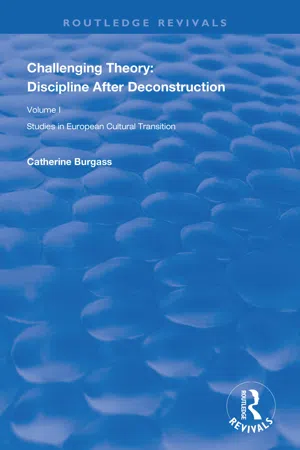
First published in 1999, this volume perceives that English literature in under threat as an academic discipline. In Challenging Theory, Catherine Burgass warns against the recent trend towards the conflation of literature teaching with cultural studies in British and American universities. Focusing on theory of deconstruction, as developed by Jacques Derrida in the 1960s, the book redresses some common mistenterpretations of Derrinda's work relating to the status of metaphysical oppositions. Part One discusses textual differences and the ways in which these may dissolve and reform according to different cultural contexts. The practical issues associated with teaching literature and literary theory in universities are examined in Part Two, while Part Three high-lights some of the move invidious claims of literary theorists, and questions the value of metaphysical analysis as a tool for political critique. Challenging Theory tackles an important debate that lies at the heart of humanities teaching. It illuminates the impact on academia of the work of critical theorists over the last thirty tears, and provides a platform for future reassessment of the relationships between literature, philosophy and theory.
eBook - ePub
Challenging Theory: Discipline After Deconstruction
Studies in European Cultural Transition , Volume One
- 179 pages
- English
- ePUB (mobile friendly)
- Available on iOS & Android
eBook - ePub
Challenging Theory: Discipline After Deconstruction
Studies in European Cultural Transition , Volume One
About this book
Information
Chapter 1
Opposition and Difference
The ‘first generation’ of poststructuralist theorists were enthusiasts with a missionary zeal. These French intellectuals of the late 1960s believed that a synthesis of linguistics, literary criticism, psychoanalysis, and ideological critique would help to foment political revolution. Of course it did not, but the word has been disseminated widely and in Britain and America poststructuralism has been recruited in the critique of humanism, Enlightenment rationality, bourgeois liberalism, English literature and the discipline which endorsed and was endorsed by these values. For some, poststructuralism provided a fillip for a discipline which for decades had subsisted on a diet of close reading supplemented by pedestrian ‘old’ historicism. There has also been a strong negative reaction from disciplinary traditionalists, who rejected Continental theory out of hand and clung resolutely to a form of Leavisite criticism. There remains an anti-theory faction in many English departments today, but the old opposition between theorist and anti-theorist is breaking down. The assimilation of theory within literary studies is indicated by the fact that since the 1980s it has been the norm, even for older universities, to include literary theory on the degree course, often as a core element. For students of English literature, theory is now part of disciplinary convention and poststructuralism is no longer the iconoclastic discourse it once was but claims are still being made for its ethical and political relevance.
Although deconstruction ranges across disciplinary boundaries and has been transformed into a coherent method of literary criticism, it is primarily a metaphysical discourse. Derrida has repeatedly shown how conceptual oppositions, whether in the texts of philosophy, literature or politics, are not mutually exclusive but irredeemably contaminated by or reliant upon each other. After Saussure, this model is accessible and, on an abstract level, cogent. But what has happened after Derrida is that deconstruction is often cited as the theoretical underpinning of arguments for the incorporation of literary theory into critical practice, or literary studies within cultural studies, or the practice of reading philosophy as literature. This assumes an untenable transition from the ideal realm of metaphysics to the real world of social practice and represents an inappropriate conflation of different types of difference. This study is an attempt to redress some common misinterpretations of Derrida’s work relating to the status of metaphysical oppositions and to block the equation that is often made between these metaphysical structures and the differences which operate within social institutions – not to reject deconstruction out of hand, then, but to point to its limitations in the face of disparate cultural differences.
From the moment deconstruction transgressed its national boundaries it encountered resistance from philosophers in the Anglo-American academy. European philosophy does have its own tradition of positivism and Derrida is even regarded by some Continental philosophers as a charlatan, but Anglo-American philosophy in the twentieth century has been associated primarily with the analytical tradition, which rejected metaphysical inquiry in favour of positivistic investigations into language, logic, and sense-perception. One of the most notorious encounters between the two traditions took place in 1977 in the form of a published debate between Derrida and John Searle over the issue of intentionality in J.L. Austin’s speech-act theory. This dialogue is remarkable for its antagonism – overt on Searle’s part, explicitly denied by Derrida. Searle pulls no punches and opens by berating Derrida for what he sees as a misreading of Austin in ‘Signature Event Context’:
It would be a mistake, I think, to regard Derrida’s discussion of Austin as a confrontation between two prominent philosophical traditions. This is not so much because Derrida has failed to discuss the central theses in Austin’s theory of language, but rather because he has misunderstood and misstated Austin’s position … and thus the confrontation never quite takes place.1
Derrida counter-attacks by claiming to agree: ‘if there is only one sentence of the Reply to which I can subscribe, it is the first’.2 Against Searle, he acknowledges a debt to Austin and accuses Searle of being ‘ultimately more continental and Parisian than I am’. Derrida substantiates this assertion by instancing the metaphysical structures and concepts that Searle has inherited, namely:
The hierarchical axiology, the ethical-ontological distinctions which do not merely set up value-oppositions clustered around an ideal and unfindable limit, but moreover subordinate these values to each other (normal/abnormal, standard/parasite, fulfilled/void, serious/non-serious, literal/non-literal, briefly: positive/negative and ideal/non-ideal)[.]3
‘All metaphysicians’, continues Derrida, ‘from Plato to Rousseau, Descartes to Husserl, have proceeded in this way’, that is, to structure their thought around hierarchical oppositions.4 Although Derrida is keen to emphasise their shared metaphysical inheritance, the fact remains that he and Searle are profoundly at odds.5 Derrida’s aggression is evident in his repeated references to ‘Sari’ instead of Searle. This appellation is apparently warranted by the fact that ‘Limited Inc’ discusses issues of copyright, authority and signature, as well as intention, and the French ‘SARL’ is an acronym equivalent to the American ‘Inc’ (incorporated), or British ‘Ltd’ (limited company), the point being that Searle does not have some sort of copyright on Austin’s work. Such lexical manoeuvres cannot fail to have been offensive to Searle (Gerald Bruns points out that the rhetorical form of catachresis or abusio is typical of Derrida) and therefore Derrida’s claim that he is not in dispute with Searle is unconvincing.6 ‘Limited Inc’ is just one example of Derrida’s intellectual obsession with the conceptual oppositions and hierarchies which he asserts underpin Western philosophy and which he incidentally, though no doubt intentionally, suggests that opposition exists where it is emphatically denied.
It is not an overstatement to say that Derrida is obsessed with oppositions; throughout his career he has repeatedly turned deconstruction on these metaphysical structures. Derrida’s thought is rooted in the philosophical tradition, but has also been deeply coloured by the terms and techniques of Saussure’s linguistic theory, as well as the structuralist anthropology of Claude Lévi-Strauss. His obsession with oppositions may be in part a reaction against the structuralism which elevated the principle of negative or binary opposition to a fundamental principle. According to Saussure, binary opposition is the means by which the units of language have value or meaning; each unit is defined against what it is not (A/not-A). Saussure presented such distinctions as fundamental to all language: ‘in language there are only differences. Even more important: a difference generally implies positive terms between which the difference is set up; but in language there are only differences without positive terms’.7 While structuralist linguistics makes extensive use of the binary paradigm in its model of language (langue and parole; synchronic and diachronic; signifier and signified), it should be remembered that binary oppositions within language are themselves functional rather than essential or fixed oppositions. This is obvious at the level of the phoneme, where any particular pairing is arbitrary. For Saussure, the terms ‘opposition’ and ‘difference’ are therefore interchangeable: ‘la langue is a system of oppositions or differences, and the task of the analyst is to discover what are these functional differences’.8 Différance represents the supplementation of Saussure’s atemporal difference – the principle by which linguistic signs acquire their value not by reference to objects outside the linguistic system but by their difference from other signs within that system – with deferral. David Wood suggests that Derrida makes ‘no attempt to evaluate Saussure’s model of language. Instead he offers us a kind of deepening of the principle of difference on which it rests.’9
But from the beginning, on Derrida’s own admission, it has been apparent that deconstruction has only very limited efficacy in undermining these metaphysical structures and there is an argument to be made that it positively reinforces them. One way to establish the destructive potential of deconstruction is to take a closer look at différance, a ‘quasi-concept’ the foundational status of which is always refuted by Derrida but which lies at the heart of his philosophical system. In compiling the attributes of this quasi-concept Derrida instructs at the outset that ‘différance is not, does not exist, is not a present-being (on) in any form; and we will be led to delineate also everything that it is not, that is, everything; and consequently that it has neither existence nor essence’.10 This appears to first to subscribe to the law of identity formulated by Aristotle in the Metaphysics: ‘it is impossible for anything at the same time to be and not to be’ {1006a}.11 Derrida wishes to claim of différance that it hovers between existence and non-existence (presence and absence), thereby evading this law:
If the displaced presentation remains definitively and implacably postponed, it is not that a certain present remains absent or hidden. Rather, différance maintains our relationship with that which we necessarily misconstrue, and which exceeds the alternative of presence and absence.12
Différance is a metaphysical-linguistic concept; like one of Plato’s forms, it occupies the realm of ideas rather than the world of things but its effects can be observed.
That différance represents some kind of threat to metaphysical oppositions is clear:
At the poin...
Table of contents
- Cover
- Half Title
- Dedication
- Title Page
- Copyright Page
- Table of Contents
- Acknowledgements
- General Editors’ Preface
- 1 Opposition and Difference
- Part I
- Part II
- Part III
- Bibliography
- Index
Trusted by 375,005 students
Access to over 1.5 million titles for a fair monthly price.
Study more efficiently using our study tools.
Frequently asked questions
Yes, you can cancel anytime from the Subscription tab in your account settings on the Perlego website. Your subscription will stay active until the end of your current billing period. Learn how to cancel your subscription
No, books cannot be downloaded as external files, such as PDFs, for use outside of Perlego. However, you can download books within the Perlego app for offline reading on mobile or tablet. Learn how to download books offline
We are an online textbook subscription service, where you can get access to an entire online library for less than the price of a single book per month. With over 1.5 million books across 990+ topics, we’ve got you covered! Learn about our mission
Look out for the read-aloud symbol on your next book to see if you can listen to it. The read-aloud tool reads text aloud for you, highlighting the text as it is being read. You can pause it, speed it up and slow it down. Learn more about Read Aloud
Yes! You can use the Perlego app on both iOS and Android devices to read anytime, anywhere — even offline. Perfect for commutes or when you’re on the go.
Please note we cannot support devices running on iOS 13 and Android 7 or earlier. Learn more about using the app
Please note we cannot support devices running on iOS 13 and Android 7 or earlier. Learn more about using the app
Yes, you can access Challenging Theory: Discipline After Deconstruction by Catherine Burgass, Martin Stannard,Gerg Walker in PDF and/or ePUB format, as well as other popular books in Social Sciences & Sociology. We have over 1.5 million books available in our catalogue for you to explore.