eBook - ePub
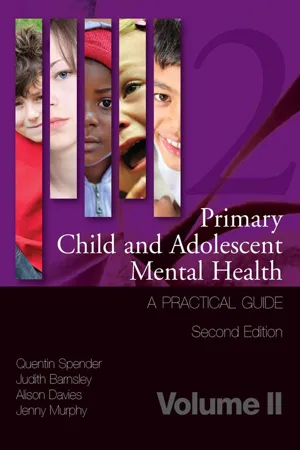
Primary Child and Adolescent Mental Health
A Practical Guide,Volume 2
- 222 pages
- English
- ePUB (mobile friendly)
- Available on iOS & Android
eBook - ePub
Primary Child and Adolescent Mental Health
A Practical Guide,Volume 2
About this book
Rewritten with the new primary care environment in mind, this greatly expanded and updated edition of Child Mental Health in Primary Care extends the structured approach of the first edition to adoelscent mental health. As in the first edition, Primary Child and Adolescent Mental Health covers each problem in a uniform way, offering definitions, assessment outlines, detailed management options and indications for referral. Numerous case examples further illuminate aspects of many conditions. Comprehensive and practical, the forty-eight chapters of Primary Child and Adolescent Mental Health cover the full range of difficulties and disabilities affecting the mental health of children and young people. The book is divided into three volumes, and can either be read from cover to cover or used as a resource to be consulted for guidance on specific problems. This book is vital for all healthcare professionals including general practitioners, health visitors and other staff working in primary care to assess, manage and refer children and adolescents with mental health problems. School medical officers, social workers and educational psychologists, many of whom are in the front line of mental health provision for children and young people, will also find it extremely useful. Reviews of the first edition: 'This very comprehensive and detailed book provides the tools for primary care health professionals not only to assess a child's needs but in many cases also to implement an initial package of care.' JUST FOR NURSES 'I have no reservation in recommending the book to all people working with children and families in any capacity. An important training text for a variety of professions. A very effective text to be used in daily practice for quick reference.' CHILD AND ADOLESCENT MENTAL HEALTH 'This book is well produced and clearly written. A useful book for anyone interested or involved with children.' FAMILY PRACTICE 'I looked through the book again and again but could not find anything missing.' NURSING TIMES
Information
PART 5
__________________________
Adolescence
CHAPTER 26
__________________________
Depression
INTRODUCTION
The term depression can be used to refer to a mood, symptom or disorder. Low moods are common, understandable reactions to unhappy experiences. Depressive symptoms (such as sad mood, tearfulness, loss of interest or social withdrawal) are also common in children with unhappy life experiences, but may be part of a disorder. This seldom occurs under the age of six years, is uncommon in prepubertal children, but increases dramatically with puberty, becoming commoner in girls than boys. Depressive disorder, together with deliberate self-harm and eating disorders, is one of the main reasons for the higher rate of adolescent mental health problems in girls than boys. Worldwide, depressive disorder affects 1–6% of adolescents.1 Bipolar disorder is less common than this, but there is continuing debate about when it is appropriate to make the diagnosis in young people — in other words, how to adapt the adult definition appropriately (see below).
The importance of adolescent depression is that:

The last point may be even more of an issue in boys than girls, since depression may masquerade as bad behaviour, irritability or substance misuse, concealing the underlying sadness and hopelessness. Adolescent depression is particularly likely to occur in a young person with a parent who has had unipolar depression or bipolar disorder.
The depressive syndrome
The syndrome of depression is a pervasive mood disorder, associated with significant suffering or impairment of functioning. In adolescents, the presentation is usually atypical (meaning that it is different from how adults present). For instance, there may be hyper-somnolence (feeling sleepy throughout the day and night) rather than difficulty sleeping: adolescents have an increased sleep requirement in any case, associated with the growth spurt. Early morning wakening is uncommon, and initial insomnia can occur with or without depression, but middle insomnia is characteristic: waking several times during the night with difficulty getting back to sleep.
BOX 26.1 Case Example
A 16-year-old girl presents to specialist CAMHS with excessive daytime sleepiness. She appears to be sleeping adequately at night, and does not seem to have other features of depression, although she is not getting to school for more than half a day at a time, and is hardly seeing any friends — both apparently because of her need to sleep. The recently appointed child psychiatrist is puzzled by this presentation, so refers her to a neurologist for further assessment.
The neurologist suggests she is depressed, and she subsequently responds to a trial of fluoxetine.
Parents and professionals are often fooled by superficial jolliness, or bouts of low mood (rather than continuous low mood), so may find it difficult to distinguish a mood disorder from ordinary moodiness. Irritability may be attributed by parents to hormones or ‘attitude’ or oppositional behaviour rather than a disturbance of mood. A young person will often conceal from her parents not only how low she feels but also her thoughts about wanting to die.
BOX 26.2 Case Example
Rohini is 14 years old when she gradually becomes more irritable with her parents, stops getting top grades at school, and falls out with both her best friends. Her general practitioner refers her to specialist CAMHS without a suggested diagnosis, and the referral is triaged to the primary mental health worker.
Initial assessment reveals marked irritability and some sleep disturbance. Rohini appears to be in a good mood for most of the interview, even when seen on her own. She says she is happy some of the time and unhappy some of the time; and denies any suicidal thoughts. She is offered some individual therapy, which she agrees to take up, although it cannot begin immediately.
Before the date for Rohini’s first individual session has arrived, she is admitted to the paediatric ward following an overdose of 15 paracetomol tablets. During the assessment the morning after, she admits to very low moods and associated frequent suicidal thoughts during the last three months: she did not admit this in the first interview, as she thought her parents would be told, and she did not want to worry them. She admits to being very good at pretending to be jolly, even when she feels quite desperate inside.
Adolescent depression may present predominantly as anxiety, which overlaps with depression in 30–75% of cases (see Chapter 20 on Anxiety Worry Fears and Phobias).3 Bodily complaints are also common, including not only tiredness/ low energy but also musculoskeletal pains4 and headaches (mainly in girls)5 (see Chapter 41 on Physical Presentations of Emotional Distress).
BOX 26.3 Case Example
Imogen is 15 years old when her headaches start to severely disrupt her GCSE work. Her general practitioner refers her to a paediatrician, who thinks the headaches are more likely to be stress-related rather than migraines. Under pressure from Imogen’s well-read parents, the paediatrician performs an MRI scan of Imogen’s brain, which is normal. They continue to pressurise her to do something about the headaches, so she asks her child psychiatry consultant colleague for advice. The child psychiatrist, who has worked with the paediatrician for some years, initially suggests some anxiety management techniques, but the paediatrician says she is unlikely to persuade either Imogen...
Table of contents
- Cover Page
- Half Title
- Title Page
- Copyright Page
- Contents
- Preface to the second edition
- About the authors
- Acknowledgements
- Part 3: Preschool
- Part 4: Middle childhood
- Part 5: Adolescence
- Index
Trusted by 375,005 students
Access to over 1.5 million titles for a fair monthly price.
Study more efficiently using our study tools.
Frequently asked questions
Yes, you can cancel anytime from the Subscription tab in your account settings on the Perlego website. Your subscription will stay active until the end of your current billing period. Learn how to cancel your subscription
No, books cannot be downloaded as external files, such as PDFs, for use outside of Perlego. However, you can download books within the Perlego app for offline reading on mobile or tablet. Learn how to download books offline
Perlego offers two plans: Essential and Complete
- Essential is ideal for learners and professionals who enjoy exploring a wide range of subjects. Access the Essential Library with 800,000+ trusted titles and best-sellers across business, personal growth, and the humanities. Includes unlimited reading time and Standard Read Aloud voice.
- Complete: Perfect for advanced learners and researchers needing full, unrestricted access. Unlock 1.5M+ books across hundreds of subjects, including academic and specialized titles. The Complete Plan also includes advanced features like Premium Read Aloud and Research Assistant.
We are an online textbook subscription service, where you can get access to an entire online library for less than the price of a single book per month. With over 1.5 million books across 990+ topics, we’ve got you covered! Learn about our mission
Look out for the read-aloud symbol on your next book to see if you can listen to it. The read-aloud tool reads text aloud for you, highlighting the text as it is being read. You can pause it, speed it up and slow it down. Learn more about Read Aloud
Yes! You can use the Perlego app on both iOS and Android devices to read anytime, anywhere — even offline. Perfect for commutes or when you’re on the go.
Please note we cannot support devices running on iOS 13 and Android 7 or earlier. Learn more about using the app
Please note we cannot support devices running on iOS 13 and Android 7 or earlier. Learn more about using the app
Yes, you can access Primary Child and Adolescent Mental Health by Quentin Spender,Judith Barnsley,Alison Davies,Jenny Murphy in PDF and/or ePUB format, as well as other popular books in Medicine & Medical Theory, Practice & Reference. We have over 1.5 million books available in our catalogue for you to explore.