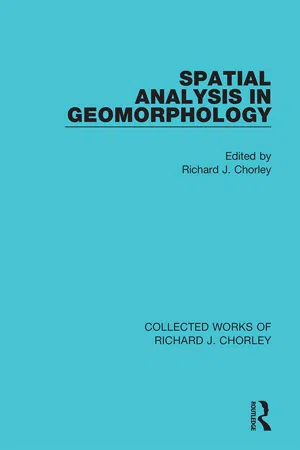
Originally published in 1972. This book covers from 'linear' statistical methods, regression and variance analysis to multivariate methods to wider spatial analytic techniques, in which a clear association is maintained between quantitative data and the spatial coordinates which locate them. The purpose of this volume is to highlight this coherent area of scholarship under the general headings of spatial point systems, networks, continuous distributions, partitioning and simulation. Seventeen authors from Britain and the United States have been brought together to produce a book whose attention is on the body of spatial techniques necessary to enable the building of dynamic spatial models of landforms which formed the keystone of much geomorphic work in future years.
- 400 pages
- English
- ePUB (mobile friendly)
- Available on iOS & Android
eBook - ePub
Spatial Analysis in Geomorphology
PART I
General
1 Spatial analysis in geomorphology
RICHARD J. CHORLEY
Department of Geography, University of Cambridge
For many geomorphologists the year 1971 marks the coming-of-age of the application of modern statistical techniques to their science. The first decade following Strahler’s (1950) pioneer use of simple statistical techniques in a genuine attack on the classic problem of slope development was characterised by the introduction into geomorphology of the whole range of ‘linear’ (as distinct from spatial) statistical techniques and especially of regression and variance analyses (Chorley 1966). Towards the end of the 1950’s more complicated types of multiple regression methods began to be used, first by means of laborious manual calculation (Melton 1957, 1958A and 1958B) and soon afterwards by the use of the early second generation of electronic computers (Krumbein 1959). At the beginning of the 1960’s, at least from the technological standpoint, geomorphology seemed to be well placed for the application of quantitative techniques to its traditional problems and, particularly, for the employment of spatial analysis in the study of landforms and their associated processes. The term spatial analysis is used in this context to include the assemblage of analytical techniques and models in which a clear association is maintained between quantitative data and the spatial co-ordinates which locate them.
Geomorphology was at that time heir to two quite distinct quantitative dynasties. The first was that concerned with the application of quantitative techniques to geology which had been pioneered by W. C. Krumbein since the middle 1930’s and which had proliferated in the 1950’s (Miller and Kahn 1962; Krumbein and Graybill 1965), particularly in terms of the spatial analysis of point data by trend-surface analysis (Chorley and Haggett 1965). The second scholarly family with which geomorphology had been traditionally associated, particularly in Europe, was human geography. By 1960 this discipline, building on the pioneer work of Hagerstrand (1953), Garrison (1955), Shaefer (1953) and others, was undergoing a rapid quantitative revolution which began to accelerate about 1958 at such a pace that at least one scholar believed it to have achieved its ends only five years later (Burton 1963). This revolution was, above all, characterised by the analysis of spatial relations between geographic phenomena and by the construction and testing of locational models of human activity (Haggett 1965). Added to these two inheritances was the increasing availability of ever more powerful electronic computers, and it appears in retrospect that in the early 1960’s geomorphology potentially stood at the beginning of a decade which would be characterised by the rapid adoption of computer-based quantitative techniques, the development of the use of models (particularly the versatile general linear model), the increasing use of probabilistic models and, especially, by the adaptation and construction of spatial geomorphic models. Ten years later we are only just beginning to see the accelerated application of these lines of attack on geomorphic problems and one might legitimately ask what has retarded these developments.
Krumbein (1969) has recently analysed the application of computer-based techniques in geology and even his incomplete information on geomorphic publications shows that, except perhaps surprisingly in the field of trend-surface analysis, the timing of initial use of these techniques by geomorphologists has been about average for the seven major geological disciplines examined. Indeed multiple regression techniques were applied in geomorphology by Melton in 1957 (and later by Krumbein (1959), Wong (1963), Chorley (1964B) and Harrison and Krumbein (1964)), sequential multiple regression by Krumbein, Benson and Hempkins in 1964, polynomial trend-surface analysis by Chorley in 1964, harmonic and variance spectra analysis to stream channel patterns by Mackay in 1963 (followed by Speight 1965), spectral analysis to the microstructure of the bottom of a Texas lake by Horton, Hoffman and Hempkins in 1962, harmonic analysis to large-scale terrain by Piexoto, Saltzman and Telwes in 1964, factor analysis to terrain classification by Aschenbrenner et al. in 1963 and by Simons et. al. in 1964 (contemporaneously with the general applications in geology by Imbrie in 1963), Markov-type analysis to stream channels by Leopold and Langbein in 1962, and spatial simulation to stream networks by the latter authors and by Schenck in 1963. The initial infusion of spatial techniques into geomorphology from geography was more limited, but nevertheless present. Cassetti applied discriminant analysis in 1964, McConnell principal components analysis to slope measurements in 1964, and the same author employed quadrat counts to treat geomorphic point data in a number of mimeographed papers at about this date.
What emerges from this cursory examination is that before the middle of the 1960s most of the array of quantitative techniques available to the environmental and social sciences had been applied to geomorphic problems by individual innovators in the science. However, when one examines the general adoption of such techniques by geomorphologists one is forced to the opinion that, by contemporary standards of change, it has been very slow. Melton’s pioneer use of correlation structures (1958B) was not substantially followed up until the work of Kennedy (1965) and of Towler (1969); the work of Chorley in 1969 represented at that time one of the few published applications of sequential multiple regression to geomorphology; space-filling models, which were innovations in geography in the 1930’s and which formed much of the basis for the development of locational analysis, were not directly applied to terrain analysis until the work of McConnell in 1965 and, particularly, that of Woldenberg in a stream of publications after 1966 (Haggett and Chorley 1969, 314–18); and ideas of systems analysis, pioneered by Strahler in 1950, and more directly applied by Chorley in 1962 and by Leopold and Langbein in the same year, have yet to reach anything approaching their full potential (Chorley and Kennedy 1971). Listings of individual research in British geomorphology (British Geomorphological Research Group 1965, 1967 and 1969) show that in 1965 only a handful of the 304 projects seemed to lean at all heavily on statistical analysis and on the use of computers, whereas in 1967 22 of the 358 workers specifically referred to these techniques, and this figure had grown to 45 out of 335 by 1969.
Not only has the diffusion of quantitative techniques in geomorphology been slow but geomorphologists have not been particularly successful in applying spatial techniques to their science – despite their obvious place in model building of terrain and geomorphic processes, and despite the scholarly links between geomorphology and socioeconomic geography. For example, a review article by Zakrzewska in 1967 lists many geomorphic articles with a spatial flavour but few which apply rigorous spatial techniques of analysis and King’s (1969) treatment of spatial forms and their relation to geographic theory assembles little evidence of quantitative spatial analysis in geomorphology, in contrast with the flood of work in human geography. A recent survey by Tarrant (1971) of the availability since 1967 of computer programmes in the environmental sciences (including geography) mainly in the United States and United Kingdom has shown that, of the 87 programmes (including duplicates) seeming to have been applied directly or indirectly to geomorphical-type problems, almost a third of these had to do with the analysis of sedimentary parameters (15) and some form of trend-surface analysis (13). Of the total geomorphic programmes about half (44) can be said to have specific spatial concern, but two-thirds of them are concentrated on a narrow body of techniques previously pioneered in geophysics, geology and cartography – namely, trend-surface analysis (polynomial; spectral; Fourier; etc.) 13, regional taxonomy (factor analysis; cluster analysis; discriminant analysis etc.) 8, and automated cartography (interpolation of contours and elevations; contour drawing; etc.) 8. The remaining 15 were concerned with spatial simulation (hydrological networks; streams; spits; etc.) 5, analysis of azimuths (especially of slop...
Table of contents
- Cover
- Half Title
- Title Page
- Copyright Page
- Original Title Page
- Original Copyright Page
- Contents
- Prefatory Note
- PART I General
- PART II Point Systems
- PART III Networks
- PART IV Continuous Distributions
- PART V Space Partitioning
- PART VI Simulation
- The British Geomorphological Research Group
- Index
Trusted by 375,005 students
Access to over 1.5 million titles for a fair monthly price.
Study more efficiently using our study tools.
Frequently asked questions
Yes, you can cancel anytime from the Subscription tab in your account settings on the Perlego website. Your subscription will stay active until the end of your current billing period. Learn how to cancel your subscription
No, books cannot be downloaded as external files, such as PDFs, for use outside of Perlego. However, you can download books within the Perlego app for offline reading on mobile or tablet. Learn how to download books offline
Perlego offers two plans: Essential and Complete
- Essential is ideal for learners and professionals who enjoy exploring a wide range of subjects. Access the Essential Library with 800,000+ trusted titles and best-sellers across business, personal growth, and the humanities. Includes unlimited reading time and Standard Read Aloud voice.
- Complete: Perfect for advanced learners and researchers needing full, unrestricted access. Unlock 1.5M+ books across hundreds of subjects, including academic and specialized titles. The Complete Plan also includes advanced features like Premium Read Aloud and Research Assistant.
We are an online textbook subscription service, where you can get access to an entire online library for less than the price of a single book per month. With over 1.5 million books across 990+ topics, we’ve got you covered! Learn about our mission
Look out for the read-aloud symbol on your next book to see if you can listen to it. The read-aloud tool reads text aloud for you, highlighting the text as it is being read. You can pause it, speed it up and slow it down. Learn more about Read Aloud
Yes! You can use the Perlego app on both iOS and Android devices to read anytime, anywhere — even offline. Perfect for commutes or when you’re on the go.
Please note we cannot support devices running on iOS 13 and Android 7 or earlier. Learn more about using the app
Please note we cannot support devices running on iOS 13 and Android 7 or earlier. Learn more about using the app
Yes, you can access Spatial Analysis in Geomorphology by Richard J. Chorley in PDF and/or ePUB format, as well as other popular books in Physical Sciences & Geography. We have over 1.5 million books available in our catalogue for you to explore.