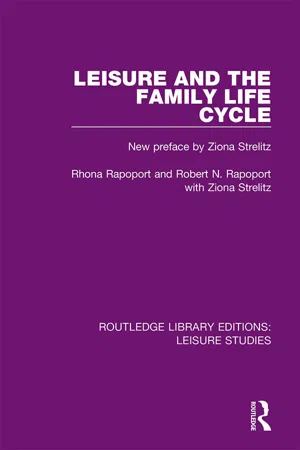
This volume, first published in 1975 with a new introduction by Ziona Strelitz, marked a pioneering contribution to family and leisure studies. The study includes empirical material collected in the form of biographical case studies. The case studies are not only rich in detail and well presented, but they provide a meaning of leisure within the pattern of life of the individuals studied. This book will be of great interest to students of leisure and family studies.
- 396 pages
- English
- ePUB (mobile friendly)
- Available on iOS & Android
eBook - ePub
Leisure and the Family Life Cycle
About this book
Information
1
Beyond palpable mass demand
People usually have some ‘freedom’ to organise their lives. But a distinctive feature of modern society is the emphasis placed on freedom of choice as a social value. Economic and political advances are, accordingly, evaluated in terms of their power to make these choices available.
Changes in key variables: work and home
There has been an overall increase in time available to spend as one chooses and in the economic, technological and organisational wherewithal to make use of it. The working week has dropped from an estimated 70-hour, six-day week in 1850 to the present norm of a 40-hour, five-day week with strong movements in the direction of a 35-hour, four-day and other variants of a shorter working week.
Riva Poor, the ‘apostle of the four-day week’, has found strong support for the idea among managers in the USA who find it economically viable as well as humanistic (Poor, 1972). In Britain the idea has been resisted both by managers and unions. The recent ‘natural experiment’ of the energy crisis showed that for many industries 80 per cent of productivity could be sustained with the three-day week. It is too soon to say whether the experience will have produced any lasting adherents to the idea that a four-fifths week might be both feasible and desirable.
Not only has the ‘normal’ working day now been formally reduced but many preparatory and peripheral activities associated with work and previously considered part of the workers’ ‘own time’ are now reckoned into wage agreements. The journey to work, washing-up time, lunch time, rest time, and so on, are legitimate parts of the paid work day for many salaried workers. This means that ‘own time’ is less taken up with occupation-related activities except where undertaken by choice.
The reality as well as the idea of a paid holiday as a right rather than a privilege has been established. Nearly everyone in the peak earning years takes at least one holiday a year unless they are very poor or disabled. The few who are neither poor nor disabled and yet do not take a holiday seem to do so as a matter of personal choice. A saturation point seems to have been reached by the early 1960s; since that time there has been a growth in ‘second holidays’. In 1971 nearly 15 per cent of the population took two holidays or more; the proportion rose to 19 per cent in 1972 and 20 per cent in 1973. These holidays mainly involve the use of the motor car but when many off-season air-package holidays became less expensive than domestic holidays, they attracted an increasing part of the holiday market. By 1972 15 per cent took a holiday abroad as compared with 10 per cent in 1970. The proportion has since fallen slightly because of ‘uncertain economics and foreign exchange situations’ (BTA, 1973). The short holiday—i.e. less than four nights away—has increased even more markedly, though increased fuel prices and general economic problems may also slow down this trend in the short term.
There is a growth in second home ownership (Downing and Dower, 1973). The recent catapulting of prices for properties in rural and coastal areas indicates the trend. These areas are now much more accessible to metropolis-dwellers because of motorway networks. There are also signs that more and more of the metropolitan population who can afford to do so will spend increasing parts of their weeks, months and years in their secondary residences. Like hobbies, these residences serve many people as bases to which they may shift their centres of life interest as they grow older. Second homes are advertised and bought as pre-retirement homes. To those in the top percentiles of the population, economically, the second home away represents a happy combination of financial investment and social-psychological preparation for the retirement eventually to come. Where the second homes are abroad, the intercultural experience provides a range of stimulating interests—language and literature, art, food and the informal study of national character.
The age of retirement has receded from the traditional three score years and ten in the early part of the century to 65, and now there is a tendency towards 60 or even earlier. Male life expectancy has increased from 59 years for those born in 1931 to 68 years for those born in 1955 (Sillitoe, 1971). Because these changes are consequences of improved technology, they have been accompanied by increased rather than decreased levels of disposable income.
The top countries with per capita GNP of over 5,000 dollars per annum are the USA, Japan, the Scandinavian countries, France, Germany and Canada. The second level with per capita GNP of 2,000–5,000 dollars includes Great Britain, Switzerland, Benelux, Finland, Italy and the USSR. Although their per capita GNP is less than the first group, these all have a high level of economic development and consumer goods (Kahn, 1972). Even in Great Britain, however, there was an increase of 113 per cent in personal weekly earnings between 1956 and 1969. During the same period, prices increased 57 per cent, making for over 50 per cent in real income. By 1971 the estimated ‘leisure £—’amount available to spend beyond the basic costs of living—was estimated to total £7,000 million in Britain. Morrell, in a market projection to 1980, estimated that by the end of this decade the amount would be £16,000 million (Sandles, 1973). (The trend may have been arrested by recent economic vicissitudes, but we cannot assess their ultimate effect.) This increase in cash available for spending on inessentials was not achieved by lengthening hours of work, though there is a sizeable minority who still work long hours because of overtime, ‘moonlighting’ and the like. It is also a feature of contemporary society that the ‘leisure class’—in the sense of time at their disposal—is no longer the élite. The latter, now comprising the professional/managerial superstructures of the occupational system, work longer hours with more like mid-Victorian norms than like their contemporaries in lower-status jobs. But this has largely been a matter of choice. The greater flexibility with work hours and greater perquisites of their jobs as well as intrinsic interest partly compensate for the more arduous pace they accept. Differences in income levels have decreased rather than increased during this period; bricklayers can make as much as, or more than, university lecturers. Both pay and time differentials between the majority of white-collar and manual workers have decreased with increasing professionalisation of work. The more meaningful distinction now seems to be between salaried and unsalaried workers: the former seek to maximise their options by achieving organisational supports, and the latter by maintaining their autonomy, even though with less financial or other advantages than previously.
The same technology that has made for greater productivity and income despite shorter working periods has also affected qualitative aspects of life. The explosion of consumer goods is an obvious aspect of this. Many inventions which were developed for utilitarian or even military purposes have become instruments of enjoyment—for example, the radio, the motorcar, the aeroplane. The miniaturisation of machines developed in the industrial context has been applied on a massive scale to the domestic scene. As machinery facilitates housework, people have more time for other purposes. This change is illustrated in Quentin Bell’s description of Virginia Woolf’s life in her country home (1972, 55-6):
To get there at all she had to walk or to bicycle for several miles or to go to the expense of a taxi or a fly. To make a light she had candles which dropped grease on the carpet, or lamps which smoked and had to be refilled with oil and trimmed every morning; heat was supplied by wood or coal … the coal had to be carried about in scuttles, grates had to be cleaned, fires laid, and if they were not competently managed they would fill the room with smoke or die miserably. In the country you got hot water by boiling it over a stove. Cold water had to be pumped up into a tank every day and Asham was furnished only with an earth closet. There were no refrigerators or frozen foods, a tin-opener was a kind of heavy dagger with which you attacked the tin hoping to win a jagged victory. All the processes of cooking and cleaning were incredibly laborious, messy and slow. [Now in contrast] ... in the evening you can make a light with which to read ... by pressing a switch. The room is warmed by central heating, you turn a tap and hot water pours into your bath or into your sink, you pull a plug and cold water gushes into your lavatory. You may do your own cooking and your own housework, but you are probably assisted by dozens of mechanical devices, tins, and tin-openers, frozen foods, refrigerators and plastic containers. Heaven knows how many thousand horses give their power every day at the touch of your fingers. No very serious effort is demanded of you when ovens have to be heated, foods ground and mixed, floors swept, rooms lighted and fires made.
Apart from less time having to be spent on the basics of living, the hours ‘set free from work’, as Phelps Brown and Browne (1969) put it, are often applied to domestic ‘do-it-yourself’ tasks which may ‘add something to the unmeasured amenities of households and to the goodness of life’. This movement, so prominent in British and American cultures, is now also gaining momentum in Europe.
The ‘leisure explosion’
The increased basic wealth and heightened freedom of choice arising from the social changes described are also reflected in an increasing number of activities not directly related to work or home life (hence having an aura of the ‘optional’). It is this area of activity people have in mind when they speak of the ‘leisure explosion’, though what this encompasses is neither entirely coherent nor consistent. The issue is more than definitional. Conceptually it is important not to reify the ‘leisure explosion’, but to see it simply as an array of linked variables in a more embracing societal change.
In 1950 there were 2¼ million private cars on the road in Britain; in 1960 the figure rose to 5½ million and in 1970 to 12 million. It is estimated that despite a levelling off, the total by 2000 will be 28 million. Car use, when expanding so explosively within the fabric of associated cultural and institutional contexts, interferes with as well as facilitates freedom of options. Recently attention has been called to the low levels of personal mobility enjoyed by some—particularly the young, the poor and the old (Hillman et al., 1973). The latest figures available underline this: 19·5 million people in England and Wales did not have the use of a car in 1971 (Hillman, 1974). Decentralisation of workplaces, greater flexibility of working hours, increased controls on vehicle circulation, new inventions of more ‘socialised’ vehicle systems, etc., will doubtless take form under the impact of this contemporary concern (Hillman et al., 1973; Patmore, 1970).
But the immediate effect on the increase in ‘freedom of choice’ is one of shock. Demand overwhelms supply; over-use creates at best the danger of a self-defeating glut—in roads, parks, beauty spots, trails, sports facilities, etc. The alarm has been sounded by visionary observers, like Michael Dower, who wrote in 1965 (5):
Three great waves have broken across the face of Britain since 1800. First, the sudden growth of dark industrial towns. Second, the thrusting movement along far-flung railways. Third, the sprawl of car-based suburbs. Now, we see, under the guise of a modest word, the surge of a fourth wave which could be more powerful than all the others. The modest word is leisure.
A town planner, Dower sees leisure in almost physical terms—compounded of increased population with higher income, greater mobility, more education, retirement and ‘free time’ generally. This amalgam of forces is seen to drive people by every conceivable means of locomotion in a quest for amenities—in and around the towns, in the country, in the mountain-tops and by the seashore and abroad. Dower estimates that the amalgam of leisure forces is such at present and into the immediate future that its thrust will exceed that of population growth by a factor of at least two to one in Britain. His image of congestion and devastation of the precious natural resources that unplanned absorption of this thrust will create is powerful and persuasive. On the cover of his report to the Civic Trust is a holiday beach crowd jammed together like the proverbial sardines (though less neatly) and inside is the observation that: ‘If everyone in England and Wales went to the seaside at the same time, each would get a strip of coast three-and-a-half inches across.’
This dramatisation of the situation is highly effective but Dower is no ‘doomwatcher’. He suggested various solutions for the different scales at which problems confront the country—urban, rural, regional, national. His suggestions draw on world experience, and proceed by practical steps. The formula is to search for and make an inventory of the resources available to the nation, region or local area (land, water, general topography, technology and finance) and to create plans using scientifically based guidelines and standards for capacity and usage, and then to implement them. Dower sees the job as one that must be tackled on a large scale, but at the same time requires deep local involvement. The co-operation of public, voluntary and commercial bodies is also called for to an extent not previously envisioned. ‘This thing leisure’, he states, ‘requires powerful authorities with big resources and clear-cut channels of responsibility ... the highest standard of co-ordination and expertise’ (Dower, 1965, 188).
We shall return to responses to the ‘leisure explosion’ of public and private, national and local ‘providers’, in a later chapter. It is relevant here to note that the ‘leisure explosion’ confronts people generally with a number of issues—the main contours of which constitute the focus of the present work. The explosion of free time, of disposable income, and of available consumer goods has been accompanied by an escalation of ‘wants’. Increased levels of education for ever-broadening sectors of the population have led to increased interest in all sorts of pursuits that can be followed with the resources increasingly available. Travel, literature, music, art, gastronomic delights and so on are in demand by ever-broadening waves of the population. Time and money, the two powerful elements which have in the past separated élites from masses most sharply, have now been made more broadly available, increasing access to valued resources of the world. The joys (and dangers) of jet travel are now available not only to film stars, tycoons and the wealthy leisured classes, but to school-teachers, bricklayers, shopkeepers and farmers. Festivals of the arts, treasures of exotic lands and ancient times, riding, golf and sailing—the sporting life—are now available to more people—and wanted by still more—than ever before. Of course, not everyone has shared in this relative ease of access. It is to be hoped that the new focus of concern with ‘the cycle of deprivation’ will generate some redress to seemingly intractable imbalances.
And yet, there are two nagging foci of concern: one that plagues the providers (or should plague them, as servants of the people) and the other that plagues everyman, more rather than less as his level of consciousness and his wants and desires escalate. The first is whether the meeting of palpable mass demand in the most direct and obvious way (i.e. adding more of the same to what has been delivered and found to be popular) is the best that can be done; and second, the concern of everyman, of how to use the available time, money and resources to create a meaningful whole life.
Palpable mass demand: the providers’ vista
Every society and culture has an inventory of artefacts and social institutions that satisfies something in popular demand. Monuments, arenas, stadia, parks and open spaces, entertainment places—songs, dances, pageants, rituals, sport—all can be seen to exist as foci of popular interest and activity. Much of any period’s ‘leisure’ resources is subject to readaptation as society changes. Boulevards and avenues laid out for military purposes, or to glorify the name of an autocrat, become people’s promenades. Private mansions, abbeys and castles become museums, and games formerly enjoyed only by the aristocracy become folk sport. As with symbols and meanings, so with leisure facilities and activities: one may alter while the other holds constant, or both may change. Hence, we have physical artefacts which persist, while the activities they generate change; activities which persist while new or improved facilities are called for; and both activities and facilities evolving together.
A distinctive characteristic of the present is the explosive increase both in what is wanted and in the means to get it. Looking down on earth from a detached height might reveal a population agitated by a strange driving force to move about, to proceed by air, rail, road, cycle or foot to many points of interest away from routine places of work and residence. Making use of available places, things or events gives rise to secondary demands: for access routes, parking places, toilets, catering facilities, information and safety devices. If not properly attended to, these secondary requirements may not only create a residue of frustrated demand, but of disastrous consequences. An example is the disaster of Altamont, California, where masses of people came together for a pop festival without adequate controls on the mob psychology (fuelled by drugs and the juxtaposition of such incendiary elements as Hell’s Angels and hippies).
This dramatic illustration is an extreme case of a wider problem, the self-defeating character of the explosion of palpable mass demand. Cars flooding out of metropolitan concentrations on weekends and at holidays make the search for calm and non-polluted environments elusive. People swarming through exh...
Table of contents
- Cover
- Half Title
- Title Page
- Copyright Page
- Revisiting Leisure and the Family Life Cycle
- Original Title Page
- Original Copyright Page
- Contents
- Figures and Tables
- Acknowledgments
- 1 Beyond palpable mass demand
- 2 Young people and leisure: identity crystallisation
- 3 Young adults: identification with social institutions
- 4 The establishment phase: life investments
- 5 Life styles for later years: personal and social integration
- 6 Leisure provision: specialist providers cannot do it all
- 7 Leisure: the individual, the family and society
- Bibliography
- Index
Trusted by 375,005 students
Access to over 1.5 million titles for a fair monthly price.
Study more efficiently using our study tools.
Frequently asked questions
Yes, you can cancel anytime from the Subscription tab in your account settings on the Perlego website. Your subscription will stay active until the end of your current billing period. Learn how to cancel your subscription
No, books cannot be downloaded as external files, such as PDFs, for use outside of Perlego. However, you can download books within the Perlego app for offline reading on mobile or tablet. Learn how to download books offline
Perlego offers two plans: Essential and Complete
- Essential is ideal for learners and professionals who enjoy exploring a wide range of subjects. Access the Essential Library with 800,000+ trusted titles and best-sellers across business, personal growth, and the humanities. Includes unlimited reading time and Standard Read Aloud voice.
- Complete: Perfect for advanced learners and researchers needing full, unrestricted access. Unlock 1.5M+ books across hundreds of subjects, including academic and specialized titles. The Complete Plan also includes advanced features like Premium Read Aloud and Research Assistant.
We are an online textbook subscription service, where you can get access to an entire online library for less than the price of a single book per month. With over 1.5 million books across 990+ topics, we’ve got you covered! Learn about our mission
Look out for the read-aloud symbol on your next book to see if you can listen to it. The read-aloud tool reads text aloud for you, highlighting the text as it is being read. You can pause it, speed it up and slow it down. Learn more about Read Aloud
Yes! You can use the Perlego app on both iOS and Android devices to read anytime, anywhere — even offline. Perfect for commutes or when you’re on the go.
Please note we cannot support devices running on iOS 13 and Android 7 or earlier. Learn more about using the app
Please note we cannot support devices running on iOS 13 and Android 7 or earlier. Learn more about using the app
Yes, you can access Leisure and the Family Life Cycle by Rhona Rapoport,Robert N. Rapoport in PDF and/or ePUB format, as well as other popular books in Social Sciences & Sociology. We have over 1.5 million books available in our catalogue for you to explore.