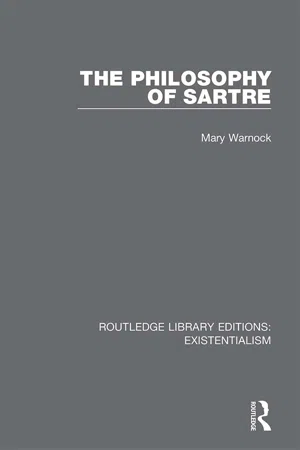
This book, first published in 1965, is a critical exposition of the philosophical doctrines of Jean-Paul Sartre. His contribution to ethical and political theory, and to metaphysics and ontology, is reviewed against the background of German idealism and phenomenology, and his arguments are presented clearly so that readers may assess their philosophical value in their own right.
- 184 pages
- English
- ePUB (mobile friendly)
- Available on iOS & Android
eBook - ePub
The Philosophy of Sartre
About this book
Information
1
Cartesianism
(1) ‘Cogito ergo sum’
Sartre, like all French philosophers, treats Descartes as the father of the subject, and ‘Cogito ergo sum’, Descartes’ supposedly indubitable foundation for his whole system, as somehow containing the germ of all truth within itself. He is not wrong to think of Cartesianism as fruitful in a quite peculiar way; but this very fruitfulness means that we, as students of Sartre, need not worry very much about what Descartes himself meant, or even what he said. His words have been interpreted in many different ways, and it will be enough for us to see what Sartre made of them. For from the seminal ideas which he found in Descartes, Sartre may be said to have developed the two main thoughts which dominate his whole philosophical development, at least up to his latest book. Up to the time of the revolutionary Critique of Dialectical Reason his philosophy rests on the twin pillars of human freedom and human powers of self-analysis. These are the main themes of Being and Nothingness, and even his political ideas may be seen in some sense to derive from these.
‘Cogito ergo sum’ is a statement of immediate self-awareness. Sartre elaborates this self-awareness in two different ways. In the first place, part of what is denoted by ‘cogitatio’ is the will. Descartes supposes us to have an immediate apprehension of our own will; that is, of our power to choose and to decide. An immediate awareness of our own freedom is thus taken to be a part of the indubitable foundation for all thought and all action. Secondly, ‘cogitatio’ means thinking about things. We are immediately aware of ideas in our minds, and these ideas are somehow related to the outside world. So, by inspecting our own consciousness, we can learn what can and cannot be known, and in what manner whatever we know is known. And since all we know is, according to Descartes, our ideas, and since these are in our consciousness, we know, at the same time as we know our ideas, something about that consciousness in which they are. We know our own minds better than anything else. This second interpretation of the ‘cogito’ led Sartre to phenomenology, and the reflective concentration on what consciousness is actually like.
(2) Awareness of freedom
In 1946 Sartre published an introduction to a selection of the writings of Descartes, which is an interesting example in itself of his characteristic method of criticism—personal, loaded, and full of insights. In this introduction the first interpretation of the ‘cogito’, as awareness of freedom, is expounded. Descartes, he says, was immediately aware of freedom in the act of judging. This immediate awareness is shared by any student of mathematics, who learns to take off by himself, leaving the guidance of his teacher, and who realizes that if he gives his whole mind to the matter and is not distracted he can work the problems out for himself. What he has to give to the task is ‘esprit’ or ‘mens’; everything, that is, which is not his body.
Descartes realizes better than anyone, Sartre says, the autonomy of thought. But this feature is quite different from the productiveness, or creativity, of thought, though these are its characteristics as well. In the Discourse Descartes did not concentrate on creativity. He was interested above all in mathematical learning, where there are fixed rules of procedure and, though the mind is free to go on alone, it must go on according to given rules. Descartes thought, according to Sartre, that the mind could not exercise creative freedom when occupied either with mathematical or scientific subjects, for a man cannot invent for himself the rules of mathematics or the rules of thought in general. He can be creatively free only in imaginative thinking. What kind of freedom is left for thought, then, in mathematics and science? Men may still be said to be free, Descartes says, to reject the false, to say ‘no’ to what is not the truth. This is freedom, and it secures that autonomy of thought which he intuited at the beginning.
But Sartre is not satisfied with this solution. Is this power to reject the false enough to give us the powerful and immediate awareness of freedom which we were supposed to have in the ‘cogito’? Sartre thinks that it is not, and that Descartes was guilty of confusion at this point. He has, Sartre maintains, two senses of ‘freedom’, and he switches from one to the other as it suits him. The first sense is that in which a man is aware that he is actively free—free, that is, to act, to judge, to comprehend, and to create; the second sense is that in which man is free only to avoid error, and this is the sense upon which Descartes falls back, when he is concerned merely to preserve the autonomy of thought in the face of the rigorousness of pre-existing rules. He tends to amalgamate the two senses when he talks of man’s responsibility when faced with the truth. He sometimes speaks as though, unless I make a judgment, a free act, there is no truth. But this is not really compatible with the example of a child learning to apply the rules of arithmetic, which hold whether the child can apply them or not.
Whether or not there is in Descartes this double use of the word ‘free’ as applied to thought is a question which need not concern us. But Sartre certainly believes that he can find two senses, and that both are important. Indeed, both senses turn out to be essential to his own view of human freedom. In the active or creative sense we know that we are free, and the fact that we can think what we choose is proof of it; it is further proved each time we perform any action whatever. In the other, non-creative, sense we are free to deny, if not to assert; to reject, if not to accept. And here we have come upon what, in Sartre’s own theory, is the most important characteristic of human consciousness, indeed that which uniquely marks it off from beings of all other kinds—namely, its power to deny, to conceive the opposite of what is presented to it, and to think of the present situation in terms of what is not the case. In neither of these two senses does Sartre think that human freedom can possibly be denied.
To return to the exposition of Descartes: Sartre says that Descartes is at every moment asserting his own freedom of thought in his denial of the scholastic doctrine of essences upon which he had been brought up, and which amounted to imprisonment. He is freely giving his own assent, and that of his readers, to the laws of nature, and rejecting the false constructions which he had been taught. In the fourth Meditation he argues that his will, by which he assents to the laws of nature, is the very same as God’s will, by which they were first created. What distinguishes God from man is not greater freedom but greater power. Freedom in this negative sense is limitless for men and is expressed in their rejection of false versions of natural laws and their acceptance of the true. (Rather quaintly, Sartre therefore finds in Descartes’ scientific doctrines the foundation of democracy. ‘No one realizes better than Descartes the connexion between the scientific and the democratic spirit.’ The system of universal suffrage can be founded on, and justified by, only the universal freedom to accept or reject, to say ‘yes’ or ‘no’.)
But freedom in the creative sense is not limitless, in Descartes’ view. For even in his own case, where he is freely inventing the laws of scientific discovery, the rigours of the pre-established order intervene. Thus, Sartre argues, even the freedom of invention which Descartes does ascribe to men is not satisfactory. For Descartes brings together his two kinds of freedom—the limitless freedom to deny the false and the limited freedom to invent rules—and in the amalgamation he speaks as though even the rules which we freely invent are somehow suggested to us in virtue of their being right. Thus we are totally free to accept or to reject the false: but the true and the right are, in some sense, given to us. And, Sartre says, ‘If man does not invent his own Good, if he does not construct his own science, he is only nominally free.’
Descartes ascribes total creative freedom—freedom to invent the good and the true—to God, along with His limitless power. And so Sartre says that Descartes has ascribed to God what should properly have been ascribed to man. However, Descartes should not be reproached for this; for his great contribution to the truth was to see that, whether one speaks of God or of man, freedom is the ‘sole foundation of being’, and that we must be aware of freedom in being aware that we exist. In Sartre’s own view the very freedom to accept or reject the false is itself creative. Our power to envisage what is not the case leads to our power to change what is. The one could not exist without the other. This is a characteristically Sartrean extension of the Cartesian views propounded in the introduction to the Selection. We shall have much more to say in a later chapter about Sartre’s doctrine of human freedom. But it is time, for the moment, to examine the other aspect of his broad interpretation of Descartes.
(3) Self-consciousness
Besides the concept of human freedom as something of which we are necessarily directly aware, Sartre claims to derive from Descartes a certain view of human consciousness in general. Indeed, it is to this view of consciousness that he himself is most inclined to award the honorific title of Cartesianism. Roughly, the view is that human consciousness must always be directed upon some object of which it will be aware; but that, further, in being aware of this object, it will also be aware of itself perceiving, or being aware. Sometimes the object of awareness will be something in the world, sometimes it will be the self. But in either case it will always be accompanied by an awareness of being aware. This second-order awareness is referred to by Sartre as ‘the pre-reflective cogito’.
From the proposition that consciousness always is, or can be, conscious of itself, various things follow. One, the importance of which as a recurring theme in Sartre’s philosophical psychology will emerge later, is a strong opposition to Freudianism. For if consciousness is defined as that which is aware of itself, the notion of the unconscious can have no possible place in psychology.
The second consequence, however, is our immediate concern. Given the existence of ‘the pre-reflective cogito’, it must always be possible to describe what consciousness is like, and, if there are different modes of consciousness, to describe these different modes. For since consciousness operates always at two levels at once it must, with sufficient care and patience, be possible to construct a kind of running commentary on what consciousness is doing at any particular moment. The description of different modes of our consciousness of the world plays an enormously important part in Sartre’s philosophy. Indeed, the possibility of this kind of description is the foundation of Being and Nothingness, his first major philosophical work, and his best. But before Being and Nothingness the method was pursued in some detail, first in his studies of the imagination, and then in his Sketch for a Theory of the Emotions. It is to the examination of these works that the bulk of the present chapter will be devoted.
But first the question may be raised whether this descriptive psychology, upon which the philosophy of Sartre is founded, has in fact anything to do with the Cartesian tradition. To this the short answer is that it has not. Sartre’s ‘Cartesianism’ is in fact not derived from Descartes at all, but from the German phenomenologists Brentano and Husserl—to whom, in fact, he acknowledges himself to be greatly indebted. Descartes, it is true, claimed to base his whole philosophy on his famous ‘cogito’ argument; but the uses to which he put it were very different. Having decided to trust neither his senses nor what he had learned from other people, he found that he could not doubt his own existence, whatever else he doubted; for he proved his own existence as a thinking being every time he doubted, or performed any other act of thought or- cognition whatever. The basis of his system of philosophy, therefore, was the proposition that he existed as a thinking being. But from here he went on to argue that, as a thinking being, he had ideas of things. And the question which he had most urgently to solve was the question of what clue, if any, these ideas gave him to the external world. Did they truly represent things in the external world as they were? Or were they all of them deceptive? Ideas were, for him, existent things which could be inspected, and which must be tested carefully in order to find out whether they were true representations of the world, or false and misleading. By far the greatest contribution to the subsequent history of philosophy which Descartes made was the raising of this particular question in this particular form. Indeed, it would not be a great exaggeration to say that his problem, that of the relation of our ideas to the external world, dominated philosophical thought until the end of the nineteenth century. The phenomenologists were among the first to try to escape from the Cartesian prison.
Descartes’ own solution to his problem was not nearly so important as his posing of it. Unadventurously, he answered that on the whole we can trust our ideas to be true representations of things, provided we take care to concentrate only upon clear and distinct ideas. Moreover, one of the ideas which we can quite certainly trust for its clarity and distinctness is the idea we have of a benevolent and non-deceptive God, who would not allow us to be perpetually deceived by our other ideas, and who on the whole guides us, even in our free inventions, towards the true rather than the false.
Besides these central arguments, however, in which Descartes concentrated on the separation between ideas and the objects of which they are representations in the mind, he argued, somewhat as an after-thought, that since all my knowledge comes to me through my mind, I must necessarily know my mind better than anything else—better, in particular, than my body or any other corporeal thing. Mental substance is luminous to itself as corporeal substance is not. Now this minor and highly dubious argument could perhaps be said to suggest the view of consciousness which we are considering here, for it might suggest that, at the same time as being aware of an object, I must also be aware of my mind perceiving that object. For instance, in Meditation II Descartes says: If the notion of perception of wax has seemed to me clearer and more distinct, not only after the sight and touch, but also after many other causes have rendered it quite manifest to me, with how much more evidence and distinctness must it be said that I now know myself, since all the reasons which contribute to the knowledge of wax or any other body whatever are yet better proofs of the nature of my mind. And there are so many other things in the mind itself which may contribute to the elucidation of its nature, that those which depend on body such as these just mentioned hardly merit being taken into account.’ This was certainly the point upon which Husserl and the other phenomenologists fastened in their reading of Descartes. To understand Sartre’s so-called Cartesianism it is necessary to try, very briefly, to state the main theses of phenomenology to which it is in fact so very closely related.
(4) Phenomenology
In 1874 Franz Brentano published a book called Psychology from an Empirical Point of View. This work can be said to be the beginning of descriptive psychology, although the spirit of Brentano’s enquiry was in many ways reminiscent of Hume. His central doctrine was that intentional existence is the unique and defining characteristic of the mental; in other words, that all mental or psychological activities whatever are necessarily directed upon some object. But what peculiarly marks off mental from physical activities is that while, if physical activities have objects at all, these must exist; in the case of mental activities their objects need not exist. Thus I may equally well think about a golden mountain, which is the object of my thought and which does not exist, as about my gold watch, which does. This distinction led, in the writings of Meinong and elsewhere, to great differences of opinion about the kind of existence which must be ascribed to the golden mountain if it is to be an object, even an object of thought. But we need not pursue these discussions here. Brentano’s aim was to provide a characterization of mental activities, or consciousness, which would make it intelligible to speak of describing consciousness itself, including its intentionality or direction upon an object, without necessarily being committed to describing, or even assigning existence to, the object itself. And he further believed that it was to the description of consciousness alone that philosophers ought to direct their attention.
Husserl wrote of Brentano’s descriptive psychology thus: ‘His conversion of the scholastic concept of intentionality into a descriptive root-concept of psychology constitutes a great discovery, apart from which phenomenology could not have come into being at all’ (Ideas: General introduction to pure Phenomenology, p. 23). What then exactly is phenomenology, which thus depends on the intentionality of mental acts? The best short source for an answer to this question is to be found in the article under that heading, written by Husserl himself, in the fourteenth edition of the Encyclopaedia Britannica.
Essentially, phenomenology consists in the analysis of what is available to introspection in its generality, without making use of any extraneous knowledge of causes, or of natural laws which apply to the outside world, which the practiser of phenomenology may have. The phenomenologist, according to Husserl, sets aside his normal standpoint, or performs an epoche. He puts into brackets, that is, everything which, as an ordinary plain man, he may happen to know or to assume about what causes his experience. This is what Husserl means by saying that ‘Phenomenology is a priori in the best sense of the word’. In describing his experience the phenomenologist does not get in any way involved in what he describes. He stands apart from it, and ‘performs a phenomenological reduction to the facts themselves’. That is to say, he concentrates, as far as he can, upon the pure experience as he has it, without presuppositions or concepts derived from elsewhere than the experience itself. This is the essence of the method.
But before Husserl can embark on the actual descriptions of internal experience he has one problem which he has to clear up, that of the Self. He distinguished ‘psychical’ from ‘transcendental’ selfhood. The former is an empirical concept. The self in this sense is what is studied by ordinary introspection (if, for instance, one ordinarily reflects upon one’s character or failings, one is concerned with the psychical self), by psychiatry, and even by history. The psychical self is in the world. Transcendental selfhood, on the other hand, is presupposed even in our most detailed description of ourselves in the psychical sense. It is what Wittgenstein later was to refer to as the ‘non-psychological self’, a limit, not a part of the world (Tractatus Logico-Philosophicus, 5.632).
There is, in this distinction, the difference we have already hinted at in Sartre between the ‘pre-reflective cogito’ (the transcendental self of Husserl) and the power of reflection, or reflexiv...
Table of contents
- Cover
- Half Title
- Title Page
- Copyright Page
- Original Title Page
- Original Copyright Page
- Contents
- Acknowledgment
- Preface
- 1 Cartesianism
- 2 Nothingness
- 3 Being-for-others
- 4 Being-in-the-world
- 5 Freedom
- 6 The radical conversion:
- Short Bibliography
- Index
Trusted by 375,005 students
Access to over 1.5 million titles for a fair monthly price.
Study more efficiently using our study tools.
Frequently asked questions
Yes, you can cancel anytime from the Subscription tab in your account settings on the Perlego website. Your subscription will stay active until the end of your current billing period. Learn how to cancel your subscription
No, books cannot be downloaded as external files, such as PDFs, for use outside of Perlego. However, you can download books within the Perlego app for offline reading on mobile or tablet. Learn how to download books offline
We are an online textbook subscription service, where you can get access to an entire online library for less than the price of a single book per month. With over 1.5 million books across 990+ topics, we’ve got you covered! Learn about our mission
Look out for the read-aloud symbol on your next book to see if you can listen to it. The read-aloud tool reads text aloud for you, highlighting the text as it is being read. You can pause it, speed it up and slow it down. Learn more about Read Aloud
Yes! You can use the Perlego app on both iOS and Android devices to read anytime, anywhere — even offline. Perfect for commutes or when you’re on the go.
Please note we cannot support devices running on iOS 13 and Android 7 or earlier. Learn more about using the app
Please note we cannot support devices running on iOS 13 and Android 7 or earlier. Learn more about using the app
Yes, you can access The Philosophy of Sartre by Mary Warnock in PDF and/or ePUB format, as well as other popular books in Philosophy & Philosophy History & Theory. We have over 1.5 million books available in our catalogue for you to explore.