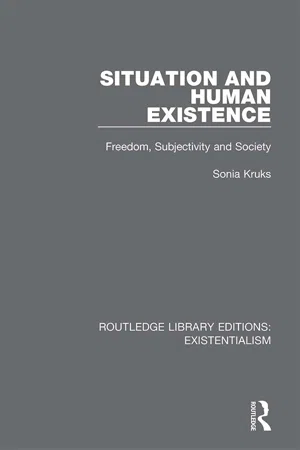
Social philosophy oscillates between two opposing ideas: that individuals fashion society, and that society fashions individuals. The concept of 'situation' was elaborated by the French existentialist thinkers to avoid this dilemma. Individuals are seen as actively situating themselves in society at the same time as being situated by it. This book, first published in 1990, traces the development of the concept of situation through the work of Gabriel Marcel, Jean-Paul Sartre, Simone de Beauvoir and Maurice Merleau-Ponty. It shows how it illuminates questions of self or subjectivity, embodiment and gender, society and history, and argues that it goes far beyond the currently fashionable notions of the 'death of the subject'.
- 232 pages
- English
- ePUB (mobile friendly)
- Available on iOS & Android
eBook - ePub
About this book
Information
Part One
Individual Situations
1
Marcel: embodiment and situation
Today, not many people read the works of Gabriel Marcel (1889-1973). Yet, as a few perceptive commentators have observed, Marcel’s thought, initially elaborated in the interwar period, is seminal in the development of existentialism and phenomenology in France. For example, writing in a now classic volume, which did much to introduce recent French philosophy to English-speaking audiences in the early 1950s, Jean Hering insisted that: ‘even if German phenomenology (to suppose the impossible) had remained unknown in France, nevertheless a phenomenology would have been constituted there; and this, to a large extent would have been due to the influence of Gabriel Marcel’.1 More recently Paul Ricoeur has observed that it was Marcel who ‘laid the foundation of what Merleau-Ponty and others later called the phenomenology of perception’.2
The reason for the general neglect of Marcel’s work is its primarily religious character. There is a long tradition of Christian philosophizing in France, much of it Catholic, within which we might attempt to locate him. But this tradition is alien both to the concerns of recent non-Catholic philosophy in France and to the mainstreams of twentieth-century Anglo-American philosophy. For those, myself included, who do not share it, the theological framework within which Marcel thinks must to some extent limit the significance of his work. This is particularly the case with his discussion of social and political life, which he tends to reduce to issues of ‘evil’ and ‘love’. But in other dimensions, the import of what Marcel has to say most definitely transcends his theological framework.
Moreover, Hering and Ricoeur are surely correct in pointing to Marcel’s influence over the atheistic postwar existentialists. For in his pursuit of ways of grasping religious experience Marcel developed a powerful critique of Cartesianism which they were to echo. He also proclaimed the need for a philosophy that would grasp ‘lived experience’ from within. He was the one who first demanded a situated or a concrete philosophy, as opposed to the kind of detached speculation which Merleau-Ponty was later to designate ‘high altitude thinking’ (pensée de survol). Both in his critique and in his call for a situated philosophy of lived experience, Marcel anticipated and influenced the work of the later generation of existentialists. If Sartre was to insist so emphatically that ‘there are two kinds of existentialists’, the Christians and the atheists,3 this point had to be made because they were two subspecies of one and the same philosophical orientation.
French existentialism is often described as a variant of German phenomenology. But in the light of Marcel’s contribution to the birth of a specifically French tradition, such a designation is clearly inadequate. For Marcel had already elaborated the broad lines of an existential phenomenology well before the 1930s. And he had done so in splendid ignorance of the work of Husserl and Heidegger (not to mention Kierkegaard and Jaspers), and with only indirect reference to Hegel.4 If, as Hering argued, Marcel had been able to initiate a distinctly French phenomenological tradition, without reference to the German schools, he did so, however, by building above all on an indigenous French tradition of philosophizing. This came to him through Henri Bergson, who was professor of philosophy at the Collège de France from 1900 to 1921.5
Bergson’s popularity before the First World War appears to have been comparable to that of Sartre after the Second World War. However, as has been pointed out, there were arguably two Bergsons – Bergson the ‘cosmologist’, originator of a spiritualist theory of evolution, and Bergson the Cartesian or ‘semi-Cartesian’ philosopher of consciousness.6 While Bergson’s contemporary fame was won by the former, it was the latter whose work bore fruit in the work of the existentialists. Arguing against positivists such as Taine and Renan, Bergson distinguished an external realm, where causality and mechanism operate, from a distinct but equally real realm of inner experience. The external realm could be comprehended through the analytical methods of mathematics, natural science and practical or instrumental reason which, together, Bergson called ‘intellect’. However, the inner realm – where causality is inoperative and where human freedom resides – was to be grasped only through ‘intuition’, a non-conceptual and immediate kind of knowledge. Knowledge of our own selves is, according to Bergson, of this intuitive kind. For we experience ourselves only through our immersion in the non-objective flow of time which he calls durée, or ‘real time’, which mathematical or physical models of time can never capture. Bergson also developed a social theory based on these distinctions. He called ‘closed’ those societies which mechanically and statically perpetuate themselves by imposing religious and moral norms on their members as external, quasi-natural, forces. These he contrasted to ‘open’ societies, in which individual moral and religious creativity freely shine forth, and in which society is engaged in a process of spiritual evolution which transcends mere survival.7
While the postwar existentialists also acknowledged a direct debt to Bergson, it was largely through Marcel that they came to him. Of the postwar existentialists, it was Merleau-Ponty who most explicitly acknowledged the influence of Marcel on his own work. In a talk given in 1959, he cited Marcel as one of the figures who had most influenced his generation in their efforts to develop, in opposition to the dominant idealism of Brunschvicg, a ‘philosophy of existence’.8 It was, Merleau-Ponty suggested, especially in Marcel’s treatment of the theme of ‘incarnation’ – the notion that ‘I am my body’ – that they found the central premise for their attack on the current orthodoxy. For, Merleau-Ponty argued, the idea of incarnation, of the centrality of my body in my existence, implied a particular manner of philosophizing, a ‘new way of thinking’. In particular, it implied that the philosopher could no longer conceive of himself as a detached ‘spectator’ of reality. Sartre too was familiar with Marcel’s work. Indeed, before he achieved notoriety as the symbol of ‘Left Bank’ existentialism, he even attended philosophical soirées which Marcel used to hold in his own home. Marcel claims that it was at his suggestion that Sartre developed his phenomenology of le visqueux (variously translated as ‘the slimy’ and ‘the viscous’) in Being and Nothingness and Nausea.9
Marcel was born in 1889 and began to study and to write philosophy in Paris in the era before the First World War, when Bergson’s influence was at its height. Marcel described his childhood as sorrowful, overshadowed by the death of his mother when he was very young. It was also, he has said, ‘a desert universe’, imbued with the ‘arid’ positivist rationalism and the ‘invincible agnosticism’ of his father and the aunt who brought him up. This in turn was compounded by the scholasticism and competitiveness of a lycée education which, he said, he endured in misery.10 It was to a philosophy of ‘inner experience’, to a somewhat mystical religiosity and also to music and the writing of drama that he turned in repudiation of this ultra rationalistic childhood experience. Thus, it would seem, his conversion to Catholicism in 1929 was a fulfilment of his earlier tendencies and presented no rupture with his prior thought or life. It was his hostility to rationalism that also prepared him to fall under the spell of Bergson, whose classes at the Sorbonne he began to attend in 1906. Of all his professors, he later wrote, Bergson was the one ‘whose thought and words took a sure and lasting hold of me’.11 It was not Bergson the evolutionist, but the philosopher of durée and opponent of abstract system, whose work Marcel absorbed and creatively reworked.
Marcel’s first major work of philosophy, the Metaphysical Journal, was written over the period 1914–1923 in an intimate diary form. It was published (with his major 1925 essay, ‘Existence and Objectivity’, as an appendix) in 1927. Marcel dedicated the volume to Bergson. Years later, in the preface he wrote to the 1950 English translation, he continued to emphasize his debt to Bergson. ‘[M]y thought’, he observed,
should appear as the prolongation of a fundamentally anti-dogmatic tradition; and if it is linked up with Bergson that is in the measure in which Bergson himself gave us the means for proceeding beyond him when in his last work he made use of the category ‘open’… Though I did not realise this in the beginning, my researches have a bearing on the conditions that permit us to maintain thought in a state of ‘openness’ in contradistinction to a systematised dogmatics closed in on itself.12
Although Bergson’s influence was great at the turn of the century, it lessened considerably after the First World War. By the 1920s and 1930s what Marcel regarded as a ‘systematised dogmatics’ was all too prevalent in French academic philosophy. There predominated a rather scholastic idealism, epitomized in the work of Brunschvicg, against which Sartre, Beauvoir and Merleau-Ponty were also to rebel. In calling for a non-systematic philosophy which attempted to ‘evoke’ what Marcel called existence – that is, our immediate experience of life, prior to the abstracting and objectifying interventions of thought – Marcel anticipated the next generation of existential philosophers, creatively transforming and handing on to them Bergson’s insistence on the reality of lived time and the priority of ‘intuition’ over ‘intellect’.
Central to Marcel’s work is the distinction summed up in the title of his 1925 essay, ‘Existence and Objectivity’. There is, he asserts, an ‘absolute priority of existence … of the existential’, which leads us ‘to the affirmation of a pure immediate, that is to say to an immediate which by its very essence is incapable of mediation’ (MJ 329). Existential philosophy must undertake the delicate and paradoxical task of trying to ‘evoke’ those unthought and unspoken experiences – of self, of love, of fear, etc. – in which we are directly immersed, yet do so without in the process destroying them by turning them into objects of contemplation. The task of philosophy is thus similar to that of poetry or drama: to express that which is unexpressed and can be only indirectly expressed. Talking of his own work, Marcel was emphatic that the unity between philosophical and dramatic work ‘describes without doubt what is most original as well as most essential in my contributions’.13 Like Marcel, Sartre and Beauvoir also moved back and forth between literary and philosophical genres and wrote (as did Merleau-Ponty) a rather literary style of philosophy. This style of existential philosophy has been the butt of criticism from ‘hard-boiled’ logical positivists and analytical philosophers. The kind of strictures Bertrand Russell passed on Bergson early in this century have been frequently echoed in criticism of his successors. ‘Of course’, Russell complained,
a large part of Bergson’s philosophy, probably the part to which most of its popularity is due, does not depend upon argument, and cannot be upset by argument. His imaginative picture of the world, regarded as poetic effort, is in the main not capable of either proof or disproof. Shakespeare says life’s but a walking shadow, Shelley says it is like a dome of many coloured glass, Bergson says it is a shell which bursts into parts that are shells again. If you like Bergson’s image better, it is just as legitimate.14
But this and other such criticisms miss the point of what Bergson, Marcel and their successors are arguing. What they seek to establish is that there are certain kinds of experience – even we might say certain kinds of truth – that are not subject to ‘proof’ of either a strictly logical or an empirically verifiable kind. The dramatic, the poetic, the metaphorical are appropriate forms of philosophic discourse because they alone enable us to approach dimensions of experience which are destroyed if we try to evaluate them by objective criteria. Although Marcel overstates his case, his work remains a useful corrective to the kind of philosophy which defines its task as no more than linguistic and logical clarification.
Both positivism and those forms of Cartesian and neo-Kantian idealism prevalent in France were, according to Marcel, guilty of objectivism. Instead of evoking our immediate inherence in existence, they rupture that immediacy by positing a world of objects distinct from the consciousness that knows and judges them: they de-situate, establishing a distance between a thinking subject and the objects thought about. They thus chop up and destroy that seamless reality which Bergson had called durée and which Marcel calls existence. The aim of a philosophy of existence, by contrast, must be to reveal ‘the indissoluble unity of existence and of the existent’ (MJ 322) by demonstrating that subject-object distinctions collapse when we attempt to analyse such fundamental human experiences as embodiment, love, human communication, or the communion with God.
But what is at issue for Marcel in his unceasing effort ‘to dissociate existence and objectivity’ (MJ 314) is not merely a matter of philosophical error. Objectivist approaches to reality – what in later works he will call the ‘spirit of abstraction’ – are not only philosophically mistaken. They involve an attitude to life, a way of being, that is destructive of the distinctly human qualities of our existence. Scientists treat natural phenomena as constituting an objective order: they regard them as objects of inquiry laid out for scrutiny before the detached scientific mind. Marcel doubts whether this assumption of distance is justified even in the domain of natural science. But what is certain for him is that if we treat our own inner experiences in this way, or take this attitude when we think about other people – as do many social scientists – we destroy what is distinctively human about our existence. The detached attitude of objectivism invites not only to indifference but also to callousness towards our fellows. It is, in Marcel’s view, the ultimate source of violence and oppression in human affairs, the point of origin of political conflict. However, before examining Marcel’s views on collective human affairs and politics in more detail, it is necessary to sketch the general aspects of his thought.
Beyond the ‘cogito’
Marcel developed his philosophy of existence initially through a critique of what he called Idealism. Empiricism, which he regarded as the traditional alternative to Idealism, he found so unacceptable that he rarely engaged in an extended or serious critique of it. Indeed, the Metaphysical Journal began by virtually dismissing empiricism out of hand, and it is hard even to know which thinkers he had in mind. Empiricism, Marcel asserted, cuts us off from all possibility of grasping the plenitude of human experience, or of approaching the non-objective truths of human existence, because it conceives sense data as the only possible source of truth.
According to Marcel, it is reflection, or what he calls the ‘self-activity of mind’, that at least begins to take us beyond the standpoint of the empiricist’s ‘immediate existence’ to ‘successive planes on which things become intelligible’(MJ 1). But these higher planes of intelligibility cannot be grounded in the immediacy of sense perception. It is not, as empiricism claims, a question of starting from objectively given sense data and building up, from knowledge acquired through the senses, to higher kinds of knowledge through the additional operations of reflection. The starting-point for proceeding towards higher planes of intelligibility is wholly other than pure sense data, and the kind of knowledge aimed at is not the ‘objective’ knowledge empiricism seeks. It is thus to the examination of idealism that the Journal rapidly turns, although only to show that (while to be taken more seriously than empiricism) it too is seriously flawed.
Marcel’s style of philosophizing is deliberately non-systematic, since he regards systemization as the imposition of false (because external) ordering principles on experience.15 The task of philosophy for Marcel is one of ‘evocation’, not of ordering or analysis. However, this refusal of systemization gives rise to a lack of terminological precision even in Marcel’s critique of other philosophical positions. In the Metaphysical Journal, the journal form itself, with its breaks in continuity and rambling interior monologue, compounds the lack of clarity. Thus, in the Jour...
Table of contents
- Cover
- Half Title
- Title Page
- Copyright Page
- Original Title Page
- Original Copyright Page
- Contents
- Editors’ foreword
- Acknowledgements
- List of abbreviations
- Introduction
- Part One: Individual Situations
- Part Two: Social Situations
- Conclusion
- Notes
- Index
Trusted by 375,005 students
Access to over 1.5 million titles for a fair monthly price.
Study more efficiently using our study tools.
Frequently asked questions
Yes, you can cancel anytime from the Subscription tab in your account settings on the Perlego website. Your subscription will stay active until the end of your current billing period. Learn how to cancel your subscription
No, books cannot be downloaded as external files, such as PDFs, for use outside of Perlego. However, you can download books within the Perlego app for offline reading on mobile or tablet. Learn how to download books offline
Perlego offers two plans: Essential and Complete
- Essential is ideal for learners and professionals who enjoy exploring a wide range of subjects. Access the Essential Library with 800,000+ trusted titles and best-sellers across business, personal growth, and the humanities. Includes unlimited reading time and Standard Read Aloud voice.
- Complete: Perfect for advanced learners and researchers needing full, unrestricted access. Unlock 1.5M+ books across hundreds of subjects, including academic and specialized titles. The Complete Plan also includes advanced features like Premium Read Aloud and Research Assistant.
We are an online textbook subscription service, where you can get access to an entire online library for less than the price of a single book per month. With over 1.5 million books across 990+ topics, we’ve got you covered! Learn about our mission
Look out for the read-aloud symbol on your next book to see if you can listen to it. The read-aloud tool reads text aloud for you, highlighting the text as it is being read. You can pause it, speed it up and slow it down. Learn more about Read Aloud
Yes! You can use the Perlego app on both iOS and Android devices to read anytime, anywhere — even offline. Perfect for commutes or when you’re on the go.
Please note we cannot support devices running on iOS 13 and Android 7 or earlier. Learn more about using the app
Please note we cannot support devices running on iOS 13 and Android 7 or earlier. Learn more about using the app
Yes, you can access Situation and Human Existence by Sonia Kruks in PDF and/or ePUB format, as well as other popular books in Philosophy & Philosophy History & Theory. We have over 1.5 million books available in our catalogue for you to explore.