Originally published in English in 1986, these volumes are far more than the story of the life of a powerful statesman. The name Bismarck sums up the entire political, social, economic and intellectual development of central Europe in the second half of the 19th Century and the internal and external shape that Germany then assumed. These books analyse how much of this was Bismarck's personal achievement or whether he was the man who put the nation on the disastrously wrong course that reached its fateful culmination in 1933? They examine whether Bismarck's success was precisely because he implemented policies for which the time was ripe and did so in ways that were in harmony with the historical evolution of central Europe.
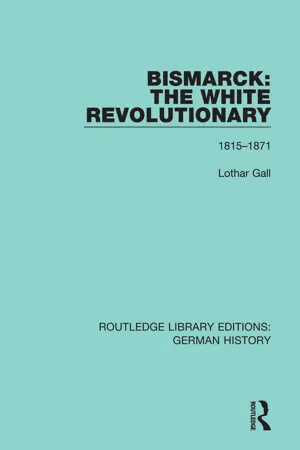
- 418 pages
- English
- ePUB (mobile friendly)
- Available on iOS & Android
eBook - ePub
PART ONE
In Search of a Way of Life
[1]
Between Two Worlds
DOI: 10.4324/9780429281716-2
Home, school and choice of profession – these are the three elements in a young person’s life that we tend, with varying degrees of emphasis, to point to as actually shaping his character and in many respects providing him with his identity. As far as Bismarck’s development is concerned, however, we can apply the rule in at best a negative sense. This gives us an initial insight into the personality of a man who remembered himself as having always been deeply solitary and thrown back on his own resources, seeking order and authority and needing them but taught by experience to expect neither from anywhere except within himself, a man whose existence was from an early age divided between searching for a way of life and playing a part.
‘I became a stranger in my parents’ house in earliest childhood and never again felt fully at home there’, he wrote in the ‘description of his inner life’, the famous ‘Werbebrief or ‘Letter of Proposal’ addressed to his future father-in-law, Heinrich von Puttkamer, an arch-conservative and strictly religious Pomeranian country squire, six months before his entry into the political arena. ‘The education I received at home was based on the viewpoint that everything was subordinate to the training of the intellect and the early acquisition of positive knowledge.’1 ‘At home’ meant under the influence of his mother, who in this respect at least was completely dominant. Nor was that the only occasion on which Bismarck, looking back, associated his early inner alienation from his parental home closely with her. Eighteen years younger than her husband, she had found herself in 1806, when she was barely 17, placed by her marriage to Ferdinand von Bismarck, a landowner in the Brandenburg March, in a world she inwardly rejected and from which she sought with all her might to remove her two sons, Bernhard (b. 1810) and Otto, who was born on his father’s Schönhausen estate near Magdeburg on 1 April 1815.
It was the world of the small Prussian landed nobility, of which it was the family’s proudest boast to be one of the oldest resident representatives in the March. That world had seen many changes since the fourteenth century, when the family’s ancestor, who came from a patrician merchant family in Stendal and was a partisan of Margrave Ludwig of Wittelsbach, was rewarded by the latter in the summer of 1345 with the estate of Burgstall. Most of those changes, however, had been undergone passively rather than actively brought about: the rise of the sovereign state, the organization of a standing army and a central administration, and the ‘transfer’ from Burgstall to Schönhausen on the east bank of the Elbe in the sixteenth century, which had been ‘extorted’ from the Bismarcks with ‘all manner of pressure and physical violence’ by the Hohenzollerns ‘purely because they coveted the hunting’, as the family’s youngest scion once resentfully remarked during the Franco-Prussian War.2 From time to time, particularly in the seventeenth century, a stand had been made against the absolutism of the ‘Swabian family’ of the Hohenzollerns, of whom the Chancellor occasionally opined that in principle, leaving aside the concept of divine right, they were ‘no better than my own’.3 But that had been no more than obstruction. And even the energy with which, standing on custom and ancient right, they had set about it had scarcely been excessive. Eventually, if under protest at first, they had reconciled themselves to the new order and even become fritzisch: Ferdinand’s grandfather, who of all the Bismarcks most resembled the future Chancellor, fell in 1742 as a colonel and an unreserved admirer of the king; his father fought at Kollin, Leuthen and Hochkirch until, severely wounded, he resigned his commission in 1758.
Against this world of dogged persistence, this long line of altogether rather bourgeois landed nobility, Wilhelmine Luise set her own family tradition, particularly the figure of her father, Anastasius Ludwig Mencken, whom she greatly admired and was always holding up to her sons as an example. Descended from an academic family from Leipzig and the son of a professor of law at the University of Helmstedt in Brunswick, Mencken had served as Cabinet secretary under Frederick the Great and subsequently as a member of the Cabinet under Frederick William II and Frederick William III. In the years preceding his death in 1801 he had eventually come to exercise a considerable influence on Prussian policy. A not uncritical supporter of enlightened absolutism, he represented the type of educated, sophisticated civil servant, experienced in office and in life, that absolute monarchy produced in its late period, principally in central Europe, and that laid the foundations of the prestige and influence enjoyed by the civil services of central Europe for a century to come. Such men saw the Old Prussian landed nobility, which often clung stubbornly to tradition, was intellectually as well as materially inflexible and tended to oppose on principle everything to do with centralized government and bureaucracy, as the major obstacle to any kind of reform in state, church and society as well as to enlightenment and sensible progress. It was in this spirit that the daughter had been educated. And Ferdinand von Bismarck, who to his monarch’s great annoyance had resigned his commission early on and retired to his estate, was a by no means wholly untypical representative of that Old Prussian nobility, notwithstanding his personal qualities, his human kindness and amiability and his pronounced liberality in the way he lived his life and in his choice of friends. Here lay the seeds of a conflict that the children and above all the more sensitive younger son probably felt more keenly than the father, who had the protection of an unfailing self-confidence and the tolerance of the chivalrous patriarch and who, moreover, largely fell in with his wife’s opinions when it came to concrete decisions affecting their lives.
This applied, for example, to the question of the children’s education. For Wilhelmine Luise von Bismarck it was a foregone conclusion that her sons should follow the new educational channel available as a result of the Prussian educational reforms carried out under Wilhelm von Humboldt after 1806. The primary aim of those reforms had been to provide the state in all spheres of its activity, including the army and the diplomatic corps, with a body of civil servants educated in a coherent spirit and to the same high standard. And civil servants, diplomats, possibly even ministers were what the sons were going to be, not lazy, complacent landed aristocrats with no ambition and no future. So there was no question of private tutors and a flexible transition to higher education, which was still the usual arrangement in rural areas at the time (in 1816 the family had left Schönhausen for Kniephof, near Naugard in Pomerania, to farm an estate inherited from a collateral branch). Instead in January 1822 the younger son, then aged 6, was sent to boarding-school in Berlin.
The school was the so-called ‘Plamannsche Lehranstalt’ or Plamann Institute, founded in the spirit of the great Swiss educational theorist Pestalozzi immediately prior to the Prussian reforms and chiefly attended by the sons of top Prussian civil servants. Of the objectives that had originally governed the school there was admittedly very little left in the 1820s, the period of intellectual and political reaction that followed the reform period and the Wars of Liberation. Here too, as was almost universal in Prussian education, deprived of its original content and context, much had become ossified in externals and mere formalities, in drill and hollow German pomposity, in an ‘artificial Spartanism’, as Bismarck himself put it.4 He always looked back with deep distaste on the five years he had spent in that boarding-school in the Wilhelmstrasse. There was ‘a great deal of coercion and method and unnatural training’; the teachers were ‘demagogic gymnasts’ and they ‘hated the nobility’.5 Moreover, the Institute had ‘in the last years of its existence taken a direction’ that ‘favoured a kind of hothouse development of the intellect rather than the education of the heart and the preservation of youthful vigour’.6
This early separation from home, aggravated by the fact that for years his mother departed to take the waters in July and so made it impossible for him to go home for the summer holidays, inevitably struck him as the quite pointless outcome of an attitude to life that was prepared to sacrifice what was natural, the genuine possibilities of happiness that life offered, to mere illusions. ‘My childhood was ruined for me at the Plamann Institute, which to me seemed like a prison’, he once said with vivid emphasis. ‘Whenever I looked out of the window and saw a team of oxen ploughing I had to weep with homesickness for Kniephof.’7 It was probably here that he formed that bitter opinion of his mother expressed in a letter of 24 February 1847 to his future wife: ‘My mother was a beautiful woman who loved outward show and had a bright and lively mind but little of what Berliners call Gemüt [‘heart’ or ‘soul’]. She wanted me to learn a lot and achieve a lot, and it often seemed to me that she was hard and cold towards me. As a little child I hated her, and later I used to deceive her – successfully – with guile.’8 Nor was that all. It would hardly be going too far to say that here, in the fact that the emotional shock of so early a separation from home was not countered by the experience of an inwardly accepted and meaningful order in the classroom and the dormitory, is the root of some of the underlying attitudes that were to characterize his entire life.
‘I really loved my father’, we read in a significant transitional passage a few lines farther on in the letter to Johanna von Puttkamer. His father was the world from which he felt so soon that he had been driven out; he was the good-humouredness of ‘live and let live’, the life of nature with its organic rhythms, the freedom and security of adulthood; he was Gemüt and individuality. On the other hand, cold and dismal, there were the city, strict discipline, a lifeless order, demands with nothing but platitudes to back them up, career-mindedness and a concept of education that called its own content into question. Here were undoubtedly set-pieces of normal human development, of the transition from the uncomplicated life of childhood to the increasing commitments of adulthood, commitments that are experienced as being harsher for the fact that the values, the future and the meaning that underlie them are not always immediately clear. But the additional factor here, which enormously aggravated the conflict, was the brutal accentuation of the problem by the special circumstances of Bismarck’s life, the possibility, which literally thrust itself upon him, of assigning them to two different spheres and forms of existence, the one bourgeois, bureaucratic and urban, the other traditional, aristocratic and rural, and not least the fact that these principles were embodied in his parents – in a form, moreover, that contradicted every traditional conception of and distribution of parental roles, with the mother representing the pushing, demanding, intellectually oriented element.
The result of all this was that for Bismarck the normal adolescent conflict with the ways of the adult world very quickly broke the bounds of the purely private sphere. Bismarck’s search for his own way of life took place in circumstances that were by nature supra-individual and of an eminently political kind. For his rejection of external demands, his failure to succeed in bourgeois terms at the same time took on a quality of loyalty to tradition and to the preservation of his patrimony.
Not that there was any question of this at first. Bismarck went through school – the Plamann Institute until the autumn of 1827, then the Frederick William Gymnasium until 1830 and finally, until he took his Abitur or school-leaving examination in April 1832, the famous ‘Graue Kloster’ (Grey Friary) in Berlin – without much demur but also with no great success or obvious intellectual or artistic interests. In all subjects equally he was a mediocre pupil about whom, even with the wisdom of hindsight, his teachers and fellow pupils were able to distinguish nothing particularly remarkable. And indeed he left school, as he put it in the famous sarcastic opening sentence of his memoirs, ‘as a normal product of our state educational system’ with superficial views and beliefs – whether or not they were the ones that, exploiting the appeal of contrast, he mentioned there – and with no firm plans for the future or even ideas about what he wanted to study. Just one remark in the few sentences in which he reminisced about his schooldays more than sixty years later contains a clue, pointing yet again to the emotional core of the conflict that was to come out more and more strongly from now on: ‘My historical sympathies’, he said with regard to the national aspirations of the period, aspirations principally of the middle classes, and to the glorification of heroes of freedom in history, ‘remained on the side of authority.’9 Authority, however, meant the traditional order, the old Prussia, the primacy of Crown and nobility, of the country and rural relationships; in short, it meant his father’s world.
For the time being, though, his actual career continued to follow the course plotted by his mother. At the beginning of the summer semester of 1832 he entered the University of Göttingen, then one of the leading universities in central Europe, to study law and so prepare himself – in a way that the eighteenth-century ‘Fürstendienst’ or ‘Prince’s Service’ had hardly known – for the civil service and if at all possible for a diplomatic career. He had accepted this professional objective not from any particular interest but because it presented itself and because his mother persistently urged him in that direction. The only alternatives open to a Prussian Junker of the period, unless of course he developed special talents and interests at an early age, were service in the army or, as the eldest son or in the case of large, subdivided properties, the management of his father’s estates. Bismarck very quickly rejected the former alternative, and it was not merely to please his mother that he did so. And there was no question of the second for the time being: Schönhausen was leased, and the father farmed the Pomeranian estates himself.
There was nothing unusual about a young student’s choice of subject and of professional objective simply imposing themselves on him from outside through the wishes of his family, through his position in society and in the absence of any alternatives or impulses of his own. The great majority of Bismarck’s fellow students, particularly those of his own circle, were in the same situation. University as a duty, as an extension of the school that by present-day standards most of them had hardly grown out of, was the usual thing, and the academic teaching took this into account to a great extent. Above all its principal component, the course of lectures, was essentially aimed at communicating knowledge that could be memorized, consisting of hours of recitation from a textbook together with voluminous collections of examples; the famous exceptions to this rule merely distort the overall impression.
It was they, however, that constituted the appeal of individual universities. They were the usually extra-curricular attractions that exerted the most powerful influence on the education, attitudes and opinions of the academic youth of the day and formed the basis of the outstanding importance of the universities in the nineteenth century, especially in central Europe. It was philosophers such as Fichte, Schelling and Hegel, theologians such as Schleiermacher (who confirmed Bismarck in Berlin in 1831), philologists such as the Grimm brothers, lawyers such as Thibaut and Savigny, historians such as Heeren, Rotteck and Dahlmann, literary historians such as Gervinus – it was such men as these who turned the universities into those centres of intellectual, moral and often also political debate that released in the more receptive and intellectually more flexible section of the student population forces of self-examination and the desire for independent knowledge of the world, in short that set free an ideal of personality that perhaps determined the inner dynamics of the century more strongly than many other influences. This provided a counterweight to the more and more marked (and in the course of economic, social and political development undoubtedly inevitable and also indispensable) tendency towards specialists and professionals – a counterweight that held back the formation of a purely functional meritocracy and created essential preconditions for the development and spread of a specifically middle-class culture.
Bismarck’s initial choice of lecture courses shows how a certain twin-track approach to university studies was very much taken for granted at the time: in addition to two courses in law to provide his ‘bread-and-butter’ training he attended, as it were for general guidance and education, courses in philosophy, the history of political science and mathematics. Of this broad choice, however, which in the following semesters in fact became steadily narrower, he made only very limited use, not only so far as his vocational courses but also so far as the other subjects were concerned. In the case of the former he soon fell back on mechanical preparation for examinations, and in the latter case his interest quickly waned – with one exception, on which he continued to lay emphasis as an old man. For at least two semesters he listened regularly and with growing interest to the historian Arnold Heeren (already 71 when Bismarck went up to university) and even from time to time sought to follow up what he heard with additional reading. The courses involved were one in general geography and ethnology, offering a sort of historical introduction to listeners from all faculties, and in the winter a course on ‘Statistics and History of the European Countries’.
Heeren was the son of a Bremen merchant family and as such was particularly interested in questions of the economy and trade and their relationship to politics in general. After studying philosophy and history at Göttingen he had turned first to ancient history, and after extensive research he had published in 1793 and 1796 a voluminous two-volume work entitled Thoughts on Politics, Communications, and Trade among the Principal Peoples of the Ancient World. The book made a great impression on Heeren’s contemporaries. Goethe called it one of the important books of the age, a work of lasting influence.10 It earned its author a chair in history at Göttingen in 1801. In the book this disciple of Adam Smith showed the close connection between and interdependence of the production and exchange of goods and international relations. In other words, he was interested in the material foundations of the foreign policy of the peoples and states of the Ancient World. His procedure and intentions, typically of the Enlightenment, were generalizing. Like Montesquieu, by whom he was greatly influenced, he was concerned above all, while recognizing the historical contingency of all human activity, to bring out something akin to general principles and guidelines as to what was permanent in and typical of that activity and of certain basic factors.
In the same spirit Heeren had gone on to look at recent history and particularly the History of the European System of States and its Colonies, as he called his likewise widely read second major work, which was written as a ‘Handbuch’, in other words rather in the manner of a textbook, and first published in 1809. In this he sought to...
Table of contents
- Cover
- Half Title
- Title Page
- Copyright Page
- Original Title Page
- Original Copyright Page
- Dedication Page
- Contents
- Introduction The ‘Circumstances of his Life’: Bismarck and his Time
- Part One In Search of a Way of Life
- Part Two ‘Let Us Rather Undertake Revolution than Undergo It’
- Notes
- Index of Names
Trusted by 375,005 students
Access to over 1.5 million titles for a fair monthly price.
Study more efficiently using our study tools.
Frequently asked questions
Yes, you can cancel anytime from the Subscription tab in your account settings on the Perlego website. Your subscription will stay active until the end of your current billing period. Learn how to cancel your subscription
No, books cannot be downloaded as external files, such as PDFs, for use outside of Perlego. However, you can download books within the Perlego app for offline reading on mobile or tablet. Learn how to download books offline
Perlego offers two plans: Essential and Complete
- Essential is ideal for learners and professionals who enjoy exploring a wide range of subjects. Access the Essential Library with 800,000+ trusted titles and best-sellers across business, personal growth, and the humanities. Includes unlimited reading time and Standard Read Aloud voice.
- Complete: Perfect for advanced learners and researchers needing full, unrestricted access. Unlock 1.5M+ books across hundreds of subjects, including academic and specialized titles. The Complete Plan also includes advanced features like Premium Read Aloud and Research Assistant.
We are an online textbook subscription service, where you can get access to an entire online library for less than the price of a single book per month. With over 1.5 million books across 990+ topics, we’ve got you covered! Learn about our mission
Look out for the read-aloud symbol on your next book to see if you can listen to it. The read-aloud tool reads text aloud for you, highlighting the text as it is being read. You can pause it, speed it up and slow it down. Learn more about Read Aloud
Yes! You can use the Perlego app on both iOS and Android devices to read anytime, anywhere — even offline. Perfect for commutes or when you’re on the go.
Please note we cannot support devices running on iOS 13 and Android 7 or earlier. Learn more about using the app
Please note we cannot support devices running on iOS 13 and Android 7 or earlier. Learn more about using the app
Yes, you can access Bismarck: The White Revolutionary by Lothar Gall, J. A. Underwood in PDF and/or ePUB format, as well as other popular books in History & Business General. We have over 1.5 million books available in our catalogue for you to explore.