Originally published in 1976 and based upon the extensive use of original archival material, this book provides a detailed account of the 2 years in which the German army enjoyed unprecedented power and influence. The rise of Hindenburg and Ludendorff is seen against the background of the failure of the army to win a decisive victory in the early stages of the war. The book provides insights into the dynamics of German militarism and imperialism, and is an important contribution to the discussion of the continuity of German history.
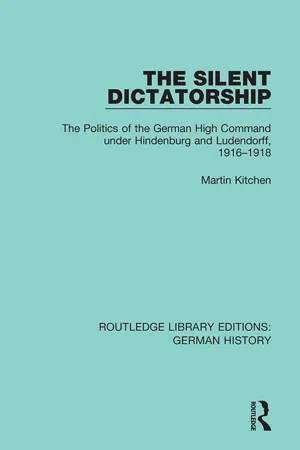
eBook - ePub
The Silent Dictatorship
The Politics of the German High Command under Hindenburg and Ludendorff, 1916-1918
- 300 pages
- English
- ePUB (mobile friendly)
- Available on iOS & Android
eBook - ePub
The Silent Dictatorship
The Politics of the German High Command under Hindenburg and Ludendorff, 1916-1918
1 THE APPOINTMENT OF HINDENBURG AND LUDENDORFF
As the war entered its third year the military position of Germany was becoming increasingly critical. The massive offensive against Verdun on which the OHL had pinned such high hopes became a bloody and costly stalemate. The British offensive on the Somme placed the German forces on the western front in a precarious situation. In the east the Russian offensive under Brusilov was so successful that Austria-Hungary seemed to be on the verge of collapse. These military set-backs to the Central Powers on both the eastern and the western fronts encouraged those countries which were considering joining the war on the side of the Entente. Both Rumania and Italy had declared war, tempted by extravagant promises for a generous settlement when the fighting was over, and convinced that Germany was near collapse. Thus by the summer of 1916 the initiative was clearly in the hands of the Entente. German strategy had been based on an underestimation of the strength of the Entente, and an overestimation of the capacity of the Central Powers to provide men and munitions. An increasing number of people were beginning to feel, if only in brief moments of disquieting insight, that the impossible could happen, that Germany and her allies might be defeated and would have to negotiate a peace that would dash the imperialist dreams for a Europe dominated by Germany.
Austria-Hungary was in a parlous state. Shortages of food and munitions, the demoralisation of the army, the incompetence of much of the officer corps and the startling success of the Russian offensive all served to heighten the tensions and contradictions within the state that many had hoped the war would help to conceal. During the Brusilov offensive it was reported that Czech and Ruthenian soldiers deserted en masse to the enemy, the first ominous signs that national differences threatened the continuation of the Austrian war effort. The war minister Krobatin felt that the situation was so critical that a catastrophe was imminent.1
In Germany the euphoria and the exaggerated hopes of the early months of the war were giving way to widespread cynicism and to increasingly frequent outbreaks of hysteria. Under the strain of two years of war and the failures of 1916 the political truce of August 1914 was rapidly crumbling. There were the first political strikes, protests against the continuation of the war for what seemed to an ever larger number of people to be the selfish aims of a greedy clique, and against the shortages and privations which the government seemed either unable or unwilling to control. At the other end of the political spectrum the Pan Germans and the heavy industrialists were organising themselves to engineer the overthrow of the chief of the general staff and the chancellor, both of whom seemed to stand between them and the realisation of their ambitious annexationist dreams. Meanwhile the chancellor, Bethmann Hollweg, attempted with his ‘politics of the diagonal’ to steer a middle course and to achieve a liberal compromise, a policy which was doomed by its very nature to failure. He feared that the Pan Germans with their shrill demands ruined any chance for a separate peace with Russia, and he hoped that by playing down the issue of war aims he might be able to appease his critics on the left. Backed by the propaganda efforts of the German National Committee (Deutsche Nationalausschuss), Bethmann Hollweg attempted, with singular lack of success, to achieve national unity and restore the Burgfrieden. These efforts were derided by the Independent Committee for a German Peace (Unabhängige Ausschuss für einen deutschen Frieden), the organisation of the extreme annexationists lead by Dietrich Schäfer. Indeed the squabbles between the Nationalausschuss and the Unabhängige Ausschuss were symptomatic of the deep-seated divisions on tactical issues which were to become vital issues in German politics in the final two years of the war. In the summer of 1916 there was, however, a fundamental agreement between the two camps on one crucial question. For the realisation of the schemes of either party Germany would have to win a military victory, and without a change in the supreme command this was unlikely to be achieved. Agreement on this issue enabled Bethmann Hollweg to stay in power for one further year, but it meant that Falkenhayn could no longer remain as chief of the general staff. That he would be replaced by Hindenburg and Ludendorff, the victors of Tannenberg and popular idols, was almost a foregone conclusion. Their appointment, however, did not end the differences between the moderates and the extremists, but proved to be a decisive victory for the extremist faction within the ruling class with whom Ludendorff particularly had the closest associations.
The dismissal of Falkenhayn was thus caused by a many-sided attack, the result of some very curious alliances, and it was to backfire with disastrous effect on many of those who took part in the plotting. In this respect the affair was a dress rehearsal for the July crisis of 1917 which was to lead to the overthrow of Bethmann Hollweg.2
Falkenhayn had never been a popular figure. He had first become widely known when as war minister he had defended the excesses of the army in Alsace-Lorraine during the Zabern affair. His ferocious language in the Reichstag on this occasion had won him some sympathy in the army and the undying hatred of many parliamentarians, but even his admirers were put off by his coldness, sarcasm and snobbish aloofness.3 Many senior officers regarded him as a pusher and a careerist, characteristics which were particularly repugnant to an officer corps that clung to its aristocratic image. He had in fact had a remarkably rapid career for a Prussian officer, becoming chief of general staff at the age of 52, a younger man than any of the army commanders and commanding generals. With his attack on Verdun a ghastly failure, which he obstinately refused to admit, and with the Russian breakthrough in the east coupled with the British attack on the Somme, Falkenhayn’s position was indeed precarious. Unable to move troops to the east he enraged Hindenburg and Ludendorff who were convinced that he was determined to spoil their chances for another spectacular victory; the high hopes for the western front dashed, he was increasingly criticised by senior commanders. Prince Rupprecht of Bavaria had grave reservations about his capabilities since the days of Ypres. The war minister, Wild, whose attitude towards Falkenhayn was highly ambivalent, felt that he was fundamentally a ‘weakling’ ( Schlappschwanz ).4
Many politicians had little love for Falkenhayn. Those on the left could not forget Zabern; the right resented his inability to create the military conditions for the realisation of their war aims programme. Many politicians were also suspicious of Falkenhayn’s political ambitions, and rumours that he wished to become chancellor continued to circulate.5 He treated the politicians with haughty disdain, refusing to keep them properly informed and constantly dabbling in political matters. It is one of the supreme ironies that many politicians, from Bethmann down, plotted to overthrow Falkenhayn so as to stop military interference with political matters, and to replace him by Hindenburg and Ludendorff whose political meddling was never surpassed, before or after, in the history of the German army.
Yet Falkenhayn was not without powerful friends, and the struggle for his dismissal was likely to be long and tough. Colonel Marschall of the military cabinet was a devoted friend to Falkenhayn and one of the few men who clearly saw the danger inherent in the appointment of Ludendorff — whose boundless ambition and pride would most likely lead him to continue to fight the war until Germany was ruined and exhausted.6 His strongest support came from the Kaiser himself, who, in spite of nagging doubts and frustration, continued to support his chief of general staff until the very last moment. Falkenhayn was careful to cultivate good relations with William, always appearing as the humble servant of the ‘Supreme Warlord’, but never in fact allowing any interference in military affairs by the monarch. There was nothing in Falkenhayn of Hindenburg’s deliberate acting up to public opinion which posed such a threat to the traditional position of the monarch with regard to the power of command. Whereas William never regarded Falkenhayn as a threat to his authority, he knew that such a threat emanated from Hindenburg and Ludendorff, and he clung to his chief of general staff knowing that the change would undermine his own position and introduce into the system an element of plebiscitary democracy that was abhorrent to him.
Bethmann Hollweg’s motives for plotting the overthrow of Falkenhayn were complex. There had long been differences between the two. The chancellor resented Falkenhayn’s interference in political affairs and had serious reservations about his military abilities. He had bitter clashes with Falkenhayn over the issue of submarine warfare and over the Balkans.7 It has even been argued that Bethmann wished to get rid of Falkenhayn so as to make possible a peace of renunciation (Verzichtfrieden) under the leadership of the enormously popular and respected Hindenburg, but this is not convincing, even though he certainly considered this aspect of the question and had suggested that the German people under Hindenburg would accept ‘any peace that bears his name’.8
The chancellor’s main concern was for an eastern strategy that would force Russia to make a separate peace, and thus enable Germany to complete the victory in the west, using unrestricted submarine warfare if necessary.9 For this policy Hindenburg and Ludendorffs strategy seemed ideal; Falkenhayn’s had already proven bankrupt. Hindenburg and Ludendorff were the men of Tannenberg, Falkenhayn of Verdun. The tremendous reputation of Hindenburg would serve to paper over the divisions which were becoming all too apparent within German society, restore the Burgfrieden, placate the left and silence the chancellor’s critics on the extreme right. With Hindenburg and Ludendorff the chancellor hoped to achieve the war aims which he had outlined as early as September 1914. He had no intention of hiding behind Hindenburg’s back, abandoning his war aims programme and negotiating a peace on the basis of the status quo. At the same time Bethmann hoped that he would be able to use Hindenburg to convince the Pan Germans and the heavy industrialists of the wisdom of his more flexible attitude towards war aims.
Bethmann’s calculations proved to be gravely mistaken. Ludendorffs political convictions, and his attitude to warfare placed him squarely in the camp of heavy industry. He had always called for close cooperation between the army and heavy industry, ideas which formed the basis of his notorious memorandum of 1912 calling for a drastic increase in the size of the army, and which had led to him being posted away from the general staff where his ideas were considered too radical. His vision of total warfare and total mobilisation was attractive to the heavy industrialists who not only stood to gain directly, but who also hoped that Ludendorffs energy would bring Germany the victory which alone would make possible the realisation of their ambitious war aims. Thus although Hindenburg and Ludendorff were men of the east, the ultra right hoped that they would overcome what they felt to be the suspicions and reservations of the chancellor and win a decisive victory in the west.10 On Hindenburg and Ludendorffs appointment to the OHL, heavy industry was given direct access to the military leadership and thus the chancellor’s opponents were greatly strengthened.11 Bethmann’s hopes that the appointment of Hindenburg and Ludendorff would scatter his opponents and restore political unity were soon to be shattered. The new OHL greatly strengthened the extremist faction and served to destroy the last remnants of the Burgfrieden.
The dangerous position of the Austrian army helped to undermine Falkenhayn’s position. Valuable reserves had to be sent from the western front to the east, and Falkenhayn had to abandon his plans for a counteroffensive on the Somme. The Austrian general staff chief, Conrad, hoped to use these reserves in a grandiose outflanking movement which would destroy Brusilov’s army, but the Russians simply changed the direction of their attack once they had been halted and inflicted severe damage on the...
Table of contents
- Cover
- Half Title
- Title Page
- Copyright Page
- Original Title Page
- Original Copyright Page
- Contents
- Dedication
- Preface
- Introduction
- 1 The Appointment of Hindenburg and Ludendorff
- 2 The Organisation of the High Command
- 3 The Economic Policy of the High Command
- 4 First Steps in Foreign Policy
- 5 Unrestricted Submarine Warfare
- 6 The July Crisis 1917 and its Consequences
- 7 Brest Litovsk
- 8 The Treaty of Bucharest
- 9 The Baltic and Finland
- 10 Eastern Policy 1918
- 11 The High Command and the Armistice
- Conclusion
- Bibliography
- Index
Trusted by 375,005 students
Access to over 1.5 million titles for a fair monthly price.
Study more efficiently using our study tools.
Frequently asked questions
Yes, you can cancel anytime from the Subscription tab in your account settings on the Perlego website. Your subscription will stay active until the end of your current billing period. Learn how to cancel your subscription
No, books cannot be downloaded as external files, such as PDFs, for use outside of Perlego. However, you can download books within the Perlego app for offline reading on mobile or tablet. Learn how to download books offline
Perlego offers two plans: Essential and Complete
- Essential is ideal for learners and professionals who enjoy exploring a wide range of subjects. Access the Essential Library with 800,000+ trusted titles and best-sellers across business, personal growth, and the humanities. Includes unlimited reading time and Standard Read Aloud voice.
- Complete: Perfect for advanced learners and researchers needing full, unrestricted access. Unlock 1.5M+ books across hundreds of subjects, including academic and specialized titles. The Complete Plan also includes advanced features like Premium Read Aloud and Research Assistant.
We are an online textbook subscription service, where you can get access to an entire online library for less than the price of a single book per month. With over 1.5 million books across 990+ topics, we’ve got you covered! Learn about our mission
Look out for the read-aloud symbol on your next book to see if you can listen to it. The read-aloud tool reads text aloud for you, highlighting the text as it is being read. You can pause it, speed it up and slow it down. Learn more about Read Aloud
Yes! You can use the Perlego app on both iOS and Android devices to read anytime, anywhere — even offline. Perfect for commutes or when you’re on the go.
Please note we cannot support devices running on iOS 13 and Android 7 or earlier. Learn more about using the app
Please note we cannot support devices running on iOS 13 and Android 7 or earlier. Learn more about using the app
Yes, you can access The Silent Dictatorship by Martin Kitchen in PDF and/or ePUB format, as well as other popular books in History & Business General. We have over 1.5 million books available in our catalogue for you to explore.