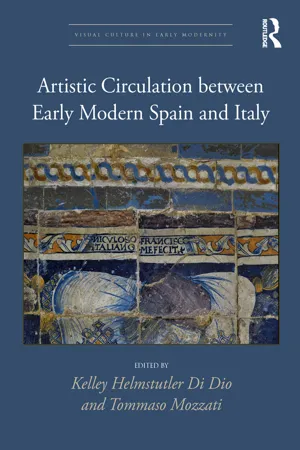
This collection of essays by major scholars in the field explores how the rich intersections between Italy and Spain during the early modern period resulted in a confluence of cultural ideals. Various means of exchange and convergence are explored through two main catalysts: humans—their trips or resettlements—and objects—such as books, paintings, sculptures, and prints. The visual and textual evidence of the transmission of ideas, iconographies and styles are examined, such as triumphal ephemera, treatises on painting, the social status of the artist, collections and their display, church decoration, and funerary monuments, providing a more nuanced understanding of the exchanges of styles, forms and ideals across southern Europe.
eBook - ePub
Artistic Circulation between Early Modern Spain and Italy
- 254 pages
- English
- ePUB (mobile friendly)
- Available on iOS & Android
eBook - ePub
Artistic Circulation between Early Modern Spain and Italy
About this book
Information
1 Domenico Fancelli and the Tomb of the Catholic Kings
Carrara, Italian Wars and the Spanish Renaissance
Five hundred years after its installation, the funerary monument of the Catholic Kings—the visual focus of the Capilla Real in Granada together with the sepulchre of Philip the Fair and Joanna the Mad—still provokes a sense of unfamiliarity in the modern observer (Plate 1). The shining surface of the Carrara marble, made opaque by the passing of time, reflects the golden light of the magnificent retablo of the high altar by Felipe Bigarny, and of the other structures carried out later, in a construction of Gothic style with traces of Italianism. Ferdinand of Aragon, who commissioned the sepulchre in 1513, wished to enhance the value of the work as well as to make its political and symbolic meanings clear through the absolute novelty of the tomb, marked by its deep contrast with Spanish artistic tradition. The choice of Carrara marble and of the Renaissance artistic vocabulary were a clear reference to Italy and a direct commemoration of the Spanish victories in the Kingdom of Naples; yet the iconography of the sepulchre enhanced the image of the kings as defenders of the Christian religion, with reference to their successes inside their kingdom against the Moors and heresy. Due to its rich decorative lexis a la romana, which was enjoying popularity in the Iberian Peninsula during the 16th century, the antique look of the monument elucidated the classical idea of Magnificence and formed part of a coherent programme of artistic propaganda of the Catholic Kings.
The monument is the climax of a celebratory programme that had started in 1504 with the foundation of the Capilla Real, a symbolic place characterized by its main political value that immediately became an image of the complete reign of the Catholic Kings, a summa of all the ventures made during their long rule. After the conquest of Granada on January 2, 1492, and the end of the victorious Crusade which definitively expelled the infidels from the Iberian Peninsula, Ferdinand and Isabel promoted the institution of some significant sites to complete the military (and also the cultural and religious) conquest of the Andalusian town, leaving a deep sign in its ancient urban texture. This climate generated a series of architectural commissions in the new territories converted to Christianity: the names of the new sites referenced the direct patronage of the Kings, such as the church of San Juan de los Reyes, the first holy building consecrated the day after the entrance of the troops in the city,1 the convents of Santa Cruz Real, Santa Isabel Real or the Hospital Real.2
This policy found its climax in Ferdinand and Isabel’s decision to be buried in Granada. For this purpose, they organized the construction of a new building next to the cathedral of Santa María de la O that would celebrate the deeds of the couple permanently.3 A similar choice answered a need the Catholic Kings had felt since the first years of their reign: namely, to identify a symbolic locus for their dynasty, which originated from the union of the two main kingdoms of the Iberian Peninsula, Castile-León and Aragon. Therefore, the political mission that the King and Queen undertook made the complexes erected by the single dynasties rather unsuitable: the monastery in Poblet, pantheon of the Aragonese kings,4 and the Miraflores Charterhouse in Burgos, started under John II of Castile and carried on by his daughter Isabel, who dedicated the erection of the sumptuous alabaster monument by Gil de Siloé to her parents.5
In 1476, Isabel took permanent control over Castile after the defeat of Joanna la Beltraneja, and the Catholic Kings took their first standpoint by starting the construction of the complex of San Juan de los Reyes in Toledo, which was intended for their corpses.6 A similar project was then replaced in the course of the events: the successes of the reconquista moved the centre of power of the kingdom towards Andalusia, and Ferdinand and Isabel were pushed to concentrate their attentions on Granada, which appeared as more appropriate to embrace the ideological message of the dynasty and to disclose a symbolic conversion of high propagandistic value.
In the meantime, we can suppose that the choice of an Italianate language was also intended as a contrast with the mudéjar style that was typical of the Andalusian tradition: by adopting Carrara marble and the Renaissance style, Ferdinand wanted to emphasize the drastic change determined by the conquest of Granada in 1492, both on historical and artistic levels.
The history of the mausoleum in Granada began on September 13, 1504, with the foundation act and the concession of the privileges.7 The “honrada capilla” was dedicated to the saints John the Baptist and John the Apostle, a choice with strong dynastic significance, as it recalled both the parents of Ferdinand and Isabel and their son who died in 1497. The chapel would become the resting place of the bodies of the founders, and the chaplains would celebrate masses for their souls. The passing of Isabel, on November 26, 1504, gave further impetus to the construction, which began in 1505 and was officially assigned to Enrique Egas in 1506.8
Though both Ferdinand and Isabel wished for the foundation of the Capilla, the death of the latter left to the first the responsibility to provide for its completion and its decoration. Ferdinand chose the tapestries from the collection of Isabel which, according to her bequest, should decorate the Capilla,9 and he arranged for the burial of his dead wife and himself. In her testament, Isabel had expressed her wish to be buried either in one of the Franciscan convents in Granada—San Francisco de la Alhambra or Santa Isabel la Real—or in another place of her spouse’s choosing.10 During the years between her death and Ferdinand’s, on January 23, 1516, the project of the Capilla Real had advanced decisively. Ferdinand could realize what was already expressed in the “carta de privilegio” of 1504, disposing the burial of the couple in the building or, if the construction was not ready to receive the corpses yet, a temporary burial in the church of San Francisco de la Alhambra.11 Moreover, in 1513 Ferdinand provided the commission of the funerary monument for his wife and himself, entrusting this task to the Florentine sculptor Domenico Fancelli.
The scholarship on the Capilla Real has frequently investigated the meaning the Catholic Kings gave to the building, exploring if their will was to create a private mausoleum or to give a dynastic meaning to it. While the foundation actually lacks any reference to the burials of the successors to the throne that would confirm the first hypothesis,12 it seems rather unlikely that the kings had not foreseen those possibilities for interpretation. In the foundation act issued in 1504, the silence about the burials might have been caused by the uncertainties about the succession to the throne. After the deaths of Prince John in 1497, and of Michael, the son of Isabel de Trastamara and Manuel of Portugal, in 1500, and then Isabel’s death in 1504, the legitimate heir of Castile was her daughter Joanna, who had already shown signs of mental instability and who was then labelled with the epithet of “the Mad”. In such a confused context, a further source of concern was the ambiguous political position of Joanna’s husband, Philip the Fair, the prince consort of Castile, who may have aroused Ferdinand’s suspicions due to his Francophile leanings. After the death of Philip in 1506 and the solution of the succession problem in the years 1509–1510,13 Ferdinand could finally return to celebrate his dynasty through a series of commissions that included the Capilla Real, where the Aragonese decided to immortalize the presence of the two founders with a monument in Carrara marble. Adding to the dynastic significance of the building, Ferdinand’s politics of image was made clear by the decision to exclude the son born from his marriage with Germaine de Foix in 1509. The little prince, who immediately died, was then buried in the monastery of Poblet.14 Nevertheless, a place was reserved in the Capilla Real for Prince Michael, who died when he was just two, after he had been designated as the heir of the kingdoms of Castile and Aragon.15 Therefore, in the wishes of Ferdinand, the Capilla should become not only the symbol of the Catholic Kings and of their deeds, but also a place of deep dynastic significance. This hypothesis finds further confirmation in the will expressed by Philip the Fair to be buried in Granada next to Isabel, should his death happen in Spain.16
The son of Philip and Joanna, Charles V, focused his attention on the chapel in Granada in order to conspicuously reiterate his lineage and to stabilize his position as the king of Spain, made difficult by the fact that his mother, the legitimate heir of Castile, was still alive. From 1518 on, Charles provided for the decoration and the transport of the bodies of Ferdinand and Isabel that remained in the church of San Francisco de la Alhambra until 1521.17 Among other projects there, his patronage provided for the retablo by Felipe Bigarny,18 the gate separating the main part of the building from the presbytery19 and the tomb of Philip the Fair and Joanna the Mad, which was commissioned in 1518 from Domenico Fancelli and executed by Bartolomé Ordóñez and his assistants after the death of the Florentine.20
While the project of the Capilla Real was the common will of the Catholic Kings, the burial was specifically planned by Ferdinand and reflects his own ambitions and the recent historical events. In 1513, the monument was commissioned to Domenico Fancelli, then carried out in Carrara and installed in 1517.21 The choice of an Italian sculptor and of the precious marble were signs of a new phase of Ferdinand’s patronage, which had already started some years before with the choice of the same sculptor and material for the tomb of Prince John22 in the church of the Dominican complex of Santo Tómas in Ávila.23
This interest in the Italian Renaissance style came in a period characterized by a renovated attention of Ferdinand on the events of the Peninsula, and was determined by the necessity to face an increasingly uncertain internal situation due to the succession of Castile during the years after the death of Isabel. The event sealing a direct contact with Italy and with its forms of art was the journey to assume control of the territories of the Kingdom of Naples recently conquered (1506–1507). At his arrival in the capital of the Kingdom, the Aragonese was received triumphantly with an apparato all’antica normally followed in Italy, but that constituted a decisive novelty for Spain, as shown by the sudden recovery of the classic paradigm in the entrances set up at the return of the King to the homeland in the towns of Valencia, Seville and Valladolid.24Therefore, it is not accidental that even the sepulchres commissioned by Ferdinand from Fancelli are rich in classical decorative elements, to be read as parts of a wider celebrative programme to enhance the Aragonese in the light of the famous examples of the Roman past.25
With his preference for the Italian Renaissance, Ferdinand had to consider the example offered by some members of the aristocracy who had already adopted the new artistic vocabulary during the first decade of the 16th century. Thi...
Table of contents
- Cover
- Half Title
- Series
- Title
- Copyright
- Contents
- List of Illustrations
- Acknowledgments
- Introduction: Spanish Italy/Italian Spain
- 1 Domenico Fancelli and the Tomb of the Catholic Kings: Carrara, Italian Wars and the Spanish Renaissance
- 2 The Tomb of Bishop Alonso de Madrigal (“El Tostado”) in the Cathedral of Ávila—The Monumentalization of the “Autorbild”
- 3 Architecture of the Retablo between Spain and Italy: On the Work of Jacopo L’Indaco, Alonso Berruguete and Diego de Siloé (1520–1530)
- 4 An Italian Fountain for the Emperor: The Fuente del Águila (1539)
- 5 Michelangelo Re-read: A Note on the Reception of His Pictorial Language in Spanish Sculpture of the Second Half of the Sixteenth Century
- 6 Circulation of Sculpture Across the Spanish Empire: The Case of Martino Regio’s Genoese Workshop and the Multiple Variations of His Name
- 7 Ribera’s Northern Italian Nexus
- 8 Courtiers, Fables and Dictionaries: Italian Books in the Collections of Velázquez, Carducho and Guerra Coronel
- 9 Guido Reni’s Influence in Seville Through Originals, Copies and Prints
- 10 Some Spanish Paintings in Florentine Collections: The Legacy of the Iberian Journey of Cosimo III de’ Medici
- Bibliography
- Author Biographies
- Index
Trusted by 375,005 students
Access to over 1.5 million titles for a fair monthly price.
Study more efficiently using our study tools.
Frequently asked questions
Yes, you can cancel anytime from the Subscription tab in your account settings on the Perlego website. Your subscription will stay active until the end of your current billing period. Learn how to cancel your subscription
No, books cannot be downloaded as external files, such as PDFs, for use outside of Perlego. However, you can download books within the Perlego app for offline reading on mobile or tablet. Learn how to download books offline
Perlego offers two plans: Essential and Complete
- Essential is ideal for learners and professionals who enjoy exploring a wide range of subjects. Access the Essential Library with 800,000+ trusted titles and best-sellers across business, personal growth, and the humanities. Includes unlimited reading time and Standard Read Aloud voice.
- Complete: Perfect for advanced learners and researchers needing full, unrestricted access. Unlock 1.5M+ books across hundreds of subjects, including academic and specialized titles. The Complete Plan also includes advanced features like Premium Read Aloud and Research Assistant.
We are an online textbook subscription service, where you can get access to an entire online library for less than the price of a single book per month. With over 1.5 million books across 990+ topics, we’ve got you covered! Learn about our mission
Look out for the read-aloud symbol on your next book to see if you can listen to it. The read-aloud tool reads text aloud for you, highlighting the text as it is being read. You can pause it, speed it up and slow it down. Learn more about Read Aloud
Yes! You can use the Perlego app on both iOS and Android devices to read anytime, anywhere — even offline. Perfect for commutes or when you’re on the go.
Please note we cannot support devices running on iOS 13 and Android 7 or earlier. Learn more about using the app
Please note we cannot support devices running on iOS 13 and Android 7 or earlier. Learn more about using the app
Yes, you can access Artistic Circulation between Early Modern Spain and Italy by Kelley Helmstutler Di Dio, Tommaso Mozzati, Kelley Helmstutler Di Dio,Tommaso Mozzati in PDF and/or ePUB format, as well as other popular books in Art & Art General. We have over 1.5 million books available in our catalogue for you to explore.