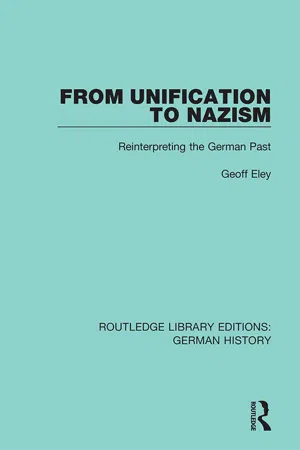
Originally published in 1986, and bringing together essays written over a 10 year period, this volume offers a coherent and challenging interpretation of the German past. The book argues that the German Empire between 1971 and 1914 may have enjoyed greater stability and cohesion than is often assumed. It suggests that Imperial Germany's political institutions showed considerable flexibility and capacity for growth and puts forward the idea that without WWI, or in the event of a German victory, the Empire might well have demonstrated its viability as a modern state. In that case, the origins of fascism should be sought mainly in the subsequent experiences of war, revolution and economic crisis and not so much in the Empire's so-called structural backwardness.
- 294 pages
- English
- ePUB (mobile friendly)
- Available on iOS & Android
eBook - ePub
Table of contents
- Cover
- Half Title
- Title Page
- Copyright Page
- Original Title Page
- Original Copyright Page
- Contents
- Acknowledgements
- Introduction
- Part One German Historial Writing
- Part Two The Social Foundations of the Kaiserreich
- Part Three ‘Enemies of the Reich’
- Part Four The Origins of Nazism
- Index
Trusted by 375,005 students
Access to over 1.5 million titles for a fair monthly price.
Study more efficiently using our study tools.
Frequently asked questions
Yes, you can cancel anytime from the Subscription tab in your account settings on the Perlego website. Your subscription will stay active until the end of your current billing period. Learn how to cancel your subscription
No, books cannot be downloaded as external files, such as PDFs, for use outside of Perlego. However, you can download books within the Perlego app for offline reading on mobile or tablet. Learn how to download books offline
We are an online textbook subscription service, where you can get access to an entire online library for less than the price of a single book per month. With over 1.5 million books across 990+ topics, we’ve got you covered! Learn about our mission
Look out for the read-aloud symbol on your next book to see if you can listen to it. The read-aloud tool reads text aloud for you, highlighting the text as it is being read. You can pause it, speed it up and slow it down. Learn more about Read Aloud
Yes! You can use the Perlego app on both iOS and Android devices to read anytime, anywhere — even offline. Perfect for commutes or when you’re on the go.
Please note we cannot support devices running on iOS 13 and Android 7 or earlier. Learn more about using the app
Please note we cannot support devices running on iOS 13 and Android 7 or earlier. Learn more about using the app
Yes, you can access From Unification to Nazism by Eley Geoff in PDF and/or ePUB format, as well as other popular books in History & Business General. We have over 1.5 million books available in our catalogue for you to explore.