- 424 pages
- English
- ePUB (mobile friendly)
- Available on iOS & Android
eBook - ePub
About this book
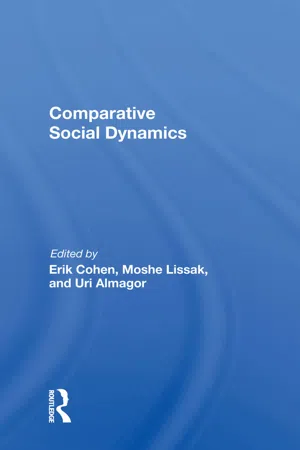
These original articles relate to major themes in the comparative study of the dynamics of cultures, modernization, and social and political change. The authors, ranking scholars in their fields, provide fresh and important insights to the study of topics such as the interface of anthropological and sociological theory, the dynamics of Latin Americ
Information
Part One
Process and Change in Tribal and Historical Societies
1
A Generation After "From Generation to Generation": Coevals and Competitors in "Cattle Complex" Societies
URI ALMAGOR
Introduction
The aim of this essay is to reassess certain aspects in Eisenstadt's 1956 study, which was the first comprehensive and theoretical formulation of the conditions giving rise to a form of social organization based on the principle of age.
Two features, among others, are central in evaluating any theoretical contribution. One is the intellectual point of departure or school of thought within which the contribution is articulated; another is the nature, quality, and extent of the available data at that time. Eisenstadt's work used analytical assumptions based on Parsons' model; his work was related to findings accumulated up to the early 1950s, especially in Africa, mainly by British anthropologists, most of whom adhered to structuralist-functionalist conventions. The overall impression gained from their writings is that they viewed age systems as semi-independent subsystems with their own criteria of differentiation, rules, and values, and that they accentuated the integrative, functional roles of age groups and the rules regulating the behavior of their members.
The combination of these two features inevitably invited criticism of Eisenstadt's hypotheses regarding the relations between different premises of age systems and kin groups, especially when further information became available from fieldwork conducted during the last three decades. This criticism centered first on the inadequacy of Parsons' categories and terminology as applied to tribal societies, and secondly (perhaps mainly) on an element of circularity in Eisenstadt's argument. This argument stated that the conditions under which age groups tend to coalesce are those in which "the family or kin unit do not constitute the basic unit of the society" and that the family "cannot ensure, or even impedes [the individual's] attainment of full social status"; this occurs in societies where "the important institutionalized roles of the [social] system are independent of the family and other particularistic units" (Eisenstadt, 1956:43, 54).
Recent fieldwork has illuminated the various ways in which features of age systems are interwoven with other social spheres, rendering the age system part of a broader, more complex social setting. This fieldwork has helped show how the age system works as a more viable, less rigid system than had hitherto been described, and has pointed out that it is precisely the small kin group (i.e., the household) that is the basic unit of the social and economic division of labor. Furthermore, in age-system societies adults as well as young men engage in various forms of exchange directly or indirectly associated with competition (both within and between households) over control of those resources that serve as the basis for the continued activity of households and the establishment of new ones.
To sustain its vitality, a theoretical contribution must continue to illuminate its subject in the light of new data. The purpose of this essay is to reconsider a theme presented in Eisenstadt's From Generation to Generation (92)—the relationship between age groups and kin units— with a dialectical objective: rather than following the trail blazed by the preceding generation, I seek to use this path as an avenue into a richer, possibly novel exploration.
This is no simple task. The application of an alternative perspective is difficult, somewhat impossible, if the working assumptions of the first anthropologists who collected the data were limited to certain conventions. Nevertheless, following Eisenstadt's lead, my approach, based on observations in fieldwork among the Dassanetch people of southwest Ethiopia and clues in the literature, will make this attempt.
Rather than categorizing kin units according to their value orientation or division of labor, and age units according to the specific functions they fulfill, I suggest that kin units be considered in terms of the resources they control, their corporate nature, the need to expand social ties, their function as a locus of competition, and their relationship to the structure of the social and exchange relations developed by each member of the unit. Similarly, the allocation of roles is not determined primarily by membership in age groups; these are better analyzed in terms of complex networks of social associations and processes involving individuals of different affiliations and ages. Such a discussion will incorporate, among other things, some points recently made by Eisenstadt and Roniger (1980).
My reconsideration is based on a case study of a society that has much in common with other "cattle complex" societies of East Africa: unless otherwise stated, it refers particularly to the Dassanetch of southwest Ethiopia who number about 15,000 souls and who inhabit the area north of Lake Turkana on both banks of the Omo River. Their economy is based on a balance between pastoralism and flood-retreat cultivation; clan members are divided into several tribal sections, each of which has a clan system that comprises a loose structure of exogamous units controlling no physical resources, with no territories of their own, no internal organization, and no joint ceremonies. In fact, clan members are scattered over various settlements and camps, and live in independent, small households that are the main units of production and consumption. The solidarity a man feels with his fellow clan members beyond those in his immediate circle of agnates is patently weak. Their main social and political organization is the generation-set system. (For a full account of the socioeconomic system of Dassanetch, see Almagor, 1978, 1978a, 1978b, and 1983.)
The following sections reveal some of the principles of cattle pastoralism and livestock exchange in East African societies as well as the structure of relationships in the age systems of these societies. Also described are the ways in which these principles and structures are in fact linked, despite their apparent incongruence.
Pastoral Households
Although I concur with Spooner, who noted that "there are no features of culture or social organization that are common to all nomads or even that are found exclusively among nomads" (Spooner, 1973:3), I nevertheless believe one can find common denominators for East African pastoral systems known as "cattle complex" societies. More specifically, I refer to particular modes of exchange, competition, and investment of resources under conditions of flux and general scarcity, which create a distinct mode of resource flows.
The core characteristics of such an economy involve, first, three essential spheres hinging on livestock: subsistence, social relationships, and values. Second, cattle pastoralism is usually practiced by small, corporate kin units that function as units of production and consumption. Third, such small nomadic units cannot sustain the whole range of cattle-husbanding activities by themselves and need a wide range of supportive relationships that cannot be supplied solely by contacts based on kinship and affinity. Fourth, and probably most important, the size of the household herd can vary according to fluctuations between periods of rapid growth and drastic decline owing to ecological factors.
These characteristics, though varying in their degree of intensity, can be found in all East African pastoral or semipastoral societies. Pastoralism is practiced by social units whose size is often determined by ecological and climatic conditions; those prevailing in East Africa are not conducive to the management of large herds in a single unit (Salzman, 1967:122). The evolution of East African pastoralism, according to Bonte (1978:185), resulted in the "nucleation" of production units through "fissioning of domestic groups" and the formation of small units based on polygynous families. Each such small unit is, as noted, the household or domestic group that consists of two or three generations and is an independent production unit.
In many of these pastoral societies the household may formally possess a single herd controlled by the head of the household, but the animals actually belong to various (male) household members of different ages, each of whom has rights on certain beasts and his own ideas as to how they should be used. Cooperation, however, is a vital necessity in the proper management of the herd—hence the mutual dependence of a father and his unmarried sons. The conflicting demands on the stock owned by a household or a kin unit are heightened by the fact that the three different spheres of livestock use (subsistence, social relationships, and values) carry different weights at different stages in a man's life cycle. For example, a young bachelor does not need to invest many beasts in establishing social ties, nor does he have to allocate part of his herd for subsistence (although he is fully aware of his animals' future potential value); an elder may be more concerned with the ritual slaughter of livestock and with extending hospitality and will therefore require a fairly large number of beasts for creating and maintaining social ties.
Since father-son interests often conflict, competition over the use of livestock becomes an intrinsic part of the relations between them. This is part of the overall social relations and exchange patterns in a pastoral society. The active protagonists are individuals who, though connected to kin groups, establish their own social networks that cut across affiliations, ages, and territories (Almagor, 1978). Such individual networks facilitate various ad hoc alignments and re-alignments of small kin units as they move from one pastureland to another. Dyson-Hudson's observations on the Karimojong can be applied to other pastoral societies as well: "the mobility of small groups is such that no limits of combination, dispersal and further realignment can be predicted" (Dyson-Hudson, 1966:175; see also Gulliver, 1958:911; Jacobs, 1965:165, 166; Spencer, 1965:7; Bischofberger, 1972:17; Baxter, 1978:164). Thus it is not surprising that where cattle pastoralism involves small, independent units and young household members know that their futures lie outside their natal households, the competition for use of livestock and the rivalry entailed in preserving one's own livestock resources can at times dominate relations within the household (see Gulliver, 1955:133-134; Jacobs 1965:192; Spencer, 1965:59-61; 1978:166; Dyson-Hudson, 1966:105-107; Legesse, 1973:66).
Since livestock is the medium of social exchange, transactions involving livestock create an infrastructure of social relationships. Livestock transactions are subject to institutionalized patterns of reciprocity, obligations, and social interaction, which are vital in a society where the mobile units are small and livestock is subject to fluctuations and natural hazards. These patterns appear in gift exchanges, hospitality, bond partnerships, and bridewealth allocations, in which, aside from the institutionalized aspects, there are elements of free choice as well.1 Individuals are free to strike up specific, utilitarian relations with others, and in this respect the market is "open" and (almost) devoid of what Eisenstadt and Roniger have called "unconditional obligations rooted in the basic components of personal and collective identity and upheld by moral sanctions" (1980:53). In other words, through transfer of stock, individuals are able to invest in relationships with a wider range of people, in the absence of prior restrictions that limit such transactions (e.g., by confining them to kin-group affiliations). And since the means of investment are relatively scarce, people wish to maximize the returns to their investment and thereby improve their position in the structure of power relations.
The general scarcity of livestock, which means that animals are not always immediately available for exchange or reciprocation, introduces a factor that constitutes a significant, basic premise in personal interrelations within the pastoral society: the concept of the potential right or claim (in effect, debts and credits) inherent in a certain relationship that endures over a relatively long period. The crucial point here is that although an individual may voluntarily enter open market-type relations, the fact that others have claims on part of his herd that they can realize at any time in the future tends to restrict some of the social relations a person may seek to establish. This is particularly evident among the Dassanetch with respect to bridewealth rights, which can be held by a fairly large number of people—some of whom may not even be kin to the bride (see Almagor, 1978:Chs. 8 and 9).
Unlike transactional relations between individuals operating within the framework of small family units, relations that are institutionalized along kinship lines in a generalized mode of exchange tend to limit an individual's scope of alternatives. In a pastoral society, long-term commitments to reciprocal obligations within such narrow bounds are liable to encounter serious obstacles as in the case, for example, of a debtor unable to deliver when called upon to do so. Similarly, if most of the people with whom one cooperates were chosen by one's father, one's ability to operate independently is severely curtailed by the limitations set by such involuntary ties. This is particularly evident in times of drought, epidemics, or disease. I refer here not to devastating livestock epidemics such as those that occurred in East Africa at the end of the nineteenth century, but to endemic conditions affecting different households to varying degrees. In such situations of shortage and need, the assistance sought by a man whose herd may have been decimated is more likely to be forthcoming from someone with whom he has personally established and nurtured reciprocal ties of cooperation than from someone with whom the ties were established by his father. The difference between the two lies in the depth of commitment: direct relationships are usually infused with mutual concern and derive their strength from being entered into voluntarily; the more formal "inherited" relationships are a function of the conventional attitudes toward and contacts with a partner's kin and descendents. The latter can thus be viewed as a kind of "second-degree" link, one that cannot always be considered dependable.
One part of the scarcity of means of exchange and reciprocal relationships entails livestock; another part relates to human resources—the scarcity of occasions in a person's life cycle during which he can establish important bonds and by that means gain access to cooperation with others. Among the Dassanetch the limited number of occasions for forging bonds do not recur; once a choice is made, therefore, that specific opportunity is "exhausted" and automatically affects subsequent choices (Almagor, 1978b). This situation forces people, and especially young men, to invest wisely in the first place. Since partners cannot re-invest a failed link elsewhere, the function of scarcity here is to reduce the likelihood that people will try to set up opportunistic short-term contracts. Young people are thus effectively prevented from manipulating their limited social resources optimally, and their weakness is the elders' strength. Moreover, early investment in too many social ties may deprive a young man of opportunities he may need at a later stage. Thus, while the patterns of long-term commitments do benefit young men to some extent, the main advantage is gained by elders who are able to keep the young men in check. It is important to remember in this context that while market-type transactions and activities are conducted mainly through means generated by the household (i.e., the household herd, manpower, and potential spouses), the actual patterns of social control operate on the level of individuals.
Owing to a combination of...
Table of contents
- Cover
- Half Title
- Title
- Copyright
- Contents
- Preface
- S. Ν. Eisenstadt: Some Personal Observations
- PART 1 PROCESS AND CHANGE IN TRIBAL AND HISTORICAL SOCIETIES
- PART 2 MODERNIZATION
- PART 3 SOCIOLOGY OF SCIENCE
- PART 4 ISRAELI SOCIETY
- PART 5 SOCIOLOGICAL AND ANTHROPOLOGICAL THEORY
- Bibliography of S. Ν. Eisenstadt's Principal Publications
- About the Contributors
- About the Book
- Other Titles of Interest from Westview Press
Trusted by 375,005 students
Access to over 1.5 million titles for a fair monthly price.
Study more efficiently using our study tools.
Frequently asked questions
Yes, you can cancel anytime from the Subscription tab in your account settings on the Perlego website. Your subscription will stay active until the end of your current billing period. Learn how to cancel your subscription
No, books cannot be downloaded as external files, such as PDFs, for use outside of Perlego. However, you can download books within the Perlego app for offline reading on mobile or tablet. Learn how to download books offline
Perlego offers two plans: Essential and Complete
- Essential is ideal for learners and professionals who enjoy exploring a wide range of subjects. Access the Essential Library with 800,000+ trusted titles and best-sellers across business, personal growth, and the humanities. Includes unlimited reading time and Standard Read Aloud voice.
- Complete: Perfect for advanced learners and researchers needing full, unrestricted access. Unlock 1.5M+ books across hundreds of subjects, including academic and specialized titles. The Complete Plan also includes advanced features like Premium Read Aloud and Research Assistant.
We are an online textbook subscription service, where you can get access to an entire online library for less than the price of a single book per month. With over 1.5 million books across 990+ topics, we’ve got you covered! Learn about our mission
Look out for the read-aloud symbol on your next book to see if you can listen to it. The read-aloud tool reads text aloud for you, highlighting the text as it is being read. You can pause it, speed it up and slow it down. Learn more about Read Aloud
Yes! You can use the Perlego app on both iOS and Android devices to read anytime, anywhere — even offline. Perfect for commutes or when you’re on the go.
Please note we cannot support devices running on iOS 13 and Android 7 or earlier. Learn more about using the app
Please note we cannot support devices running on iOS 13 and Android 7 or earlier. Learn more about using the app
Yes, you can access Comparative Social Dynamics by Erik Cohen in PDF and/or ePUB format, as well as other popular books in Social Sciences & Sociology. We have over 1.5 million books available in our catalogue for you to explore.