- 258 pages
- English
- ePUB (mobile friendly)
- Available on iOS & Android
eBook - ePub
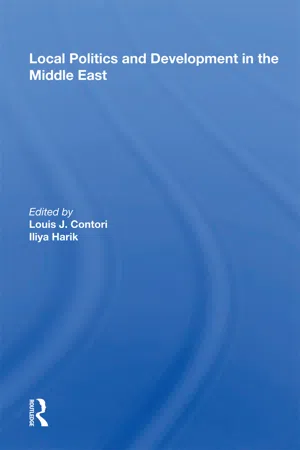
Local Politics and Development in the Middle East
About this book
Although development at the local level is a primary goal of most assistance schemes, most development agencies and banks know little of politics at the local level in developing countries. As a result, assistance programs generally lack relevance to indigenous populations and are--at the community level--viewed as being controlled from the "outside." The authors of this book concentrate on how local politics influence development in the Middle East, with the intent of encouraging more appropriate--and thus more effective--assistance programs. They discuss general policy issues and the nature of center-periphery relations in Middle East countries and delve into specific problems encountered in Egypt, Jordan, Lebanon, Syria, Iraq, Turkey, Tunisia, and North Yemen, showing how information about local political schemes can aid administrators of development programs in providing assistance that is acceptable--and accepted--at the local level. The case studies provide a broad base for planning, encompassing capitalist, state capitalist, and socialist systems in both rural and urban settings.
Information
1
Introduction
Louis J. Cantori and Iliya Harik
Scholarly attention to the study of local societies in the Middle East reflects three kinds of emphases. The first reflects the cultural and social concerns of anthropologists as expressed in ethnographic studies. This approach considers the local community as the unit of analysis by itself. A second scholarly concern views development of local societies in terms of center inspired service delivery or in terms of efforts to establish a dynamic developmental structure at the local level. A third emphasis is of a political nature and concerns the impact of national politics on local communities. Whether expressed in terms of political system, elites or class, the tendency in the third approach has been to focus more upon the macro national level rather than the micro local level. It is accurate to say that anthropological and developmental concerns account for the overwhelming majority of scholarly studies of local communities.
There are, however, four ways in which the political understanding of local communities is important. The first has to do with the policy aspect of development. How, where and by whom, and for whom development policy is formulated are important questions. A second factor has to do with the tendency in the Middle East, and perhaps the Third World generally, to institute policies of decentralization. By so doing, they give additional significance for the study of local communities. A third factor has to do with what Kesselman and Rosenthal have called a "national culture of localism," i.e., the manner in which local political relationships and values are projected on to the national level.(1) Whether observed in the kinship/consulative bedouin political style of Saudi Arabia or in the images of family and village in President Sadat's speeches, the tendency of national leaders to express or act in accordance with local values is in evidence. Related to the foregoing is a fourth political importance, namely the relationship of local societies to political stability. Political stability seems affected by local politics in at least two possible ways. The first has to do with political revolt itself (e.g. revolution, demonstrations, etc.). The Iranian revolution of 1979 appears to have been a relatively rare case of a rural based rebellion. Otherwise, political revolt appears more normally as an urban and not a rural phenomenon. Political stability is threatened less dramatically but in the long run just as seriously by the weakening of the legitimacy of the government. At a minimum such an eventuality can lead to economic non-performance in the often crucial agricultural sector which in turn might contribute to overall political deterioration and revolt.
The studies in this volume reflect the diversity of the research interests of their authors to say nothing of the ethnic, religious, cultural and geographical diversity of the Middle East. There are two perspectives, however, which are common to all the studies: the relationship between central political power and the local community and the nature of local political processes themselves. Hopkins focuses upon technology and the international economic order as background factors to his consideration of center-periphery relationship. Thus, the introduction of new techniques of agriculture in the nineteenth century was accompanied by the integration of the agricultural economies of the Middle East into the world capitalist system. In the period of the 1950's and 1960's, new social frameworks for development emerged (e.g., the revolutions and coups in Egypt, Iraq and Syria). In the third phase of the 1970's and '80's new technology such as dam construction, and mechanization ushered in a new phase of agribusiness under capitalist or state-capitalist auspices. Hopkins then goes on to enumerate what he feels are the characteristic patterns of center-periphery relations. Empirically Hopkins sketches the international economic system within which the succeeding studies in the volume are located. Theoretically, he presents an alternative conception of the locus of political power implicit to most of the studies. Hopkins offers the point of view of dependency theory that locates significant, if not total power, in the international capitalist system. Most of the other studies, however, tend to view such power as an aspect of the national center or the sub-national governmental institutions.
The studies of Egypt by Harik and Khadr deal with a country with a large history of continuous and highly centralized political authority. To a significant extent, that authority system was based upon a closely linked and politically effective combination of a landowning class and a modern professional middle class. When the British unilaterally granted Egypt a qualified national independence in 1922, this class of people gained greater power. The revolutionary regime of Gamal Abd al-Nasser eliminated this class and replaced it at the local level by new institutions of central governmental authority. Anwar al-Sadat's presidency, which started in 1970, inaugurated a policy of administrative and political decentralization in which local authorities were intended to exercise extensive responsibility for managing local affairs.
Khadr's study of the fishing society in Aswan shows clearly that during the Nasser period central political authority was in fact exerted in such a way as to reinforce a pre-existing local elite in its dominant position. It also documents whether as a result of alternative strategies to obviate this elite during the Nasser period or later in the Sadat period (only hinted at inasmuch as field research was carried out in 1975-76), the local elite may have changed its membership but it still governed local affairs.
Harik's study timewise deals with the period of President Sadat's policy of decentralization and the changes which were made in the Nasser implemented local institutions. It offers an outline of the different development strategies of Nasser and Sadat and makes an assessment of their failures and achievements at the local level. Unlike the Aswan fishing community studied by Khadr, elites in upper and lower Egypt examined by .Harik changed character under Nasser and Sadat, and political administrative structures became diversified. In terms of the impact of the center upon the periphery, it would appear that development is perhaps leading as a policy and a process towards reinforcing local elite dominance and possibly towards a greater degree of local political autonomy.
While this may be true of rural Egypt, Cantori and Benedict's study of a local Egyptian urban quarter differs significantly from those of Khadr and Harik both in terms of geographical location and in terms of focus. It complements a rural Egyptian representation by being concerned with urban Egypt. Its concern is primarily with perceptions of leadership roles rather than elite structure or center-periphery relations. Urban neighborhoods are purely residential in character and consist of individuals playing a diversity of occupational roles. If there is a single enterprise, as in the case of the madbah (slaughterhouse) in the Cantori and Benedict study, its relationship to the political center is legal and organizational but not one of government service delivery and/or supporting programs. Thus the urban neighborhood which is geographically closer to the political center is significantly more free from central control. An important factor contributing to the solidarity of the madbah neighborhood is the Sa'idi or southern Egyptian regional point of origin of its inhabitants. The strength of kinship factors among the people from that area of Egypt is well known by other Egyptians and contributes to a live and let live attitude towards the quarter.
Both Khadr's and Harik's studies identify the phenomenon of economically little diversified communities in their relationship to an assertive political center. The Tunisian community studied by Larson, on the other hand, is socially and economically mixed by reason of service, agricultural and mining occupations. She notes that policies from the center were hampered by their authoritarian nature and inadequacy for local conditions. She also stresses managerial deficiencies as impediments to successful implementation.
Center-periphery relations in Syria, on the other hand, appear different in nature due to institutional importance of the Ba'th Party as an instrument of mobilization. As Hinnebusch points out, however, the Ba'th Party is not a monolithic structure with strong authority at the center. Instead, for reasons having to do with its past history, its center has been fragmented and its local organization emanated less from the center than from particularly local conditions. Not only are its local branches dominated by local political elements but such ancillary organizations as the Youth Union and the Peasant Union are also locally dominated. Less like the case of Egypt and Tunisia, development seems to proceed within locally adapted governmental structures rather than around them or in spite of them. Egypt and Tunisia are political systems with a long tradition of centralized political rule. Syria is a new state in comparison, having been created after World War I, and therefore is less nationally integrated and stable than the other two countries.
Another new state, Jordan, has accomplished a similar degree of integration and extension of centralized political authority in a very different manner. Gubser presents a case study of the way in which effective political leadership from the center had first coopted nomadic domination of sedentary/urban populations, and then, by making them politically/socially mobile, was able to supplant their authority at the local level. The key to the success of this process has been the strong character of the king.
All of the preceding case-studies discussed so far, with the exception of Jordan, have been of socialist or socialist-oriented political systems, where the political role of the center has been an assertive one. Jordan is not different in this respect even when a market economy approach is the basis of analysis. The political center in Jordan asserted itself locally in order to establish political control.
Although a republic, Turkey resembles Jordan in that the political center asserts strong political control over local communities and lacks a socialist orientation. Kiray's study documents the impact upon the local community of the expansion of the modern market economy and the contraction of the traditional economy, as the communities livelihood shifts from near subsistence grain agriculture to fruit and vegetable truck farming and to industry. The study also indicates how a portion, at least, of the traditional local elite is able to capitalize upon this process and enrich themselves. Consistent with the general pattern of the preceding studies, development results in a greater degree of integration into the national political system but this is accompanied by the reinforcement of a local elite and the maintenance or even increase in local autonomy.
The question of local elites, the local autonomy of communities and a weaker role of the political center appears in an exaggerated form in the cases of Yemen and Lebanon. As Tutweiler points out in the case of Yemen, it is the local community that takes the initiative in development, both because it historically enjoyed autonomy and because of the political instability of the center in the years following the proclamation of a republic in 1962. Not only does Tutwiler's study document this process with respect to such projects as road building, but also how local elites have used traditional resources such as zakat (religious charitable contributions) for modern purposes. Tutwiler also shows how a traditional local elite is eventually replaced by a younger more modern one. As development proceeds, the periphery comes into a more dependent relationship to the center but there remains a sense in which the periphery appears to be sacrificing its local autonomy more on its own terms rather than those of the central government.
Joseph deals with a local urban community of Armenian refugees who settled in Beirut in the twenties and thirties and have since become naturalized Lebanese citizens. She points out that the Armenian community in Borg Hammond possesses both a highly disciplined political party and a variety of cultural organizations including ones with linkages to the world Armenian community. This effective organization is important to maintaining the Armenian community within the neighborhood, and in gaining benefits from the political center. In fact, however, the Armenians possess so much communal self-sufficiency that the political center figures little in their political or developmental progress. This ability to prosper on the basis of their own resources and through access to international agencies reflects the potential for autonomous community growth in a democratic system even while it also reflects the as yet unresolved question in contemporary Lebanon, of the proper balance of central political authority, and degree of local political autonomy.
In conclusion, two sets of concerns have been addressed in this volume. There are first the empirical generalizations relating parts of the system to each other. Second, there is the emphasis in policy and its impact on the process of local political and economic development.
The first of the empirical generalizations begins with a consideration of the nature of the political system within which the local community is located. It is obvious from the examples of Egypt and Yemen that the political center varies considerably in its effectiveness. Even when the center is effective the range of its impact upon the periphery will vary with its economic orientation toward development. This is reflected in the cases of the state socialist regimes such as Egypt, Syria and Tunisia on the one hand and the more free enterprise-oriented Turkish and Jordanian systems, on the other hand. In most of these regimes, rural communities are more likely to be targeted by central government. The largest sector of the labor force is in rural areas and government revenue is derived to a larger extent from the agricultural sector. The economic betterment of rural lower income populations, on the other hand, is most often a secondary objective. Urban populations, in contrast, are the focus of government bounties and services for considerations of their potential political threat in view of their physical location at the political center.
The second concern focuses on policy and underlines the importance of decentralization, local participation, effective management and human resources for the success of development strategies. It is possible to speculate on the preceding aspects of policy that while development may mean an increasing impact of the center upon the periphery, local autonomy may also be preserved or even increased in the process.
It should be clear from what already has been said and from a reading of the specific contributions that political development is the focus of this volume. Each one of the papers reflects a policy concern relevant to broader developmental perspectives, and may also hopefully serve the concerns of development students of other developing areas.
Footnotes
1. Mark Kesselman and Donald Rosenthal, Local Power and Comparative Politics (Beverly Hills, California: Sage Professional Papers in Comparative Politics, 1974).
2
Development and Center Building in the Middle East
Nicholas S. Hopkins
Introduction
This paper deals with the relationship between development and the creation of a strong central government in the Middle East, It explores the idea that those who sponsor development programs are interested not only in the potential economic benefits, but also in the political consequences. The outcome is thus to create a different kind of society, or perhaps to reinforce imaginatively an existing one, in which their own role and position will be enhanced. If development programs are designed at one level to improve the economic situation of one or another category in the population, that is never done without political calculation as well. Thus for instance, programs designed to raise the income level of the poorest segment of the population can be construed as strengthening the political position of the dominant sponsoring elite both directly in that such an improvement in the standard of living removes some of the pressure for a larger share in the pie from such populations, and also indirectly in that it absorbs such populations into the socio-economic structure organized and run by the elite and thus it gives the non-elite an interest in the continuity of this economic structure.
In other words, if we were to ask the questions, "Does development develop?", "What does development develop?", or "Whom does development develop?", the answers might be, for instance, that the real benefits of rural development are felt in the capital, while the relative difference between urban and rural, between rich and poor, may even increase. "Development" might be seen as developing above all a socioeconomic structure centered around the extraction of the surplus from the rural areas to the benefit of the wealthier urban areas, and aiding in the creation of new classes part of whose project it is to organize the integration of the country as a whole into the world capitalist system. Thus while the manifest function of "development" carried out under government auspices might be to raise the...
Table of contents
- Cover
- Half Title
- Title
- Copyright
- Dedication
- Contents
- Preface
- 1. INTRODUCTION
- 2. DEVELOPMENT AND CENTER BUILDING IN THE MIDDLE EAST
- 3. LOCAL LEADERSHIP IN URBAN EGYPT: LEADER, FAMILY AND COMMUNITY PERCEPTIONS
- 4. CONTINUITY AND CHANGE IN LOCAL DEVELOPMENT POLICIES IN EGYPT: FROM NASSER TO SADAT
- 5. LOCAL PATTERNS OF LEADERSHIP AND THE DEVELOPMENT OF THE ASWAN HIGH DAM LAKE
- 6. SYRIA: THE ROLE OF IDEOLOGY AND PARTY ORGANIZATION IN LOCAL DEVELOPMENT
- 7. NEW INSTITUTIONS AND PROCESSES IN A TRADITIONAL SETTING: EXAMPLES FROM AL-KARAK, JORDAN
- 8. LOCAL-LEVEL POLITICS AND DEVELOPMENT IN LEBANON: THE VIEW FROM BORJ HAMMOUD
- 9. TA AWUN MAHWIT: A CASE STUDY OF A LOCAL DEVELOPMENT ASSOCIATION IN HIGHLAND YEMEN
- 10. NATIONAL SEEDS IN LOCAL SOIL: WILL DEVELOPMENT GROW?
- 11. DEVELOPMENT IN RURAL TURKEY: LEADERSHIP OR PATRONAGE?
- About the Contributors
- Index
Trusted by 375,005 students
Access to over 1.5 million titles for a fair monthly price.
Study more efficiently using our study tools.
Frequently asked questions
Yes, you can cancel anytime from the Subscription tab in your account settings on the Perlego website. Your subscription will stay active until the end of your current billing period. Learn how to cancel your subscription
No, books cannot be downloaded as external files, such as PDFs, for use outside of Perlego. However, you can download books within the Perlego app for offline reading on mobile or tablet. Learn how to download books offline
Perlego offers two plans: Essential and Complete
- Essential is ideal for learners and professionals who enjoy exploring a wide range of subjects. Access the Essential Library with 800,000+ trusted titles and best-sellers across business, personal growth, and the humanities. Includes unlimited reading time and Standard Read Aloud voice.
- Complete: Perfect for advanced learners and researchers needing full, unrestricted access. Unlock 1.5M+ books across hundreds of subjects, including academic and specialized titles. The Complete Plan also includes advanced features like Premium Read Aloud and Research Assistant.
We are an online textbook subscription service, where you can get access to an entire online library for less than the price of a single book per month. With over 1.5 million books across 990+ topics, we’ve got you covered! Learn about our mission
Look out for the read-aloud symbol on your next book to see if you can listen to it. The read-aloud tool reads text aloud for you, highlighting the text as it is being read. You can pause it, speed it up and slow it down. Learn more about Read Aloud
Yes! You can use the Perlego app on both iOS and Android devices to read anytime, anywhere — even offline. Perfect for commutes or when you’re on the go.
Please note we cannot support devices running on iOS 13 and Android 7 or earlier. Learn more about using the app
Please note we cannot support devices running on iOS 13 and Android 7 or earlier. Learn more about using the app
Yes, you can access Local Politics and Development in the Middle East by Louis J. Cantori,Iliya Harik in PDF and/or ePUB format, as well as other popular books in Politics & International Relations & Middle Eastern Politics. We have over 1.5 million books available in our catalogue for you to explore.