- 352 pages
- English
- ePUB (mobile friendly)
- Available on iOS & Android
eBook - ePub
About this book
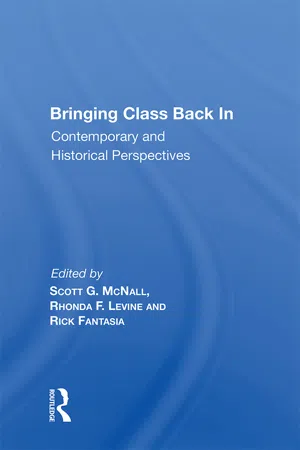
In recent years, a flurry of "poststructuralist," "post-Marxist," and "statecentered" approaches have emerged in historical and sociological scholarship. Far from ignoring these developments, the study of class has shaped and been shaped by them. As the selections in this volume indicate, class analysis changes and develops, while sustaining itself as a powerful, refined working tool in helping scholars understand the complexities of social and historical processes. This volume provides a cross-section of the rich body of social theory and empirical research being produced by scholars employing class analysis. It demonstrates the variety, vibrancy, and continuing value of class analysis in historical and sociological scholarship. The work of promising young scholars is combined with contributions from well-established figures to produce a volume that addresses continuing debates over the relationship between structure and agency, the centrality of class relations, and the dynamics of class formation, class culture, and class consciousness.
Information
1 Introduction
SCOTT G. MCNALL RHONDA F. LEVINE RICK FANTASIA
Class is one of the most widely used and thoroughly contested concepts in the social sciences. There is little agreement among social scientists in general, and sociologists in particular, on the exact meaning of class or the explanatory power of the word itself. It resonates with political meaning for some, but for others it means no more than an individual's position on a scale that correlates years of education, income, and occupation.
Those who study class fall into two camps. On one side, we find class theorists who work in a tradition born in the 1960s and 1970s. Jerry Lembcke points this out in his chapter on the analysis of the U.S. working class in this volume. In the context of stalled campus and civil rights movements in the United States, many class theorists looked to the success of Marxist movements in other countries and pondered the role of the working class in transforming industrial societies. This led to questions about the changing composition of the working class and about whether that class, especially in advanced industrial countries, had retained its special role. That is, why wasn't the working class fulfilling the destiny identified for it by Marxist theory? This prompted these theorists to ask whether there were any real or meaningful differences between the working class and the middle class. Much effort has been expended in developing a Marxist map to help chart changed class structures and understand the nature of the middle or new classes.
The chapters that follow move beyond that concern. One of the primary goals of this volume is to recapture the central elements of a Marxist class analysis and show how and why it is more efficacious than other approaches for understanding class in comparative and historical perspective, as well as for understanding modern industrial societies. But before tracing the elements that such an analysis would involve, let us characterize the other theoretical camp, which uses the Weberian perspective, and consider why one perspective might be favored over another.
The hallmark of the Weberian perspective, as Löic J.D. Wacquant notes, is its multidimensionality. Class is understood as the summation or some weighted combination of a variety of position effects, e.g., property, income, occupation, authority, education, or prestige. Class is both objective and subjective and can be realized in the realm of consumption as well as the realm of production. In a Weberian schema, production and property relations are important but by no means sole determinants. Weberian conceptualizations, therefore, deny the antagonistic character of capitalist social relations of production and describe class in terms of exchange and market relations (see, for instance, Giddens [1973] and Parkin [1979]). In short, common life-chances define a basic class. In a Weberian system, classes can be divided and subdivided at will, as Erik Olin Wright notes. All that a theorist need do, for example, is show that people within certain categories, such as professional, technical, or managerial groups, have some sort of marketable skill that gives them an advantage over another category of people in the labor market. This method of conceptualizing classes has a number of limitations, as well as some advantages.
As we have already noted, Weberians take the market as given, ignoring the class struggles that led to the creation of a specific economic system. Neither the polity nor the economy are seen as actively created or as problematic. As a corollary, because class is seen as relational rather than oppositional, Weberians miss the dual nature of class formation and struggle. They neither assume nor look for underlying conflicts of material interest. Weberians are not interested in developing a schema to explain similarities and differences of classes across cultures and through time or in comparing and contrasting precapitalist and postcapitalist societies. The Weberian framework, then, imposes severe constraints on a theorist's ability to conceptualize and understand large-scale processes of social change.
Also, a Weberian perspective, because of its focus on skill level and individual attributes, does not examine class capacities, as Lembcke argues. Class capacity generally refers to the ability of the working class to liberate itself, as a class, from subordination to the capitalist class. If one believes class position and capacity are based on skill levels, then one would necessarily have to conclude that the potential for the working classes to effect political and economic change is presently limited. If, on the other hand, one believes class capacity is based on a collectivity that is more than the sum of its parts, then the situation is reversed. And, indeed, as Lembcke notes, scholars such as Rick Fantasia (1988) have found that cultures of solidarity are an important aspect of working-class culture—a finding that would not have been possible using a Weberian approach. What a Weberian perspective (Parkin 1979, p. 25) can do is draw a map of society that locates people in terms of differences in property, skills, or authority. It can compare, with relative ease, the class composition of different countries and quickly determine whether some category of people sharing the same life-chances is expanding or contracting, using such an additive model.
However, neither the Weberian nor the Marxian perspective is static. Moreover, the divide between the two approaches has been dissolving, as both Weberians and Marxists focus on problems of proletarianization, the role of credentials and culture in creating and maintaining class boundaries, and the independent role played by bureaucracies in structuring the middle classes. Both may also view status not as a passive attribute but as one means by which fractions of a class actively organize to protect their relative standing from challenges (Foster 1974, Wallerstein 1979). Nevertheless, the Marxist model remains distinctive because of its focus on class conflict and its steadfast hold on the concept of exploitation.
Though classes are obviously of critical importance in Marx's view of history and the development of capitalism, he offers no systematic analysis of the concept of class. And generations of scholars since Marx have yet to arrive at a consensus over the various aspects of the concept of class (Wright 1980). The essential features for any Marxist analysis of class are that classes are defined in relationship to other classes within a given system of production, as Kathleen Stanley and Dean Braa, along with others, note in this work. The social relations of production form the material basis of class, rather than market relations or relations of exchange. Further, the nature of capitalism is such that social classes stand in contradictory and antagonistic relations with one another, and capitalist social relations are exploitative because one category of people must sell their labor power to survive, while another purchases labor power to make a profit. In other words, class struggle revolves around the relations of production; it is fundamentally a struggle over surplus value or the rate of exploitation (Godelier 1978; Prezworski 1980). The contradiction of capitalism, revealed in the age-old struggle between capitalists and workers, is expected to persist until a new system emerges, based on different social relations of production. In Marx's vision, the working class is the historical agent destined to change the system of exploitation.1 Class, from a Marxist perspective, is therefore "simultaneously an objective and subjective phenomenon, both something independent of members' consciousness and something expressed in conscious thought and practice" (Therborn 1983, p. 39, emphases added).
One of the primary elements of class, as an objective phenomenon, is class structure (Hobsbawm 1984). This term simply refers to the diverse economic locations or positions (e.g., white-collar, blue-collar, managerial) that make up a society. Class structure is important because it sets objective limits to the historical development of class struggles (Zeitlin 1980). For example, at any given moment, one group might be numerically superior to another, which could heighten its chance for economic and political success (Katznelson 1986). Class struggle, on the other hand, can also affect class structure because it simultaneously "shapes and realigns the internal relations within classes and the relation between them. . . . In this sense, and to this extent, classes possess an inherently contingent historicity. They are determined by their place in a historically specific ensemble of production relations and by their self-activity, which constitutes and reconstitutes these relations and their place within them" (Zeitlin 1980, p. 3, emphases in original).
Here, we have an answer to those who challenge Marxist definitions of class on the grounds that the working class has not produced revolutionary movements throughout the world. First, as Aristide Zolberg (1986) has pointed out, though capitalism required a working class, it did not require it in a particular form. The working classes in some countries have been revolutionary, and in others they have not, depending on specific historical circumstances. This does not mean, however, that there is ever an absence of conflict. It means, as we will see from our contributors, that conflict can be channeled in ways that inhibit revolution. Second, there is no necessary correspondence between economics and politics in general, in spite of what Marx might have implied at points in his writing.
To summarize, we have noted that class has an objective and subjective component, is a process, is defined in opposition to other class processes, and is historically contingent. It is not, we hasten to add, that the economy does not count, simply that classes are made and unmade in history, not given. Let us consider the question of historical contingency by drawing on Zolberg (1986, pp. 431-50), who cited differences in British and U.S. class structures and explored the ways in which they were affected by differences in the mode of production and the polity.
British industrial development preceded that of the rest of the world by almost half a century. As a result, wage levels were higher there than in other countries, and an aristocracy of labor evolved. As Marc W. Steinberg demonstrates, the formation of British working-class ideology depended on how British workers crafted a vocabulary to deal with their circumstances out of available streams of discourse. Trade unionism was something of a folk invention. British workers were also an ethnically homogeneous group, huddled together into large industrial communities. These communities were welded together by common work experiences, leisure activities, and the local pub and music hall. And workers had no difficulty in seeing the differences between themselves and the owners. As E. P. Thompson (1963) and others (Hobsbawm 1984; Stedman Jones 1983) have demonstrated, a distinctive working class arose in the latter half of the 1800s after a strong state system had developed and before an elaborate mass party system was formed. When mass-based parties did develop, they tended to serve distinct class groupings, which meant that the working class had an organizational basis from which to mount an assault on the state and on other classes and with which to work for policies that served its distinct interests. The British working class was relatively effective in developing as a unique entity and defending its interests because it constituted the majority of the work force.
The situation in the United States was quite different. In the first place, the United States was actually more industrialized than Great Britain, if we measure industrialization by degree of capital intensity or calculate it in terms of horsepower per capita. This meant that fewer skilled and unskilled workers were needed to fuel the capitalist economy. One consequence was that a large white-collar class arose very early in the process of industrialization. Another important difference between Britain and the United States was that much of the U.S. labor supply came from immigration. By 1910, for instance, over one-fourth of the labor force was foreign born, with concentrations as high as one-third in manufacturing and one-half in mining (Zolberg 1986, p. 442). Many of these immigrants had no intention of staying, which contributed to the rise of business unionism for transient immigrant workers who were tied closely to the workplace and were interested, primarily, in higher wages. Again, because the work force was composed of immigrants, it was segregated by ethnicity, which contributed in the long run to the emergence of a segmented labor market that, of course, still exists. In addition, democracy preceded industrialization in the United States, which meant that transclass parties had developed before the end of the nineteenth century. These parties served to blur and mediate class tensions, as did other U.S. transclass organizations, such as churches and fraternal orders (see Orr and McNall, this volume). Paradoxically, then, and in contradistinction to what Marx thought, it was often in those countries where the impact of capitalism was most brutal that transclass political parties mitigated its effects by integrating people into the political sphere (Zolberg 1986, p. 452). This, of course, does not tell the whole story of class formation in Great Britain and the United States for we would also have to consider such factors as the world wars and how they suppressed class consciousness, the effect of ethnic divisions, and how the upper and middle classes mobilized (see, for example, Mintz and Roy in this volume). But this brief characterization does provide an illustration of what we mean when we say that class is contingent. However, this does not mean that we cannot talk meaningfully about the process of class formation or what the role of the polity or the economy will be. We must simply make reference to distinct historical and comparative examples to understand the process and the outcome.
Shelley Feldman suggests that if we are to understand contemporary class formation and class relations within Bangladesh (and thus, by extension, within any country), we must also (1) consider how a particular economy is inserted into the global marketplace, (2) consider those international class relationships that shape relations of accumulation, and (3) be aware of particular configurations of state-class relationships. Bangladesh has experimented over the last three decades with ways to expand the industrial sector and incorporate the rural proletariat. These experiments failed because the structural conditions necessary for success were lacking; the colonial experience and a devastating war of independence had eroded institutional infrastructures and provided no industrial elite. This left room for a rural elite to dominate in the countryside and control the flow of resources designed to transform production. The capitalization of Bangladeshi agriculture thus significantly increased the number of landless and marginal producers as well as the pressures on the rural labor market. At the same time, these landless laborers had few opportunities to move into the industrial sector, with the consequence that proletarianization was intensified. New programs have been designed to provide credit to simple commodity producers in rural areas, but these have caused family members to exploit themselves and one another (particularly men exploiting women in the family) as they strive to produce and pay back small loans. In short, another program for development is foundering on the shoals of previously existing class structures and relationships. The past continues to shape the future.
This is what Stephen Valocchi finds when he explains differences in the welfare systems of Britain, Sweden, and the United States. As he shows clearly, the state served to mediate the effects of class forces on policymaking in ill cases; that is, no class was able to institute its entire agenda. However, some were more successful than others, which could be accounted for by seeing state structures as the products of previous class struggles and compromises and as embodying the interests of those who had won those struggles. Not surprisingly, as Valocchi points out, the winners of previous battles were the best organized members of the capitalist class. But the influence of this class on welfare policy was, in turn, determined by the extent to which precapitalist elites or other segments of capital had embedded themselves within the state. In short, historical class compromises and coalitions had become part of the state structure that influenced future policy decisions.
As Carl Strikwerda demonstrates, members of Belgian working-class communities in Ghent, Brussels, and Liège responded in very different ways to the process of industrialization. They did not form one united Belgian working class because they were divided over the issue of religion and because, within the cities he studied, distinctive local politics and economic structures were key variables in determining class relationships and formation. Thus, multiple cultural identities and power relationships shaped the development of working-class formation. For instance, all three cities had Socialist movements, and all Socialists were ve...
Table of contents
- Cover
- Half Title
- Title
- Copyright
- Contents
- Preface
- 1 Introduction
- PART I CLASS STRUCTURE
- PART II CLASS FORMATION
- PART III CLASS POWER, CONFLICT, AND STRUGGLE
- PART IV CULTURE, IDEOLOGY, AND CONSCIOUSNESS
- About the Book and Editors
- About the Contributors
- Index
Trusted by 375,005 students
Access to over 1.5 million titles for a fair monthly price.
Study more efficiently using our study tools.
Frequently asked questions
Yes, you can cancel anytime from the Subscription tab in your account settings on the Perlego website. Your subscription will stay active until the end of your current billing period. Learn how to cancel your subscription
No, books cannot be downloaded as external files, such as PDFs, for use outside of Perlego. However, you can download books within the Perlego app for offline reading on mobile or tablet. Learn how to download books offline
Perlego offers two plans: Essential and Complete
- Essential is ideal for learners and professionals who enjoy exploring a wide range of subjects. Access the Essential Library with 800,000+ trusted titles and best-sellers across business, personal growth, and the humanities. Includes unlimited reading time and Standard Read Aloud voice.
- Complete: Perfect for advanced learners and researchers needing full, unrestricted access. Unlock 1.5M+ books across hundreds of subjects, including academic and specialized titles. The Complete Plan also includes advanced features like Premium Read Aloud and Research Assistant.
We are an online textbook subscription service, where you can get access to an entire online library for less than the price of a single book per month. With over 1.5 million books across 990+ topics, we’ve got you covered! Learn about our mission
Look out for the read-aloud symbol on your next book to see if you can listen to it. The read-aloud tool reads text aloud for you, highlighting the text as it is being read. You can pause it, speed it up and slow it down. Learn more about Read Aloud
Yes! You can use the Perlego app on both iOS and Android devices to read anytime, anywhere — even offline. Perfect for commutes or when you’re on the go.
Please note we cannot support devices running on iOS 13 and Android 7 or earlier. Learn more about using the app
Please note we cannot support devices running on iOS 13 and Android 7 or earlier. Learn more about using the app
Yes, you can access Bringing Class Back In by Scott G. McNall in PDF and/or ePUB format, as well as other popular books in Social Sciences & Sociology. We have over 1.5 million books available in our catalogue for you to explore.