eBook - ePub
Engineering Project Management
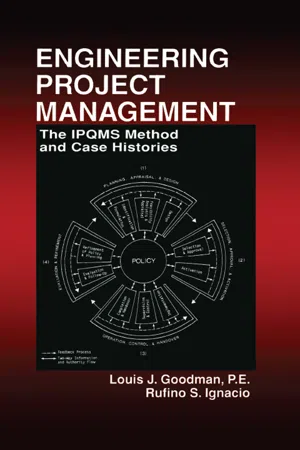
The IPQMS Method and Case Histories
- 232 pages
- English
- ePUB (mobile friendly)
- Available on iOS & Android
eBook - ePub
About this book
This book presents IPQMS (Integrated Planning and Quality Management System) as a powerful management methodology. This system ensures cost-effectiveness as well as quality in the constructed project, environmental cleanups, and other sectors - providing an integrative force for essential teamwork in industry and government. This book contains business and engineering case studies, illustrating a principle, issue, or approach in making a decision. Each case study examines the spectrum of a particular project, demonstrating the interrelationships among policy makers, planners, designers, implementers, and managers in creating a project.
Information
1 | A Case for Infrastructure Renewal with Accountability |
1.1 INTRODUCTION
The main purpose of this book is to introduce the IPQMS (Integrated Planning and Quality Management System) and related case histories that represent autopsies or postmortems of projects. Experience shows that lessons learned from past costly mistakes and disasters are invaluable in achieving quality projects on time and on budget.1,2 This is the first book to show how to prepare guidelines and checklists for new programs or projects. The 20-year study demonstrated that the IPQMS can be adapted to programs and projects in different sectors. It can also be adapted to the growing trend for design-construction projects. The use of this system will be applied to rebuilding America’s infrastructure (Chapter 10).
The economic and social well-being of a nation are directly related to the quality of its infrastructure and environment. The demise of past civilizations — Egyptian, Roman, Inca, and others — accelerated when they stopped maintaining and improving their public works. Unfortunately, the U.S. is now guilty of ignoring the inadequacy of its infrastructure. Indeed, this is happening despite the efforts of the Rebuild America Coalition, which was established in 1987.3
1.2 OUR DETERIORATING INFRASTRUCTURE
America is at a crossroads in its battle to maintain economic strength and quality of life. Both are jeopardized by the nation’s apathy toward repairing and expanding our existing national infrastructure, and cleaning up the environment. Infrastructure covers highways, bridges, airports, water supply systems, wastewater treatment plants, solid waste disposal facilities, and public schools. It includes the need to provide clean air and water, and control disease. Thus, it is a basic need to sustain and further economic and social growth in all nations.
It is estimated that 60 percent of the nation’s highways need work, ranging from repaving to major structural rehabilitation. According to the Federal Highway Administration4, ±35 percent of the 575,000 highway bridges in the U.S. are structurally deficient or functionally obsolete. Some cities have water-main leaks that lose up to 30 percent of their water supply every day. Such widespread decline threatens to disable entire systems made unstable by delayed maintenance and stop-gap repairs. Conservatively, the loss of man hours and fuel because of detours and traffic congestion costs both industry and the public sector over $30 billion each year, and the cost is increasing.3
In addition, nearly 31 percent of America’s public schools were built before World War II. Thus, about a third of the country’s 42 million schoolchildren are trying to prepare for adult life in schools that lack proper heat, ventilation, and bathroom facilities.
Directly related to public health is the on-going pollution of our nation’s lakes, rivers, streams, and bays. This is compounded by outbreaks of bacteria in municipal drinking water supply systems, such as the one that made 400,000 people sick in Milwaukee in 1993.3
Though much progress has been made since the Clean Water Act of 1972, the task requires constant attention. Much remains to be done. A profile of U.S. water resources includes the following:3
• More than 3.5 million miles of rivers and streams
• 62,000 square miles of lakes, ponds, and reservoirs
• 5,300 miles of Great Lakes shoreline
• 37,000 square miles of estuaries
As of 1992, states reported the following:
• 8 percent of rivers, 43 percent of lakes, and 13 percent of estuaries were contaminated with toxic chemicals
• Of the assessed rivers, 38 percent are polluted to the point where they fail to meet designated uses
• 44 percent of lakes, ponds, and reservoirs fail to meet designated uses
• 97 percent of the Great Lakes shoreline miles fail to meet designated uses
In addition to the foregoing, there is the problem of hazardous waste which impacts public health in all 50 states. The number of toxic waste sites has increased despite the efforts of the Environmental Protection Agency’s Superfund Program. Public health problems were found to be worse with the official exposure of the nuclear weaponry research in 1992 — thousands of contaminated sites in 13 states.5,6 The nuclear weaponry resulted from secret bomb factories and represents a total collapse of ethics and accountability in our government and the defense contractors.
The foregoing infrastructure and related environmental problems are compounded by the serious problems in the U.S. construction industry. Our construction industry is one of the nation’s largest single industries, and, unfortunately, it is also the most fragmented and least progressive.
Without continuous investment in infrastructure, a modern economy fails to grow. Our economic competitors are keenly aware of this. All of the major industrialized countries invest a higher percentage of gross domestic product in public works than the U.S. (Japan leads all of the G-7 countries. In 1992, its infrastructure investment was roughly triple that of the U.S. It also leads in productivity growth, about triple the rate of our country.) Rhetoric about laying the foundation for a better America rings hollow when we are last on the list of countries investing in their own economic future.
Infrastructure requires continuous attention. Federal, state, and local governments, under pressure to cut budgets, often delay maintenance and repair. This, of course, is not economical at all, but the most expensive form of underinvestment. Instead of leaving behind more than we found, our legacy to our children will be to break the unspoken promise of a better life, to pass on the debts we didn’t pay and a diminished quality of life. It’s not too late to make good on that promise, but as a nation we must act now. The necessary action must ensure optimization of dwindling resources to provide infrastructure rebuilding that is cost effective and high quality. This will require accountability! This will require the use of an integrated planning and quality management system such as the IPQMS.
1.3 STATUS OF THE ENVIRONMENT
Before the 1970s, few people worried about hazardous waste as long as they were not affected by the harmful by-products. The first national concerns on the dangers to life resulting from contamination of the environment were highlighted with the passage of the National Environmental Policy Act (NEPA) in 1969. NEPA created the Environmental Protection Agency (EPA) in 1970 with a mandate to safeguard the nation’s environment. Section 102 of NEPA outlined the specific requirements that any proposed action, such as new programs or projects, would have to meet in terms delineating the environmental impact and providing for public comment.
Unfortunately, in the past, no provisions were made for dumping of hazardous wastes. This severe problem was compounded by two facts: (1) the U.S. military is the nation’s largest polluter and its activities have been covered up by its classified (secret) status, and (2) engineers and scientists found that the EPA-accepted method of containing most waste materials in the 1970s was flawed. Despite special linings and barriers to prevent the waste from seeping, leaks occurred after a few years of “containment”. These leaks seeped into the water supplies of communities and wildlife habitats.
The nation was shocked in the 1970s when the story of Love Canal in upstate New York hit the media. Dumping started in the 1920s and accelerated after Hooker Chemical Company purchased the property in the 1940s. Engineers at the Hooker Chemical Company plant in California advised their superiors that the company was creating a serious public health problem by violating pollution limits and dumping toxic wastes. The Love Canal tragedy erupted a few years later when construction of a new school broke the clay seals that had held the chemicals inside. The highly toxic chemicals seeped through the soil toward the school and hundreds of homes surrounding the canal. Over 400 different chemicals were eventually identified, with some known to cause birth defects and cancer. Love Canal was found to be the “tip of the iceberg” — one of thousands of hazardous waste sites across the country.
From an environmental standpoint, Love Canal was not an isolated event. By 1978 the public had already witnessed dozens of environmental and public health disasters: a fire on the surface of the Cuyahoga River in Ohio, an enormous oil spill in Santa Barbara, the Kepone poisoning of the wells of Hopewell, Virginia, the inadvertent mixture of cancer-causing fire retardant with cattle feed in Michigan, the 17,000* containers of hazardous chemicals found in the “Valley of the Drums” near Louisville, the release of a dioxin cloud over Seveso, Italy, and a massive cluster of birth defects among infants in a Woburn, Massachusetts neighborhood.
There are many forms of hazardous wastes, produced by industries such as manufacturers of chemicals, paints, petroleum products, and electrical equipment. In addition, the U.S. military and its contractors are major producers of toxic waste from nuclear weaponry research and development. In fact, all military installations have contaminated the environment with no regard for public health and safety.
The federal government has identified approximately 450 substances as hazardous to public health and the environment. For example, dioxin is one of the most toxic substances known. It covers a class of 75 chlorine-related compounds which are waste by-products from the manufacturing of chemicals and paper products. These toxic materials have been dumped in landfills and waterways, ending up in drinking water supply systems and food systems, including fish. Other chemicals that threaten health and the environment include polychlorinated biphenyls (PCBs). PCBs have been used to make paint, plastics, adhesives, and printing ink. They can cause cancer, birth defects, and skin diseases. Mercury is another industrial waste byproduct that is poisonous — and yet has found its way into the food system from waterways.
In addition to the foregoing, there are many problems resulting from nuclear waste, including power plants and nuclear weaponry research and development. The latter is a “time bomb” because of the secret status of the research during the Cold War era, 1947–1992. There are untold thousands of sites on military bases and installations where tens of billions of gallons of toxic and radioactive wastes have been dumped into porous soil.
The discovery of Love Canal and scores of other dangerous chemical waste sites ignited fear and outrage across the country in the late 1970s. Galvanized into action — largely to remove immediate threats in communities such as Love Canal, New York — Congress in 1980 enacted the Comprehensive Environmental Response, Compensation and Liability Act (CERCLA), which quickly became known as Superfund. The law provided $1.6 billion in cleanup funds and gave the EPA authority to force parties responsible for the contamination to conduct the cleanups or repay the federal government for its cleanup costs.
Superfund’s implementation has attracted almost continual criticism since its inception. In its first years, congressional investigations into allegations of mismanagement and political manipulation of the program led to the resignation of EPA’s administrator and the incarceration of the Superfund program’s top official. In addition, the EPA Superfund was placed on the government’s list of high-risk programs in 1992.7 Seventeen federal programs were so rated because of their vulnerability to waste, fraud, abuse, and mismanagement. Meanwhile, the number of highly toxic sites had grown to over 1300 in 1994, after spending over $14 billion. The EPA Superfund Programs 1, 2, and 3 (1980–1995) are discussed as an IPQMS postmortem in Chapter 8.
In addition to the industrial dumping of hazardous wastes into the environment for many years, we now find that there are thousands of sites at military bases and installations contaminated by nuclear wastes from the Cold War era (1947–1992) research and development of nuclear bombs and weaponry.5,6
Evidence of the on-going contamination is presented in the next section on the bomb factories. Additional evidence is documented in the IPQMS postmortems of the operation of the Trans-Alaska Pipeline System (Chapter 6), the EPA Superfund Programs 1 to 3 (Chapter 8), and the Hanford Nuclear Reservation (Chapter 9).
1.4 NUCLEAR WASTE CONTAMINATION
The age of nuclear energy, now over 50 years old, has given the world a great source of energy for both good and evil. On the one hand, it has helped to provide the electric power that does so much to make our lives more productive and enjoyable. On the other hand, it has terrorized us with the awful weapons it has created and the dama...
Table of contents
- Cover
- Half Title
- Title Page
- Copyright Page
- Dedication
- Table of Contents
- Foreword
- Chapter 1 A Case for Infrastructure Renewal with Accountability
- Chapter 2 The Integrated Planning and Quality Management System (IPQMS)
- Chapter 3 The IPQMS and Case Histories
- Chapter 4 Guidelines for Researching and Writing IPQMS Case Histories
- Chapter 5 The Trans-Alaska Pipeline System (TAPS): Planning, Design, and Construction (1968-1977)
- Chapter 6 The Trans-Alaska Pipeline System (TAPS): Operations of the Pipeline (1977-1997)
- Chapter 7 The Washington Public Power Supply System: Nuclear Power Plants 1968-1992
- Chapter 8 The EPA Superfund Programs 1, 2, and 3, 1980-1995
- Chapter 9 Executive Summaries of Two Additional Cases
- Chapter 10 How to Use Lessons Learned in Rebuilding Infrastructure and Cleaning the Environment
- Appendix A Abstracts of Case Studies and IPQMS Case Histories
- Appendix B Sample IPQMS Checklist
- Appendix C Members of International, Multidisciplinary Project Team, 1975-1983; Contributors, 1984-1997
- Selected Bibliography
- Index
Trusted by 375,005 students
Access to over 1.5 million titles for a fair monthly price.
Study more efficiently using our study tools.
Frequently asked questions
Yes, you can cancel anytime from the Subscription tab in your account settings on the Perlego website. Your subscription will stay active until the end of your current billing period. Learn how to cancel your subscription
No, books cannot be downloaded as external files, such as PDFs, for use outside of Perlego. However, you can download books within the Perlego app for offline reading on mobile or tablet. Learn how to download books offline
Perlego offers two plans: Essential and Complete
- Essential is ideal for learners and professionals who enjoy exploring a wide range of subjects. Access the Essential Library with 800,000+ trusted titles and best-sellers across business, personal growth, and the humanities. Includes unlimited reading time and Standard Read Aloud voice.
- Complete: Perfect for advanced learners and researchers needing full, unrestricted access. Unlock 1.5M+ books across hundreds of subjects, including academic and specialized titles. The Complete Plan also includes advanced features like Premium Read Aloud and Research Assistant.
We are an online textbook subscription service, where you can get access to an entire online library for less than the price of a single book per month. With over 1.5 million books across 990+ topics, we’ve got you covered! Learn about our mission
Look out for the read-aloud symbol on your next book to see if you can listen to it. The read-aloud tool reads text aloud for you, highlighting the text as it is being read. You can pause it, speed it up and slow it down. Learn more about Read Aloud
Yes! You can use the Perlego app on both iOS and Android devices to read anytime, anywhere — even offline. Perfect for commutes or when you’re on the go.
Please note we cannot support devices running on iOS 13 and Android 7 or earlier. Learn more about using the app
Please note we cannot support devices running on iOS 13 and Android 7 or earlier. Learn more about using the app
Yes, you can access Engineering Project Management by Louis Goodman,Rufino Ignacio in PDF and/or ePUB format, as well as other popular books in Technology & Engineering & Project Management. We have over 1.5 million books available in our catalogue for you to explore.