eBook - ePub
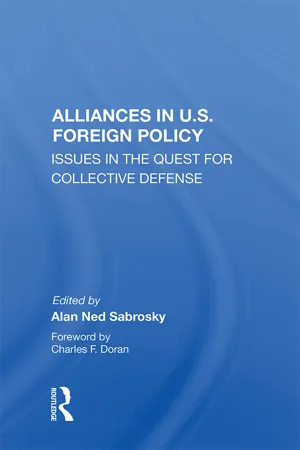
Alliances in U.S. Foreign Policy
Issues in the Quest for Collective Defense
- 168 pages
- English
- ePUB (mobile friendly)
- Available on iOS & Android
eBook - ePub
About this book
This volume addresses a selected set of issues that appear to be especially salient with regard to alliances in U.S. foreign policy in general and to North Atlantic Treaty Organization in particular, presenting questions about alliance purpose and cohesion that demand a response.
Information
1
Alliances in U.S. Foreign Policy
Alan Ned Sabrosky
Introduction
Scarcely a day passes without some reference to "alliances" or "international partnership" appearing in the media. We are told that the North Atlantic Treaty Organization (NATO) is in difficulty because of divisions within it over trade relationships with the Soviet Union. We hear of commitments which the United States has undertaken to safeguard the security of Israel. We recall the uncertainty that appeared in Washington as the South Atlantic War of 1982 pitted two allies, Great Britain and Argentina, against one another over the Falklands (or Malvinas, as the Argentines called them). We may reflect upon various assertions that the United States remains a reliable guarantor of the security of its partners, despite certain misadventures in Southeast Asia in the past decade. And we may view with either chagrin or satisfaction (depending on our politics and the issue at hand) the U.S. Government's decision to forego concluding a formal alliance with South Africa, to speak of Saudi Arabia as an ally, and to warn that the fall of the pro-American government in El Salvador may threaten other U.S. allies in Central America.
What is all too often lost in such considerations, however, is a full understanding of both the diverse character of alliance relationships in the modern world, and the proper role of alliances in U.S. foreign policy. All alliances are not created equal. They do not endow their members with the same degree of safety or influence in world politics, however convenient it may be in some circles to present alliances in such an oversimplified way for public consumption. And they do not play an equally obvious or important role in U.S. foreign policy, however comfortable we may have become with their presence since the end of the Second World War.
The object of this paper is to bring an added measure of clarity to our understanding of America's alliances in the contemporary international order. This will be done in four steps. First, I will discuss the concept of alliance in a general sense. Second, the U.S. experience with alliances will be appraised. Third, I will briefly examine one of this country's most current foreign commitments—NATO—in light of that experience. Fourth, and finally, I will outline the preferred role alliances should play in the years ahead, and how this country might best move in that direction, in order to provide a framework upon which the following chapters may build.
Alliances in World Politics
Consensus on anything is rare in world politics. Few, however, disagree with the contention that alliances traditionally have been seen as one of the essential elements of any balance of power system. Within that context, alliances may be seen as a "resource" which nations seek to use to achieve certain objectives.1 One such objective is to augment implicitly the power a state may bring to the game of nations, giving it more political leverage during peacetime than it would be able to provide for itself alone at the same cost and risk. Another objective is to enhance the stability of the relevant international system by using an alliance either to deter a potential adversary or to restrain a rambunctious associate. And a third national objective is to have a wartime partner, augmenting its own capabilities and avoiding a "worst case" outcome of having to fight alone. In all instances, of course, the controlling principle is theoretically straightforward: an alliance must enhance a nation's security, or at least not undermine it.
A number of factors influence the extent to which an alliance actually gives a nation the potential to attain the aforementioned objectives in accordance with that general principle. These include a nation's position in the international hierarchy and the distribution of effective power in the world; variations in its definition of national interests and foreign policy goals; and the quality of its leadership, as well as the efficiency of its governmental decisionmaking apparatus. These, and similar, considerations necessarily enter into any assessment of the degree to which alliances in general, or a specific alliance in particular, may actually live up to the expectations of its signatories.
Looking at the domestic and international political context within which alliances must operate, while necessary, is obviously not sufficient. One must also look at the alliances themselves. Alliances may truly be considered "many-splendored things," at least in the sense that each alliance incorporates some combination of a number of specific attributes. One is the type of bond that defines an alliance commitment.2 A "formal" or de jure bond exists when all of the participants (described in some instances as "high contracting parties") have ratified the agreement in accordance with their respective constitutional or statutory procedures. This creates a mutual (and supposedly binding) commitment recognizable under international law. An "informal" bond reflects an apparent or de facto commitment on behalf of one party that may or may not be reciprocated by the object of that commitment. Such a bond may be created by executive agreement; it may occur in the context of (e.g.) a series of arms sales or grants; it can arise as an adjunct to a formal alliance which specifies still other countries as "protocol states," protected by the alliance but not obligated to endorse it; or it can obtain in conjunction with a foreign policy doctrine that extended a protective "security umbrella" over some part of the world. The extent to which such informal pacts are considered binding in any sense of the term obviously depends upon the precise combination of circumstances operative in each case.
A second attribute is the membership of the alliance. There are actually two aspects to this attribute: (a) the size of the membership, and (b) the power status of the signatories.3 In the former case, one speaks of a distinction between "bilateral" alliances (of only two states), and "multilateral" alliances (with three or more states). In the latter instance, the classic distinction is between "major" powers on the one hand, and "minor" powers on the other. Today, a third category—that of "middle" powers (e.g., France and Japan)—is being used with increasing frequency to take account of the more complex character of power and influence relationships that obtains in the modern world.
A third attribute is the class of an alliance commitment. This represents the type of obligation nominally assumed by the signatories to a pact. There are a number of different ways of categorizing alliances in this respect. One commonly used procedure differentiates among: (a) offensive or wartime alliances, in which the signatories band together for the express purpose of waging war against some third party; (b) defensive or mutual security pacts, in which the signatories agree to come to one another's assistance in the event a member of the alliance is attacked; (c) neutrality or nonaggression pacts, whose members agree not to become involved in a war against one another; and (d) what is called an entente, which is an "understanding" that can range from a de facto offensive/defensive pact to an expression of mutual interest in one another's well-being (many informal pacts would necessarily fall into this category).
The fourth and final attribute is the scope of the accord. This involves considerations of: (a) the formal duration of the pact, including the provisions, if any, for renewal; (b) the various obligations or burden-sharing arrangements undertaken by the signatories on their collective behalf; (c) the casus foederis—that is, the conditions under which the alliance commitments assumed by the signatories will be activated; and (d) the decisionmaking process involved in preparing for, or responding to, the contingencies the alliance was designed to meet. The precise scope of an alliance is often extremely sensitive, since it may entail the identification of specific adversaries and specific national objectives that the signatories do not want to become public knowledge. Thus, the public or "open" document defining a pact may be couched in somewhat ambiguous or overly general terms, with those provisions requiring more delicate handling being reserved for secret protocols or informal "memoranda of understanding" among the alliance partners.
In all cases, of course, one must be careful not to ascribe undue significance to the formal terms of a pact. It is always necessary to distinguish the actual character of an alliance relationship from the nominal one contained in the accord itself. World politics and national interests change, and with them the nature of whatever bond might exist between two or more nations. A nominally weak alliance may become stronger in practice over time, even if its "official" character does not change, as in the case of the Anglo-French Entente Cordiale of 1904. On the other hand, putatively binding obligations, such as that which aligned Italy with Germany and Austria-Hungary in the pre-World War I "Triple Alliance," may turn out to be worthless when put to the test.4 Formal allies may even attack one another, a fact demonstrated most strikingly when Germany violated its nonaggression pact with the Soviet Union in 1941. There is also some question with regard to the role alliances play in achieving the objectives set out for them. Credible alliances may well lubricate the balance-of-power mechanism in world politics and avert some wars, but it is difficult to demonstrate either point empirically in a conclusive manner. It is equally difficult to refute persuasively contentions that truly binding alliances may actually reduce a nation's diplomatic freedom of action in peacetime, and encourage the expansion of what might have been a more limited conflict if war occurs. At best, the evidence is mixed in each instance.
These caveats notwithstanding, certain empirical regularities or patterns of performance do appear to exist in the historical record of alliances over the past two centuries.5 Perhaps the most intriguing conclusion to be drawn from that record is that alliances have not performed nearly so well as the conventional wisdom would have it, at least with regard to the fundamental "fight-the-war" function of reliably binding states to come to one another's assistance in war. As Table 1.1 demonstrates, the most common response of alliance partners when their pacts were put to the test of war was to stand aside and remain neutral. Such behavior could hardly be reassuring to states which believed alliances did represent an added measure of security in war.
TABLE 1.1 THE WAR PERFORMANCE OF ALLIANCE PARTNERS, 1816-1965

To be sure, there are some indications that nations in alliances are more inclined to fight alongside one another than is the case in the absence of such commitments. Some alliances, in some eras, also do better than others in this respect. In general, the most reliable alliances (in the "fight-the-war" sense used above) over time have tended to be formal bilateral defense pacts composed of states of equivalent power status, with reasonably well-crafted limitations on the scope of the commitments assumed by the alliance partners. On the other hand, large alliances encompassing states of greatly disparate power that have accepted a broad or open-ended commitment within the alliance, or neutrality and nonaggression pacts of any type, have had a much more checkered past. In an alliance, in short, it seems that diversity and ambiguity are often incompatible with that reliability of performance during wartime that should be the principal test of the worth of an alliance. It seems that there is much to be said for David Fromkin's remark that "Treaties of alliance are overvalued,"6 except, perhaps, in a symbolic sense.
No Entangling Alliances? The American Experience7
This admixture of substantive value and symbolic attachment has been an inherent part in the American experience with alliances, once the United States decided to put aside its long-standing determination to avoid "entangling alliances." Indeed, it is well worth remembering that alliance politics are a relatively new experience for this country. Until the Second World War, the United States simply avoided formal alliances to the point that its entry into the First World War in 1917 saw Washington proclaiming America's status as an associated power free of the obligations and commitments that presumably tied the allied powers to one another. Nor was there anything especially remarkable in the U.S. approach to alliances up to that point. In fact, the United States simply followed a slightly stricter variant of the path taken by Great Britain during the 19th century, recognizing that the absence of formal alliances provided an added degree of diplomatic maneuverability without compromising a security predicated on geography and the limited threat posed by the strategic technology of the era.
All of that changed with the Second World War and the Soviet-American "Cold War" that ensued. Except for the Cold War, it is likely that the United States would have once again foresworn formal military alliances as it had after the First World War, relying on its participation as a leading member of the United Nations to avert the situation that arose in part because of Washington's abstention from the League of Nations, But the onset of the protracted conflict with the Soviet Union made security commitments other than those of the United Nations necessary, while the globalization of the Cold War and the doctrine of containment that accompanied the Communist victory in China (1949) and the armed clashes in Korea (1950-53) and Indochina (1946-54) brought with them a globalization of America's security commitments. Throwing aside its earlier disdain for alliances, the United States entered into the quest for alliances with abandon, structuring an extensive system of formal and informal alliances over the next decade. Prominent multilateral pacts included the Rio Pact (1947), which brought together the nations of the Western Hemisphere; the North Atlantic Treaty Organization, or NATO (1949), which aimed at containing the USSR in Europe; ANZUS (1952), that tied Australia, New Zealand, and the United States to one another; and the Southeast Asia Treaty Organization, or SEATO (1955), organized in response to the Communist victory in Indochina in 1954 and including under its wing the so-called "protocol states" of South Vietnam, Laos, and Cambodia. Bilateral pacts were forged with South Korea, Taiwan (then known as the Republic of China), the Philippines (which was also a member of SEATO), and Japan. And informal arrangements abounded, ranging from the U.S. role as a "silent partner" in the Central Treaty Organization (CENTO) and its avowed commitment to the security of Israel, to American endorsement of various Third World regimes via the medium of security and economic assistance programs. Even the level of "detente" with the Soviet Union espoused in the early 1970s and reflected in the Soviet-American "Declaration of Basic Principles" (1972) represented a de facto nonaggression pact that, in time, might have evolved into an entente with interesting implications for other alliance systems.8
By the mid-1950s, an imposing edifice was in place. The nation which had once declared its intention of staying outside of the balance of power system with its network of alliances found itself at the center of the most extensive system of alliances in the world. More to the point, that system had much to show for its existence, at least in its early years. Western Europe remained outside of the Soviet orbit; containment largely worked; and alliance partners (or at least some of them) did band together on occasion, even if somewhat belatedly as in the case of the Dominican Republic crisis of 1965. But subsequent events have raised a number of disturbing questions about the substantive worth of that alliance system to the United States. Prominent among these events have been the demise of the three Indochinese protocol states in 1975, presaging the demise of SEATO a few years later; the disappearance of CENTO from the contemporary diplomatic lexicon; and the compounding of injury with insult when the United States, in its quest for improved diplomatic relations with the People's Republic of China (PRC), accepted the PRC's position on Taiwan and unilaterally abrogated its defense pact with that country.9 Less terminal, but no less injurious to the reputation of America's alliance system, have been the continuing uneasiness within NATO on a variety of issues affecting the alliance, and the acrimonious exchanges with Israel.
Although it is possible to exaggerate the individual importance of any of these developments, their combined impac...
Table of contents
- Cover
- Half Title
- Series Page
- Title
- Copyright
- Dedication
- Contents
- Foreword
- Preface
- 1 Alliances in U.S. Foreign Policy
- 2 Extended Deterrence and Alliance Cohesion
- 3 Economic Relationships Among the Allies: Sources of Cohesion and Tension
- 4 No Entangling Alliances? The Congress and NATO
- 5 Public Opinion: The Fulcrum of Alliance Cohesion
- 6 Changing Patterns of Collective Defense: U.S. Security Commitments in the Third World
- 7 The Continuing Quest for Collective Defense
- About the Contributors
- Index
Trusted by 375,005 students
Access to over 1.5 million titles for a fair monthly price.
Study more efficiently using our study tools.
Frequently asked questions
Yes, you can cancel anytime from the Subscription tab in your account settings on the Perlego website. Your subscription will stay active until the end of your current billing period. Learn how to cancel your subscription
No, books cannot be downloaded as external files, such as PDFs, for use outside of Perlego. However, you can download books within the Perlego app for offline reading on mobile or tablet. Learn how to download books offline
Perlego offers two plans: Essential and Complete
- Essential is ideal for learners and professionals who enjoy exploring a wide range of subjects. Access the Essential Library with 800,000+ trusted titles and best-sellers across business, personal growth, and the humanities. Includes unlimited reading time and Standard Read Aloud voice.
- Complete: Perfect for advanced learners and researchers needing full, unrestricted access. Unlock 1.5M+ books across hundreds of subjects, including academic and specialized titles. The Complete Plan also includes advanced features like Premium Read Aloud and Research Assistant.
We are an online textbook subscription service, where you can get access to an entire online library for less than the price of a single book per month. With over 1.5 million books across 990+ topics, we’ve got you covered! Learn about our mission
Look out for the read-aloud symbol on your next book to see if you can listen to it. The read-aloud tool reads text aloud for you, highlighting the text as it is being read. You can pause it, speed it up and slow it down. Learn more about Read Aloud
Yes! You can use the Perlego app on both iOS and Android devices to read anytime, anywhere — even offline. Perfect for commutes or when you’re on the go.
Please note we cannot support devices running on iOS 13 and Android 7 or earlier. Learn more about using the app
Please note we cannot support devices running on iOS 13 and Android 7 or earlier. Learn more about using the app
Yes, you can access Alliances in U.S. Foreign Policy by Alan Ned Sabrosky in PDF and/or ePUB format, as well as other popular books in Politics & International Relations & International Relations. We have over 1.5 million books available in our catalogue for you to explore.