This book focuses on how the population crisis as a governing apparatus was assembled as a particular form of Malthusian rationality. A central argument is that U.S. leadership in governing the population crisis required both a global and local appreciation of population dynamics.
eBook - ePub
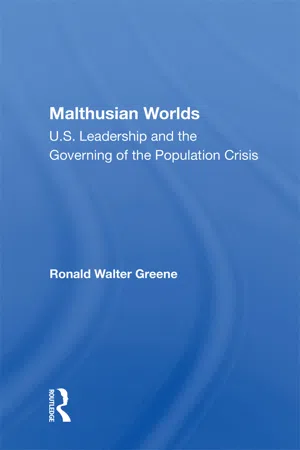
Malthusian Worlds
U.S. Leadership And The Governing Of The Population Crisis
- 274 pages
- English
- ePUB (mobile friendly)
- Available on iOS & Android
eBook - ePub
About this book
Information
1
The Malthusian Couple
A unique feature of modern government is the desire to rule a population by focusing on the administration of life. This claim suggests that the authority and legitimacy of modern forms of government do not rely on the ability to threaten its subjects with death but instead are grounded in the ability to promote the welfare of its subjects. This thesis emerges in the final part of Michel Foucault's first volume of the History of Sexuality, "The Right of Death and Power over Life."1 In this section, Foucault recontextualizes the nineteenth-century discourse on sexuality as being implicated in a form of power he calls bio-power. Bio-power, understood as the power over life, works at the intersection of two vectors: an anatomo-politics, which conceptualizes the "body as a machine" and aims at generating ever more productivity from the individual body, and a bio-politics, which looks to the "species body," targeting the biological processes of life and death in order to monitor and intervene in the welfare of a population. As Foucault writes, "the disciplines of the body [anatomo-politics] and the regulations of the population [bio-politics] constituted the two poles around which power over life was deployed."2
For Foucault, sexuality was invented as an object of knowledge through the crisscrossing discourses that occupy this unique space between the "disciplines of the body" and the "regulations of the population." The nineteenth century did not invent erotic practices; what it invented was the idea of sexuality as knowledge, a series of discourses that attempt to locate the truth about humanity in sex. The invention of sexuality as the repository of human truth contributed to the knowledge required to govern through the administration of life. To promote the welfare of a nation, Foucault argued, four figures needed regulation: the hysterical woman, the masturbating child, the Malthusian couple, and the perverse adult. This book describes how the United States acquired a desire to govern this Malthusian couple and how that desire has generated a spatial imagination concerning the places that produce and are threatened by the Malthusian couple. In this chapter I want to trace the relationship between Malthus and the organization of modernity.
The Malthusian couple owes its name and its peculiar history to the writings of Thomas Robert Malthus. Malthus first set out his principle of population in an anonymous publication in 1798 titled An Essay on the Principle of Population, As It Affects the Future Improvement of Society, with Remarks on the Speculation of Mr. Godwin, M. Condorcet, and Other Writers.3 Although anonymous publications were routine during this period of British history Malthus did not attempt to conceal his identity and in 1803 he published an expanded second edition, an edition he considered significantly different from the first. The second edition was titled An Essay on the Principle of Population, or a View of Its Past and Present Effects on Human Happiness, With an Inquiry into Our Prospects Respecting the Future Removal or Mitigation of the Evils Which It Occasions.4 Most of the first edition was incorporated into the second edition, and the 1803 edition became the primary edition for future controversies about the importance of the Essay. From 1803 to 1826, Malthus published four more editions. The third edition in 1806 included an appendix titled A Reply to the Chief Objections Which Have Been Urged Against the Essay on the Principle of Population. Due to a rather botched production process, Malthus decided to put out a fourth edition in 1807, a time roughly corresponding to his new job as professor of history and political economy at East India College, a school dedicated to the education of civil servants preparing to govern India. A fifth edition was prepared and published in 1817 with a supplement to the 1806 appendix. In 1824, Malthus penned an article on the principle of population for the Encyclopaedia Britannica, which became the basis for the Summary View of the Principle of Population, published in 1830, four years after the sixth and last edition of the Essay controlled by Malthus. Malthus died in 1834, but two more nineteenth-century editions appeared in 1872 and 1890, respectively Finally in 1914, the ninth edition, published as a volume in the Everyman's Library collection, became the key twentieth-century version of the Essay; however, the Everyman edition lacked the appendices of 1806 and 1817. Finally, the first edition of the Essay was reprinted in 1926 by the London Royal Economic Society, and this reprint became the primary version of the original.
At this point it is necessary to speak to the differences between the first and second editions. The most obvious difference is in terms of organization. The first edition consists of nineteen chapters, with the first two summarizing the fundamental principle of population and Chapters 3 through 7 offering empirical support for the operation of the principle since the beginning of human civilization. Chapters 8 through 17 apply the principle of population to the writings of Enlightenment Utopians the Marquis de Condorcet and William Godwin, as well as the political economist Adam Smith. The last two chapters show how the principle of population is consistent with God's plan for humanity. The second edition is organized into four books. The first seventeen chapters of the original Essay are dispersed into the first three books: Book I, Of the Checks to Population in the less civilized parts of the World, and in Past Times; Book II, Of the Checks to Population in the different States of Modern Europe; and Book Three, Of the different Systems of Expedients which have been proposed or have prevailed in Society as they affect the Evils arising from the Principle of Population. Book IV, Of our future Prospects respecting the Removal or Mitigation of the Evils arising from the Principle of Population, replace Chapters 18 and 19 of the first edition, excising Malthus's original theological defense for the principle of population.
Donald Winch notes that along with removing the theological chapters from the first edition, the second edition differs from the first in three more ways. First, Malthus advocated the role of moral restraint, primarily understood in terms of delayed marriages and a celibate lifestyle, as a preventive check to population, attenuating the rather dismal inevitability structuring the original edition. The second edition also inaugurated more emphasis on human agency as a contributing force in arresting the negative consequences of the principle of population, thus placing more faith in human institutions to negotiate the challenges of "natural laws." Lastly, Malthus intensified his attacks on the Poor Laws.5
Thomas Robert Malthus imagined the conjugal relationships between husbands and wives to be one haunted by misery or vice. Although the production history of the Essay led to differences between the editions, Malthus held to this simple maxim: "The power of population is indefinitely greater than the power in the earth to produce subsistence for man."6 He offered the outline of his argument in three parts: (1) population cannot increase without the means of subsistence, (2) population will increase where the means of subsistence are available, and (3) this power of population increase cannot be stopped without producing misery or vice. His writings on population dynamics challenged the goals of moral reformers by arguing that the arithmetic increases in agricultural production would be unable to keep pace with the geometrical increase in population growth. For Malthus, the dreams of revolutionary Utopians and the more modest efforts to improve the condition of England's poor were doomed to failure without knowledge of the "principle of population." Malthus assumed a severe inelasticity associated with the food supply; thus, positive checks to an expanding population waited in the wings. These positive checks took the form of war, famine, and disease. In the second edition, Malthus would emphasize that a couple might take action to restrict their reproduction by the use of "preventive checks" such as delayed marriage, voluntary celibacy, and abstinence in marriage. Although pessimism might be the emotion that best describes his writings on population, Malthus offered these preventive checks as moral alternatives to the vices of contraception, infanticide, and prostitution.
This summary of the principle of population describes the basic logic of the power of population; it does not give a very clear portrait of the Malthusian couple. In this chapter I discuss how the principle of population attaches itself to new places and people in order to invent and reinvent the Malthusian couple. Although I begin in the nineteenth century, the central focus of this book is to explain how the United States formulated a will to govern this new threat to individual, national, and global security in the twentieth century. The first goal of this chapter is to bring into focus the particular characteristics and habits attributed to the Malthusian couple. I turn to the writings of Thomas Malthus to show how the invention of the Malthusian couple as an object of government is a constitutive force in the emergence of modernity. In other words, Malthus is not an incidental feature but an essential component for the emergence of modern forms of government. In so doing, I will highlight the importance of Malthus as a rhetorician and as a political economist as well as demonstrate how the principle of population begins to be recontextualized in the second half of the nineteenth century through its encounter with the discourses of race and empire. As we will see, the Malthusian couple of the nineteenth century served an important role in the formation of a bourgeois (European/modern) self by coding fertility as a form of cultural distinction.
The second part of the chapter describes how Malthus's ideas arrived in the United States at the beginning of the twentieth century. To elucidate the emergence of a racialized Malthusian panic in the first quarter of the twentieth century, I rely on Lothrop Stoddard's Rising Tide of Color.7 From here, I turn to the formation of the Population Association of America and account for the differences between what Hodgson calls "biological and classical Malthusians."8 Finally, the second section ends with a discussion of the emergence of demography's defining contribution to the relationship between population growth and modernity: the demographic transition. The demographic transition established a line between Malthusianism as a popular discourse and demography as a social science. Yet, the demographic transition, too, used fertility rates as a cultural marker for modernity. The demographic transition also serves to bring my story to World War II and the need to reinvent the Malthusian couple.
Malthus and the Modern
From the time of the first edition of the Essay until his death (1834) Malthus was a leading advocate and "expert witness" on a host of public issues that traversed the British Crown during the first third of the nineteenth century. His rhetorical involvement included positions on the abolition of slavery and the abolition of the Poor Laws; he supported Catholic emancipation and the removal of the tithe paid by Irish Catholics to support the Anglican Church; he was involved in the debates over the efficacy of emigration to relieve the problems of poverty, and his writings were also dead center on a host of controversies in political economy such as the Wages Fund Theory, free trade, and the Corn Laws. Malthus was a Whig, although the political identity of being a Whig was extremely fluid and marked by strong factional disagreements. Malthus's philosophical standpoint was that of a moral utilitarian.9 Given this rather rich public life, it makes sense to offer a rhetorical reading of the principle of population.
Arthur Walzer argues that "the Essay on Population is preeminently a rhetorical achievement" since it existed as "an instrument of refutation" within the context of a public controversy.10 Although the consequences of the French Revolution were becoming less of a topic of conversation by the time the first edition of the Essay appeared, Malthus thought of the Essay as standing between the conservative Burke and the radical Utopians like William Godwin and the Marquis de Condorcet.11 Walzer suggests that the primary significance of the Essay was not the principle of population but Malthus's use of the principle to challenge the optimism of Enlightenment reformers. I will return to the importance of Malthus's turn against the linear progress of humankind later. First, I want to explore Walzer's claim that the Essay owes its rhetorical force to its imitation of Newton's Principia.
Walzer offers a different rhetorical context for reading Malthus than the public debates on the consequences of the French Revolution or the internal disagreements in political economy. Walzer suggests that the debates over proper scientific methodology that sprung up in the seventeenth and eighteenth century offer the proper context for understanding the rhetorical composition of the first edition of the Essay. Specifically, the scientific debate concerned Newton's critique of Descartes's vortex theory on methodological grounds. It is not necessary to outline the particulars of Newton's critique of Descartes. What is important is that Newton emerged from these debates, according to Walzer, with a more secure and modern method for discovering the natural laws governing empirical phenomena. As Walzer comments, this debate left the impression that
Newtonian science was "English, modern, and universal," whereas the followers of Descartes were accused of being scholastic, eccentric, and perhaps most damning of all, French.12 It is Walzer's argument that Newton's method, through the influence of William Duncan's translation and appropriation in the Elements of Logick (1748), was the ...
Table of contents
- Cover
- Half Title
- Series Page
- Title
- Copyright
- Dedication
- Contents
- Acknowledgments
- List of Acronyms
- Introduction
- 1 The Malthusian Couple
- 2 Developing the Population Apparatus
- 3 Containing Malthus
- 4 Greening the Population Apparatus
- 5 Malthus Travels
- Bibliography
- Index
Trusted by 375,005 students
Access to over 1.5 million titles for a fair monthly price.
Study more efficiently using our study tools.
Frequently asked questions
Yes, you can cancel anytime from the Subscription tab in your account settings on the Perlego website. Your subscription will stay active until the end of your current billing period. Learn how to cancel your subscription
No, books cannot be downloaded as external files, such as PDFs, for use outside of Perlego. However, you can download books within the Perlego app for offline reading on mobile or tablet. Learn how to download books offline
Perlego offers two plans: Essential and Complete
- Essential is ideal for learners and professionals who enjoy exploring a wide range of subjects. Access the Essential Library with 800,000+ trusted titles and best-sellers across business, personal growth, and the humanities. Includes unlimited reading time and Standard Read Aloud voice.
- Complete: Perfect for advanced learners and researchers needing full, unrestricted access. Unlock 1.5M+ books across hundreds of subjects, including academic and specialized titles. The Complete Plan also includes advanced features like Premium Read Aloud and Research Assistant.
We are an online textbook subscription service, where you can get access to an entire online library for less than the price of a single book per month. With over 1.5 million books across 990+ topics, we’ve got you covered! Learn about our mission
Look out for the read-aloud symbol on your next book to see if you can listen to it. The read-aloud tool reads text aloud for you, highlighting the text as it is being read. You can pause it, speed it up and slow it down. Learn more about Read Aloud
Yes! You can use the Perlego app on both iOS and Android devices to read anytime, anywhere — even offline. Perfect for commutes or when you’re on the go.
Please note we cannot support devices running on iOS 13 and Android 7 or earlier. Learn more about using the app
Please note we cannot support devices running on iOS 13 and Android 7 or earlier. Learn more about using the app
Yes, you can access Malthusian Worlds by Ronald Walter Greene in PDF and/or ePUB format, as well as other popular books in Social Sciences & Sociology. We have over 1.5 million books available in our catalogue for you to explore.