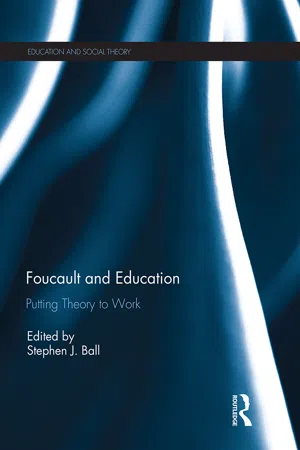
Specially selected by Stephen Ball, this is a collection of the best and most interesting recently published papers that 'use' Foucault to analyse, destablise and re-claim educational 'problems'. Arguably the best known social theorist in the western world, Foucault's work is now widely used by researchers and writers in many fields of social science. These papers not only demonstrate the practical applicability of Foucault to things 'cracked' and things 'intolerable' in making them 'not as necessary as all that'; they are also transposable, in that they offer forms and methods of analysis which can be taken up and applied and used in other settings, sectors, and policy fields.
- 226 pages
- English
- ePUB (mobile friendly)
- Available on iOS & Android
eBook - ePub
About this book
Information
The problem trap: implications of Policy Archaeology Methodology for anti-bullying policies
James Scheurich argues that practices of policy – normalized over time through repetition – serve three purposes. They structure social problems for which policy is designed to address; construct certain people, implicitly or explicitly, as problem individuals; and shape policy solutions. Following Foucault, he offers what he calls Policy Archaeology Methodology as an approach to policy analysis that emphasizes how particular social problems (but not others) are socially constructed in certain ways within certain political and social contexts. The purpose of policy archaeology as a mode of analysis is ‘to investigate … the grid of conditions, assumptions, forces which make the emergence of a social problem … possible’. Drawing from his method of inquiry, I identify, through examination of policy documents, how the problem of bullying in schools has come to be understood in certain ways (the dominant narrative) and how policy solutions are constrained and limited accordingly, thereby confounding their purpose. I suggest that Scheurich’s perspective provides a way of addressing bullying that accounts for complexity in ways that current approaches mostly do not even consider.
[F]resh effort of thought has to be made in order to understand our times.
(Gordon 1991, 46)
This paper will serve two purposes. One is to describe an unconventional methodology for analysing policy called Policy Archaeology Methodology (PAM), as proposed in this journal by James Scheurich (1994).1 The other purpose is to position the notion of bullying (i.e., the dominant way that bullying has come to be understood) and policies related to it within a PAM framework. I argue that the very ways in which the problem of bullying has become widely defined and conceptualized is, from my point of view, part of the problem of bullying as being resistant to anti-bullying efforts, and persistent as a problem in schools around the world. What is (and who are) identified as the ‘problem’ is shaped through discourse, by which I mean the definitional aspects of bullying that not only constrain understanding of the problem but also place limitations on the practices of policies meant to address bullying. Paradoxically, the identification and articulation of the problem is a significant part of the problem. I refer to this paradox as the problem trap.
I begin by describing PAM and highlighting problems of current and problematic approaches to policy and policy analysis upon which a PAM framework illuminates.
Policy Archaeology Methodology (PAM)
Scheurich positions PAM against conventional approaches to policy analysis. Conventional approaches define particular problems and describe the instrument by which the problem is to be assessed (Pal 1997). However, the ways in which problems are articulated and approached varies in accordance with degrees of power held by individuals. Whose voices are included in articulations of the ‘problem’? Who gets to decide how goals to resolve the stated problem are to be set and met? Who gets to state the terms of reference for the problem and how have they been informed of such terms? How might the dominant narrative of the problem belie broader social complexities, controversies, inequities, and contexts? Policy is a realm of power, which, as Michele Foucault (1978/1990) reminds us, is never static. Policy is thus more accurately conceptualized as a process of continual negotiation and contestation (Ball 1990; Fowler 2000; Ozga 2000) rather than as an output in the form of a textual product. As Deborah Stone puts it, ‘[p]olicy is more like an endless game of Monopoly than a bicycle repair’ (1997, 259).
Monopoly is an apt metaphor, given that certain people have, attain, and maintain more resources with which to play the game than do other people. Such is the case with policy development. In the ever-contested terrain of education, people in roles of educational authority, such as trustees and superintendents, tend to play a larger role in policy development than do students and parents (Young and Levin 2002). Linked with resources is the question of competing interests, as indicated in Stephen Ball’s claim that policies ‘typically posit a restructuring, redistribution and disruption of power relations, so that different people can and cannot do different things’ (1993, 13).
Ball (1993) further makes distinctions between policy as text and policy as discourse. The former, he argues, are the policies themselves. Texts are products that appear stable and coherent but are really never closed or complete and are constituted by multiple compromises (11). Policy texts are continually up for negotiation and re-negotiation, and thus are characterized by ad hocery even with their appearance of stability. Policy as discourse flourishes within relations of power and thereby concerns not only what is said (the text), but by whom, when, where, and by what authority (14). As instruments that delineate what Foucault would call ‘regimes of truth’, policies are, to quote Ball (1993), ‘set within a moving discursive frame which articulates and constrains the possibilities and probabilities of interpretation and enactment’ (15).
Ball (1990) also describes policy as instruments that disguise the ‘messy realities’ of society. Patti Lather (2008) echoes Ball’s sentiments in her advocacy for approaches to policy that ‘take into account the complexity and messiness of practice-in-context’ (362). Similarly, feminist policy analysts such as Catherine Marshall (1999) argue that policy formulations rarely address the complexities of people’s actual lives in favour of statistical fondness for neat demographic categories of gender, socioeconomic status, and age, among others. ‘Critical feminist analysis insists on recognition of complexity’, Marshall asserts, ‘that the categories are mixed, have many elements that make up whole beings, and are not static but evolve’ (57). Policy analysis is similarly instrumental, evaluative, and prescriptive; and involves choosing courses of action to elucidate the content and effects of policy. In short, analysis is the act of making sense of policy.
A more critical approach to policy analysis calls into question social and power relations within institutions and is directed towards analysis of the whole, rather than of specific parts, to elucidate processes of change (Ozga 2000, 46). Rather than search for perfect solutions to complex social problems, policy analysis that accounts for relations of power draws attention to taken-for-granted assumptions about constructs that inform policy, exposes the effects of policy on the daily activities in organizations, and examines the ways in which policies potentially have an undue impact upon particular individuals and groups (Bogdan and Biklen 2003, 21).
Such notions about social contexts of policy production and invested interests are approaches to policy that are non-standard, perhaps even marginalized in policy discourse. Scheurich argues that conventional policy analysis conceptualizes social problems as disease but neither questions the emergence of the social problem as a problem, nor elucidates the interconnectedness of social problems.
The work of Scheurich is based upon Foucauldian analysis of relations of power. Foucault was not a historian in the conventional sense, even though his analyses illuminate much about the history of prisons, mental illness, and sexuality. Foucault believed that discursive practices set parameters around that which can be talked about by legitimating only certain agents of knowledge and sites of knowledge production, and not others. Such practices are normalized through repetition and legitimization, and are embodied in patterns of general behaviour, modes of knowledge transmission and diffusion, technical processes, and institutional practices such as policy and regulation (Foucault 1977). In his essay entitled Governmentality, Foucault (1991) describes the art of modern government as ‘essentially concerned with answering the question of how to introduce economy – that is to say, the correct manner of managing individuals’ (92).
Even though Foucault did not focus analytical attention on schools, except to mention them as a forum through which governmentality is enacted, Marshall (1999) argues that Foucault’s archaeological approach has important implications for education and educational research. Marshall points out that the purpose of education is to foster the intellectual development of children. Since the practices and processes to do so are legitimated as being in the ‘best interests of the child’, it is the case that the context of learning is one of power and legitimacy (Young and Levin 2002). In a Hobbesian sense, schools rely on discipline, defined and legitimized through policy, to foster order in classrooms as insurance that children will grow to become ‘good’ citizens of society. Schools, then, hold the promise for future order within society. Cleverly alluding to Foucault, Lather makes the point that a paradigmatic surge towards instrumentality of research and policy constitutes a persistent view ‘that education research should be disciplined and punished’ (2008, 361).
Guided by scientism (Lather 2008), policy analysts and historians tend to focus upon explaining social problems rather than upon describing conditions that facilitate their emergence into social visibility. The purpose of policy, reflecting the modernist compulsion to categorize and label, is to maintain social order. Experts and other agents of social control identify certain problems as contrary to order, thus channelling a focus on discourse about containment and management.
Yet, to acknowledge that policy is instrumentalized as social control does not explain how particular problems gain visibility in public discourse, whereas others are barely acknowledged. Drawing from Foucault, Scheurich (1994) suggests that the focus of PAM ‘is to investigate the intersection or, better, the constitutive grid of conditions, assumptions, forces which make the emergence of a social problem, and its strands and traces, possible’ (300). Thus, rather than beginning with analyses of policy after bullying has emerged into social visibility, PAM provides a framework by which to identify the construction of the problem of bullying. In addition, policy archaeology interrogates the construction of the range of policy solutions and highlights the inadequacies of the debates that are framed within such a range. For Emery Roe (1994), narrative policy analysis (of which PAM is arguably one form) highlights how power and politics are implicated in controversies characterized by uncertainty, complexity, and polarization. Certainly, usual policy responses to bullying disguise these three characteristics that collectively confound the dominant narrative – what might be called the official story – of bullying, which is that it is behaviour in need of correction.
Policy research methodologies typically involve step-by-step approaches that guide analytical processes. While Scheurich (1994) describes PAM in step-by-step fashion as four separate arenas, he is clear that the boundaries of these arenas are permeable and non-linear. Accepting that caveat, a brief description of each arena will provide the basis from which to examine safe schools policies in British Columbia, employing PAM as an analytical lens.
A first arena interrogates social problems as empirical givens by situating them as constructed and emergent. Unlike conventional approaches to policy analysis, PAM ‘begins prior to the emergence and social identification of a “problem” as a problem … and examines the naming process, the process by which problems enter the gaze of the state and policy researchers’ (1994, 300).
A second arena describes complex groups of relations that construct social problems and policy solutions. A grid of social regularities provides conditions upon which problems are identified and categorized, thus becoming socially visible. Scheurich examines how social regularities are produced and reproduced through intersections of gender, class, race, governmentality, and professionalization, among others. Such intersections constitute the grid through which social problems are constructed and articulated, thus becoming ‘real’. It is not that regularities determine social problems, but rather that regularities facilitate the conditions by which discourse proliferates and practices are carried out.
A third arena of PAM is one that describes how a range of possible policy choices is shaped by the grid of social regularities. Scheurich emphasizes that the shaping of social problems and identifying policy solutions is ‘preconceptual’ (1994, 303), meaning that such processes are neither intentional nor conscious agendas of individual policy analysts and makers. Situating policy solutions and choices within the grid of social regularities positions an analysis that articulates ‘impossible’ (303) policy options. As Wanda Pillow describes it in her critical feminist policy analysis of discourses about teen pregnancy, ‘educational policy does not develop in a vacuum, but is affected by beliefs, values, and attitudes, situated in discourses, which in turn affect school policy by creating or limiting educational policy options’ (2004, 9).
Finally, a fourth arena contextualizes conventional policy studies within broader contexts, specifically liberal social order that fuels policy to organize the social world and categorize social actors. Policy, broadly stated, is to create and maintain order, or at least the appearance of order, both of which, to repeat Ball’s (1990) observation, disguise the ‘messy realities’ of society.
PAM applied
Reiterating Scheurich’s important caveat, PAM is not a linear methodology. Here, then, I discuss policies on safe schools in the province of British Columbia, Canada, and their wider circumstantial contexts and draw from Scheurich’s methodology without necessarily adhering to his instructive format. Given that moral panics about bullying and youth violence are not limited to Western societies (see for instance Ohsako 1997), I have no reason to believe that the situation in British Columbia is particularly unique, even if the particulars that I describe below are.
I begin with a report commissioned by the provincial government in British Columbia that provides a context by which to understand anti-bullying policies in the province’s school districts. The government created in 2002 a task force to study the issue of violence in British Columbia schools. According to the public report submitted by the Task Force after conducting a series of public forums throughout the province, they found that, ‘a significant number of students report that they do not feel safe at school’ and that, ‘many people … have been either unable or unwilling to confront and discuss the issue of violence among our children and youth’ (Mayencourt, Locke, and McMahon 2003, 10).
Mayencourt and his colleagues also claim to have, ‘learned that bullying behaviour is often founded in discrimination based on perceived “differences” such as race, disability, gender or sexual orientation’ (9). Evidently, a move was afoot to present bullying as an expression of stigmatized difference, rather than of only mean or violent behaviour of individual children. Here, I point to the issue of homophobic bullying as an example of such difference, common among children but rarely addressed in policies and programmes and often absent from scholarly research on bullying. The Task Force report repeatedly mentions homophobic bullying in the main body of the report. For instance, Mayencourt and his colleagues:
heard that even the perception of being homosexual or of being tolerant of homosexuality is enough to result in harassment and intimidation, including both emotional and physical abuse from those who choose to bully. Presenters expressed concern about the frequent use of homophobic language in schools. (15)
Teachers, they continue:
tried to raise the issue of homophobia in schools [but] had met resistance from the school board, other school staff, parents and students. These teachers said that when they had tried to increase awareness around homophobia in their school … they felt shunned by parents, students and even by their peers and colleagues. (19)
However, none of the recommendations that stem from the main report acknowledge, much less attempt to deal with, social difference in any form. Such exclusion is especially glaring given the title of the Task Force report, which is, Facing our fears, accepting responsibility (Mayencourt, Locke, and McMahon 2003).
Is it through mere oversight that a government response to bullying in schools, framed as ‘facing fears’ and ‘accepting responsibility’, does not do precisely what the title promises? How is it, more specifically, that recommendations for actions to curb bullying in schools does not include suggestions for responding to homophobic violence when the report itself claims that such violence is widespread in British Columbia schools? Facing our fears, accepting responsibility is an instance of how discourse shapes the problems to be discussed and the range of policy solutions to be considered. Bullying is widely viewed as behaviour that must be corrected or expunged, thus the authors limit their recommendations to such solutions.
Seeing and constructing meanings in a generic way, which is broadly the case where notions of bullying are concerned, are discursive practices that become normalized thr...
Table of contents
- Cover
- Half Title
- Series Page
- Title Page
- Copyright Page
- Contents
- Citation Information
- Notes on Contributors
- Introduction ߝ the use and abuse of Michel Foucault in Educational Studies: thinking about what is true
- 1 The problem trap: implications of Policy Archaeology Methodology for anti-bullying policies
- 2 Analysing policy in the context(s) of practice: a theoretical puzzle
- 3 Governmentality and ‘fearless speech’: framing the education of asylum seeker and refugee children in Australia
- 4 Care of the self, resistance and subjectivity under neoliberal governmentalities
- 5 Regimes of performance: practices of the normalised self in the neoliberal university
- 6 Writing genealogies: an exploration of Foucault’s strategies for doing research
- 7 Foucault and Special Educational Needs: a ‘box of tools’ for analysing children’s experiences of mainstreaming
- 8 ‘Bodies are dangerous’: using feminist genealogy as policy studies methodology
- 9 Social anxiety, sex, surveillance, and the ‘safe’ teacher
- 10 Humanism, administration and education: the demand of documentation and the production of a new pedagogical desire
- 11 Foucault, Docile Bodies and Post-Compulsory Education in Australia
- 12 Monumentalizing disaster and wreak-construction: a case study of Haiti to rethink the privatization of public education
- Index
Trusted by 375,005 students
Access to over 1.5 million titles for a fair monthly price.
Study more efficiently using our study tools.
Frequently asked questions
Yes, you can cancel anytime from the Subscription tab in your account settings on the Perlego website. Your subscription will stay active until the end of your current billing period. Learn how to cancel your subscription
No, books cannot be downloaded as external files, such as PDFs, for use outside of Perlego. However, you can download books within the Perlego app for offline reading on mobile or tablet. Learn how to download books offline
Perlego offers two plans: Essential and Complete
- Essential is ideal for learners and professionals who enjoy exploring a wide range of subjects. Access the Essential Library with 800,000+ trusted titles and best-sellers across business, personal growth, and the humanities. Includes unlimited reading time and Standard Read Aloud voice.
- Complete: Perfect for advanced learners and researchers needing full, unrestricted access. Unlock 1.5M+ books across hundreds of subjects, including academic and specialized titles. The Complete Plan also includes advanced features like Premium Read Aloud and Research Assistant.
We are an online textbook subscription service, where you can get access to an entire online library for less than the price of a single book per month. With over 1.5 million books across 990+ topics, we’ve got you covered! Learn about our mission
Look out for the read-aloud symbol on your next book to see if you can listen to it. The read-aloud tool reads text aloud for you, highlighting the text as it is being read. You can pause it, speed it up and slow it down. Learn more about Read Aloud
Yes! You can use the Perlego app on both iOS and Android devices to read anytime, anywhere — even offline. Perfect for commutes or when you’re on the go.
Please note we cannot support devices running on iOS 13 and Android 7 or earlier. Learn more about using the app
Please note we cannot support devices running on iOS 13 and Android 7 or earlier. Learn more about using the app
Yes, you can access Foucault and Education by Stephen Ball, Stephen J. Ball in PDF and/or ePUB format, as well as other popular books in Pedagogía & Educación general. We have over 1.5 million books available in our catalogue for you to explore.