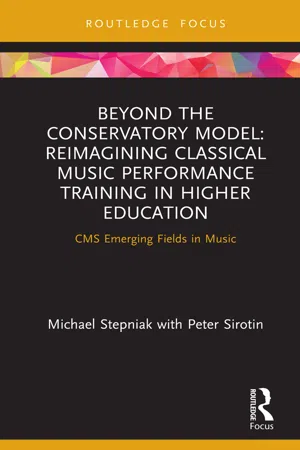
Amid enormous changes in higher education, audience and music listener preferences, and the relevant career marketplace, music faculty are increasingly aware of the need to reimagine classical music performance training for current and future students. But how can faculty and administrators, under urgent pressure to act, be certain that their changes are effective, strategic, and beneficial for students and institutions? In this provocative yet measured book, Michael Stepniak and Peter Sirotin address these questions with perspectives rooted in extensive experience as musicians, educators, and arts leaders. Building on a multidimensional analysis of core issues and drawing upon interviews with leaders from across the performing arts and higher education music fields, Stepniak and Sirotin scrutinize arguments for and against radical change, illuminating areas of unavoidable challenge as well as areas of possibility and hope. An essential read for education leaders contemplating how classical music can continue to thrive within American higher education.
eBook - ePub
Beyond the Conservatory Model
Reimagining Classical Music Performance Training in Higher Education
- 124 pages
- English
- ePUB (mobile friendly)
- Available on iOS & Android
eBook - ePub
Beyond the Conservatory Model
Reimagining Classical Music Performance Training in Higher Education
About this book
Information
1
Beyond Beauty, Brilliance, and Expression
Musicianship and Reconnecting With the General Public1
Joy, Pleasures, and a Growing Discomfort
Many of us classical music performers grew up spending years apprenticing with master musicians, feeding an appetite for music making that was gloriously insatiable. We quickly grew to relish great artists and works from the past few centuries in classical music and the past century or so in jazz. The attraction was as inevitable as it was natural. Those two eras, after all, coincided with the development of extraordinary compositional and performance technique and produced musical works (and performances) that revealed moments of profound splendor and brilliance.
The fact that the increasing virtuosity and complexity of these two music genres coincided with their slowly decreasing popularity within the general public this past century didn’t seem so much a fault of the music as a testament to its increasing sophistication. And our performance training—informed by tradition and focusing with rapt intent on beauty of tone, brilliance in technique, and clarity and authenticity in expression—has continued to largely ignore the awkward issue of our music’s decreasing presence in the lives of those around us. Whether we were composers or performers, it was clear to us that we had a heroic charge: to propel traditions that were exceptional in their aesthetic nuance and historical significance. And we have been proud to meet that challenge, promoting art for art’s sake as possible and graduating performers with often remarkable playing skills. As one prominent faculty member lamented in a recent article, it would be so wonderful if we could support the development of young musicians who enter higher education with an unconditional love for music by providing them with a learning and teaching environment relative free of the myriad practical concerns related to marketplace and career pathways.2
We have sought to pursue art for art’s sake even while being part of institutions and educational systems endlessly ravenous for more tuition revenue, endlessly ravenous for more and better pupils to fill ensembles, courses, programs, and faculty loads.3 The joy and pleasures of classical and jazz music have been virtually boundless for most of us “in the know.” And for those of us fortunate to work within educational communities boasting exceptional performance series, that joy is ongoing. I think of a number of standout performances within my own conservatory during the past couple of years—the breathtaking honesty and intensity of Gidon Kremer and Kremerata Baltica, the spellbinding inventiveness of Cecile McLorin Salvant, the virtuosic whimsy of Roomful of Teeth. Most readers will have their own examples.
All this said, I must admit a discomfort that seems to have reached a tipping point; a discomfort with the dichotomy between these joyful experiences and two stubborn realities: the ever-increasing employment challenges facing our graduating music performance students and the relative unpopularity of these two musical genres among the general public. In having to repeatedly consider the issues, I’ve come to an uncomfortable conclusion: beyond all their extraordinary splendor, the cultures surrounding our two music performance disciplines—the “art music” genres long privileged in our conservatories and college/university music departments—have come to contain a small and pernicious quality. That pernicious quality, one further exacerbated by the peculiar pressures within our higher education system as outlined earlier and in the next chapter, might be described as follows: thrilled by beauty and brilliance and by the aesthetic experiences accessible to us fortunate few, we increasingly adopted an attitude that cared little for one additional critical component of musicianship (at least as understood long ago): the interest to connect with and move the average general-public listener. The cost of that inherited mindset among both composers and performers, of our “not caring if you listen,” has been nothing short of devastating.
Consider that never in human history have people had easier access to music. As studies such as Nielsen’s 2017 Music 360 Report reveal, thanks in part to the advance of streaming technology platforms, the general population of the United States over the age of 13 listens to music in excess of 32 hours weekly.4 (That average of 32 hours of listening per week is up from an average of 26.6 and 23.2 hours for 2016 and 2015, respectively.) While there is broad engagement with music, there are two musical genres that have increasingly moved to the periphery of ordinary life, the very two genres that I would argue have become unusually comfortable ignoring emotional connection between music performer and the general-public listener. It should come as no surprise when we learn (as we do annually now from the Nielsen Music Year End Report) that public consumption of classical or jazz music recordings now typically hovers at around 1 percent of such consumption. As the jazz pianist Bill Anschell bluntly explained with only slight exaggeration, “People who want to play jazz actually outnumber those who enjoy or even tolerate it, let alone pay to hear it.”5 The decline has been a long time coming. While many of the data regarding classical audience size in the early twentieth century are anecdotal, it seems clear that when it came to radio audience preferences and record industry sales, classical music and jazz were a major force. As Russell Sanjek reported in his well-researched book, “semiclassical and classical” programming occupied nearly 70 percent of program time of network-created radio programming in the late 1920s and early 1930s,6 and the sale of classical records represented almost 35 percent of industry sales in 1952.7
To be sure, there have been music leaders in the academy along the way who have urged us to pay more attention to the general marketplace. I think immediately of Peter Schoenbach’s argument to the National Association of Schools of Music in 1999 that we must pay more heed to the connection between music performance training and careers available to our students.8 And I think of the ongoing blogs of such change-advocates and arts leaders as Greg Sandow.9 In the more recent past, our schools have increasingly responded by tweaking the edges of curriculum (while retaining core courses and traditional apprenticeship models): new courses for students in social media branding, marketing, entrepreneurship! Using the breathless language that is commonplace around higher education marketing, we’ve typically announced any tweaks to curriculum as revolutionary or innovative even while they largely remain, in the words of one exceptional CMS Task Force, little more than a “scattering of new offerings atop an unchanging foundation.”10
Caught between performance faculty largely uninterested in pursuing any profound curricular changes that could seemingly threaten the shared value of art for art’s sake and a marketplace increasingly disinterested in our graduating students and their musical skills, many of us higher education leaders have replied to the unpopularity issue with a sigh. It is easy for us to lament the many external reasons jazz and classical music have become tied for least popular musical genre. Tops among the culprits we can easily list are the following: diminishing attention spans; the proliferation of entertainment options for audiences; the greatly increased presence of creative energy and inventiveness in popular entertainment; and the worse-than-ever level of pre-college education (including general music education).
Again, many of our performance-oriented artist faculty have remained less concerned about these realities. Their viewpoint is understandable. Buoyed by the success that they and their most fortunate student performers have had and continue to have as performers within major venues, buoyed by a well-developed and reliable audience base for traditional programing within their own institutions, and having in front of them a repertoire and discipline worthy of lifelong examination, why should they care much about issues of general popularity or the employment marketplace facing the typical graduating music performer? It’s a question that tuition-paying parents of those same graduating students are more than happy to answer.
Ways We in Higher Education May Help
It almost goes without saying that the most responsible reaction to a changed marketplace with extraordinarily limited full-time employment opportunities for our graduates would be not only to train our students differently but to also train far fewer of them. But there are too many compelling justifications to continue the status quo. No, it is unlikely that we will pursue any reduction in the number of music performance programs, faculty, and students voluntarily. So what are ways we in higher education could help this state of affairs?
At the most superficial level, a reshaped definition of musicianship would require us to fundamentally reshape general BM/MM/DMA performance degrees, not only to continue to support the development and promotion of exceptional artistry (we must stand for that) but also to help strengthen the orientation of our young musicians toward connection-making.11 But this enlarged definition of musician-ship would, in fact, require us to rethink virtually every area of our operations and work.
Before turning to some of the most significant areas that would require our rethinking, a side note is worth mentioning here. If our shared working definition of musicianship included a central concern with connecting with general-public listeners, we would also likely begin to impact and strengthen the relevance of our cherished artforms to the world around us. As we’re reminded weekly, this additional concern of connection with general-public listeners is being embraced by an extraordinary array of forward-looking professional ensembles and companies—consider the experiments of Opera Philadelphia or California Symphony for just two recent examples.
The adoption of an enlarged definition of musicianship (as described earlier) would create urgency for change across our entire curriculum and workplace. The following list of changes and strategies are illustrative of what we could and would need to pursue. To be clear, even the full employment of all these listed changes would not radically improve the popularity of our musical genres or ease the tough employment landscape facing our graduating students anytime soon. Given the state of things, however, we must do more to get things moving in the right direction.
To begin with, this enlarged concept of musicianship would force our music schools to reimagine all aspects of our current apprenticeship model. We would need to ensure that student performance evaluations in all our undergraduate and graduate performance degrees—in end-of-semester juries, sophomore screenings, recitals, and the like—focused not only on how well a student sounded and played/sang but to what extent she was able to connect with and engage members of the general public in and through her musical performance. I think here of teachers like Midori who push students to perform in unorthodox spaces in front of ordinary people, learning along the way how to engage and communicate meaningfully with fellow human beings. (Even this approach—hardly radical to be sure—remains far outside the norm in our conservatories and music schools.)
Yes, this would require the need to develop new evaluation methods. Our music schools have multiple ways of measuring how well a student sounds and plays/sings, but we certainly don’t have robust ways to measure a student’s achievement in “attracting and engaging members of the general public.” And we would need to be mindful that an initial positive reaction to a performance by the general public is not the sole marker of success; we would also need to help young musicians learn how to build longer-term engagement with new audiences and would need to figure out how to evaluate that capacity and skill. Creating a relevant evaluation tool would be exceptionally difficult but likely not impossible. Of course, some may be scandalized by the idea of attempts to assess something so extraordinarily personal and subjective. But if we are to evaluate music performance in the academy (and it s...
Table of contents
- Cover
- Half Title
- Series Page
- Title
- Copyright
- Contents
- Series Editor’s Introduction
- Introduction
- 1 Beyond Beauty, Brilliance, and Expression: Musicianship and Reconnecting With the General Public
- 2 Gathering Insights From the Field: How the Classical Music Marketplace Is Changing, and What That Change Means for the Training That Students Need
- 3 Why This Change Is Unusually Difficult: Three Specific Factors May Be Thwarting the Will and Ability of Music Leaders to Change Performance Training Models
- 4 Making Change That Counts
- Appendix: Select Readings on Leadership, and Leading Change in Higher Education
- Index
Trusted by 375,005 students
Access to over 1.5 million titles for a fair monthly price.
Study more efficiently using our study tools.
Frequently asked questions
Yes, you can cancel anytime from the Subscription tab in your account settings on the Perlego website. Your subscription will stay active until the end of your current billing period. Learn how to cancel your subscription
No, books cannot be downloaded as external files, such as PDFs, for use outside of Perlego. However, you can download books within the Perlego app for offline reading on mobile or tablet. Learn how to download books offline
Perlego offers two plans: Essential and Complete
- Essential is ideal for learners and professionals who enjoy exploring a wide range of subjects. Access the Essential Library with 800,000+ trusted titles and best-sellers across business, personal growth, and the humanities. Includes unlimited reading time and Standard Read Aloud voice.
- Complete: Perfect for advanced learners and researchers needing full, unrestricted access. Unlock 1.5M+ books across hundreds of subjects, including academic and specialized titles. The Complete Plan also includes advanced features like Premium Read Aloud and Research Assistant.
We are an online textbook subscription service, where you can get access to an entire online library for less than the price of a single book per month. With over 1.5 million books across 990+ topics, we’ve got you covered! Learn about our mission
Look out for the read-aloud symbol on your next book to see if you can listen to it. The read-aloud tool reads text aloud for you, highlighting the text as it is being read. You can pause it, speed it up and slow it down. Learn more about Read Aloud
Yes! You can use the Perlego app on both iOS and Android devices to read anytime, anywhere — even offline. Perfect for commutes or when you’re on the go.
Please note we cannot support devices running on iOS 13 and Android 7 or earlier. Learn more about using the app
Please note we cannot support devices running on iOS 13 and Android 7 or earlier. Learn more about using the app
Yes, you can access Beyond the Conservatory Model by Michael Stepniak,Peter Sirotin in PDF and/or ePUB format, as well as other popular books in Education & Education Administration. We have over 1.5 million books available in our catalogue for you to explore.