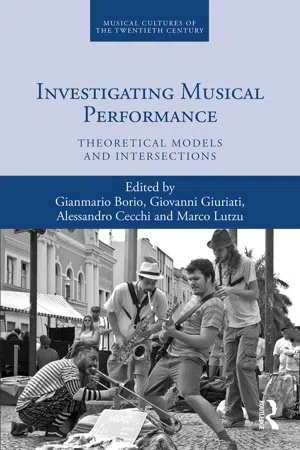
Investigating Musical Performance considers the wide range of perspectives on musical performance made tangible by the cross-disciplinary studies of the last decades and encourages a comparison and revision of theoretical and analytical paradigms. The chapters present different approaches to this multi-layered phenomenon, including the results of significant research projects. The complex nature of musical performance is revealed within each section which either suggests aspects of dialogue and contiguity or discusses divergences between theoretical models and perspectives. Part I elaborates on the history, current trends and crucial aspects of the study of musical performance; Part II is devoted to the development of theoretical models, highlighting sharply distinguished positions; Part III explores the relationship between sign and sound in score-based performances; finally, the focus of Part IV centres on gesture considered within different traditions of musicmaking. Three extra chapters by the editors complement Parts I and III and can be accessed via the online Routledge Music Research Portal. The volume shows actual and possible connections between topics, problems, analytical methods and theories, thereby reflecting the wealth of stimuli offered by research on the musical cultures of our times.
eBook - ePub
Investigating Musical Performance
Theoretical Models and Intersections
- 240 pages
- English
- ePUB (mobile friendly)
- Available on iOS & Android
eBook - ePub
Investigating Musical Performance
Theoretical Models and Intersections
About this book
Information
Part I
Overviews/perspectives
1 Empirical methods in the study of music performance
An interdisciplinary history
Martin Clayton
The editors of this volume ask whether the approaches of ethnomusicology and historical musicology to investigating musical performance can be brought together. In order to answer that question and assess future prospects, it is necessary to look in more detail at the approaches taken within the two disciplines and their historical trajectories. The aim of the present chapter is to make such a comparison, addressing in particular the place of ‘empirical’ methodologies (intended as those involving the analysis of quantitative performance data describing for instance timing, pitch, loudness or movement) in both disciplines.
For some researchers in both ethnomusicology and historical musicology, the empirical investigation of performance has long been an essential element of the serious study of music. For others, such investigations have been at best an optional extra, if not actively resisted, an attitude associated with a conception of each discipline as exclusively humanistic. While the trajectories of empirical methodologies in the two disciplines have much in common, interactions between them have been rare. Eric Clarke’s 2004 overview of empirical research in historical musicology, for example, makes no reference to research on non-Western music, nor does Caroline Palmer’s chapter on music performance in Diana Deutsch’s The Psychology of Music (Palmer 2013). Although Alf Gabrielsson’s extensive account in an earlier edition of the same work (1999) mentions ethnomusicologist John Baily’s work on motor patterns in instrumental performance (e.g. 1985), and Jane Davidson (2009) adds to this an acknowledgement of the seminal work of John Blacking (1977), it is hard not to conclude that ethnomusicology has been of marginal interest to music psychology, while empirical approaches in historical musicology have tended to align with this pattern. A similar charge could perhaps be levelled in reverse at ethnomusicologists such as Charles Keil, who developed his own distinctive theory of performance timing with little reference to the history of psychological research on the topic (1987, 1995). The general rule seems to have been that historical musicology and ethnomusicology have behaved as if the other did not exist.
The next two sections outline brief histories of empirical methods in historical musicology and ethnomusicology, respectively; in both cases I go into more detail on a selection of sources relating to rhythm and timing, which help to highlight some of the reasons for the disciplinary divergence. This is also a particularly promising area of current and future cooperation, as the work on entrainment by this author and colleagues may demonstrate (Clayton et al. 2005). The last section briefly addresses some of the critiques that have been levelled against these methods within the two music disciplines, before discussing some common ground and arguing that a degree of convergence in recent years raises the possibility, albeit not the certainty, of a future marked by productive interdisciplinary convergence.
Trajectories: Musicology, psychology and performance
Recent histories of empirical musicology cite a seminal study carried out in the Sorbonne’s experimental psychology laboratory by Alfred Binet and J. Courtier (1895), in which the authors describe a mechanical apparatus for recording the keypresses of a pianist. Their primary interest was movement control – the same authors had published a paper two years earlier analysing upper-limb movement in drawing (Binet and Courtier 1893) – and their focus was on the regularity of force and timing under specific biomechanical constraints, rather than the contribution of this control to musical expression. Building on this and a handful of other studies of timing – some using a ‘tapping’ paradigm that continues to be applied to this day – the American psychologist Charles H. Sears attempted detailed studies of musical performance for the first time in 1902. For this investigation, a reed organ rather than a piano was used, with timing information collected by means of electrical contacts attached to the underside of the keys, the signal from the highest (soprano) part being traced on a kymograph drum (see Brock-Nannestad 2014 for a description of this technology). Four musicians were asked to play a selection of hymns on the organ, and Sears calculated the differences between individual interpretations, including their overall tempo and regularity. As Sears put it, ‘How far the trained musician accomplishes what the notes set before him indicate and what he sets out to do is an interesting question not only to the psychologist, but also to the musician’ (1902: 28). Thus, while the inspiration was psychological, for the first time the implications of such empirical work for musical practice and pedagogy began to be considered.
The next major landmark is surely provided by the body of work conducted by Carl Seashore and colleagues. Seashore’s 1919 monograph The Psychology of Musical Talent focuses on perceptual and productive capacities, developing methods of measuring musical talent and thus assisting pedagogy. He writes of his aim that ‘it may serve as a somewhat intensive presentation of a specific subject for the student of educational psychology, child-study, vocational and industrial selection, or vocational and avocational guidance’ (1919: vii). Over the 1920s and 1930s, however, his attentions turned more to the measurement of expert musical performance, striving alongside his original aims to empirically identify the qualities of Western art music well performed. His University of Iowa laboratory, then, had a more musicological focus than most of its precursors.
The later work is conveniently collected in Seashore’s 1938 volume Psychology of Music. Among many other topics can be found those based on audio recordings (for example, investigating vibrato), and studies of piano playing using the ‘Iowa piano camera’, another in what has proved a long line of devices for capturing keyboard performance (1967 [1938]: 233ff). Indeed, he begins his introduction to the 1936 collection Objective Analysis of Musical Performance by enthusiastically acknowledging the impact on academic research of technological advances in sound and film recording, telephony, and broadcasting (1936: 5). Sound recording had been enthusiastically adopted by music researchers ever since J. Walter Fewkes made the first ‘field recording’ on wax cylinder in 1890, soon after Thomas Edison’s invention became commercially available in 1888. While comparative musicology settled on manual transcription from sound recordings as its core method, psychologists experimented with methods of automatic graphical representation – approaches that only occasionally impacted on musicological research.
Despite the fact that motor control had been a concern of psychologists studying music performance from Binet and Courtier onwards, little work was done on bodily movement – and technology may have been a factor here in a more negative sense. Doing so from film would have been an even greater challenge than working from sound recordings or from the kind of data produced by piano recording devices. In Seashore’s chapter on ‘Primitive music’ he nonetheless expresses great enthusiasm for the potential of sound film as a research tool (1967 [1938]: 346). His material for this chapter is all derived from comparative musicologist Milton Metfessel’s 1928 study of ‘Negro songs’, which makes extensive use of photography, but as a way of recording aspects of the auditory signal, not bodily movement (so-called ‘phonophotography’).
Until this point there had been little acknowledgement of comparative musicology in studies of Western music performance. In Seashore’s introduction to Metfessel’s volume, though, he notes the history of investigating ‘primitive music’ from sound recordings, suggesting that new techniques now allowed for the photographic recording of sound (1928: 7, credited to a paper first read in 1924). He closes his introduction with a familiar plea to study and preserve ‘native’ songs from around the world before these diverse styles were ‘obliterated’ by culture contact (1928: 16). Metfessel’s study puts Seashore’s proposal into practice through a series of meticulous analyses. It is nonetheless striking that eight years later, all Seashore could muster for his Psychology of Music collection was a summary of the same findings – in practice they had not served as the inspiration to others that he had apparently hoped.
Little progress seems to have been made in the four decades following Seashore’s 1938 book, until Dirk-Jan Povel’s 1977 study of rhythm in the performance of a section of Bach’s Well-tempered Clavier. This study introduces an apparently new methodology, namely the extraction of event onset times from audio recordings – a complicated procedure at that time, involving the filtering of tape recordings of harpsichord performance. Four years later, L. Henry Shaffer’s study introduced photovoltaic cells to a grand piano, an update of Seashore’s approach, but now storing and manipulating the data on a computer. It is worth noting that Shaffer’s study goes into significant detail on theories of motor control, once again the main area of psychological interest (1981). The same apparatus is referred to in Eric Clarke’s 1985 study of the performances of Eric Satie’s piano music, but by 1990 Clarke and Carol Krumhansl were reporting the use of MIDI to record timing directly to the computer. One thing that has remained consistent since 1895 has been the prominent place given to the study of keyboard performance: in his 2004 overview, in fact, Clarke focuses almost exclusively on this topic. The nature of the instrument and the technologies available for extracting data means that rather than pitch – which appeared to be of great interest to Seashore – studies have since focused increasingly on timing, and to a lesser extent on dynamic contours. This is not to say that the empirical study of Western art music has actually focused exclusively on keyboard performance since the 1970s – witness for example studies of movement and gesture in singers and instrumental soloists (e.g. Davidson 1993; Wanderley et al. 2005). Nonetheless, Clarke will have had little concern over his characterisation of the field.
Such has been the explosion of empirical study of musical performance since the 1980s that it is not possible to give a comprehensive overview here. Rather, it will be more productive to consider the role and the extent to which these ‘empirical’ methods have been integrated into the mainstream of historical musicology. Particular mention should be made here of the CHARM1 and CMCPC2 projects which brought together some of the United Kingdom’s most distinguished musicologists: Eric Clarke (a pioneer in the application of empirical methodologies and psychological perspectives, already cited), Nicholas Cook, John Rink, Daniel Leech-Wilkinson and others. These projects should be considered also in the context of another scholarly trajectory that owes its existence to technology: the qualitative and interpretive study of historical sound recordings, as pioneered by Robert Philip (1992, 2004). The CHARM initiative, in a sense, brought together the qualitative historical approach of Philip with the quantitative and psychologically informed approach of Clarke, with the aim of establishing a more secure empirical basis for musicology. As Cook and Clarke explain in the introduction to their Empirical Musicology volume:
Empirical musicology … can be thought of as musicology that embodies a principled awareness of both the potential to engage with large bodies of relevant data, and the appropriate methods for achieving this; adopting this term draws attention to the potential of a range of empirical approaches to music that is, as yet, not widely disseminated within the discipline.
(2004: 5)
Whether one agrees with Cook and Clarke that where data is available and hypotheses can be tested, musicologists should be willing to do so, or whether one is invested in the idea of musicology as an exclusively humanistic discipline that avoids quantitative data, CHARM and its successor surely achieved the objective of drawing attention to empirical methods. One of the achievements of this project was to establish the method of analysing sound recordings within the mainstream of musicology, either to compare multiple performances of the same work (Cook 2007) or to explore some of the finer details of individual musicians’ styles. In the latter case, Leech-Wilkinson manages to incorporate aspects of empirical analysis in support of a fundamentally humanistic, musicological argument, albeit framed in his Preface as the outcome of empirical analysis: ‘Nothing comes across more clearly from this work in musical science than that the performer is the source of all the most specific musical meaning’ (2009).
It is equally true that many musicologists have simply ignored the application of such approaches. As Georgina Born writes, this work offers a radical challenge to prevailing modes of musicological discourse:
While [CHARM] is a welcome development, it indicates the profound dislocation that has existed between the philological orientation of score-based musicology and the aural-oral nature of recording … the terms of the detente remain uncertain: cognitivist and positivistic, or hermeneutic and cultural-theoretical?
(Born 2010: 235–6)
Whether the term ‘positivistic’ is a fair description of CHARM is a question worth considering at more length than is possible here, but the point is that it has sometimes been perceived as such. Empirical methods cannot simply be regarded as add-ons, but rather profoundly challenge aspects of prevailing musicological p...
Table of contents
- Cover
- Half-Title
- Series
- Title
- Copyright
- Contents
- List of illustrations
- List of contributors
- Note to reader
- Introduction
- PART I Overviews/perspectives
- PART II Listening/positioning
- PART III Sign/sound
- PART IV Gesture/shape
- Index
Trusted by 375,005 students
Access to over 1.5 million titles for a fair monthly price.
Study more efficiently using our study tools.
Frequently asked questions
Yes, you can cancel anytime from the Subscription tab in your account settings on the Perlego website. Your subscription will stay active until the end of your current billing period. Learn how to cancel your subscription
No, books cannot be downloaded as external files, such as PDFs, for use outside of Perlego. However, you can download books within the Perlego app for offline reading on mobile or tablet. Learn how to download books offline
Perlego offers two plans: Essential and Complete
- Essential is ideal for learners and professionals who enjoy exploring a wide range of subjects. Access the Essential Library with 800,000+ trusted titles and best-sellers across business, personal growth, and the humanities. Includes unlimited reading time and Standard Read Aloud voice.
- Complete: Perfect for advanced learners and researchers needing full, unrestricted access. Unlock 1.5M+ books across hundreds of subjects, including academic and specialized titles. The Complete Plan also includes advanced features like Premium Read Aloud and Research Assistant.
We are an online textbook subscription service, where you can get access to an entire online library for less than the price of a single book per month. With over 1.5 million books across 990+ topics, we’ve got you covered! Learn about our mission
Look out for the read-aloud symbol on your next book to see if you can listen to it. The read-aloud tool reads text aloud for you, highlighting the text as it is being read. You can pause it, speed it up and slow it down. Learn more about Read Aloud
Yes! You can use the Perlego app on both iOS and Android devices to read anytime, anywhere — even offline. Perfect for commutes or when you’re on the go.
Please note we cannot support devices running on iOS 13 and Android 7 or earlier. Learn more about using the app
Please note we cannot support devices running on iOS 13 and Android 7 or earlier. Learn more about using the app
Yes, you can access Investigating Musical Performance by Gianmario Borio, Giovanni Giuriati, Alessandro Cecchi, Marco Lutzu, Gianmario Borio,Giovanni Giuriati,Alessandro Cecchi,Marco Lutzu in PDF and/or ePUB format, as well as other popular books in Kunst & Kunst Allgemein. We have over 1.5 million books available in our catalogue for you to explore.