eBook - ePub
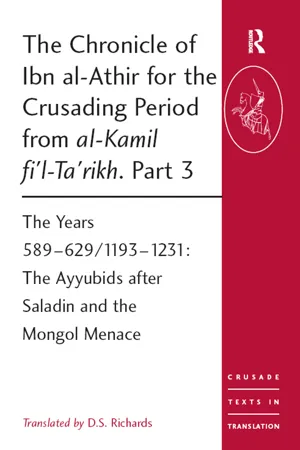
The Chronicle of Ibn al-Athir for the Crusading Period from al-Kamil fi'l-Ta'rikh. Part 3
The Years 589–629/1193–1231: The Ayyubids after Saladin and the Mongol Menace
- 344 pages
- English
- ePUB (mobile friendly)
- Available on iOS & Android
eBook - ePub
The Chronicle of Ibn al-Athir for the Crusading Period from al-Kamil fi'l-Ta'rikh. Part 3
The Years 589–629/1193–1231: The Ayyubids after Saladin and the Mongol Menace
About this book
The Chronicle of Ibn al-Athir (1160-1233AD), entitled "al-Kamil fi'l-Ta'rikh", is one of the outstanding sources for the history of the mediaeval world. It covers the whole sweep of Islamic history almost up to the death of its author and, with the sources available to him, he attempted to embrace the widest geographical spread; events in Iraq, Iran and further East run in counterpoint with those involving North Africa and Spain. From the time of the arrival of the Crusaders in the Levant, their activities and the Muslim response become the focus of the work. A significant portion of this third part deals with the internal rivalries of the Ayyubid successors of Saladin, their changing relations with the Crusader states and in particular the events of the Damietta Crusade. As always, these events are portrayed against the wider background, with considerable emphasis on events in the eastern Islamic world, the fortunes of the Khwarazm Shahs and the first incursions of the Mongols.
The Chronicle of Ibn al-Athīr
The Ayyūbids after Saladin
and
the Mongol Menace
The Year 589 [1193]
[97] Account of the circumstances of [Saladin’s] family and children after his death
When Saladin died in Damascus, his eldest son al-Afḍal Nūr al-Dīn ‘Alī was with him. While he was alive, Saladin had more than once made all his army swear an oath to al-Afḍal, so at his death al-Afḍal became ruler of Damascus, the coastal plain, Jerusalem, Baalbek, Ṣarkhad, Busrā, Baniyas, Hūnīn, Tibnīn and all the districts as far as Dārūm.
His son al-‘Azīz ‘Uthmān was in Egypt and he took control there, his rule becoming firmly based. Another son, al-Ẓāhir Ghāzī, was in Aleppo. He took control of it and all its dependencies, such as Ḥārim, Tell Bāshir, A‘zāz, Barziyya, Darbsāk and others, [98] while Maḥmūd, son of Taqī al-Dīn ‘Umar, who was in Ḥama, gave him allegiance and sided with him. Shīrkūh ibn Muḥammad ibn Shīrkūh, who was in Homs, gave his allegiance to al-Afḍal.
Al-‘Ᾱdil had already gone to Kerak, as we have mentioned,1 and remained there securely, not presenting himself before any of his nephews. Al-Afḍal sent to him, requesting his presence. Although al-‘Ᾱdil promised to comply, he did not, so al-Afḍal repeated his message and tried to frighten him with al-‘Azīz, the lord of Egypt, and with Atabeg ‘Izz al-Dīn, lord of Mosul, for the latter had marched from Mosul into al-‘Ᾱdil’s lands in the Jazīra, as we shall relate. Al-Afḍal said to him, ‘If you come, I shall equip troops, march to your lands and keep them safe, but if you stay, my brother al-‘Azīz will attack you because of your mutual hostility. If ‘Izz al-Dīn takes your lands, there is nothing to protect Syria from him.’ He also said to his envoy, ‘If he comes back with you, [that is excellent], but if not, say to him, “I have my orders. If you come to him at Damascus, I shall return with you, but if you do not, I shall travel to al-‘Azīz and swear to an alliance with him on terms of his choosing.”’
When the envoy came to him, he promised to go with him, but when the envoy saw that he had nothing from him but his promise, he informed him of what he had been told about coming to terms with al-‘Azīz. Thereupon al-‘Ᾱdil travelled to Damascus and al-Afḍal provided him with an army. He also sent to the lords of Homs and Hama and to his brother al-Ẓāhir Ghāzī in Aleppo, urging them to send troops with al-‘Ᾱdil to the Jazīra to defend those lands from the lord of Mosul and warning them of the consequences if they did not do so. Among other things he said the following to his brother al-Ẓāhir: ‘You know the friendship2 of the people of Syria for the Atabeg house. By God, if ‘Izz al-Dīn takes Ḥarrān, the population of Aleppo will rise against you and you will surely be driven out before you know what is happening. The people of Damascus will do the same with me.’ They therefore agreed to send troops with al-‘Ᾱdil. They equipped them and sent them to al-‘Ᾱdil, who had already crossed the Euphrates. [99] Their troops camped in the district of Edessa in the Meadow of Flowers.3 We shall relate what al-‘Ᾱdil did, God willing.4
Account of Atabeg ‘Izz al-Dīn’s expedition to al-‘Ᾱdil’s lands and his withdrawal on account of illness
When Atabeg ‘Izz al-Dīn Mas‘ūd ibn Mawdūd ibn Zankī, lord of Mosul,5 heard of Saladin’s death, he gathered his advisers, including Mujāhid al-Dīn Qaymāz, the great man of his state and commander of everyone in it, being his viceroy, and consulted them about what to do. They remained silent, but one of them, my brother Majd al-Dīn Abū’l-Sa‘ādāt al-Mubārak, said to him, ‘I think that you should set out quickly without a baggage train but with your lightly armed men and your special guard and order the rest to join you later. You should give anyone who requires anything to equip him what will allow him to set out and he should join you at Nisibis. You ought to write to the provincial rulers, such as Muẓaffar al-Dīn ibn Zayn al-Dīn, lord of Irbil, your nephew Sanjar Shāh, lord of Jazīrat ibn ‘Umar and your brother ‘Imād al-Dīn, lord of Sinjār and Nisibis, to inform them that you have taken the field and ask them for help and offer to swear to whatever they demand. When they see that you are on the march, they will fear you. If your brother, the lord of Sinjār and Nisibis, does not agree to cooperate, begin with Nisibis, seize it and leave someone there to hold it. Then go to Khābūr, which he also possesses, assign it [to someoneḥ] and leave its army facing your brother to prevent him from deploying, if [100] he has a mind to. Or you should move against Raqqa. It will not defend itself. Then proceed to Ḥarrān and Edessa. There is nobody there to hold it, neither lord nor army and no treasure. Al-‘Ᾱdil took both places from the son of Taqī al-Dīn but did not stay there to put their affairs in order. They were relying on their strength and did not expect this turn of events. When you have finished in this direction, return to deal with those who withhold allegiance and fight them. There is nothing to be fearful of in your rear, for your lands are great and there is no worry about all those behind you.’ Mujāhid al-Dīn replied, ‘The best course is for us to write to the provincial rulers, ask their opinion about action and win them over.’6 My brother said, ‘If they advise against acting, will you accept what they say?’ ‘No,’ he said, and my brother went on, ‘They will only advise against it, because they do not want our sultan to be strong because they fear him. I can just see them deceiving you as long as the Jazīra lands remain devoid of any lord or army. If someone comes here to hold on to them, they will declare their hostility to you.’ He was unable to say more than this for fear of Mujāhid al-Dīn, since he saw that he favoured the view he himself had expressed. They broke up, intending to write to the provincial rulers, which they duly did and each of them advised no action until it was seen what Saladin’s sons and their uncle would do. Thus they procrastinated.
Mujāhid al-Dīn repeated his messages to ‘Imād al-Dīn, lord of Sinjār, with promises and blandishments. In this state of affairs they received a letter from al-‘Ᾱdil from his camp near Damascus, after he had set out from Damascus to return to his lands, in which he mentioned his brother’s death and that the country was now firmly in the hands of his son al-Afḍal, as people had agreed to obey him, and that he himself was the guiding hand of al-Afḍal’s state. Al-Afḍal had sent him with a large and numerous army to march to Mardīn, because he had heard that its lord had moved against some of his villages. He wrote a great deal in this vein. They thought it true and that there was no doubt about what he said, so they failed [101] to act and follow that [previous] plan. They sent out spies and news came to them that about 200 tents, no more, were outside Ḥarrān.7 They then changed their minds and prepared to march, but before terms of an agreement could be decided between them and the lord of Sinjār, the Syrian troops, which al-Afḍal and others had sent, came to al-‘Ᾱdil, who was strengthened by them. Atabeg ‘Izz al-Dīn moved to Nisibis, where he and his brother ‘Imād al-Dīn joined forces and marched by way of Shabakhtān8 towards Edessa. Al-‘Ᾱdil had camped near it at the Meadow of Flowers. They were greatly fearful of him.
When Atabeg ‘Izz al-Dīn arrived at Tell Mawzan, he fell ill with dysentery. He stayed for a number of days too weak to move, losing a lot of blood. He feared he would die, so left the army with his brother ‘Imād al-Dīn and returned without his baggage with 200 horsemen, accompanied by Mujāhid al-Dīn and my brother Majd al-Dīn. After he had reached Dunaysir, weakness overwhelmed him. He summoned my brother and wrote his last testament. Then he travelled on and entered Mosul, ill, on 1 Rajab [3 July 1193].
Account of the death of Atabeg ‘Izz al-Dīn and a little about his life
This year Atabeg ‘Izz al-Dīn Mas‘ūd ibn Mawdūd ibn Zankī ibn Ᾱqsunqur, lord of Mosul, died at Mosul. We have mentioned how he returned ill. He continued ill until 29 Sha‘bān9 [30 August 1193] and then died (God have mercy upon him). He was buried in the madrasa he had built opposite the seat of government. He had remained for more than ten days uttering nothing but the dual confession of faith and recitations from the Koran. If he spoke any other words, he asked pardon of God and then [102] reverted to his previous behaviour. He was granted a good end (may God be pleased with him!).
He was (God have mercy on him) of excellent character, a man of much goodness and kindness, especially to elders who had served his father. He treated them with reverence and kindness, liberality and respect, and paid attention to their words. He used to visit the pious, favour them and solicit their support. He was mild, little given to punishment and very shy. He did not speak to anyone next to him without lowering his gaze and he never said no to anything he was asked for, out of shyness and a generous nature. He performed the Pilgrimage and at Mecca (God guard it) donned the ragged garment of Sufism. He used to wear those rags every night, go out to the mosque he had built in his palace and there pray for about a third of the night.
He was tender-hearted and solicitous for his subjects. I have heard that one day he said, ‘I lay awake a lot last night. The reason is that I heard the voice of a wailing woman. I thought that so-and-so’s child had died, for I had heard that he was ill. I was upset and rose from my bed to walk around the roof. After a long time like this I sent a servant to the guards and he sent one of them to learn what had happened. He returned and mentioned a man I did not know. I calmed somewhat and went to sleep.’ The man whose son he thought had died was not one of his own retainers but was just one of his subjects.
His death should have been mentioned later but we have treated it earlier to keep what is recorded about him as a consecutive narrative.
Account of the killing of Baktimur, lord of Khilāṭ
This year on 1 Jumādā I [5 May 1193] Sayf al-Dīn Baktimur, lord of Khilāṭ, was killed. Two months separated his killing and the death of Saladin. He made an excessive show [103] of exulting in Saladin’s death, so God Almighty gave him no respite. When Saladin died, he rejoiced greatly. He fashioned a throne on which he sat and called himself Exalted Sultan Salaḥ al-Dīn. His title had been Sayf al-Dīn but he changed that and also took as his personal name ‘Abd al-‘Azīz. He gave signs of being unbalanced and mad, making preparations to attack and besiege Mayyāfāriqīn, but his death forestalled him.
His death came about as follows. Hazār Dīnārī, also one of Shāh Arman Ẓahīr al-Dīn’s mamlukes, had become powerful and gathered a large following. He married Baktimur’s daughter and was ambitious to rule. He arranged for someone to kill Baktimur and after his death succeeded him as ruler of Khilāṭ and its dependencies. Baktimur was a religious man, good and pious, much given to charity, good works and almsgiving, who loved the men of religion and the Sufis, to whom he was generous and much attached, as he was to all his subjects, beloved by them and just towards them. He was liberal, brave and just to his subjects and ruled them well.10
Miscellaneous events
This year Shihāb al-Dīn,11 king of Ghazna, wintered in Peshawar.12 He sent his mamluke [Quṭb al-Dīn] Aybak with many troops and ordered him to enter India to take booty and captives, and to conquer what lands he could. He did so and returned safely, he and his troops, with their hands full of spoils.
[104] In Ramaḍān this year [September 1193] there died Sulṭān Shāh,13 ruler of Marv and other parts of Khurasan. His brother ‘Alā’ al-Dīn Tekesh succeeded, whom we shall mention under the year 590 [1194], God willing.
This year the Caliph al-Nāṣir li-Dīn Allāh ordered the building of the library in the Niẓāmiyya Madrasah at Baghdad and transferred there thousands of valuable books beyond compare. In Rabī‘ I [7 March–5 April 1193] the building of the hospice was completed which the caliph had also ordered to be erected at the Ṭāhirī Harem in West Baghdad on the Tigris. It was one of the most beautiful hospices and he brought to it many of the most handsome volumes.
The caliph conquered a castle in Khuzistan this year. The reason for this was that its ruler Sūsyān ibn Shumla14 appointed a governor there who behaved badly towards its local troops. Some of them betrayed and killed him and proclaimed the caliph’s watchword. The latter sent men there who took it over.
Two great meteors came to earth and a great noise was heard. This was after dawn had broken and their light eclipsed the moon and the light of day.
This year Emir Dā’ūd ibn ‘Īsā ibn Muḥammad ibn Abī Hāshim, emir of Mecca, died. The emirate of Mecca had continued to be held now by him and now by his brother Mukaththir up to the time he died.15
Also this year there died Abū’l-Ra...
Table of contents
- Cover
- Series Page
- Half Title
- Title Page
- Copyright Page
- Table of Contents
- Preface
- Introduction
- The Chronicle of Ibn al-Athīr
- Bibliographical References
- Index
Trusted by 375,005 students
Access to over 1.5 million titles for a fair monthly price.
Study more efficiently using our study tools.
Frequently asked questions
Yes, you can cancel anytime from the Subscription tab in your account settings on the Perlego website. Your subscription will stay active until the end of your current billing period. Learn how to cancel your subscription
No, books cannot be downloaded as external files, such as PDFs, for use outside of Perlego. However, you can download books within the Perlego app for offline reading on mobile or tablet. Learn how to download books offline
Perlego offers two plans: Essential and Complete
- Essential is ideal for learners and professionals who enjoy exploring a wide range of subjects. Access the Essential Library with 800,000+ trusted titles and best-sellers across business, personal growth, and the humanities. Includes unlimited reading time and Standard Read Aloud voice.
- Complete: Perfect for advanced learners and researchers needing full, unrestricted access. Unlock 1.5M+ books across hundreds of subjects, including academic and specialized titles. The Complete Plan also includes advanced features like Premium Read Aloud and Research Assistant.
We are an online textbook subscription service, where you can get access to an entire online library for less than the price of a single book per month. With over 1.5 million books across 990+ topics, we’ve got you covered! Learn about our mission
Look out for the read-aloud symbol on your next book to see if you can listen to it. The read-aloud tool reads text aloud for you, highlighting the text as it is being read. You can pause it, speed it up and slow it down. Learn more about Read Aloud
Yes! You can use the Perlego app on both iOS and Android devices to read anytime, anywhere — even offline. Perfect for commutes or when you’re on the go.
Please note we cannot support devices running on iOS 13 and Android 7 or earlier. Learn more about using the app
Please note we cannot support devices running on iOS 13 and Android 7 or earlier. Learn more about using the app
Yes, you can access The Chronicle of Ibn al-Athir for the Crusading Period from al-Kamil fi'l-Ta'rikh. Part 3 by D.S. Richards in PDF and/or ePUB format, as well as other popular books in History & World History. We have over 1.5 million books available in our catalogue for you to explore.