- 198 pages
- English
- ePUB (mobile friendly)
- Available on iOS & Android
eBook - ePub
Judgement And Decision
About this book
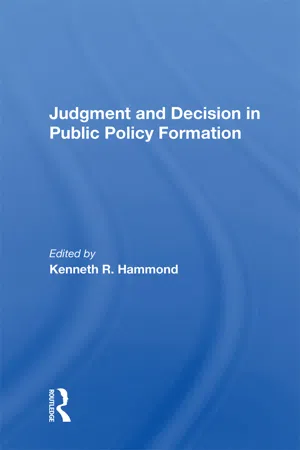
From various vantage points the authors consider the topic of judgment and decision in policy formation. Richard Lamm, governor of Colorado, describes the problem of utilizing scientific knowledge in the context of political survival. Joseph Coates, assistant to the director, Congressional Office of Technology Assessment, explores the nature of public policy issues. Kenneth Hammond, director of the Center for the Study of Judgment and decision in Policy Formation at the University of Colorado, describes the competence of thought that can he brought to bear on public policy issues. Paul Slovic, Decision Research Inc., addresses the problem of risk assessment in policy formation from the point of view of a cognitive psychologist. Ward Edwards, director, Social Science Research Institute, University of Southern California, describes the general manner in which decision theory may be applied to policy formation. Kenneth Boulding, program director, Institute of Behavioral Science, University of Colorado, provides an overview of judgment and decision in policy formation. Eillel Einhorn, professor of industrial psychology, University of Chicago, shows the consequences of fallible judgment for social policy formation. Kenneth Hammond and Leonard Adelman provide an example of the application of judgment analysis to a public policy issue.
Trusted by 375,005 students
Access to over 1.5 million titles for a fair monthly price.
Study more efficiently using our study tools.
Information
Subtopic
Política1
The Environment and Public Policy
Richard D. Lamm
I am honored to appear before the American Association for the Advancement of Science today. I have no scientific credentials, and few political ones, so I will speak only as a public policy maker who worries a lot. Serving the public is an increasingly hazardous duty--but I believe public policy to be one of the greatest challenges of our time.
It is my deep belief that we are faced with a crisis of crises--and that our political and scientific solutions are not keeping up with the pace of problems. Further I believe that we truly live in a hinge of history--and that we will see dramatic change in the years ahead. Some of this change will be helpful--some harmful--but on balance I believe that the crises we are faced with are moving us into the most hazardous time of human history. We are sailing speedily into a world as new and unknown as the world Columbus sailed into, and neither the politicians nor the scientific community are prepared for the nature and extent of change.
None of the problems are new to you--thermonuclear destruction, the energy crisis, lack of confidence in our institutions, the population explosion, pollution and depletion of natural resources, and many more. In each of these areas, I believe that the solutions are lagging far behind the problems. We are entering into a watershed time of human history with serious flaws in our problem solving machinery. Neither our institutions nor our value systems are structured to meet the challenges of our times. Because of this, problems which could be solved in a timely manner are not being solved, or in many cases not even worked on.
It is clear that the public today looks to both scientists and politicians to help them out of the Niagara of problems which are coming at them. They have a great faith in science and technology, and, despite Watergate, a high hope for a political leader who can lead them to a better life. As a recent pollster stated, they have "high hopes but low expectations" that we will produce an effective political leader who will help us solve the coming problems of energy crisis, drought, inflation, unemployment, and natural resource consumption.
The truth is, however, that we have very little leadership in politics any more; we now have umpires. Politicians survive because they don't rock boats, because they are usually chosen in a game which makes the common denominator the most likely winner.
Science is a process which seeks truth--politics is a process which seeks survival. Survivability is that quality which makes in the political value system a successful "politician." We can lament this fact, criticize it roundly, pray for "profiles in courage" but inevitably we are surely to live our future, as we have observed in our history, with "survivability" as an overriding consideration in virtually every political judgment.
Where the scientist will put forth his findings, and conclusions and ask for criticism so that the "feedback loop" is complete--a politician stays as far away from criticism as he or she possibly can. Kenneth Boulding has described the differences well in an article in Science:
The relationship between the scientific and the political communities is one of constant mutual frustration. There is a feeling on both sides that each ought to be able to help the other. The political community is constantly faced with making what it thinks are at least important decisions. Every decision involves the selection among an agenda of alternative images of the future, a selection that is guided by some system of values. The values are traditionally supposed to be the cherished preserve of the political decision-maker, but the agenda, which involves fact or at least a projection into the future of what are presumably factual systems, should be very much in the domain of science. Bad agendas make it much harder to make good decisions and if the decision-maker simply does not know what the results of alternative actions will be, it is difficult to evaluate unknown results. The decision-maker wants to know what are the choices from which he must choose. It is not surprising, therefore, that there is a demand for a one armed scientist or economist without that infuriating other hand.
The culture of the political community is very different. It is dominated in the first place by lawyers who are trained to win cases rather than to solve problems. The lawyers' "problem" is not to produce testable propositions, but to win the case. For politicians, likewise, the problem is to win elections and to please the majority of their constituents. The "scientific" problem-solving which is involved in getting the best legislation of the best decisions is incidental to the larger problem of political survival. We should not necessarily blame lawyers and politicians for behaving like lawyers and politicians. It is, in fact, what we hire them and elect them to do. The legal and political subculture is not the result of pure chicanery and foolishness. It has evolved over many generations for some very good reasons. The main reason is that where decisions involve distributional changes, that is, where they make some people better off and some people worse off, problem-solving in the scientific sense would not come up with any answers. Legal and political procedures, such as trials and elections, are essentially social rituals designed to minimize the costs of conflict. The price of cheap conflict, however, may be bad problem-solving in terms of the actual consequences of decisions. So far, the social invention that will resolve this dilemma does not yet seem to have been made. [But see chapters 2, 3, & 4, this volume: Ed.]
The policy maker in elective office is constantly faced with a classical dilemma--he sees the need for dynamic new policies but questions his political survivability if he proposes them. Whatever pretensions of courage he claims, he is caught between what he knows to be necessary and what he thinks will be accepted politically. Every critical decision may be his last. The raven sits on his shoulder and for every decision whispers "evermore." The dilemma is historic and has been faced by political figures throughout history. Al Smith, one of the world's most practical politicians, once said "A politician can't be so far ahead of the band he can't hear the music." His value system placed political survivability at the absolute top of his priorities, and however "progressive" his thinking it was within the relatively continuing context of the next election.
Why do we want to survive? For many simply complicated, idealistically selfish reasons.
In Colorado and most states it is not to feather our nests; there is stupidity in the legislative process, but little actual corruption. The reason is not that simple. For one thing the petty fame attached to the smallest, least prestigious office is itself corrupting. Most of our legislators can't be called Dr. or Professor or Esquire.
Once in a while someone with Old Testament eyes stumbles into the process and wants to change things in ways that do not accord with the rules, but he is soon neutralized. Most of us find in the words of one of the most successful people in my profession, The Honorable Everett Dirksen, that the oil can is mightier than the sword.
We also want to survive because though we are bit actors, it's still the most exciting show around. There is a tension, an excitement, an illusion of power if not actual power. We want to survive to be there.
As John F. Kennedy said: "Winning isn't everying--but losing, that's nothing." We do not have tenure--we want to survive.
It is highly likely that within a democratic framework the focus on survival will continue to hold. Ideally, perhaps, one can long for heroic political figures who are willing to take a long lead off the safe second base of political respectability. However, even when one does find his own profile of courage he is seldom in a position to succeed in passing legislation alone. Democracy is advanced by a heroic legislator, but legislation ultimately only succeeds by a full majority of conventional politicians. We live with myopia--as one Speaker of the U.S. House of Representatives stated "What do I care about posterity--what has it every done for me?".
Let me now evaluate how a policy maker--or at least this policy maker evaluates the contributions and the failings of the science and technology community. I am a little taken aback when I think of why I, as a Governor of a state with a myriad of problems, don't use more of the scientific resources I have here in this state. Most of the fault is mine, but not all. I find that the scientific community has a tendency to formulate problems narrowly--to have a specialized tunnel vision which does not see or fully appreciate all the public policy factors of a decision. Biologists use biological modes, economists use econometric models, engineers mechanical models. Comprehensive policy is not readily adapted to such modes. (See also chapter 2: Ed.)
In addition to finding too often single dimensional solutions to multifaceted problems it would appear to this decision maker that scientists often tend to ignore resource limitations and the agony of politically implementing many of the proposed "solutions." We speak to each other across our "two cultures" but we seldom communicate. Universities are looked at more as budget problems than as exciting resources to be used. As Coates points out in chapter 2, this state of affairs is not solely the fault of public officials.
Public policy--diamond like--takes on a new dimension every direction it takes. We need more than bright minds, we need wisdom. But science at best is not wisdom, it is knowledge, while wisdom is knowledge tempered with judgment. This judgment is too often missing in the accelerating pace of scientific advance. Lewis Mumford, writing on the automation of knowledge, states it succinctly: "... decisions of critical importance to the human race are being taken today on the basis of ten year old knowledge, confidently applied by highly disciplined specialists who too often display the short comings of ten year old minds, for they regard as a special merit their deliberate practice of cutting their minds off from ten thousand years of human experience and culture. . . strangely, they have not even a suspicion that the vast quantity of exact knowledge now at our dispoal is no guarantee whatever of our having sufficient emotional sensitiveness and moral insight to make good use of it; if anything, the contrary has already proved true." (See chapter 3 for a discussion of the role of judgment in public policy formation.)
I find that one of the great challenges of the future will be to differentiate what science and technology can do from what it cannot do. Its promise is great--it can and will continue to make dramatic breakthroughs in field after field--it can continue to improve significantly the human condition--but as a policy maker, I fear that people have too much faith in its miracles, that the cornucopia of its benefits can seriously excuse, postpone and delay some public policy considerations which we must institute.
Science and technology are seen as the twentieth century equivalent of the miracle of the loaves and fishes--a solution to not only some of our problems--but to all of our problems. Farming the sea is unlikely to "solve" the problem of a population exploding dramatically in a world which hardly affords sufficient diet to 50 per cent of its inhabitants. Miracle grains are impressive, but we increasingly are doubtful if we can sustain the investment in energy, water and capital to have that be a long lived solution.
We need badly in most parts of the world an ethic which makes people want fewer kids--more than the perfect contraceptive. We need social innovation as badly as we need scientific innovation. We rely on only technological solutions at our hazard.
We live in the midst of a large intellectual schizophrenia. One world view held by many very good and intelligent people is that our current economic problems are merely temporary hiccups in the system that will soon give way to Daniel Bell's salubrious vision of the "post-industrial state." This vision of American forecasts shorter workweeks, abundance for all, and a constantly rising per capita income. The economic pie will continue to grow, says this scenario, indeterminately. The other vision of America is that we are heading into an age of scarcity. There are "limits to economic growth," goes the argument, which require us to make new institutional arrangements.
It is axiomatic that our definitions of our problems control and dictate how we define the solutions. If shortages of energy or of natural resources are caused by inadequate supply, the solution is simple: increase supply. If, however, the shortage is due to excessive demand, the solution is vastly different. In fact, it urges us to invest our time, capital, and efforts in almost the opposite direction. Is our economic glass half-empty or half-full? Are shortages caused by inadequate supply or excessive demand? It is, alas, more than just a difference of opinion. It becomes a major public policy decision. As one source put it recently in an editorial on the energy crisis:
Had the United States moved soon enough, much could have been done to avert the crisis. Mass transit could have been encouraged over highway building, bringing great savings in fuel as well as comfort. Research into ways to remove pollutants from coal or to turn it into gas or oil could have been pushed harder; that would have enabled the country to make greater use of the abundant fuel. Building codes could have been changed to require more effective heat-conserving insulation of homes.
Instead, with remarkable consistency and perverse ingenuity, the nation kept doing exactly the opposite of what was required. For almost two decades, Washington has been spending tens of billions of dollars to subsidize highway building. Almost every American office building has been constructed with closed air systems that require air conditioning no matter what the outside temperature.
We have a limited supply of capital and capital formation potential. Impressive as our economic might is, it has very definite limits. Capital--others have stated so well--is our stored flexibility to adjust to tomorrow's problems. How we invest that capital is a public policy decision which well might dictate whether or not our social, political and economic system survives the bumps and shocks ahead. Do we "develop" our way out of shortages by synthetic fuels, massive federal programs like Vice President Rockefeller proposed of spending $100 billion--or do we "conserve" our way out of them? Do we attempt to feed the voracious consumption we have accustomed ourselves to, or do we put it on a diet? We probably have to do some of both--both develop and conserve-- but these are not equal on the national agenda nor in our cultural heritage.
Our whole intellectual and social history urges a clear way out of shortages--a formula of drill, mine and refine, a strategy that is pushed by our belief in the infinite and of boundless frontiers, limitless resources and a total belief in science.
We move to solve today's problems as we have solved so many others: roll up our sleeves, use our American ingenuity, call upon our puritan heritage, push aside the doubters, and get to work. However, history has a way of playing tricks on civilizations. "New occasions teach new duties, time makes ancient good uncouth" says the old Presbyterian hymn. History is made by men and women who recognize that civilizations are changed by people who think Copernican thoughts.
I do not believe that the transportation crisis will be solved by more super highways or faster airplanes--nor our energy use curbed by working on the supply side of the equation--as opposed to the demand side. Nor do I believe we can live sane lifestyles by Keynesian solutions which pump the economy into new and more magnificent excesses of consumption. It is not necessarily physical limits to growth--nor resources--but a realistic appraisal that the geopolitical and geoeconomic factors do not begin to give us the flexibility we need in managing a complex country.
Take natural resources. In a wink of the historical eye, we have moved the power to set price and supply, from the consuming nations to the producing nations. Supply availability and price are largely controlled outside the continental United States. The U.S., which used to set the price and control the supply of virtually all major metals and minerals, now sets the price on only iron ore. OPEC is well known.
Less known, however, are the other cartels which have been formed recently:
---The seven major bauxite exporters have formed the International Bauxite association and have significantly increased their earnings.
---The six leading phosphate-producing countries have tripled their prices with additional changes likely.
---Four leading copper producers, through the Inter-governmental Council of Copper Exporting Countries, have succeeded, at least to date, in the initial steps to increase their market power.
---Tin producers through the International Tin Agreement, are seeking a 42% increase in the guaranteed price of tin.
---The leading coffee producers have succeeded, through stockpile financing agreements and mutual understandings, in seizing control of world coffee prices.
---Five of the leading banana producers, through the organization of banana exporting countries, have levied sizeable taxes on banana exports to boost their returns.
---Many other exporters of commodities, including iron or...
Table of contents
- Cover
- Half Title
- Series Page
- Title
- Copyright
- About the Book
- Contents
- List of Figures
- List of Tables
- Foreword
- About the Editor and Authors
- Introduction
- 1 The Environment and Public Policy
- 2 Toward Increasing Competence of Thought in Public Policy Formation
- 3 What Is a Public Policy Issue?
- 4 Technology for Director Dubious: Evaluation and Decision in Public Contexts
- 5 Judgment, Choice, and Societal Risk Taking
- 6 Observations on Judgment and Public Policy Decisions
- 7 Science, Values and Human Judgment
- 8 Decision Errors and Fallible Judgment: Implications for Social Policy
- Further Reading
- Index
Frequently asked questions
Yes, you can cancel anytime from the Subscription tab in your account settings on the Perlego website. Your subscription will stay active until the end of your current billing period. Learn how to cancel your subscription
No, books cannot be downloaded as external files, such as PDFs, for use outside of Perlego. However, you can download books within the Perlego app for offline reading on mobile or tablet. Learn how to download books offline
Perlego offers two plans: Essential and Complete
- Essential is ideal for learners and professionals who enjoy exploring a wide range of subjects. Access the Essential Library with 800,000+ trusted titles and best-sellers across business, personal growth, and the humanities. Includes unlimited reading time and Standard Read Aloud voice.
- Complete: Perfect for advanced learners and researchers needing full, unrestricted access. Unlock 1.5M+ books across hundreds of subjects, including academic and specialized titles. The Complete Plan also includes advanced features like Premium Read Aloud and Research Assistant.
We are an online textbook subscription service, where you can get access to an entire online library for less than the price of a single book per month. With over 1.5 million books across 990+ topics, we’ve got you covered! Learn about our mission
Look out for the read-aloud symbol on your next book to see if you can listen to it. The read-aloud tool reads text aloud for you, highlighting the text as it is being read. You can pause it, speed it up and slow it down. Learn more about Read Aloud
Yes! You can use the Perlego app on both iOS and Android devices to read anytime, anywhere — even offline. Perfect for commutes or when you’re on the go.
Please note we cannot support devices running on iOS 13 and Android 7 or earlier. Learn more about using the app
Please note we cannot support devices running on iOS 13 and Android 7 or earlier. Learn more about using the app
Yes, you can access Judgement And Decision by Kenneth R. Hammond in PDF and/or ePUB format, as well as other popular books in Política y relaciones internacionales & Política. We have over 1.5 million books available in our catalogue for you to explore.