- 354 pages
- English
- ePUB (mobile friendly)
- Available on iOS & Android
eBook - ePub
About this book
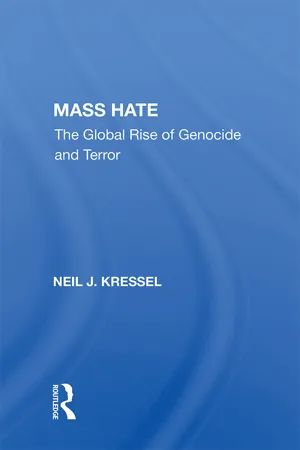
This book draws together the results of six decades of research on the psychology of mass hate. It focuses on situations where large portions of nations or cultural groups have participated in mass murder, acts of terror, or other atrocities against unarmed civilians.
Information
1
The Hater's Mind
Sick people are made by a sick culture; healthy people are made possible by a healthy culture. But it is just as true that sick individuals make their culture more sick and that healthy individuals make their culture more healthy.1
Abraham Maslow, Psychologist
The twentieth century has been a century of hostility, an epoch in which the brutality of humankind has erupted and flowed more expansively than ever before. During the past eight decades, mass hatred has reached genocidal proportions in Turkey, Germany, Indonesia, Nigeria, Bangladesh, Burundi, Cambodia, Bosnia, Rwanda, and elsewhere. Blood has gushed so freely, and with such frequency, that one might consider the urge to kill one's neighbor an inborn characteristic of our species.
Moreover, during the latter part of the century, the power to wreak bloody havoc on innocent civilians across the globe has fallen into the hands of terrorists whose hate knows no bounds. By the early years of the next century, these terrorists may possess nuclear devices that will make their previous methods seem quaint.
People often ask whether mass hatred could ever again flourish as it did in Nazi Germany. Only Americans—optimistic by nature, unschooled in world affairs, and protected by a powerful constitution—can deny the obvious, and unnerving, answer.
Our century has taken butchery to a new level. It has drawn great minds to evil causes, and introduced nightmarish technologies of destruction. Worst of all, it has spawned legitimizing ideologies that have provided misguided inspiration to tens of millions. Unless humanity learns to tame its murderousness, the twenty-first century promises more of the same. The only hope lies in understanding the human impulse to hate and, more important, the forces that transform that impulse into action.
Throughout the twentieth century, the overwhelming majority of Americans have been shielded against the worst excesses of human conflict. Despite the best efforts of the Ku Klux Klan, Michigan Militia, Aryan Nation, Nation of Islam, and others, mass hatred in the United States has been, at most, a disturbing side-show. The bombing of the Federal Building in Oklahoma City exacted an unprecedented toll in lives but so far has not sparked any campaign of extremist violence. Whether America's golden shield will hold, however, remains to be seen.
This book will draw together the results of six decades of research on the psychology of mass hate. It will focus on situations where large portions of nations or cultural groups have participated in mass murder, acts of terror, or other atrocities against unarmed civilians selected primarily because of their race, religion, ethnicity, nationality, or ideology. The goal is to crawl into the minds of the haters, however despicable, and to share their world, at least momentarily, to learn why they are so willing to act as they do and under what circumstances they might be less likely to take part in violence. Additionally, we will examine the prospects for an eruption of mass hatred in the United States.
Three examples help clarify the central issues of this book, two from the recent past and one from the Nazi era.
Bosnia, 1992: Psychosexual Destruction
An estimate of twenty thousand rapes, offered by independent human rights organizations and European Community investigators, may overstate or understate the scale of the terror. The primarily Muslim Bosnian government set the figure at fifty thousand for the early phase of the war in Bosnia. The first figure is more plausible, though both are difficult to confirm and, therefore, likely to provoke skepticism if cited as authoritative. (A U.N. war crimes commission has collected reports of three thousand rapes and identified about eight hundred victims by name.)2 What appears beyond question, however, is that thousands of Muslim girls and women have endured horrifying sexual degradation, sometimes repeatedly, and often as a prelude to torture or a bullet to the head. And many experts claim that Serbian soldiers participated as part of a sanctioned "ethnic cleansing" campaign. Anna Quindlen in the New York Times aptly described this campaign as "a particularly sophisticated and brutal form of genocide...which relies on the psychosexual destruction of those who would bear the next generation of Bosnian Muslims, so hated by the warring Serbs."3
Victims of sexual assault seldom wish to discuss their ordeals, much less embellish and magnify them. Many women probably choose to suffer in silence, owing to shame, shock, societal taboos, and fear of reprisals against loved ones. Thus, we have little reason to doubt the disturbing tales recounted by Bosnian women like Rasema, a thirty-three-year-old mother who resisted a gang rape in front of her two daughters. Her Serbian attackers reportedly threatened, "We will cut out your teeth! Do you want us to slaughter your children, to watch us cutting them into pieces, piece after piece?"4
Another Muslim woman, Sofija, was raped every night for many months by five or six different Serbian soldiers.5 Yet another, at the Partizan Sports Center, endured twenty-nine rapes in one night before passing out.6 In Bosnia, during the summer of 1992 and more recently, the bodies of women and girls have become just another battlefield. The scars will remain decades after the military conflict has ended, not least in the tormented lives of children born of forced impregnations.
According to feminist author Susan Brownmiller, "there is nothing unprecedented about mass rape in war when enemy soldiers advance swiftly through populous regions...."7 After all, the Japanese in World War II forced thousands of Asians to serve as "comfort women" for their troops. Advancing Soviet and Nazi soldiers also left behind a trail of rape. Pakistani soldiers did the same in Bangladesh in 1971. But the Bosnian situation may differ in degree, and to the extent that Bosnian Serbs used rape as part of a policy.
We are left with the question why this took place, and it is a question that burns the conscience. What does it say about human nature, that sizable chunks of modern societies, in this case thousands of Serbs, can participate in the mass rape of women and children, the murder of unarmed thousands, the destruction of whole communities of human beings? And are the Serbs' crimes mitigated in the least by the atrocities perpetrated on a much smaller scale by Croatians and Bosnian Muslims?
"We were ordered to rape so that our morale would be higher," claimed Borislav Herak from a Bosnian military prison in Sarajevo. "We were told we would fight better if we raped the women."8
Herak, a twenty-one-year-old Serbian soldier, admitted that he went on a six-month rampage of sexual assault, throat-slitting, and machine-gunning in the summer and fall of 1992. In a matter-of-fact monotone, he described how he would select his victims from an ever-changing supply of Muslim girls and women kept at the Sonja Cafe near Sarajevo, an alleged "rape camp." It remains unclear precisely how many Muslims were raped or killed by Herak, although he did not contest charges at his trial that he killed thirty-five and raped sixteen. Another Serbian attacker, a policeman who raped a twenty-year-old woman from his own town, protested to his victim, "It is war, you can't resist, there is no law and order."9
Little from what we know of Borislav Herak's background suggests a particular propensity for him to have acted as he did; he was an undistinguished textile worker and mechanic, a low-ranking soldier, patriotic to the Serbian cause, but not especially so. When asked how he felt after killing three villagers who turned out to be Serbs, not Muslims, Herak showed little remorse. "I was not sorry because they had a color television set," he explained.10 (Color televisions brought a good price in the black market.)
Was he, as he asks us to believe, a victim of circumstance? Did he succumb to primal urges for sex and violence that are present in all humans or, at least, all men, but deeply submerged during ordinary times? In psychiatric terms, Herak acted as a sociopath, or antisocial personality, a person who violated the rights of others without remorse, without loyalty to anyone. But where exactly does this analysis get us, when so very many others in the Serbian army acted similarly? And if Herak truly felt no remorse, why did he speak so freely about his role in the atrocities? Perhaps he enjoyed the publicity.
Are the roots of Herak's crimes to be found in his moral upbringing, his political views, his prejudices, his family life, his ambitions? What are we to make of Herak, the man? When sentenced to death, he did not object. He asked for some cigarettes.
Manhattan, 1993: Muslim Holy War
The questions we ask about Herak apply to most participants in crimes of mass hatred, including terrorists.
The bombing of the World Trade Center by Muslim extremists and the barely averted attack on other New York City targets show the impunity with which hate-driven terrorists can penetrate the defenses of the United States. The strike on the World Trade Center resulted in several deaths, a thousand injuries, tens of thousands evacuated, and damages approaching $1 billion.
Had the FBI been just a little less effective, or perhaps less lucky, New Yorkers might have seen a band of poorly organized conspirators succeed where large, enemy armies had always failed—in bringing massive bloodshed to the American main-land. A bomb blast in the Lincoln Tunnel or the Holland Tunnel, two of the terrorists' prime targets, could have brought tile, cement, mud, steel, and water crashing down on hundreds, maybe thousands, of commuters.
The Muslim extremists' plan to blow up the United Nations possibly would have killed dozens of delegates, and even dealt a major setback to the international organization. Successful attacks on the other targets would have resulted in similar devastation. One terrorist reveled in enthusiasm about the possibility of bombing the Diamond District on 47th street in Manhattan: "Boom—broken windows, Jews in the streets."11
Who could have conceived such schemes? When we examine the list of conspirators associated with the failed plot against the U.N., FBI building, and Hudson River tunnels, we see a group of devout, ultrafundamentalist Muslims; most had ties to the expatriate Egyptian cleric, Sheikh Omar Abdel Rahman, and his mosque in Jersey City, New Jersey.12 All of the conspirators, save two, were immigrants: one a Palestinian from Jordan, several from Egypt, several from the Sudan. Most were in their thirties, some married, some not; none was wealthy.
One leader of the failed plot, Siddig Ibraham Siddig Ali, held a degree in economics from the Sudan and had worked as a security guard and a taxi driver. He trained in "self-defense" with a group of Muslim militants in Pennsylvania on weekends. He had been active in raising money for the defense of suspects in the World Trade Center bombing and for El Sayyid Nosair, who had been accused of the murder of Rabbi Meir Kahane. In secretly taped conversations with an FBI informer, Siddig Ali discussed plans to procure things necessary for an attack on the United Nations, including a vehicle, dynamite, false identity papers, and a safe house for preparing a bomb. He and the informer also considered a counterfeit scheme in order to finance the plot.13 Later, Siddig Ali confessed to his role in the failed scheme and provided prosecutors with useful information.
Siddig Ali's coconspirators included Mohammed Saleh, a gas station operator described by friends as very religious and devoted to his three children, but, also, convicted of charges related to the sale of heroin.
One of the few American citizens in the group, Clement Rodney Hampton-El (known in his Flatbush apartment project as Dr. Rasheed), aged fifty-five at the time of the plot, has an especially curious background. Hampton-El, a Black Muslim whose father was also a Black Muslim, had fought for Islamic fundamentalists in the Afghanistan war. He received a leg wound of which he was particularly proud, and spoke often about returning to Afghanistan for another chance at martyrdom. Many neighbors respected Hampton-El, a sometime medical technician, and told of his opposition to drug dealers and crime. He apparently also worked with dying children and AIDS-infected patients.
But Hampton-El had ties to al-Fuqra, a violent, secretive group of Black Muslim extremists that takes marching orders from the radical Sheikh Mubarak Ali Jilani Hashmi of Lahore, Pakistan, One interviewer reports that Hampton-El had said he wanted to return to fight in Afghanistan because he was "afraid of what he might do here if he saw injustice and racism."14
What, then, motivated the conspirators? They, themselves, refer to anger over American support for Israel and opposition to Egyptian president Hosni Mubarak. They shared an immersion in the world of extremist Islam arid, in most cases, immigrant status. All apparently believed that they were fighting injustice; and all shared a diffuse hostility toward the "Great Satan," America.
But, none of these commonalities provides a very satisfying answer to the fundamental question, why. For this, we must look deeper.
Germany, 1933–1945: Eradicating the Jewish "Bacillus"
One would think that, by now, nobody would need to be told about the crimes of the Nazis. Hundreds of books by survivors, perpetrators, and scholars testify to the indisputability of the Holocaust; every conceivable form of evidence, written, spoken, visual, is available, and it is fair to say that our certainty about the Holocaust is no less than our confidence that a man named Hitler ever existed. Still, as historians Deborah Lipstadt and Pierre VidalNaquet amply demonstrate in recent books, a growing cadre of writers persists in denying the historical reality of Nazi genocide.15 So it continues to be necessary to document how millions of Jews were forced from their homes; how being productive members of a "civilized society" offered no protection; how the einsatzgruppen lined up defenseless villagers and mowed them down with machine guns; how women, children, and men unable to work, such as the old and disabled, were stripped, gassed, and burned to ashes in massive death camps.
Still, by now, the average, educated person has heard enough of the gory details. The significant remaining question deals with motivation. Even after six decades of analyses by social scientists of every stripe, our understanding of how and why so many individuals joined in Hitler's plan remains inadequate. Traditional explanations based on economics and politics provide part of the answer, but the deepest understanding emerges from psychology.
Why, for example, did apparently normal engineers agree to build the crematoriums used to burn the bodies of millions of innocents who had just choked to death on Zyklon-B? Hate may in fact have contributed very little to their motivation. According to testimony given to the Soviets after the war and recently published, these engineers knew precisely what their work would accomplish.16 One cited fear to explain his complicity: "I knew that if I refused to continue with this work, I would be liquidated by the Gestapo."
Another, who showed much initiative in his designs of the human ovens, spoke of patriotism: "I saw it as my duty to apply my specialist knowledge in this way in order to help Germ...
Table of contents
- Cover
- Half Title
- Title
- Copyright
- Dedication
- Contents
- 1. The Hater's Mind
- 2. Ethnic Cleansing in Bosnia
- 3. Muslim Extremists in New York
- 4. Rwanda—The Legacy of inequality
- 5. Why People Followed Hitler
- 6. The Power of the Situation
- 7. The Personality of the Perpetrator
- 8. Can Anything Be Done?
- Notes
- Index
Trusted by 375,005 students
Access to over 1.5 million titles for a fair monthly price.
Study more efficiently using our study tools.
Frequently asked questions
Yes, you can cancel anytime from the Subscription tab in your account settings on the Perlego website. Your subscription will stay active until the end of your current billing period. Learn how to cancel your subscription
No, books cannot be downloaded as external files, such as PDFs, for use outside of Perlego. However, you can download books within the Perlego app for offline reading on mobile or tablet. Learn how to download books offline
Perlego offers two plans: Essential and Complete
- Essential is ideal for learners and professionals who enjoy exploring a wide range of subjects. Access the Essential Library with 800,000+ trusted titles and best-sellers across business, personal growth, and the humanities. Includes unlimited reading time and Standard Read Aloud voice.
- Complete: Perfect for advanced learners and researchers needing full, unrestricted access. Unlock 1.5M+ books across hundreds of subjects, including academic and specialized titles. The Complete Plan also includes advanced features like Premium Read Aloud and Research Assistant.
We are an online textbook subscription service, where you can get access to an entire online library for less than the price of a single book per month. With over 1.5 million books across 990+ topics, we’ve got you covered! Learn about our mission
Look out for the read-aloud symbol on your next book to see if you can listen to it. The read-aloud tool reads text aloud for you, highlighting the text as it is being read. You can pause it, speed it up and slow it down. Learn more about Read Aloud
Yes! You can use the Perlego app on both iOS and Android devices to read anytime, anywhere — even offline. Perfect for commutes or when you’re on the go.
Please note we cannot support devices running on iOS 13 and Android 7 or earlier. Learn more about using the app
Please note we cannot support devices running on iOS 13 and Android 7 or earlier. Learn more about using the app
Yes, you can access Mass Hate by Neil J. Kressel in PDF and/or ePUB format, as well as other popular books in Politics & International Relations & Politics. We have over 1.5 million books available in our catalogue for you to explore.