eBook - ePub
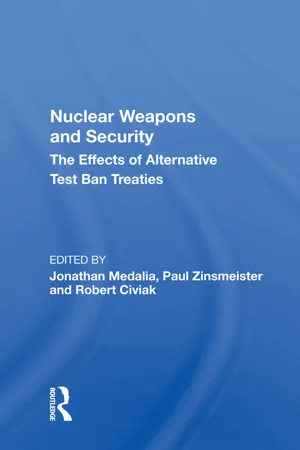
Nuclear Weapons and Security
The Effects of Alternative Test Ban Treaties
- 292 pages
- English
- ePUB (mobile friendly)
- Available on iOS & Android
eBook - ePub
About this book
This book presents the debate on the test ban issue. Its first goal is agreement on effective verification measures to make it possible to ratify the Threshold Test Ban Treaty and the Peaceful Nuclear Explosions Treaty.
Information
1
Introduction
David Cheney, Robert Civiak, Jonathan Medalla, and Paul Zinsmeister
Efforts among the nations of the world to achieve a total ban on nuclear test explosions have waxed and waned for more than three decades. Although a complete ban has not been achieved, diplomatic negotiations have produced four treaties limiting nuclear explosions: (1) the Limited Test Ban Treaty of 1963, signed by over 100 nations including the United States and the Soviet Union, in which nuclear testing in the atmosphere, in space, and under water is banned; (2) the 1968 Treaty on Non-Proliferation of Nuclear Weapons (NPT), in which some 130 nations have pledged not to acquire nuclear weapons or other nuclear explosive devices; and (3) the Threshold Test Ban Treaty (TTBT) of 1974 and (4) the Peaceful Nuclear Explosions Treaty (PNET) of 1976, in which the United States and the Soviet Union agreed to ban military and peaceful nuclear explosions with an explosive yield greater than 150 kilotons (kt). The latter two treaties have not been ratified, but each nation has undertaken to abide by the 150-kt limit as long as the other does.
For the past few years, the Soviet Union has been calling for negotiations with the United States toward a comprehensive test ban, but has until recently refused to discuss stricter verification procedures for the TTBT and PNET, which was the Reagan Administration precondition for such talks. In another venue, the House repeatedly passed legislation to restrict U.S. weapons tests to below one kiloton so long as the Soviet Union abided by the same restriction. Congressional pressure on the Reagan Administration and progress on bilateral negotiations to reduce the size of U.S. and Soviet nuclear arsenals appear to have spurred both nations to agree to talks with the ultimate objective of the complete cessation of nuclear testing as part of a wide-ranging arms reduction process. The first goal in the talks, which began on November 9,1987, is agreement on effective verification measures to make it possible to ratify the TTBT and the PNET.
Debate on the test ban issue often has been shrouded in contradictory arguments and emotional appeals. To help remedy this situation, Representatives William S. Broomfield and Beverly Byron asked the Congressional Research Service to "undertake a major study of all aspects of the nuclear testing issue in order to create an objective, factual and analytical basis for Congressional consideration of various nuclear test ban and testing moratoria initiatives." This report responds to that request. It concentrates on three possible kinds of treaties between the United States and the Soviet Union: a comprehensive test ban treaty (CTBT), a low-yield threshold treaty (LYTT) either allowing nuclear test explosions up to 1 kt or allowing tests up to 20 kt (compared to the current 150-kt limit), and a Quota Treaty that would limit the number of nuclear test explosions to some specified number (presumably one or two a year) over a given period, perhaps in conjunction with a threshold below 150 kt.
This report examines several aspects of these treaties. By way of background, it discusses the history of test ban efforts (chapter 2) and nuclear warhead technology, stockpiles, and testing (chapter 3). Next, it examines consequences of these treaties in three key areas: development of new nuclear weapons (chapter 4), maintenance of confidence in stockpiled nuclear warheads (chapter 5), and determination of the effects of nuclear explosions on military equipment (chapter 6). It then considers U.S. ability to verify compliance with various treaties limiting nuclear testing. It concludes by discussing the views of the non-superpower nuclear weapon states and the NATO allies on these treaties and the implications of these treaties for efforts to slow the worldwide spread of nuclear weapons. This report is written from the U.S. perspective because, glasnost notwithstanding, much less is known about Soviet nuclear weapons capabilities and programs.
The balance of this introductory chapter summarizes our findings on the topics in chapters 4-8.
Implications of a More Restrictive Nuclear Test Ban on Nuclear Weapons
Nuclear testing is an integral part of (1) developing new nuclear weapons, (2) maintaining confidence in existing nuclear weapons, and (3) assessing the vulnerability of military systems to the effects of nuclear weapons. To the extent a test ban treaty is more restrictive than the current regime, it will limit the capability of the United States and the Soviet Union to increase or maintain the military value of their nuclear weapons. Our findings regarding the extent to which different treaties might affect the value of nuclear weapons follow.
- Neither a CTBT, an LYTT, or a Quota Treaty would by itself prevent deployment of nuclear weapons, but each would restrict to varying degrees, the development of new nuclear warheads.
A new test ban alone would not prevent the United States or the Soviet Union from deploying more nuclear weapons of existing types; nor is it likely to prevent deployment of new weapons currently in advanced stages of development.
Both countries have nuclear weapons under development. The Soviet Union is flight testing a new ICBM and will probably begin flight testing a new SLBM soon, but there is no unclassified information regarding new warheads for these or other Soviet weapons under development. In the United States, warheads for two weapons are in the final stage of development: the W88 warhead for the Trident II and the W82 warhead for an upgraded 155 mm nuclear artillery projectile. Much of the testing has been done on these warheads. If a test ban treaty precludes further testing, the armed forces likely would have less confidence in the warheads than they desire, but it also is likely that they would have sufficient confidence to deploy either weapon. The W87, planned for use on Midgetman, is fully tested and used on the MX (Peacekeeper). No further tests are planned with respect to its modification and use on Midgetman if production of the W87 for Midgetman follows production of the W87 for MX with little delay.
Except for those in advanced stages of development, a CTBT would preclude development of new warheads optimized to new delivery systems or missions. Specifically, under a CTBT the United States could not optimize a strategic earth penetrator warhead or a warhead for a maneuvering reentry vehicle (MaRV). Both warheads are currently undergoing feasibility studies. The United States and Soviet Union could, however, unless forbidden by other arms control measures, develop improved weapon systems using existing or slightly modified warheads. For example, the United States could deploy MaRVs or earth penetrator weapon systems using existing or modified warheads, but the resulting systems would be of less military value than would be the case if new warheads optimized to the missions were developed.
The effect of an LYTT on warhead development would depend on the threshold. It is difficult to develop a modern warhead without testing it at a substantial fraction of the intended yield. A 1-kt LYTT would have almost the same effect as a CTBT on the development of current generation strategic weapons,1 but it would permit unhindered development of some tactical weapons. The so-called neutron bomb, for example, has a yield in the 1-kt range. A 20-kt LYTT could allow considerable development of strategic warheads. For example under a 20-kt LYTT, it might be possible to develop warheads for earth penetrators and MaRVs that could have significant strategic value if sufficient accuracy of delivery can be achieved to compensate for limited warhead yield.
The effect of a Quota Treaty would depend on the number of tests permitted and whether it includes a threshold below 150 kt. A quota of one or two tests a year would be similar to a CTBT with respect to developing new warheads to the extent that other testing requirements (e.g., to maintain confidence in existing warheads or to protect military hardware against nuclear effects) were given priority.
- A CTBT or Quota Treaty would for all practical purposes prevent the development and deployment of future generations of nuclear weapons. Some such weapons might be developed under a 20-kt LYTT and to a much more limited extent under a 1-kt LYTT.
For this report, future generation nuclear weapons are those that enhance, suppress, or direct specific outputs from nuclear explosions, as well as nuclear weapons concepts yet unknown. A virtually unlimited variety of such future weapons is theoretically possible, but few might have military uses.
A CTBT would for all practical purposes prevent development of future generation nuclear weapons because extensive nuclear testing would be required to understand and make use of their properties. A Quota Treaty allowing one or two tests per year would have a similar result, although it is conceivable that the United States or Soviet Union might be able to develop a weapon over decades if it were given priority over other testing requirements.
A 20-kt LYTT, and to a much lesser extent a 1-kt LYTT, would allow research on future generation weapons, but whether effective weapons could be developed or deployed is problematical. Theoretically, low yield weapons could be used effectively in space or in the upper atmosphere, where damaging radiation or particles can travel large distances. Development of such weapons is also constrained by the Limited Test Ban Treaty, which prohibits nuclear testing in the atmosphere or space.
Two future generation weapons concepts which have had underground tests are the hypervelocity pellet gun (nuclear shotgun) and the X-ray laser. Both weapons would be used to destroy targets in space. The hypervelocity pellet gun would shoot small particles at extremely high velocities toward a target. It appears that a 1-kt LYTT would permit development of this weapon, since one kiloton is more than enough energy for this task. An X-ray laser would absorb X-rays from a nuclear explosion and re-emit them in narrow beams toward multiple targets. The efficiency of this process is currently very low and even with substantial gains it appears that high yields (perhaps even above the current 150-kt testing limit) may be needed for an effective weapon. Research on many aspects of an X-ray laser could proceed under a 20-kt LYTT and on some aspects under a 1-kt LYTT.
- A CTBT (and possibly a 1-kt LYTT) would reduce U.S. and Soviet capability to test for the effects of X-rays and the synergistic effects of all products of a nuclear explosion on military systems. A Quota Treaty and a 20-kt LYTT could permit such tests. Other nuclear effects can be simulated adequately by nonnuclear means.
Effects tests are used to understand the effects of nuclear weapons and improve the ability of military systems to survive nuclear explosions. The more a treaty restricts using nuclear explosions for effects testing, the more it serves to constrain development of new weapons generally.
Most nuclear effects can be simulated adequately by nonnuclear means. The major result of limiting the use of nuclear explosions for effects tests would be to diminish U.S. and Soviet capability to assess and improve the resistance of equipment such as military satellites, reentry vehicles and potential SDI systems to nuclear generated X-rays and to the synergistic effects of simultaneous multiple nuclear effects.
The United States conducts one or two nuclear effects tests a year. To sustain an equivalent capability under a CTBT would require a significant improvement in producing X-rays by nonnuclear means. Pending these improvements, extra measures could be taken to protect systems against X-rays (e.g., extra shielding, more resistant electronics), although such measures may impose performance penalties.
Effects tests could be conducted under a Quota Treaty (although they would have to compete with other test requirements) and under a 20-kt LYTT. In principle, most of the knowledge of the effects of nuclear explosions on military equipment gained from underground tests could be obtained from explosions of devices with yields of less than 1 kt. Whether such nuclear devices could be developed under a 1-kt LYTT is not evident from open sources.
A halt in effects testing is not likely to affect deployment of the Trident II (D-5) and Midgetman missiles because effects tests will have been completed on their reentry vehicles, which are the stage most vulnerable to nuclear attack. Other tests are scheduled to assess the vulnerability of the D-5 and Midgetman missiles to Soviet nuclear-armed ballistic missile defenses. Precluding these tests could reduce confidence in the ability of these systems to survive the effects of such warheads, but D-5 and Midgetman will face only a severely constrained defense (100 interceptors around Moscow) as long as the Antiballistic Missile Treaty holds.
- Any test ban more restrictive than the current regime would over time reduce confidence among U.S. and Soviet leaders that some warheads in their respective stockpiles would perform as designed. This effect would become more pronounced over many years.
The performance of stockpiled warheads can degrade or become suspect over time as materials deteriorate with age or as design or production defects are discovered. To assure they will be ready on demand, stockpiled warheads are monitored through an extensive program of disassembly, inspection, and nonnuclear testing. These procedures usually suffice to detect and fix problems. Occasionally, nuclear tests on warheads under development reveal problems with warheads in the stockpile. On rare occasions, tests have been used to look for flaws in deployed warheads; in at least one case, a problem was found. Sometimes, tests have been used to evaluate problems or to verify performance after a fix.
Any test ban more restrictive than the current regime would, over time, lead to some reduced confidence in the reliability of warheads because it would preclude some confidence tests to address specific warhead problems and because the full range of testing helps warhead designers maintain their expertise to identify, evaluate, and fix warhead problems.
It appears likely, however, that a substantial loss of confidence in warhead reliability would not occur for many years. The current U.S. inventory contains 26 distinct warhead types. For 12 of the 26 warheads, nuclear tests subsequent to their deployment identified or confirmed a problem or demonstrated that a warhead would work after a problem had been corrected. For all but two of these warheads, the test or tests were done within four years of their deployment. Following that initial shakeout period, warheads have remained in the stockpile for 20 years or more without problems for which nuclear tests were conducted, so that the reliability of tested nuclear warheads appears sustainable for long periods without further nuclear testing.
- Confidence in the present U.S. stockpile of nuclear warheads is high. Several measures could slow the loss of stockpile confidence under a test ban. These measures, however, raise confidence issues of their own.
At present, a warhead is much less likely to malfunction than other weapon system components such as the rocket engine or the guidance system. Under a more restrictive test ban, some problems in aging warheads could be corrected by replacing deteriorated or suspect warheads or their components with warheads or components newly remanufactured to original specifications. This approach would avoid some uncertainties resulting from an inability to test. Other uncertainties, however, would arise: (1) Flaws in the original design or rapidly occurring degradation of components or materials could not be fixed by remanufacturing. (2) It would be difficult to have full confidence in remanufactured warheads without testing them because slight variations in materials, components, and the production process could cause the remanufactured warheads to fail.
Difficulties of remanufacture could be eased by building more robust warheads than existing ones and testing them before a more restrictive test ban took effect. For example, warheads containing more nuclear material or high explosive would generally be less sensitive to deterioration. This approach would not, however, guard against some types of deterioration or against many design and production defects. Moreover, a more robust warhead generally equates to a heavier or less efficient warhead, which could necessitate other adjustments such as arming missiles with fewer warheads or building larger missiles.
In some cases, one type of warhead could be used to replace another that had become suspect. Such substitutions are often possible with existing warheads. As examples, bombers carry five types of strategic nuclear bombs, Minuteman III currently carries two different warhead types, and Trident II may 2carry two warhead types. If confidence in a warhead type declines, a substitute could be manufactured and used. Substitution, however, entails two limitations. First, national capability is often reduced by substitution. The substitute warhead may be less capable by itself or in its new role; alternatively, it may have more capability than is needed, which wastes nuclear material, raises cost, or reduces other aspects of capability. (For example, replacing a lower-yield warhead with a heavier, typically higher-yield, warhead would reduce missile range or reduce the number of warheads a missile could carry.) Second, manufacturing new warheads without testing them is subject to the uncertainties noted above.
Several treaties would result in less loss of confidence in the reliability of stockpiled warheads than would a CTBT. In theory, a Quota Treaty permitting one or two tests per year could be sufficient for evaluating suspected problems in stockpiled warheads and for testing modifications that need to be made, given that one or two tests a year are conducted for these purposes now. Under a quota,...
Table of contents
- Cover
- Half Title
- Title
- Copyright
- Contents
- List of Tables and Figures
- Acknowledgements
- About the Contributors
- 1 Introduction
- 2 The Test Ban Debate: Forty Years of New and Recurring Themes
- 3 Overview of U.S. and Soviet Nuclear Weapons and Testing Programs
- 4 Effects of More Restrictive Nuclear Test Bans on New Weapon Development
- 5 Effects of More Restrictive Test Bans on Maintaining Confidence in the Warhead Stockpile
- 6 Effects of More Restrictive Test Bans on Nuclear Effects Testing
- 7 Verification Issues
- 8 Effects of More Restrictive Test Bans on Other Countries
- Appendix A: The International Nuclear Non-Proliferation Regime
- Appendix Β: International Verification: The IAEA
- Appendix C: Linkage of a CTBT with the Non-Proliferation Regime: Views from the NPT Review Conferences of 1975, 1980 and 1985
- Appendix D: List of Non-Aligned Nations Showing Which Are Parties to the Limited Test Ban Treaty, the Latin American Nuclear Free Zone Treaty, and the Non-Proliferation Treaty
- Appendix E: Treaty Banning Nuclear Weapon Tests in the Atmosphere, in Outer Space and Under Water
- Appendix F: Treaty Between the United States of America and the Union of Soviet Socialist Republics on the Limitation of Underground Nuclear Weapon Tests
- Appendix G: Treaty Between the United States of America and the Union of Soviet Socialist Republics on Underground Nuclear Explosions for Peaceful Purposes
- Appendix H: Letter of Introduction
- Appendix I: Letter of Submittal
- Appendix J: Letter of Transmittal
Trusted by 375,005 students
Access to over 1.5 million titles for a fair monthly price.
Study more efficiently using our study tools.
Frequently asked questions
Yes, you can cancel anytime from the Subscription tab in your account settings on the Perlego website. Your subscription will stay active until the end of your current billing period. Learn how to cancel your subscription
No, books cannot be downloaded as external files, such as PDFs, for use outside of Perlego. However, you can download books within the Perlego app for offline reading on mobile or tablet. Learn how to download books offline
Perlego offers two plans: Essential and Complete
- Essential is ideal for learners and professionals who enjoy exploring a wide range of subjects. Access the Essential Library with 800,000+ trusted titles and best-sellers across business, personal growth, and the humanities. Includes unlimited reading time and Standard Read Aloud voice.
- Complete: Perfect for advanced learners and researchers needing full, unrestricted access. Unlock 1.5M+ books across hundreds of subjects, including academic and specialized titles. The Complete Plan also includes advanced features like Premium Read Aloud and Research Assistant.
We are an online textbook subscription service, where you can get access to an entire online library for less than the price of a single book per month. With over 1.5 million books across 990+ topics, we’ve got you covered! Learn about our mission
Look out for the read-aloud symbol on your next book to see if you can listen to it. The read-aloud tool reads text aloud for you, highlighting the text as it is being read. You can pause it, speed it up and slow it down. Learn more about Read Aloud
Yes! You can use the Perlego app on both iOS and Android devices to read anytime, anywhere — even offline. Perfect for commutes or when you’re on the go.
Please note we cannot support devices running on iOS 13 and Android 7 or earlier. Learn more about using the app
Please note we cannot support devices running on iOS 13 and Android 7 or earlier. Learn more about using the app
Yes, you can access Nuclear Weapons and Security by Jonathan Medalia in PDF and/or ePUB format, as well as other popular books in Politics & International Relations & International Relations. We have over 1.5 million books available in our catalogue for you to explore.