- 254 pages
- English
- ePUB (mobile friendly)
- Available on iOS & Android
eBook - ePub
About this book
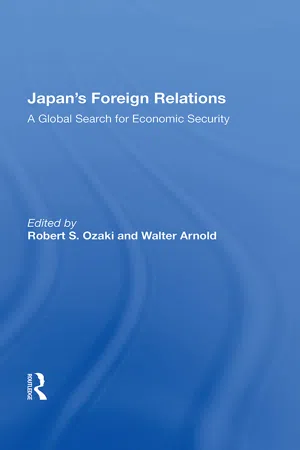
After World War II, Japan reemerged in the arena of international relations as an almost exclusively economic power without military might or territorial ambitions. Within some thirty years it transformed itself from a semideveloped state to a technological superpower with an economy that today is the second largest in the free world, next only to the United States, accounting for over 10 percent of total global production. The management of a rapidly growing industrial state with little domestic supply of resources necessarily requires great skill in the difficult task of maintaining sufficient access to overseas markets to sustain internal economic activity. Not surprisingly, then, Japan's foreign relations from World War II to the present have been heavily conditioned by economic considerations. This collection of original articles investigates how the economic growth of Japan has affected the pattern of its foreign relations and where and to what extent economic principles have had to be compromised for political, legal, cultural, or ideological reasons. The contributors, experts on Japan's economy, politics, and foreign relations, analyze the state of Japan's foreign relations with North America, the EC, Oceania, the Soviet Union, COMECON, China, ASEAN, the Middle East, Latin America, Africa, Korea, and Taiwan, focusing on developments in the last seven years and predicting likely trends in the 1980s.
Information
Part 1
Advanced Industrial Countries
1
Japan and North America
Gaining Entry to North American Markets
Japan’s foreign relations since regaining independence in 1952 have been dominated by the struggle to integrate itself into world markets. Saddled with a pacifist constitution drafted by the U.S. occupation officials in 1946 and dominated by a strongly pacifist public opinion and political party opposition, Japan has relied on U.S. military protection. It has only reluctantly agreed to modest rearmament in return for entry into North American markets and for North American sponsorship in the liberal world trading system under the General Agreement on Tariffs and Trade (GATT).1 Incorporated into the Western alliance system against the Sino-Soviet bloc during the early cold war, Japan was also long cut off from its natural and complementary trading partners on the Asian continent and reliant on more expensive raw materials from North America.
The warfare that erupted in the early 1950s over Korea pitted the United States, assisted by its allies, including Canada, against North Korea and China, backed by the Soviet Union. Americans and Canadians alike lost their lives in the effort to defend the noncommunist states, including Japan, and to maintain a strong military position for the United States and those who became its allies in East Asia. John Foster Dulles, appointed by President Harry S Truman, played the leading role in negotiating the San Francisco Peace Treaty of 1951 with Japan. The same day Japan signed the treaty in the Opera House it signed a bilateral security treaty at the Presidio of San Francisco lending military bases in Japan exclusively to the United States and ensuring protection of Japan from communist military and political pressure.
The Soviet Union refused to sign the treaty permitting the continued U.S. military presence and political influence in Japan. The People’s Republic of China had not been invited to San Francisco. Instead, Dulles and U.S. senators persuaded Japanese Prime Minister Shigeru Yoshida to sign, albeit reluctantly, a peace treaty with the rival Nationalist government on the island of Taiwan to ensure that the San Francisco Peace Treaty would be ratified by the U.S. Senate. Japan was induced to join the committees coordinating the embargoes of strategic exports to communist countries; the one for China (China Coordinating Committee, or CHINCOM) was particularly restrictive. Thus, Japan came to be largely cut off for a long time from trade with China and North Korea, which had been important Japanese sources of food and minerals.2 It was cut off also from potential sources of fuel, minerals, and forest products in Soviet Siberia. Poor relations with the USSR still restrict access there. Instead, Japan came to rely heavily upon the more distant and expensive supplies of North America.
Isolated by the occupation, Japan was slow to recover until the burden of economic aid for Japan and then the cold war stimulated the United States to look upon Japan as a potential ally rather than a defeated enemy. The emergency supplies of grain and cotton supplied by the U.S. occupation authorities helped the U.S. government to dispose of surplus stocks and paved the way for the later lucrative agricultural trade with Japan; it has become the largest market in the world for U.S. farm products. It is also the second-largest customer for Canadian wheat (China is the largest). U.S. surplus and obsolescent military aid was sent later—a precedent for the inadequate Japanese military equipment today.
When Germany was granted independence in the Western zones by the United States, Great Britain, and France, it readily agreed to rearm and introduce conscription in order to become a full North Atlantic Treaty Organization (NATO) ally. As one of the group of allies, it no longer was a threat to the others. Australia, New Zealand, and the Philippines—still fearing Japan—insisted on bilateral security treaties with the United States before agreeing to the San Francisco Peace Treaty.3 Japan, without other allies, remained heavily dependent upon the United States, but it rejected conscription and all but the most modest defensive military role. It ruled out nuclear weapons for itself and would not let the United States bring them in under its constitutional limitations. Much of the public and the opposition parties opposed U.S. bases and the security treaty. Unlike the German or British socialists, they preferred neutrality in the cold war or even favored China and the Soviet Union.
Under the occupation the U.S. leaders insisted on opening up Western markets to Japanese exports despite attempts by Great Britain and other allies to restrict the Japanese textile and shipbuilding industries, which later became strong competitors. To increase export earnings and foreign food supply for Japan, the occupation officials authorized Japanese Antarctic whaling expeditions against Australian objections. When the West Coast industry in Canada and the United States tried to restrict Japanese offshore fishing, Dulles arranged for a separate tripartite North Pacific Fisheries Convention with Japan, Canada, and the United States. It required Japanese abstention from fishing for the chief food fish, such as salmon, halibut, and herring, in the eastern Pacific.4 Thus, economic restrictions were kept out of the peace treaty but were permitted to some extent by the separate fisheries convention. U.S. policymakers refused to protect their home industry from Japanese canned salmon exports, which were permitted to undersell domestic U.S. producers.
Canada’s commercial treaty with Japan made room for Japan in its market. During the 1954 debates in the House of Commons a U.S. official was quoted approvingly on the need to provide outlets for Japanese trade to keep Japan from being drawn into the sphere of the communist bloc. The opposition Conservative party and Canadian Commonwealth Confederation (CCF) speakers agreed on the strategic need to keep Japan on the Western side as well as on support of the commercial treaty as a means to ensure a market for Canadian resource exports to Japan, the most important point for Canada. About that time, when Japan was eagerly trying to join the signatories of GATT, both Canada and the United States took the lead in sponsoring Japan’s entry to help it obtain the most-favored-nation tariff treatment by the other adherents. Great Britain, Australia, and France tried to keep Japan out and only slowly and reluctantly extended the favorable trade treatment. Canada also sponsored Japan’s entry to the Colombo Plan against Indonesia’s objections. Within Canada, the Canadian Manufacturers’ Association and the Canadian Textile Association deplored admitting the competing Japanese textiles at lower tariffs after their battering from U.S. and British low-priced textiles.
Thus it was that the comparatively wealthy North American countries, the United States and Canada, which had suffered the least war damage, welcomed Japan into their domestic markets and world trade generally. For them the strategic and military desirability of Japan’s adherence to the noncommunist side in the cold war was paramount, inclining them to accept Japanese commercial competition while gaining an important commercial outlet of their own for agricultural and resource exports to Japan. The European states, like Japan, were chiefly exporters of manufactured goods and suffered more directly from Japanese competition, which they consequently were reluctant to face. In contrast to Japan’s previous warlike behavior, its government now only rearmed to the minimum degree necessary to ensure U.S. “cooperation” in opening its markets, transferring new technology, and keeping the Soviets at bay. The U.S. use of Japan as its main base in East Asia achieved its global strategic goal of containing the communist states’ expansion and extended influence. Obligated only to defend its own territory, Japan will not go to the defense of its ally if attacked elsewhere.
The “miracle” of Japan’s extraordinary economic achievements in the 1950s and 1960s was greatly facilitated by the uninterrupted large-scale world trade growth, the comparatively liberal world trade regime into which Canada and the United States had ushered Japan, and the new heavy and durable-goods industry backed by the bureaucrats of the Ministry of International Trade and Industry (MITI).5 Also, by 1965 the chronic balance-of-payments deficits of Japan ceased, and it racked up trade surpluses as a result of its new competitive and high-quality consumer goods and machinery exports. Except for aircraft, U.S. manufactured exports lost their competitive edge, leaving the United States— like Canada—more an exporter of raw materials. Canada had exported raw materials to the large Japanese market that needed them both for its own domestic use and for manufacturing for export, but Canada’s small population and market could not absorb enough Japanese exports to give Canada an unfavorable trade balance.
Japan’s protected market with high tariffs, quotas, and barriers to foreign investment was tolerable when it was weak, but when it joined the Organization for Economic Cooperation and Development (OECD) and the International Monetary Fund (IMF) as a full member in the mid-1960s, it came under pressure to reduce the protective measures. It did so to a major extent by the early 1970s. With détente, under President Nixon, the cold war receded as the superpowers dealt directly with each other on strategic matters over the heads of their allies. Therefore, as military matters declined in importance, the two oil-price crises, inflation, unemployment, and severe recession took center stage and both Japanese protectionism and competition assumed major importance.
The competition from traditional Japanese exports like textiles, clothing, and shoes was reduced in the 1950s and 1960s by informal voluntary export restraints (VERs) whereby Japanese government or industry agreed to temporarily limit exports of items that the United States and Canada claimed damaged their industries. Japan was more likely to capitulate to the United States on such restraints than to Canada because it felt a greater obligation for the economic and defense benefits it had received. It agreed more reluctantly to similar restraints to Canada, even though that country was willing to share a larger part of its market with Japan. The advantage of the VERs was that they avoided direct bilateral restrictions by either the United States or Canada that would have violated their obligations under the GATT.
When President Nixon demanded textile restraints from Prime Minister Eisaku Sato in 1969, foreign exporters had only about 4 percent of the U.S. market, of which only half was due to Japanese textile exports, scarcely a damaging proportion.6 By 1971 the president was ready to use the Trading with the Enemy Act to stop Japanese textile exports in his frustration at Japan’s failure to comply. His insistence was due to the desire to carry out a pledge to U.S. textile producers who had supported his election campaign. Backed by his national-security assistant, Henry Kissinger, and his secretary of the treasury, John Connally, he launched an economic offensive against his allies.
On August 15, 1971, to the universal consternation of the United States’ trading partners, the United States abandoned the gold-exchange standard to depreciate the dollar and levied a 10 percent surcharge on foreign imports. The damaging import sanction was lifted only two months later when Japan, Canada, and Western Europe revalued their currencies upward to turn the terms of trade in the favor of the United States. This was only the opening skirmish in the ongoing trade war that still seems to be in progress among the allies. In the face of those cataclysmic Nixon shocks the Japanese textile industry quickly capitulated to a governmental compromise that satisfied the president and ended the surcharge. It was a Pyrrhic victory, because soon afterward the Japanese producers themselves were priced out of the market both at home and abroad by cheaper textiles from the newly industrializing countries (NICs) like South Korea, Taiwan, Hongkong, and Singapore.
Another Nixon shock was administered on July 15, 1971, just before the trade sanctions. The president announced a visit to China to improve relations with the other major communist state. It was a dramatic reversal from previous policy toward China, a hostile one that the United States had imposed on Japan. Only a few months earlier the U.S. secretary of state had solemnly reassured Japan it would be fully informed of any change in China policy, yet Prime Minister Sato was told only a few minutes before the public announcement. The outcome was Sato’s fall from power and a sharp but temporary wave of anti-American sentiment in Japan. Japan took an independent initiative in granting full diplomatic recognition to China, seven years before the United States did, and also repudiated its recognition of Taiwan.
Smarting from their treatment by the Nixon administration, the Canadian and Japanese cabinet ministers met in Toronto in September for regular consultations. Japanese Foreign Minister Takeo Fukuda said “Japan and Canada should form an alliance” to press for U.S. reconsideration of its surcharge.7 This was a rare example of even a tentative inclination to join the other allies to get the United States to change its policies. Canada was inclined to criticize Japan’s protectionism, but both countries were dismayed at the loss of “their special status” with the United States and increased their efforts to diversify their trade to reduce their economic dependence on the U.S. market. Canada launched a decade-long federal government campaign, “the third option,” to increase trade and cultural contacts with Japan.
Protectionism Against Japan’s Competitive Exports
During the period of détente with China and the Soviet Union that followed the Nixon-Kissinger initiatives, the United States also withdrew from its military involvement in the Vietnam War. It permitted its military forces to decline while the Soviet Union continued its steady buildup of nuclear missiles and air and land forces, as well as a blue-water navy not only in the NATO theater and in the Middle East, but in East Asia as well. At the same time, the USSR negotiated arms-control agreements and human-rights accords to encourage friendly economic ties with the United States and with the other NATO allies who were inclined to be increasingly independent of the United States.
Japan was dependent for 99 percent of its oil from abroad, most from the Middle East where the Organization of Petroleum Exporting Countries (OPEC) succeeded in exacting enormous oil price increases during the October War between Egypt and Israel. After an initial bout of sharp inflation and a halt in its previously very high economic growth, Japan managed to quickly absorb the full impact of the enormous oil price increases by increasing the productivity of its already highly efficient industries or by phasing out some of the more wasteful or high-energy-using industries. Canada and the United States, blessed with huge oil and gas supplies of their own, protected their consumers and less efficient industries to retain their political support by keeping domestic prices low, thus encouraging wasteful and inefficient use of energy. The result was a leaner, more efficient Japan that became even more competitive in world markets for its manufactured exports and—correspondingly— a Japan more impervious to the less competitive U.S. or Canadian manufactured exports to its own market. This led to a period of “unceasing acrimony,” as it has been termed by Nobuhiko Ushiba, former ambassador to both Canada and the United States and a chief negotiator in the trade conflict in the late 1970s.8
The principal issues between Japan and the United States have been the protection demanded by U.S. firms in electronics—chiefly color television, steel, and automobiles together with demands by the U.S. government for greater entry into the Japanese market for telecommunications equipment and agricultural products. Canada, too, has entered the fray in defense of television, steel, and automobiles. The...
Table of contents
- Cover
- Half Title
- Series Page
- Title
- Copyright
- Contents
- List of Tables
- Preface
- Introduction: The Political Economy of Japan’s Foreign Relations
- PART 1 ADVANCED INDUSTRIAL COUNTRIES
- PART 2 SOCIALIST COUNTRIES
- PART 3 DEVELOPING COUNTRIES
- List of Abbreviations and Acronyms
- About the Contributors
- Index
Trusted by 375,005 students
Access to over 1.5 million titles for a fair monthly price.
Study more efficiently using our study tools.
Frequently asked questions
Yes, you can cancel anytime from the Subscription tab in your account settings on the Perlego website. Your subscription will stay active until the end of your current billing period. Learn how to cancel your subscription
No, books cannot be downloaded as external files, such as PDFs, for use outside of Perlego. However, you can download books within the Perlego app for offline reading on mobile or tablet. Learn how to download books offline
Perlego offers two plans: Essential and Complete
- Essential is ideal for learners and professionals who enjoy exploring a wide range of subjects. Access the Essential Library with 800,000+ trusted titles and best-sellers across business, personal growth, and the humanities. Includes unlimited reading time and Standard Read Aloud voice.
- Complete: Perfect for advanced learners and researchers needing full, unrestricted access. Unlock 1.5M+ books across hundreds of subjects, including academic and specialized titles. The Complete Plan also includes advanced features like Premium Read Aloud and Research Assistant.
We are an online textbook subscription service, where you can get access to an entire online library for less than the price of a single book per month. With over 1.5 million books across 990+ topics, we’ve got you covered! Learn about our mission
Look out for the read-aloud symbol on your next book to see if you can listen to it. The read-aloud tool reads text aloud for you, highlighting the text as it is being read. You can pause it, speed it up and slow it down. Learn more about Read Aloud
Yes! You can use the Perlego app on both iOS and Android devices to read anytime, anywhere — even offline. Perfect for commutes or when you’re on the go.
Please note we cannot support devices running on iOS 13 and Android 7 or earlier. Learn more about using the app
Please note we cannot support devices running on iOS 13 and Android 7 or earlier. Learn more about using the app
Yes, you can access Japan's Foreign Relations by Robert S. Ozaki in PDF and/or ePUB format, as well as other popular books in Politics & International Relations & Asian Politics. We have over 1.5 million books available in our catalogue for you to explore.