- 154 pages
- English
- ePUB (mobile friendly)
- Available on iOS & Android
eBook - ePub
Medical Care And The Health Of The Poor
About this book
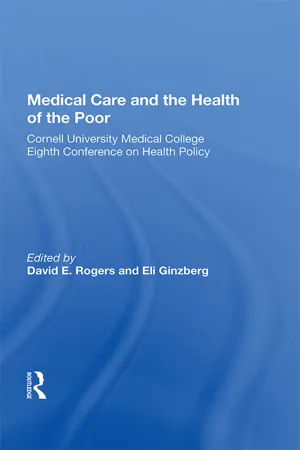
This book reproduces the seven invited papers that were prepared for the Cornell University Medical College Eighth Conference on Health Policy on the theme medical care and the health of the poor. The topics included looks at physician supply, clinical decisionmaking, and social values.
Trusted by 375,005 students
Access to over 1.5 million titles for a fair monthly price.
Study more efficiently using our study tools.
Information
1
Overview
The chapters that follow reproduce the seven invited papers that were prepared for the Cornell University Medical College Eighth Conference on Health Policy on the theme medical care and the health of the poor. Chapter 4 reproduces the speech delivered by the newly appointed commissioner of health in New York City, Dr. Margaret Hamburg, and the book concludes with a summation on the conference by the co-convener, Dr. David Rogers, who emphasizes the policy directions that emerged from the two-day discussion. Despite some differences in emphasis and interpretation, the conferees were in broad agreement as to the directions for policy initiatives.
In this overview chapter I have set myself the task of informing the reader about the principal issues on which the conferees centered their attention, taking care to note both the broad areas of agreement and the issues about which differences were not fully resolved. This overview and the subsequent chapters follow the order in which the several presenters delivered their papers.
Victor Fuchs begins by raising incisive questions about the relationship between poverty and health. He points out the conceptual difficulties one encounters in defining the term poverty; what measures of health should be employed—morbidity, mortality, or disability; how such measures differ among age groups in the same country and among countries; and whether the relationship between poverty and health is mediated by such factors as individual differences regarding time preferences and self-efficacy.
Fuchs goes on to raise additional policy questions such as the correlation between specific aspects of poverty and poor health. Do the poor suffer more morbidity and higher mortality because they are unable to obtain ready access to the health care system and quality care? Or is their inferior health status more a reflection of inadequacies in nutrition, housing, and neighborhood conditions? Fuchs also emphasizes the tensions that exist in a democracy such as ours among the drive to greater equity, the resistance of the public to higher taxes, and the societal necessity to pay attention to efficacy in the use of scarce resources.
Paul Starr looks at the politics of health care inequalities. The issue at hand could be reformulated as, “How much inequality in health care can a democratic society tolerate, and how much inequality in access to health care should responsible citizens in a democracy accept?” Starr remarks that most democratic societies have not necessarily committed themselves to broad-based “universalism”; rather, they have been willing to tolerate a considerable degree of inequality in the provision of medical care to different classes. He believes that a reasonable degree of inequality of access can be consistent with the democratic ethos so long as the poor are part of the same broad system of health care available to the rest of the society, even if the wealthy have the option of using their own money to obtain extra care. Starr concludes that if the poor are part of the mainstream system of care, they will enjoy the basic protection against illness that should be available to all citizens in a democracy.
Sir Douglas Black is the author of a well-known 1980 report that examined the relationships between occupational class and health status in Great Britain during the three decades of experience under the National Health Service. That report revealed that while there were notable improvements in the overall long-term trends in mortality and morbidity, the relative standing among the country’s five occupational classes had not narrowed, much less disappeared, over the three decades.
In reflecting on this surprising outcome, Black focuses special attention on individuals and families that live in particularly disadvantaged environments. He sees the “social deprivation” that they suffer as the key cause of their inferior health status and dismisses the notion that their poor health is the primary cause of that deprivation.
In seeking leverages for constructive change, Black singles out children as the primary group warranting special attention and assistance since improving their health will have long-term payoffs. He recommends greater safety for children at home and at play to reduce serious accidents and premature death; better nutrition via school meals; and regular assessment and recording of their hearing, vision, height, and weight at school; and health education that discourages cigarette smoking.
Dr. Nicole Lurie looks closely at the experiences of the poor in securing effective treatment for hypertension and diabetes. She notes that because of less education, membership in a stigmatized group, and inadequate insurance coverage, the poor are likely to encounter major barriers to effective diagnosis and treatment.
Focusing primarily on financial barriers, Lurie emphasizes that in the case of chronic conditions in which patients must make use of ongoing medications, many of which have risen substantially in price, if also in efficacy, inadequate money or insurance coverage is a major barrier to optimal care. Although improved insurance coverage would not remove all barriers to optimal care since considerations of race and patient-physician circumstances might still impede the poor obtaining optimal treatment, such an improvement would help increase the quality and effectiveness of the care the poor do receive.
Doctors Mary Charlson, John Allegrante, and Laura Robbins focus on arthritis and its treatment. In doing so, they point out that the poor and the less educated are much more likely to develop arthritis and to develop more severe manifestations of the disease, are less likely to seek treatment, and are less likely if treated to undergo major surgical interventions that can moderate and often cure the condition. What is more, the authors demonstrate that the much higher prevalence and seriousness of the disease among the poor reflect in the first instance the dysfunctional work, much of it involving bending and heavy lifting, that so many of them have earlier performed.
Even if it is difficult in the short and middle term to eliminate the jobs that contribute to disability resulting from arthritis, modern medicine can do much to moderate and remove the dysfunctional consequences of the illness—but only if the poor have broadened access to the health care system. Such broadened access would be cost-effective for society by reducing the long-term costs of care for large numbers of seriously afflicted arthritic patients.
Dr. C. Arden Miller sounds an upbeat note in regard to children’s health by stressing that several interventions have proved effective, including income supplementation, newborn screening, family planning, and Head Start. Miller focuses on the latter two interventions. He emphasizes that unwanted or mistimed childbearing is a harbinger of poor pregnancy outcomes and that Americans are conspicuously poor users of contraceptives.
He also remarks that the serious lack of health assessment, surveillance, and treatment for children in the early developmental years who need medical attention and treatment could be addressed by Head Start. It is an ideal instrument for providing such health surveillance of children and for securing parental involvement in their care. To date, however, the program serves only about 20 percent of all poor children. Taxpayers have been unwilling to fund the program at the level that is required. This is an egregious neglect that if overcome could make a significant contribution to improving the health and future opportunities of poor children.
Diane Rowland reviews the aims and successes of both Medicare and Medicaid and emphasizes that each has contributed substantially to broadening the access of the elderly and the poor to health care services. Medicare has come close to being a universal system since almost all of the elderly are covered. Medicaid, however, has never covered more than about two-thirds of the poor and today possibly not much more than half. But even Medicare has its shortcomings: The financially vulnerable elderly have to make substantial co-payments to obtain care, especially if they lack Medigap coverage or are not eligible for Medicaid. Rowland concludes from her in-depth review that improving health care for the poor must include universal financing with adequate benefits.
In my summary I note that although substantial agreement emerged during the conference in favor of a more inclusive system of health care financing and delivery with minimal or no exclusion of any group based on income, location, or other social characteristic, serious barriers still exist to the achievement of this objective in the immediate or near future. In 1965 when the legislation instituting Medicare and Medicaid was passed, total U.S. health care expenditures amounted to $41 billion. They are estimated for calendar 1992 to be around $820 billion and are on their way to $1 trillion by 1994–1995. Projections to the year 2000 point to the necessity of finding a second trillion dollars, which is highly improbable for a $5.5 trillion economy that is growing at 2 to 2.5 percent per annum.
Thus, I voice a caution: Significant improvements in medical care for the poor will require that the more affluent beneficiaries of Medicare accept fewer benefits and/or higher taxes; that those who enjoy both good wages and comprehensive health care benefits forego some or most of the federal tax subsidy that helps finance these benefits; that many acute care hospitals with an average occupancy of slightly more than 60 percent merge, change their mission, or close; that many of the more than 9 million people currently employed in the health care industry find employment in other sectors of the economy; that physicians and other health professionals recognize and accept that their relative earnings will decline; that the well insured accept considerable restrictions on their choice of providers; that government substantially restrict the scope of private health insurance companies; and that the principal payers—government and employers—put in place a system of global budgeting and basic reforms aimed at simplifying the complex and costly administrative superstructure. In the absence of these and still other major reforms, the federal government, whose accumulated deficit has grown from $1 to $4 trillion since the beginning of the 1980s, will be hard-pressed to maintain its present and prospective outlays for Medicare and Medicaid, much less put in place improved coverage for the poor.
The best hope for a significant improvement in the health of the poor rests on a strong and continuing expansion of the U.S. economy accompanied by an expanded program of social reform. The poor need more jobs, more income, more subsidized housing, and better public education as much or more than they need better access to health care. Thirty years separated the Great Society from the New Deal. By the mid-1990s, the country should be ready for a new advance.
2
Poverty and Health: Asking the Right Questions
Gertrude Stein, noted author and confidante of the leading writers, artists, and intellectuals of her time, lay dying. Her closest friend and lifetime companion, Alice B. Toklas, leaned forward and said, “Gertrude, what’s the answer?” Gertrude looked up and with her last breath said, “Alice, what’s the question?”
Regarding the issue of medical care and the health of the poor, we must indeed ask “what is the question?” Or, more appropriately, “what are the questions?” Unfortunately, too often the only questions addressed by writers on health policy are those for which they have predetermined answers. I propose to inject a different perspective by raising several theoretical questions about poverty and health so as to elicit answers that might improve public policy.
Who Are the Poor?
A logical place to begin is by asking what we mean by poverty—that is, who are the poor? This question has a long history within economics and even from the perspective of that single discipline gives rise to considerable controversy over definition and measurement. The question becomes even more important, however, when poverty is discussed in relation to health. As an economic concept, there is general agreement that poverty refers to some measure of income (or wealth) that indicates “inadequate” command over material resources. In the health care field, however, the concept often gets transformed into an amorphous set of “socioeconomic conditions” or an ill-defined “culture of poverty.”
Let us try to avoid such confusion. This is not to deny that people can be “poor” in ways other than economic. They can be “spiritually impoverished,” “morally bankrupt,” “unhealthy,” and so on. But to the extent possible, let us strive for clarity. If we mean low income, let us say low income. If we mean education, let us say education. And if we mean alcoholism, cigarette smoking, crime, drug abuse, fragmented families, hazardous occupations, sexual promiscuity, slum housing, social alienation, or unhealthy diets, let us say so explicitly. If we constantly redefine poverty to include anything and everything that contributes to poor health, we will make little progress either in theory or practice.
Even when poverty is defined in terms of income, there are numerous questions still to be answered, such as adjustment for size and composition of household, but we can leave them to the specialists.1 There is one conceptual issue, however, that is so important as to require explicit discussion. Should poverty be defined according to some fixed standard (absolute income) or according to position in the income distribution (relative income)? In my judgment, we need to combine both approaches. If we cling only to a fixed standard, economic growth gradually raises almost everyone out of poverty so defined, but the problems we usually associate with poverty persist. So-called subsistence budgets are adjusted to new social norms. Alternatively, to define poverty in terms of the bottom 10 or 20 percent of the income distribution does not help us get to the heart of the problem either. In a society with little inequality of income, being at the lower end need not have the same negative implications as when the distribution is very unequal.
People usually think of themselves as poor (and are regarded as poor) when their command over material resources is much less than others. Poverty as an economic concept is largely a matter of economic distance. Thus, in 1965, I proposed a poverty threshold of one-half of median income.2 The choice of one-half was somewhat arbitrary, but the basic idea would not change if a level of four-tenths or six-tenths was chosen instead.
There is considerable resistance to such a definition because a reduction in poverty so defined requires a change in the distribution of income—always a difficult task for political economy. But I believe it is the only realistic way to think about poverty. In this respect, as in so many others, Adam Smith had a clear view of the matter more than 200 years ag...
Table of contents
- Cover
- Half Title
- Title
- Copyright
- Contents
- List of Tables and Figures
- Introduction
- 1 Overview
- 2 Poverty and Health: Asking the Right Questions
- 3 The Politics of Health Care Inequalities
- 4 Poverty, Public Health, and Tuberculosis Control in New York City: Lessons from the Past
- 5 Inequalities in Health
- 6 Medical Care and the Poor: Focus on Hypertension and Diabetes
- 7 Socioeconomic Differentials in Arthritis and Its Treatment
- 8 Making a Difference in the Health of Children
- 9 Health Care of the Poor: The Contribution of Social Insurance
- Summary
- About the Contributors
- Cornell University Medical College Eighth Conference on Health Policy
- Index
Frequently asked questions
Yes, you can cancel anytime from the Subscription tab in your account settings on the Perlego website. Your subscription will stay active until the end of your current billing period. Learn how to cancel your subscription
No, books cannot be downloaded as external files, such as PDFs, for use outside of Perlego. However, you can download books within the Perlego app for offline reading on mobile or tablet. Learn how to download books offline
Perlego offers two plans: Essential and Complete
- Essential is ideal for learners and professionals who enjoy exploring a wide range of subjects. Access the Essential Library with 800,000+ trusted titles and best-sellers across business, personal growth, and the humanities. Includes unlimited reading time and Standard Read Aloud voice.
- Complete: Perfect for advanced learners and researchers needing full, unrestricted access. Unlock 1.5M+ books across hundreds of subjects, including academic and specialized titles. The Complete Plan also includes advanced features like Premium Read Aloud and Research Assistant.
We are an online textbook subscription service, where you can get access to an entire online library for less than the price of a single book per month. With over 1.5 million books across 990+ topics, we’ve got you covered! Learn about our mission
Look out for the read-aloud symbol on your next book to see if you can listen to it. The read-aloud tool reads text aloud for you, highlighting the text as it is being read. You can pause it, speed it up and slow it down. Learn more about Read Aloud
Yes! You can use the Perlego app on both iOS and Android devices to read anytime, anywhere — even offline. Perfect for commutes or when you’re on the go.
Please note we cannot support devices running on iOS 13 and Android 7 or earlier. Learn more about using the app
Please note we cannot support devices running on iOS 13 and Android 7 or earlier. Learn more about using the app
Yes, you can access Medical Care And The Health Of The Poor by David E. Rogers in PDF and/or ePUB format, as well as other popular books in Social Sciences & Social Policy. We have over 1.5 million books available in our catalogue for you to explore.