- 404 pages
- English
- ePUB (mobile friendly)
- Available on iOS & Android
eBook - ePub
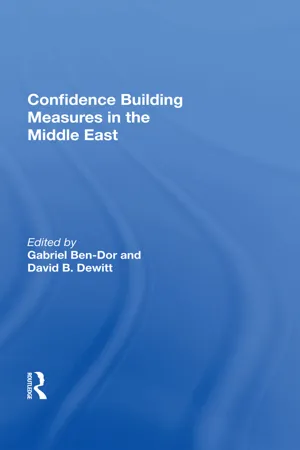
Confidence Building Measures In The Middle East
About this book
Confidence Building Measures (CBMs) were pioneered in Europe at the height of the Cold War. The immediate goal of such measures is to create enough trust between parties in international conflicts to avoid mutually unfavourable-sometimes dangerous-outcomes due to misunderstandings. The long-term goal of CBMs is to move the contending parties closer
Information
Part One
Introduction
1
Confidence Building Measures in the Middle East
The Nature and Importance of Confidence Building
There are many things that can be done to facilitate the project of confidence building in the Middle East,1 but probably none more important than defining the terms, and delimiting the subject by way of those definitions. So the first thing is to think systematically about what we mean by “confidence building,” and possibly by “confidence” and “security building measures.” Such definitions would have to go beyond the constraints of time and context and attempt to reach meanings that would be universally valid,2 otherwise we will never be able to transcend the limitations of the fact that the terms were born in the East-West context, with particular emphasis on Europe, in the 1970s and the 1980s, in particular within the institutional mechanism of the Conference for Security and Cooperation in Europe (CSCE).3
Primarily, confidence building measures address themselves to the need to avoid outcomes that are unfavorable to parties even if they are in a conflictual relationship. In other words, contrary to some prevailing impressions, the occupation with confidence building measures does not assume an orientation to conflict resolution or to a peace process. It does not presuppose that the political will exists to transform a relationship radically. Rather, it assumes that whatever form the relationship may take, there are likely to be many situations in which the parties would be interested in avoiding mutually unfavorable outcomes. For instance, even in a heated conflict characterized by adverse relationships, in all probability the parties are not interested in an inadvertent breakdown that will create war which is not wanted by either side. Yet such possibilities and dangers exist and in fact they are inherent in the unstable structure of large human communities. In order to prevent such risks from materializing and causing conditions to deteriorate to the detriment of all concerned, it is possible to take various measures, some of them preventive, some of them confidence building, and some of them both.
Preventive measures could be theoretically divorced from confidence building, but in practice this is not likely. It is not possible to prevent inadvertent breakdowns without tackling the lack of faith that normally prevails between conflictual adversaries. Let us assume by way of an example that a relatively junior officer goes berserk in one of the contending armed forces, and starts shooting on his own authority, without regard to the policy of his country. Obviously, his own leaders will want to minimize the damage caused by his irresponsible behavior, and in order to do that they will have to communicate with the leaders of the other side and convince them that the incident was indeed a random occurrence that did not represent official policy. For that it is necessary to have lines of communication open, perhaps along with a mechanism of consultation and mediation. Even then, however, the other side may be reluctant to believe that this is a bona fide attempt to make up and avert further danger, since obviously a long historical record of hostility has generated a lack of faith in the intentions and the motives of the other. In other words, there is a lack of confidence, and that is mutually detrimental, regardless of the basic flaws in the relationship. If things are to be improved, more confidence must be created, and for that it is necessary to introduce confidence building measures.
Such measures as a rule will have to do with communications. In order to persuade the other that what you do is bona fide it is necessary not only to make the attempt to say so repeatedly, but also to allow the other side to gain a better insight and perhaps a voice in what you do by way of bringing questions and reservations into your activities with your forces. Hence, one of the first and most effective forms of confidence building in the East-West relationship had to do with a system of early notification to the adversary of large scale maneuvers in order to make sure that these will not be misunderstood and taken as a hostile step if something goes wrong. The very act of taking the trouble to announce intentions in advance is a fairly radical step, especially in a structure of hostile relations. Nevertheless, such a step was taken, and practically no one argued that, as a result, any of the parties suffered from damage to the national interest.
However, this step did not suffice because of various considerations. The question arose as to whether, in announcing intentions in advance, one would not be believed; that is, the adversary might not believe that you would announce everything that needs to be announced or the adversary might see in this notification an effort to lull them into a lack of readiness.
To this difficulty we should add the dynamics of a nuclear arms race that in reality had run its course. As a result, numerous negotiations were undertaken in order to control the arms race, and to bring it to a halt by way of a massive agreement regulating possession, development and testing. Of course, parties are not likely to enter into such agreements if they do not believe that they can be monitored and verified. In order to make monitoring and verification more attainable, steps were then taken to allow access to one’s strategic sites by the adversary along with such rather dramatic steps as allowing, and in fact inviting, its inspectors into one’s own military exercises, allowing overflights by the enemy’s surveillance aircraft and the like. Over the years all this created an intense relationship that not only created an enormous store of knowledge between the parties, but also created a much higher degree of trust.
Of course, trust is partly a matter of individual psychology, partly a matter of culture, and partly a matter of objective circumstances. Objective circumstances can be controlled by political will and particularly by political agreement. This was a case in point. Extensive access to the soft points of the enemy, and mutual exposure to massive amounts of sensitive information as well as the intensive system of communications, visibly demonstrating the commitment of both sides to the prevention of accidents and others mutually undesirable outcomes, graphically and vividly depicted a possibility of introducing a much higher degree of mutual confidence. To the extent that this was due to a conscious effort to accomplish trust by a series of artificially contrived steps for that purpose, we are justified of speaking of confidence building measures. Since avoiding accidents was not the exclusive goal of these steps, the more ambitious objectives being changing the entire relationship by fortifying faith in the other party’s good intentions, it is possible to argue that such steps are not only preventive, but also positive. Hence the term confidence building is amply justified.
Our first example demonstrates two interrelated aspects of the process of confidence building. First, it is obvious that the initial stimulus to think about the possibility of confidence building is a matter of enlightened self-interest without regard to the degree of hostility between the parties to the conflict. The second is that, once this enlightened self-interest leads the parties to undertake measures that were initially designed as no more than preventive, these measures contribute decisively to confidence building, since prevention cannot be considered exclusively a technical series of steps. Once the parties have undergone this much of a learning process, new possibilities in their relationship open up and creative statesmanship has a new niche of its own. At a more advanced stage, it is also possible that the coexistence, one might say structured coexistence that has been experienced by the parties in the process, allows them to think systematically about more basic aspects of the relationship, perhaps in order to transform or reduce the conflictual elements that have been dominant in it so far. However, this is not necessarily the case. Confidence building is, initially speaking, a technique much like negotiations or mediation. It is obvious from the literature that negotiations and mediation are excellent aids to conflict resolution, but they do not have to be introduced into conflict situations because of that. This point is so important that it bears repetition and some further exploration.
One can imagine a study of negotiations and mediation in the Middle East criticized on the grounds that the basic orientation of the parties is still conflictual, and not designed to aid conflict resolution. But this criticism would not be very strong, because it would be obvious that parties negotiate and utilize various form of mediation in all stages and types of conflicts, hence that conflict resolution is not a necessary precondition for using them, although extensive and regular use of them may facilitate a conflict resolution orientation at some later stage. It is possible to regard confidence building in a similar way, on the same analytical level. This comparison should help us understand the ontological status of the term, and perhaps this understanding will do away with the reluctance of some of us to deal with the term simply because we consider ourselves as “realists” who see the conflict as lacking political leaders with the will to transform and reduce it, along the lines of what took place in the East-West conflict and particularly in Europe.
Indeed, it is obvious that transplanting a Western term born in very specific—and probably very unique—circumstances in Europe to other areas of the world is a very hazardous enterprise. Not only are the political cultures different, presenting different clusters of ideas, habits, customs and symbols, but the issues at stake are quite different too. In Europe, unlike in the Middle East, there were no major territorial questions to resolve by the time of the CSCE, nor were there issues related to the existence of the parties, quite unlike the case of Israel or the Palestinians when the latter dimension of the conflict made it particularly bitter and not amenable to resolution or even regulation. Obviously, an existential type of conflict is quite different than an incremental one, since in the latter, confidence building is really a matter of logic, whereas in the former, the struggle for existence renders the entire structure of the relationship so intense and so much oriented toward zero-sum conceptions as to make everything that has to do with trust and confidence a major problem almost by definition. This difference alone should make us wary of generalizing about the Middle East on the basis of the European experience. Nevertheless, we have to realize that there are many different conflicts in the Middle East, some on the regional level and some on a country-by-country basis, some having to do with the fundamental Arab-Israeli problem and others with inter-Arab and inter-Islamic issues. Even within the framework of the Arab-Israeli conflict there are many different issues, and one has to make analytical distinctions between them. Certainly the country-by-country relationship of Egypt and Israel is qualitatively different from the existential struggle for the land of Israel/Palestine on a communal or ethnic basis. In fact, the Egyptian-Israeli relationship itself has undergone major changes in its eventful history, and what we now see does not resemble that which we saw during the turbulent Nasser years. In any case, the present structure of the relations between Israel on the one hand, and most regional actors on the other, is such that it does allow for confidence building measures to be introduced even in the lack of radical changes in the political will, simply because in the vast majority of the cases the conflict is not zero-sum or it can be transformed, so that it does not rule out many pragmatic forms of cooperation.
Even the simple and rudimentary example of confidence building that we have introduced so far demonstrates that the term has to be understood in a variety of contexts, according to some basic dimensions of variance. The first objective of trust is the self, and this is neither a facetious nor a trivial observation. Not all parties to a conflict have confidence in themselves, and many of the steps that they take are indeed intended to build just that trust in the self of the party concerned, either in the sense of fortifying the value system or in terms of fortifying the constituency concerned. Some argue that all politics are domestic politics, and while this may or may not be true, it is important to remember that in any case the domestic aspects of considerations in an acute conflict deserve to be treated with respect and to be kept in mind virtually at all times. The next major dimension is confidence toward the other, the other being the adversary or adversaries in the conflict. Of course, the fundamental understanding of confidence building is taken to be along this dimension, as in building confidence between the parties to the conflict. Another important dimension is that of outside actors (and these are certainly of immense importance in the Middle East), such as the Great Powers and international institutions, chiefly the United Nations. Finally, there is the question of confidence in the relationship itself, which in many cases has a structure and an existence of its own and therefore has to be considered as an entity in its own right, and not necessarily as a mere outcome of other factors, such as the way that one party regards another. Many of these relationships are dual, trilateral or multilateral, which complicates things that much more.
Obviously, a conflict characterized by existential elements, which then tends to create a zero-sum orientation, is acute enough. But the fact is that in cases such as the Arab-Israeli conflict, the relationships involve multiple actors who may well be involved in other conflicts, hence complicating the general situation that much more. A major example of this would be the system of inter-Arab relations. In fact, speaking about the Arab-Israeli conflict may already be a misnomer since there are so many different Arab forces involved, many of them mortally at odds with one another. The interrelationship between the two conflict systems has been the subject of a fair amount of research and controversy, yet it obviously has not been settled. It makes sense then to take into account that when we attempt to analyze the chances of confidence building between Israel and the “Arabs” we speak about a complex entity that may not exist at all in the real world of politics. Is there or is there not something labeled “the Arab world” that makes sense as an existing entity that can be identified with some degree of coherence and consistency? Yet many of these reservations apply to Israel also. While Israel obviously exists, it is by no means a monolith, even on some of the most fundamental questions of foreign policy and security. In past periods many Arab leaders chose to ignore the political pluralism in Israel, but recently this has changed quite dramatically. If anything, the distinction that Arab (and not only Arab) leaders make about the attitudes of the two major parties tends to exaggerate the differences between them and to underestimate the general complexity of the Israeli political scene, which is driven by many competing forces in relationship to such issues as the economy, society, ethnic relations and religion. All of these variables impinge on the macro-political level, and hence on Israeli attitudes to questions in the Arab-Israeli conflict. Yet the sum total of Israel, and any major force within it, is far more than a set of attitudes on any single dimension of public and political life. A relationship with Israel has to take all this into account.
If one wishes to establish a relationship of trust and confidence with the other, knowing the other is already a step forward can help to accomplish this. Even though more knowledge frequently implies knowing more things that are not particularly palatable, generally speaking, confidence probably cannot be based on ignorance and the resulting fears and misconceptions about one’s potential partners. Not taking any relationship for granted, and working on the relationship in order to enhance it in the light of greater and more profound knowledge is one important requirement on the road to confidence building. One might add that much of this is already discernible in the Israeli-Palestinian relationship (although admittedly there is a long way to go), which may be one reason why observers are relatively sanguine about the future of that relationship compared to say the one between Syria and Israel, notwithstanding the better record of the latter. Of course knowledge, in and of itself, is value-neutral in that it does not necessarily create either a hostile or a friendly relationship, but it does appear to be a necessary precondition for a stable relationship within the framework of confidence building.
The Dimensions of Confidence Building 4
Confidence building thus does have cognitive dimension, as it does involve knowledge in a significant way. However, it also has other important dimensions.5 There is the affective dimension that has to do with feelings. Such dimensions are often estimated in political analysis, yet they play an obviously important role in politics. Not only do we have likes and dislikes, sometimes very strongly held, but our values, our ideologies and sometimes our evaluations are affected by them, consciously or subconsciously. When we like someone, we are more likely to trust him or her, whereas instinctive or traditional dislike will probably lead us to a lack of trust even where it seems to be analytically unjustified. Finally, confidence also has a strong evaluative dimension. Beyond knowledge about an adversary in a conflict and basic emotions about it, we will always have an assessment as to the intentions and capabilities on the other side, and these assessments normally endure over quite some time apart from the ongoing analytical process, so that the resulting evaluation becomes a factor or a variable in its own right, frequently lacking the analytical component of the original process.
Evaluation has to do with several dimensions regarding the partner in the confidence building process. First, there is the question of intentions or will: what does the partner want, what are his or her objectives in pursuing the given stage in the conflict, how genuine is his or her commitment to a policy of conflict reduction and/or confidence building at this time? Now, to the outside analyst it is obvious that such a question is not only difficult to answer (just ask anyone who has experience in intelligence or strategic assessment) but also that the answer at any given time is contingent on dynamic factors, so that there is an element of time involved (we have already referred to the fact that participants in conflicts rarely behave like uniform actors in rational models.) Yet political dynamics have a life all their own, and they do not allow a contingent answer, such as “it depends,” to existential questions. People will have an evaluative answer to such questions based on patterns of past experience and will normally change their minds only in response to very strong stimuli such as massive transformations versus past behavior. Failing that or anticipating that we would normally proceed on the basis of past assumptions, the evaluative component of the confidence building process indeed has an existence of its own.
The second evaluative feature of great importance is the one oriented to capabilities. In general, assessing another is normally a combination of thinking that other’s intentions as well as capabilities. In confidence building, there is no exception. We may believe on occasion that the adversary indeed wishes for some reason to engage in confidence building, but we may still decide not to trust it because our evaluation (again, based on past experience) will guide us to conclude that confidence building is not a feasible option. This evaluation can be based on our assessment of the domestic constraints deriving from the nature of the constituency, the value system or the ideology involved, supposedly “objective” factors such as economic interests or even ...
Table of contents
- Cover
- Half Title
- Title
- Copyright
- Contents
- List of Tables and Figures
- Acknowledgments
- About the Contributors
- PART ONE Introduction
- PART TWO Regional Actors: The Israelis and the Palestinians
- PART THREE Regional Actors: Arab States
- PART FOUR External Actors and Interactions
- PART FIVE Reflections About Confidence Building in the Middle East
- Appendix A: The Arab Press: Newspapers and Circulation in Thirteen Countries
- Appendix B: Radio-Listening in Arab Countries, 1974
- Selected Bibliography
- About the Book
Trusted by 375,005 students
Access to over 1.5 million titles for a fair monthly price.
Study more efficiently using our study tools.
Frequently asked questions
Yes, you can cancel anytime from the Subscription tab in your account settings on the Perlego website. Your subscription will stay active until the end of your current billing period. Learn how to cancel your subscription
No, books cannot be downloaded as external files, such as PDFs, for use outside of Perlego. However, you can download books within the Perlego app for offline reading on mobile or tablet. Learn how to download books offline
Perlego offers two plans: Essential and Complete
- Essential is ideal for learners and professionals who enjoy exploring a wide range of subjects. Access the Essential Library with 800,000+ trusted titles and best-sellers across business, personal growth, and the humanities. Includes unlimited reading time and Standard Read Aloud voice.
- Complete: Perfect for advanced learners and researchers needing full, unrestricted access. Unlock 1.5M+ books across hundreds of subjects, including academic and specialized titles. The Complete Plan also includes advanced features like Premium Read Aloud and Research Assistant.
We are an online textbook subscription service, where you can get access to an entire online library for less than the price of a single book per month. With over 1.5 million books across 990+ topics, we’ve got you covered! Learn about our mission
Look out for the read-aloud symbol on your next book to see if you can listen to it. The read-aloud tool reads text aloud for you, highlighting the text as it is being read. You can pause it, speed it up and slow it down. Learn more about Read Aloud
Yes! You can use the Perlego app on both iOS and Android devices to read anytime, anywhere — even offline. Perfect for commutes or when you’re on the go.
Please note we cannot support devices running on iOS 13 and Android 7 or earlier. Learn more about using the app
Please note we cannot support devices running on iOS 13 and Android 7 or earlier. Learn more about using the app
Yes, you can access Confidence Building Measures In The Middle East by Gabriel Ben-dor in PDF and/or ePUB format, as well as other popular books in Politics & International Relations & International Relations. We have over 1.5 million books available in our catalogue for you to explore.