- 266 pages
- English
- ePUB (mobile friendly)
- Available on iOS & Android
eBook - ePub
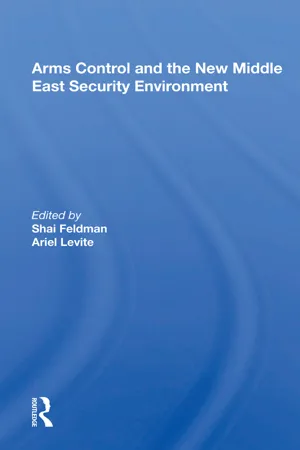
Arms Control And The New Middle East Security Environment
About this book
This volume incorporates the talks delivered at a conference on 11 Arms Control and the New Middle East Security Environment, 11 held in Ginosar (Israel) in January 1992. The conference was organized within the framework of the Project on Security and Arms Control in the Middle East conducted by Tel Aviv University's Jaffee Center for Strategic Studies. Some 28 scholars from eight different countries, together with some 30 Israelis, took part in the conference deliberations.
Information
1. Introduction
Shai Feldman
This volume incorporates the talks delivered at a conference on "Arms Control and the New Middle East Security Environment," held in Ginosar (Israel) in January 1992. The conference was organized within the framework of the Project on Security and Arms Control in the Middle East conducted by Tel Aviv University's Jaffee Center for Strategic Studies. Some 28 scholars from eight different countries, together with some 30 Israelis, took part in the conference deliberations.
When the Jaffee Center's arms control project was launched in 1990, the subject of arms control was foreign to all Middle East countries, including Israel. Having assessed that developments in the region would soon place the topic on the region's agenda, we saw an acute need to educate and socialize members of Israel's policy elite regarding the issues involved. For this purpose, the Ginosar Conference was designed to expose Israelis--scholars, government officials and senior members of the media--to international scholars and former officials well versed in the subject.
The objective of the conference was to air the experience gained in arms control in other regions--primarily but not exclusively in the US-Soviet and NATO-Warsaw Pact context--and to familiarize Israelis with this experience. In addition, a significant effort was made to examine the effects of the new Middle East security environment that was emerging after the end of the Cold War, the breakup of the Soviet Union and the 1990-91 Gulf War, on the prospects for applying arms control in the region. From the outset, our interest in the subject was broad, encompassing not only arms reductions and non-proliferation, but also confidence- and security-building measures (CBMs) as well as the means for verifying compliance with the various agreements reached.
Meanwhile, developments in the region confirmed the expectations and assumptions guiding our project's design. And as it turned out, the Ginosar Conference could not have been more timely. Thus, soon after we met in Ginosar, the Middle East Multilateral Conference was held in Moscow, launching the complex deliberations of the working group on Arms Control and Regional Security (ACRS) in the Middle East. This produced immediate demand for education on the issues involved.
These unique circumstances also explain our decision to produce this volume despite the very late publication date. First, we feel we owe this to our colleagues, in Israel and abroad, who were not privileged to share our deliberations at Ginosar. Secondly, we believe that students of the Middle East might find it useful to have a picture of the factors that affected the prospects for applying arms control measures in the region when the multilateral process was launched. Finally and most significantly, our examination and editing of the texts convinced us that they contain significant insights and original analysis to merit publication.
Within this context, three reminders are extremely important. First, this volume does not comprise academic research papers. The speakers at Ginosar were asked to share their insights and experiences with us, and these were subsequently edited for the benefit of those who could not be there. The best indication of the quality of these insights is that most of them remain relevant to this very day. However, it is important to remember that the chapters of this volume comprise edited presentations. For the most part, these are think-pieces and briefs, and should not be held to the standards expected of academic research papers that are normally found in edited books or journal articles.
Secondly, while most insights remain relevant, it must nevertheless be emphasized that the presentations printed here were delivered in their original form in January 1992. Finally, most of our participants were employed in government, public or other institutions. Some have joined such institutions since the Ginosar Conference. In all cases they delivered their presentations at the conference in their private capacity. Thus, none of the comments they have made should be viewed as reflecting the institutions to which they belonged or that they have joined since the conference was held.
The conference presentations addressed five main topics. Anthony Cordesman and Barry Posen laid the foundations by elaborating the role of arms and military systems in the Middle East, and their implications for the prospects for arms control in the region. Cordesman's analysis questions whether the magnitude of the problem propelling interest in Middle East arms control--fear that the huge quantities of advanced weapons acquired by the region's states will result in great harm--is as serious as most observers believe. He argues persuasively that most of the region's military establishments manifest gross mismanagement and structural inefficiencies. Their governments insist on purchasing NATO-standard state-of-the-art weapons that are usually more advanced than anything the human and military infrastructure of these states can absorb. These systems are also very expensive, limiting the number of units that can be purchased. At the same time, advanced weapons are far more dependent than area weapons on the efficient functioning of the integrated command, control, communications and intelligence (C3I) support system. Yet most of the region's states lack such efficient support systems, while their dependence on outside technical support presents a serious constraint on the use of military force. As a consequence, these states can derive much less output from their arms than their high military expenditures would otherwise indicate. In turn, this means that their armed forces can do far less damage than most observers expect.
Cordesman's analysis also questions the commonly held premise that the proliferation of advanced weapons is particularly worrisome. Indeed, he argues that "high technology conflicts have tended to be quick and decisive and to produce far fewer casualties than long civil conflicts or prolonged conflicts between military forces with only moderate capability." This is probably because precision weapons kill far fewer people around the targets they hit, thus resulting in fewer casualties than those associated with the use of 'traditional' area weapons. In any case, Cordesman's point illustrates that concern about casualty rates cannot be a credible motive for arresting the spread of advanced conventional munitions.
Cordesman also points out the dynamics of the many different conflicts throughout the Middle East. This has significant implications for arms control, because in contrast to Europe, where the existence of a single conflict allowed an assessment of relative military power, such a yardstick for ascertaining 'military balance' does not exist in the Middle East.
Barry Posen proposes a different yet complementary cause for the difficulty of calculating a military balance in the Middle East. He points out that conventional military systems are quite fragile and that the military forces of different states are very dissimilar--much more than they appear to the superficial eye. This is particularly the case when 'traditional' military establishments confront systems that are structured along a new format--the "Thorough Exploitation of Science and Technology (TEST)." Posen points out that it is "the integrated application on the battlefield of capabilities laboriously developed in peacetime, supported by a military, scientific and industrial infrastructure that is active not only in peacetime, but capable of direct participation, even in a short war, that gives the new format its remarkable capability."
Posen argues that the IDF is the only military force in the region that meets the characteristics of the TEST format. Thus it would be difficult to apply conventional arms control not only because it would not be easy to estimate a balance between military systems that do not meet TEST standards with the IDF, but also because Israel "would need to preserve this asymmetrical advantage over the Arab war coalition. This advantage was hard won; it would drastically reduce Israeli casualties in any future conflict. Hence, it is almost inconceivable that the Israeli military would give up this advantage in the framework of an arms control agreement."
The second issue addressed in the framework of the conference was the threat perceptions of Israel and the Arab states. Ascertaining these threats is exceedingly important, since the region's states are likely to view any future arms control agreement as an avenue for alleviating the threats they face. Ephraim Kam analyzes the Arab states' threat perceptions and points to a further difficulty facing the prospects for arms control in the region: the multiple sources of the threats perceived. For example Syria, while fearing Israel, also fears Iraq and Turkey. Indeed, as Kam argues, "during the last decade the threat cluster in the [Persian] Gulf overshadowed, at least for some Arab states, even the perceived Israeli threat." Thus Saudi Arabia's fears of Iraq and Iran seem greater than its concerns regarding Israel. These multiple sources of threats render difficult indeed the task of designing a new regional equilibrium through arms control or any other means.
Dore Gold analyzes Israel's threat perceptions, and points out that as a consequence of positive developments in the regionsuch as the enduring Israeli-Egyptian peace, the Arabs' loss of their Soviet patrons, and the divisions in the Arab world manifested in the 1990-91 Gulf War--the threat Israel faces has lost its specificity. Nevertheless, these developments might reverse course, thus exposing Israel once again to the constant and basic vulnerabilities that result from the long-standing asymmetries characterizing the relationships between Israel and its neighbors. These include asymmetries in size and in potential for coalition formation, and the asymmetries in numbers and force structures between the IDF and the large Arab war machines.
The third part of our conference was devoted to a preliminary discussion of the prospects of arresting the arms race in the Middle East. Ariel Levite elaborates a rather pessimistic view of the prospects for arms control in the region. He points out the continued appeal of acquiring high performance and ever more exotic conventional weapons, and the increasing interest in the acquisition of ballistic missiles. He discusses the role of civil and active defense programs, possibly propelling the region's states to acquire ever more robust forces in order to maintain strategic deterrence. He emphasizes the spreading perception that the utility of chemical arsenals is limited, resulting in increased interest in nuclear weapons. He also argues that perceptions that supplier regimes may be tightening controls might encourage the region's states to pursue preemptive purchases. Finally, he addresses the impact of the increased range of weapons in expanding the states' threat horizons: states which earlier did not figure in other states' threat assessments must now be taken into account, since for the first time they possess systems that can deliver munitions and do great harm to the assessing state.
Levite also argues that the character of most Middle East governments presents serious limitations on the prospects for applying arms control in the region. He notes the propensity of some of the region's states to adopt a rather flimsy attitude regarding the need to comply with agreements they have signed; the likelihood that, having undertaken such agreements with the full intention to comply, the regime might abruptly disappear and be replaced by a new government that does not consider itself bound by commitments undertaken by its predecessors. Finally, the rather careless approach that some of the region's states have adopted regarding safety and environmental issues, produces less responsible modes of storing weapons. This must affect assumptions that have traditionally guided the design and application of verification methods.
Patrick Clawson provides a provocative critique of the economic rationale for conventional arms control. First, he argues that most Middle East states are perfectly capable of sustaining their current high level of arms purchases. He demonstrates this point through the examples of Syria and Israel. He claims that Syria's newly-earned $2-3 billion in annual oil revenues compensates for its loss of previous Soviet subsidies for its arms acquisitions, and that Israel could increase its military spending by 50%, if it were willing to return to the levels of taxation it applied during 1986-87.
Clawson also argues that the conclusion of peace agreements in the Middle East would not necessarily lead the states involved to reduce their defense expenditures. This is because such accords will result in serious military dislocations, such as the loss of expensive facilities which would need to be substituted, and the need to gain the support of the respective military establishments by 'bribery.' Finally, Clawson argues that the incentive to reduce defense expenditures perceived by the region's states is in any case limited, since "lower military spending would not lead to greater economic growth." This is because the money saved is not likely to be channeled to investments that would generate economic growth, and because the economic impact of defense expenditures is not entirely negative. Clawson points out that economic growth in the Middle East requires structural reform, not more financial resources. He further argues that much of the foreign assistance that was channeled to the Middle East was politically motivated, and most probably would not have been provided without the rationale and requirements generated by the Arab-Israel conflict.
Christophe Carle presents a French perspective on the prospects for arms control in the Middle East. He notes that the gap between the US and French approaches to arms control have narrowed in recent years, partly due to the "increasingly common recognition that over time and in many cases, the spread of sensitive knowledge and its technological and industrial applications in the military realm are indeed inevitable." Carle also identifies greater American willingness to accept the French view that regards "some instances of proliferation as reflecting legitimate sovereign self-defense needs that result from genuine security concerns." On the other hand, France also moved closer to the US-led non-proliferation consensus by joining the NPT.
On the other hand, France remains critical of important aspects of Washington's approach to non-proliferation. Arms exports assume ever greater importance for the survival of the French military industries. It also sees the US approach as suffering a "gap between the advertised intention to implement restraints on the one hand, and the magnitude of agreed and foreseeable US sales to the Middle East and the Gulf on the other hand." In reality, the US, France and other European states share an identical but competing interest in marketing their arms for foreign sales aggressively, thus making the prospects for supplier restraint less than promising.
Carle also examines the implications of Israel's nuclear posture on the prospects for arms control in the Middle East, and questions the merits of Israel's continued nuclear ambiguity. He argues that the claim that an explicit Israeli posture would accelerate regional proliferation does not hold ground, since Israeli ambiguity did not constrain Iraq and Iran from launching their nuclear programs. He also predicts that such a change in Israel's posture would not be heavily criticized, since the world already regards Israel as a nuclear state: "The fiction of Israeli nuclear virginity is wearing so thin that no one takes it at face value anymore." In his view, Israel can in any case easily sustain external pressures since "there is no credible scenario for Israeli denuclearization in the foreseeable future. Neither is it possible to argue that Israel has any less reason than France to maintain a nuclear security-insurance policy over the long term." Yet the effects of continued ambiguity on the prospects for arms control are negative because "there can be no valid and credible arms control and disarmament without transparency."
The fourth focus of the Ginosar Conference comprised an effort to examine the experience of other regions in arms control. Jerome Paolini's presentation examines the possibility that the negotiations and agreement on Conventional Forces in Europe (CFE) might serve as a model for arms control in the Middle East. Paolini stresses that one of the most important lessons of NATO-Warsaw Pact arms control is that fundamental political preconditions are indispensable if concrete results are to be achieved. He argues that until such preconditions were achieved, "arms control had little to do with disarmament: it was about managing the nuclear arms race and attempting to foster strategic stability between superpowers." Indeed, the lesson of the CFE is that "arms control generates very few positive results when implemented without a political settlement of the confrontation at stake." Thus, the key to the CFE's success was that by the time the negotiations were opened, the strategic and political context in Europe had been completely altered following the advent of Michael Gorbachev.
Paolini also stresses a number of pertinent lessons that could be drawn from the experience gained with the CFE negotiations format: that arms control should be conceived as an element of a comprehensive peace process; that negotiations should be restricted to the region's states, even if the problems involved are relevant to extra-regional parties as well; and that negotiations should be conducted by sovereign states and should not follow an Arab-Israeli coalition negotiation format.
Paolini warns that "defining conventional stability in a truly multipolar negotiation would be very difficult." In his view, the experience with CFE suggests that conventional arms control should be negotiated separately from nuclear issues and that acceptance of the principle of asymmetric cuts is a prerequisite to success. Within this context, Israel might have to trade reductions in its air-power for significant cuts in the Arabs' ground forces.
Wlodzimierz Konarski follows with some lessons that could be drawn from the architecture and dynamics of the Conference on Security and Cooperation in Europe (CSCE). Konarski emphasizes the importance of a CSCE-type process and the confidence-building measures adopted in its framework, when conditions are not yet suitable for arms reductions. Indeed, he argues that without this CBM infrastructure, the later CFE arms reductions agreement could not have been concluded. He also stresses the importance of the rule of consensus in insuring the survival and endurance of the CSCE.
Konarski points out that the success of a CSCE-type process in the Middle East would depend on the political will of the region's states; on the extent to which they would regard the peace process as progressing at a rate that promises eventual success; on the adoption of a framework based on the principle of equal rights; and on the contribution of outside powers--primarily the US--to the framework's success.
Shekhar Gupta shares with the conference participants the experience of applying CBMs in the India-Pakistan context. These include competitions and sports between soldiers of the two countries; the establishment of 'hot lines'--aimed at preventing inadvertent escalation--between local commanders on the two sides of the border; the conduct of so-called 'flag meetings' between commanders, aimed at resolving practical problems; and the agreement on non-attack of nuclear installations.
Gupta argues that confidence building would have advanced further had India not rejected Pakistan's proposal that a five-power (India, Pakistan, Russia, China, and the US) conference be held to discuss the nuclear issue in South Asia. He also recommends that India open its borders to Pakistanis, and that Pakistan allow the selling of Indian books and magazines. Ultimately, he says, "people from both countries have to sit down and clean up school textbooks reciprocally."
Gupta also makes a controversial point: "the first prerequisite for any serious confidence-building regime between India and Pakistan is that these two states go overt with their nuclear programs." Gupta argues that confidence cannot be built around ambiguity, because one cannot be assured who controls the weapons. Also, ambiguity does not allow the development of public awareness regarding the strategic and other consequences of nuclear weapons.
The final focus of our conference deliberations comprised an effort to examine various facets of the US approach to non-proliferation. Geoffrey Kemp places the efforts of the Bush administration to arrest proliferation in historical context, illustrating that while America's record in this context was impressive, its desire to support c...
Table of contents
- Cover
- Title
- Copyright
- Contents
- Acknowledgments
- 1. Introduction
- Part I Arms Races and War in the Middle East
- Part II Arab and Israeli Threat Perceptions
- Part III The Prospects for Arms Control in the Middle East
- Part IV The Experience of Other Regimes
- Part V US Non-Proliferation Policy
- Contributors
Trusted by 375,005 students
Access to over 1.5 million titles for a fair monthly price.
Study more efficiently using our study tools.
Frequently asked questions
Yes, you can cancel anytime from the Subscription tab in your account settings on the Perlego website. Your subscription will stay active until the end of your current billing period. Learn how to cancel your subscription
No, books cannot be downloaded as external files, such as PDFs, for use outside of Perlego. However, you can download books within the Perlego app for offline reading on mobile or tablet. Learn how to download books offline
Perlego offers two plans: Essential and Complete
- Essential is ideal for learners and professionals who enjoy exploring a wide range of subjects. Access the Essential Library with 800,000+ trusted titles and best-sellers across business, personal growth, and the humanities. Includes unlimited reading time and Standard Read Aloud voice.
- Complete: Perfect for advanced learners and researchers needing full, unrestricted access. Unlock 1.5M+ books across hundreds of subjects, including academic and specialized titles. The Complete Plan also includes advanced features like Premium Read Aloud and Research Assistant.
We are an online textbook subscription service, where you can get access to an entire online library for less than the price of a single book per month. With over 1.5 million books across 990+ topics, we’ve got you covered! Learn about our mission
Look out for the read-aloud symbol on your next book to see if you can listen to it. The read-aloud tool reads text aloud for you, highlighting the text as it is being read. You can pause it, speed it up and slow it down. Learn more about Read Aloud
Yes! You can use the Perlego app on both iOS and Android devices to read anytime, anywhere — even offline. Perfect for commutes or when you’re on the go.
Please note we cannot support devices running on iOS 13 and Android 7 or earlier. Learn more about using the app
Please note we cannot support devices running on iOS 13 and Android 7 or earlier. Learn more about using the app
Yes, you can access Arms Control And The New Middle East Security Environment by Shai Feldman in PDF and/or ePUB format, as well as other popular books in Politics & International Relations & Middle Eastern Politics. We have over 1.5 million books available in our catalogue for you to explore.