- 288 pages
- English
- ePUB (mobile friendly)
- Available on iOS & Android
eBook - ePub
About this book
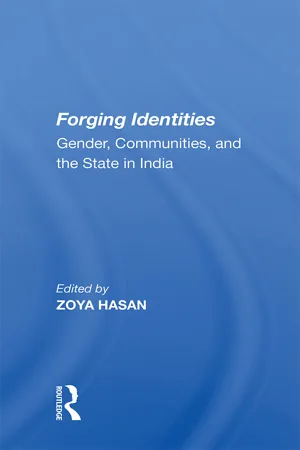
This volume challenges the assumption that Muslims in India constitute a homogeneous community. Focusing specifically on gender issues, the contributors instead locate the Muslim womens community within the social, economic, and political developments that have taken place in the subcontinent, pre- and post-Independence, in order to examine how the
Information
Communal Property/Sexual Property: on representations of Muslim women in a Hindu nationalist discourse1
Paola Bacchetta
My objective in this essay is to explore representations of Muslim women in the discourse of India's most extensive non-party Hindu nationalist organisation, the Rashtriya Swayamsevak Sangh (RSS). As such, the focus is not on the real identities of Muslim women as they define themselves, but rather, on characteristics which are constructed and assigned to them within often overtly anti-Muslim propaganda. My task will be to locate and reveal the representations, but moreover, to attempt to dismantle them so as to come to an understanding of their functionality in the discourse. I shall discuss the archive, my contentions and approach in just a moment; first, some general remarks on the RSS and its literature are in order.
The RSS was founded in 1925 in Nagpur, Maharashtra (then the Central Provinces), but first soared into the limelight in 1948 when, after being accused of involvement in Mahatma Gandhi's assassination, it was banned and then exonerated. Since then, it has captured public attention on various occasions, as it has been repeatedly implicated in the provocation and orchestration of Hindu-Muslim conflict. At the time of writing, it has again been banned in India, due to its alleged involvement in a most recent anti-Muslim event: the unlawful, ruthless, calculated demolition of a sixteenth century mosque, the Babri Masjid.
Opponents of the RSS have often called it a "Hindu fascist organisation",2 because of its goals, its tactics, its rigidly hierarchical internal structure, and its anti-democratic mode of functioning. Ultimately, its raison d'etre is to eliminate the present secular, pluralistic Indian nation-state, and to replace it with a Hindu rashtra. The latter would exclude all others (Muslims, Christians, Jews, Zoroastrians, etc.) from the citizen-body, but also some sects internal to Hinduism which defy the RSS ideals of asceticism (certain tantrik and shakta sects, for example). The RSS' highest-level leaders are appointed, not elected, and remain in office for life. In all, it has had only three Sarsanghchalaks (Supreme Leaders), and each has played a major role in the organisation's orientation: Dr. Keshav Baliram Hedgevar (1925 to 1940), Madhav Sadashiv Golwalkar (1940 to 1973), and Balasaheb Deoras (1973 to the present).
Today, the organisation comprises 2.5 million core members or Swayamsevaks ("volunteers"). who spend a minimum of one hour per day in para-military and ideological training. Core membership has always been confined to males and, until recently, has been overwhelmingly, if not exclusively, drawn from the upper castes. In addition, the RSS has several hundred Sangh Parivar (family organisations) which seek to mobilise wider sectors of society in professional unions (for students, teachers, artisans, industrial workers, etc.) or around specific issues (the Vishwa Hindu Parishad,3 another main actor in the present Babri Masjid conflict, is one such example). The first Sangh Parivar was the Rashtra Sevika Samiti, its separate women's organisation, founded in 1936.4 The RSS (and many of its Sangh Parivar) are concentrated mainly in north and central India, but have also spread to Kerala, Tamil Nadu and abroad (over 46 countries according to its own estimation).
The RSS has created a powerful machinery for the production and dissemination of its ideology. It possesses publishing companies which produce a wide array of textual materials in English and most vernacular languages, and has its own distribution network and bookstores. They exist in the urban centres of regions where the RSS is well established—Nagpur, Delhi, Ahmedabad, Bangalore, Pune, Bombay, for example.
The archive, the discursive strategies, my contentions
The RSS has an internal system by which it hierarchicalises its texts.5 Here, I analyse works which comprise its master narrative,6 and some lower-level materials provided they are similarly destined for all-India and international circulation within the organisation. These range from the earliest to some of the most recent. However, they are limited to the trans-regional, transnational lingua franca of the RSS: English.7 As such, it is probable that what follows represents only the tip of an iceberg. Subsequent local-level studies in regional languages are likely to uncover additional dimensions.
In the texts in question here, generally, the Speaking Subjects are RSS ideologues, and the Addressees are RSS members or potential members. The discourse is "performed", in the sense of Bakhtin,8 with the aim of homogenising members ideologically, recruiting potential members, and motivating them into action. Its communicative strategy is highly effective. This is due to strategic operations regarding content and form, which merit a few words of explication.
The RSS ideologues construct the content of their texts through a process of selectivity, re-combination, rearrangement, reprioritisation, and re-interpretation of elements from various contending discourses in their context. The materials range from Brahminical Hinduism, to nineteenth century Hindu reformist and revivalist discourses, to western cultural nationalist theories, to major and trivial events (in the sense of faits divers),9 to elements of the discourses of its opponents. Where possible, the RSS uses Brahminical symbols and signifiers to render the discourse familiar to its upper-caste and, more recently, upwardly mobile lower-caste10 audience, to disguise its political nature, to lend it moral sanctity and therefore legitimacy. In addition, it relies to a great extent on repeating and reinforcing received ideas (in the sense of idées reçues)11 insofar as they work to its advantage. The RSS ideologues are more concerned with evoking response than with facts. For this reason, and because the discourse is unclosed, constantly evolving through time, it easily accommodates contraḋictory statements and images.
The second domain of strategic action is literary form. In the present works, the RSS tends to make use of genres and styles identifiable within the framework of contemporary English and which it designates as such: political treatises, journalistic accounts, satire, short stories, letters, etc.12 These categories are certainly problematic and elsewhere I have problematised them.13 Briefly, I have argued that they can be understood in terms of their historicity, their uniqueness, and their instability. That is, they are the result of confrontations and intermixtures among several generic systems, of several languages (Marathi, English, Hindi, sometimes Sanskrit) over time, in which one language (English) and certain genres have come, for the moment, to overshadow the others.14 Other possibilities are always latent.
Furthermore, the RSS texts rarely appear as internally homogenous, closed entities. They are often (intentionally) constructed as poly-generic,15 and within each isolatable genre, poly-stylistic. The RSS uses genre and style to express, to displace or to conceal various contents. This is possible because of the nature of genre itself: each genre has its own particular space/time frame,16 its own field of representation, and allows for distinctive layers of potential meaning and precise registers of meaning within each layer. What may be an unacceptable content in one genre at a particular point in social time/space, may be perfectly expressible in another genre in the same social time/space, even in the same text. Indeed, the RSS says different types of things about Muslim women in different genres, and in some does not speak of them at all.
Now, my contention is this: the RSS makes strategic use of genre, style and an array of rhetorical devices, finally, to represent Muslim women as objects of potential or realised communal and sexual appropriation. The functionality of such representations in the discourse is multiple, contextual: at various points it is to release tension, evoke emotion, reinforce Hindu male solidarity, disempower Muslim males, or denigrate femininity.
For those who are somewhat familiar with the RSS, this proposition may seem untenable. In fact, the RSS is most widely understood in terms of its ascetic imagery, and the chastity of its members. I hope to dispel such popular notions17 which take into account only a limited section of the discourse and inadvertently participate in the RSS' project of legitimisation. To do so, I should like to begin with some observations on the place of Muslim women in relation to other identities in the discourse.
Muslim women in the RSS constellation of identities
The RSS is primarily concerned with the production of an ideal Hindu male identity, and it is around the latter that it forges all its other identity models. In comparison, Muslim women appear rarely in its discourse, and yet, I shall argue, they constitute an indispensable aspect of it.
The RSS' stress on individual Hindu male identity is reflected in its name: Rashtriya (National) Swayam (Self) Sevak (Worker) Sangh (Association). The "Self" in question is the empirical, material self-acting-in-the-world, as opposed to classical Hinduism's immaterial, spiritual Self (Atman, Brahman). The RSS believes that self-realisation must take place in the material world, individually and collectively. In order to realise himself, the individual Swayamsevak is to peel back the layers of may a (illusion), to become "conscious" of his essential Hindu self and of his Oneness with the Hindu Nation. He does so by participating in the RSS where he acquires physical strength, builds his character and works collectively with other Swayamsevaks for the Hindu nation. In this schema, the RSS selectively draws from the Brahminical concept of spiritual self-realisation, replaces its Universal Oneness with the Oneness of the Hindu Nation, and transposes the entire ...
Table of contents
- Cover
- Title
- Copyright
- Contents
- Introduction: Contextualising Gender and Identity in Contemporary India
- Reading and Writing about Muslim Women in British India
- Gender and the Politics of Space: The Movement for Women's Reform 1857-1900
- Defining Women through Legislation
- Minority Identity, State Policy and Political Process
- Identity Politics, Secularism and Women: A South Asian Perspective
- The Constitution and Muslim Personal Law
- Between Community and State: The Question of Women's Rights and Personal Laws
- Education, Money and the Role of Women in Maintaining Minority Identity
- Preserving Identity: A Case Study of Palitpur
- Communal Property/Sexual Property: On Representations of Muslim Women in a Hindu Nationalist Discourse
- Muslim Socials and the Female Protagonist: Seeing a Dominant Discourse at Work
- Urdu, Awadh and the Tawaif: the Islamicate Roots of Hindi Cinema
- Notes on Contributors
- Index
Trusted by 375,005 students
Access to over 1.5 million titles for a fair monthly price.
Study more efficiently using our study tools.
Frequently asked questions
Yes, you can cancel anytime from the Subscription tab in your account settings on the Perlego website. Your subscription will stay active until the end of your current billing period. Learn how to cancel your subscription
No, books cannot be downloaded as external files, such as PDFs, for use outside of Perlego. However, you can download books within the Perlego app for offline reading on mobile or tablet. Learn how to download books offline
Perlego offers two plans: Essential and Complete
- Essential is ideal for learners and professionals who enjoy exploring a wide range of subjects. Access the Essential Library with 800,000+ trusted titles and best-sellers across business, personal growth, and the humanities. Includes unlimited reading time and Standard Read Aloud voice.
- Complete: Perfect for advanced learners and researchers needing full, unrestricted access. Unlock 1.5M+ books across hundreds of subjects, including academic and specialized titles. The Complete Plan also includes advanced features like Premium Read Aloud and Research Assistant.
We are an online textbook subscription service, where you can get access to an entire online library for less than the price of a single book per month. With over 1.5 million books across 990+ topics, we’ve got you covered! Learn about our mission
Look out for the read-aloud symbol on your next book to see if you can listen to it. The read-aloud tool reads text aloud for you, highlighting the text as it is being read. You can pause it, speed it up and slow it down. Learn more about Read Aloud
Yes! You can use the Perlego app on both iOS and Android devices to read anytime, anywhere — even offline. Perfect for commutes or when you’re on the go.
Please note we cannot support devices running on iOS 13 and Android 7 or earlier. Learn more about using the app
Please note we cannot support devices running on iOS 13 and Android 7 or earlier. Learn more about using the app
Yes, you can access Forging Identities by Zoya Hasan in PDF and/or ePUB format, as well as other popular books in Politics & International Relations & Asian Politics. We have over 1.5 million books available in our catalogue for you to explore.