- 254 pages
- English
- ePUB (mobile friendly)
- Available on iOS & Android
eBook - ePub
About this book
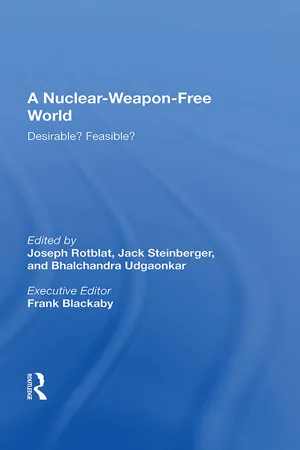
The world total of some 50,000 nuclear warheads is beginning to fall off sharply. It should be well below 10,000 by the year 2000. Should the ultimate target be zero? The idea of a nuclear-weapon-free world (NWFW) was put back on the world agenda by President Gorbachev in 1986. President Reagan also had a vision of a world without nuclear weapons.
Information
Part C
Feasibility of a NWFW
4
Technological Problems of Verification
The focus of this chapter is on technical methods to verify compliance with the rules governing a nuclear-weapon-free world. These procedures are designed to verify the elimination of existing nuclear warheads and stocks of plutonium and highly enriched uranium (HEU) for nuclear explosives, and to reveal illicit nuclear explosives or undisclosed plutonium or HEU, or facilities for their covert production. I have not included verification of elimination of systems that could be used for delivery of nuclear explosives, since practically any vehicle one can think of might be used, under some conditions, to place nuclear explosives on target. Nor have I included non-nuclear components of nuclear explosives unless they could clearly have no purpose other than for making nuclear explosives (for example, assembled devices with all the components needed for a nuclear explosive except the needed special nuclear materials).
Along with many others, I have become convinced that effective technical means for detecting unlawful removal of objects or materials from disclosed facilities (including containers) exist or can be developed soon. Many of the methods for doing this with very high assurance are in place in national and international nuclear safeguards systems. One can think of very effective ways to fill gaps in this assurance.
I have, therefore, found that the greatest challenges are in the following questions:
- How can unauthorized diversion of materials or devices from disclosed facilities be prevented, as opposed to detected, long enough to assure that the diversion does not present a substantial threat? This has to do not only with physical security against theft by non-national organizations, such as terrorists or other criminals, but also with a government that decides, for whatever reasons, to withdraw (perhaps suddenly) from international safeguarding agreements. It also relates to situations where there is a takeover of nuclear facilities by government factions, private enterprises, or revolutionary movements that do not abide by treaties.
- How can a high assurance be achieved that no significant quantities of nuclear warheads or special nuclear materials have been secretly withheld or produced in undisclosed facilities?
- What responses to detection of violations (including ones that have led to evident possession, or even actual use, of nuclear weapons) are possible that avoid rapid breakdown of the rest of a NWFW regime?
Technology can help provide answers to these questions. But non-technical actions may add further ways of deterring violations in a NWFW, and help prevent a breakdown of the principal infrastructure related to a NWFW in which significant violations have not yet happened. These are discussed in Chapter 6.
Definitions
Unambiguous definitions of what is forbidden (and, in some cases, what is allowed) in a NWFW are needed for specifying appropriate verification procedures. I have found the following definitions helpful for this purpose.
A nuclear weapon is a destructive system that incorporates one or more nuclear explosives. This definition excludes weapons that use non-explosive releases of nuclear energy, such as from a nuclear reactor or from radioactive materials, to cause damage.
A nuclear explosive is a device that, in less than 10 microseconds, can release at least as much nuclear energy as the chemical energy contained in a mass of chemical high explosive equal to the total weight of the device. This definition, which is somewhat arbitrary, is proposed to distinguish between pulses of nuclear energy that do not create shock waves, and nuclear explosions that create shock waves and release more energy per unit weight than chemical explosives. The definition of a nuclear explosive may be different in the context of a nuclear test ban, where even ‘zero yield’ (e.g. nuclear yield less than equivalent to one kilogramme of high explosive) nuclear explosions may be prohibited.
This definition excludes nuclear reactors that may release dangerous amounts of radiation following accidental or planned fast excursions, even though the heat energy released may be greater than the energy content of an equivalent mass of high explosive. Small nuclear reactors without shielding, and requiring less than one kilogramme of plutonium or HEU, could be pulsed to deliver high radiation doses out to several hundred metres or so, but I am not aware of their ever having been under serious development.
The total weight of a nuclear explosive is taken to include only those parts of it that are required for it to be armed, fused, detonated, and exploded. It would not, for example, include the weight of re-entry vehicles or guidance systems for missiles.
A fission explosive is a nuclear explosive that derives most of its energy from heavy nuclides that are capable of sustaining a fast neutron fission chain reaction. These special nuclear materials include uranium of which at least 6 per cent is U-235 or U-233; all isotopes of plutonium; and, possibly, any of several other transuranic nuclides. (Uranium enriched to less than 20 per cent in U-235 is now generally not called special nuclear material, but this rather arbitrary exclusion, I have argued, should be changed). This definition of fission explosives includes ones that are ‘boosted’ by the release of neutrons from contained mixtures of deuterium and tritium, whose energy release is small compared to the total. The thermonuclear energy released in boosted fission weapons is equivalent to the fusion of the order of grammes of deuterium and tritium (equivalent to several dozen tons of high explosive).
A thermonuclear explosive is a nuclear explosive that derives a substantial fraction of its energy directly from thermonuclear reactions.
Although it may be theoretically possible to make nuclear explosives without using any special nuclear (fissionable) materials, this has apparently not yet been achieved. Serious efforts to develop pure fusion explosives light enough to qualify as deliverable explosive weapons have been underway since the late 1950s, but with no announced or strongly suspected successes so far. Inertial confinement approaches to fusion power would make use of very small thermonuclear explosions, but the total weight of the apparatus necessary to create the explosions still remains orders of magnitude greater than the mass of high explosive equivalent to the energy released by the explosions.
Some minimum quantity of special nuclear material is, therefore, required to make any kind of nuclear explosive. This minimum quantity is sometimes called a ‘strategic quantity’. However, it is not well defined, on fundamental physical grounds, and it depends on the design and the practical accuracy of fabrication. The minimum actual quantities which have been successfully used are highly classified, and likely to remain so for the foreseeable future. These quantities are much smaller than the 20 kilogrammes of highly enriched uranium or 6 kilogrammes of plutonium that are often cited as needed for making fission explosives, and are approximately the critical masses of metal spheres of the materials at normal metallic density, if surrounded with good neutron reflectors. 1 The critical masses of special nuclear materials vary inversely with the square of their compression over normal density when rapidly assembled by a chemical implosion system. 2 Achievable compressions can be considerable, depending on the skills of the designers and fabricators. Note that the mass that needs to undergo fission to release 1 kiloton of energy is 60 grammes.
Guiding Principles for Technical Verification of Compliance with Rules Established in a NWFW
Since special nuclear materials are required to make nuclear explosives, my main focus is on techniques to verify that no such materials are accessible for illegal incorporation into nuclear explosives. The non-nuclear components of nuclear explosives can vary considerably with their design, and many or all of them can be useful for other purposes and are widely accessible. I argue that the principal routes to making nuclear explosives inaccessible are the elimination of existing stockpiles and global control of all special nuclear materials and means for their production, to make them unavailable for unauthorized use.
Five steps are essential for these purposes:
- Disclosure of existing stockpiles of nuclear explosives, military special nuclear materials, and facilities for their production.
- Disclosure of existing non-military stockpiles of special nuclear materials, and facilities for produdng them.
- Application of the Prindple of Containment to all disclosed nuclear explosives, special nuclear materials, and facilities that store or can produce them. According to this prindple, all such materials and facilities (including shipping and storage containers) are contained within spedfied physical boundaries. These boundaries are monitored to assure that there is no undetected, unauthorized removal of materials or devices across them. The boundaries are also designed to inhibit strongly, by appropriate physical security systems, any unauthorized entry, or unauthorized removal of materials or devices.3
- Dismantlement of all existing nuclear explosives (e.g. warheads), and safe and environmentally acceptable permanent disposal of all contained special nuclear materials and non-nuclear components.
- Use of surveillance systems (including ones that are under national, as well as international control) designed to detect undisclosed nuclear explosives, special nuclear materials, and facilities for producing them. Provisions would also be made for prompt on-site inspections of facilities suspected of use for such purposes.
Application of these technical principles cannot absolutely guarantee that undisclosed facilities, special nuclear materials, or nuclear explosives, have not been kept secret in violation of the rules of a NWFW. It will, therefore, also be necessary to rely on political and societal actions that not only deter cheating of any kind, but also stimulate people—who find out about cheating, whether within their own government or not—to reveal this to appropriate international authorities with minimum fears of reprisal. This broad category of safeguards, discussed in Chapter 6, should be an integral part of a global system of verification of compliance in a NWFW.
Each of the five technical aspects of such a system is explored in more detail in the following sections.
Disclosure of Existing Military Stockpiles and Facilities
Estimates Related to Military Uses
There are still about 50,000 nuclear explosives owned by the five announced nuclear-weapon states. More than 90 per cent are accounted for by the United States and the Commonwealth of Independent States (CIS). 4 Estimated total quantities of special nuclear materials in these explosives or associated production operations are: highly enriched uranium (HEU, at greater than 90 per cent enrichment in U-235), about 1500 tonnes; plutonium, about 260 tonnes. 5 Of these totals, the estimated quantities actually now in the warheads are: plutonium, 180 tonnes; HEU, 810 tonnes.5 The considerable uncertainties in these estimates are discussed below.
Nuclear submarine reactors (mostly US) account for a total of about 50 tonnes of HEU.5 Many submarines of other countries use only low enrichment uranium not suitable for high performance military nuclear explosives. (Actual enrichments and quantities are classified and therefore very uncertain.)
Perhaps several tonnes of HEU and plutonium are also under control of military establishments, for other purposes, such as CIS space power supplies, some low power military reactors, and for military R&D not directly connected with nuclear explosives.5
Perhaps several dozen tonnes each of plutonium and HEU are in scrap and other wastes accumulated from military production in the United States since the early 1940s. I have found no official tallies of totals of such US scrap and waste material, but have never been challenged for making this statement informally to a number of experts on the subject. Comparable quantities of similar scrap are probably also in CIS. The total of each in the other announced nuclear-weapon states may add up to a few hundred kilogrammes.
Besides disclosing quantities of nuclear explosives and accessible special nuclear materials, all existing facilities for produdng or storing them would have to be disclosed, and verifiably dismantled, or made available for application of containment safeguards. Some military facilities for produdng special nuclear materials not to be used in nuclear explosives might be allowed to operate, but only under containment safeguards. An example is uranium enrichment or fuel fabrication for ship propulsion reactors.
The number of physically separate facilities (i.e. buildings, bunkers) that have been or are now used for handling nuclear warheads, or military plutonium or HEU, probably exceeds 1000 (perhaps considerably) in the USA and CIS. At least several hundred more probably exist in the other announced nuclear-weapon states. I have been unable to find any systematic tallies of such facilities. Their locations are often still classified. All of them should be disclosed in a NWFW, and subject to detailed inspection and, where appropriate, containment safeguards. It is credible that data on the locations and status of all such facilities are widely dispersed among different agencies of each of the governments that have military nuclear programmes. I have found no tally of all such separate facilities (e.g. different process buildings, bunkers, missile silos, transport vehicles, etc. within which nuclear warheads or special nuclear materials might be hidden). But it seems dear that the global total number of facilities that should be subject to inspection and, in some cases, application of containment safeguards, must number in the thousands, at least.
Inherent Uncertainties in Military Stockpiles
The above estimates are not accurate disclosures by governments; they have been estimated from some government disclosures in the United States and from some other indicators of total production rates.
Even government people, with complete access to records accounting for nuclear explosives and special nuclear material flows associated with their manufacture, are faced with some inherent uncertainties in inventories of special nuclear materials in the warheads, in current process streams or storage, and in wastes. (I assume, I hope correctly, that all governments that have nuclear explosives know exactly how many of each type are deployed, in storage, or in transport).
There are no official published data on the accuracy of accounts of total present quantities of U-235 and plutonium (including its isotopic composition) now in the inventories (not including accumulated wastes) associated with military systems. It is credible that these are known in every country to within better than 1 per cent, perhaps much better. Note, however, that 1 per cent uncertainty in the present inventory of military special nuclear materials under US or Russian control corresponds to about 1000 kilogrammes of plutonium or 5000 kilogrammes of highly enriched uranium.
The uncertainties in the total, cumulative production of these materials, and the disposition of solid and liquid retrievable and unretrievable wastes, are much larger. Cumulative quantities of ‘materials unaccounted for’ (MUFs) in HEU and plutonium production, processing, and fabrication streams in the United States have been reported as several tens of tonnes of each. These estimates apply to imbalances in material accounting systems. The unaccounted for materials are presumed ‘lost’ in larger than measured production of wastes. Directly estimated cumulative, non-retrievable quantities of waste plutonium have been published by the US Department of Energy at about 7000 kilogrammes. This is th...
Table of contents
- Cover
- Half Title
- Title
- Copyright
- Contents
- Preface
- About the Contributors
- About the Book
- A Nuclear-Weapon-Free World: Executive Overview
- Part A Historical Review
- Part B Desirability of a NWFW
- Part C Feasibility of a NWFW
- Part D Alternative Routes to a NWFW
- Part E Intermediate Steps
- Index
Trusted by 375,005 students
Access to over 1.5 million titles for a fair monthly price.
Study more efficiently using our study tools.
Frequently asked questions
Yes, you can cancel anytime from the Subscription tab in your account settings on the Perlego website. Your subscription will stay active until the end of your current billing period. Learn how to cancel your subscription
No, books cannot be downloaded as external files, such as PDFs, for use outside of Perlego. However, you can download books within the Perlego app for offline reading on mobile or tablet. Learn how to download books offline
Perlego offers two plans: Essential and Complete
- Essential is ideal for learners and professionals who enjoy exploring a wide range of subjects. Access the Essential Library with 800,000+ trusted titles and best-sellers across business, personal growth, and the humanities. Includes unlimited reading time and Standard Read Aloud voice.
- Complete: Perfect for advanced learners and researchers needing full, unrestricted access. Unlock 1.5M+ books across hundreds of subjects, including academic and specialized titles. The Complete Plan also includes advanced features like Premium Read Aloud and Research Assistant.
We are an online textbook subscription service, where you can get access to an entire online library for less than the price of a single book per month. With over 1.5 million books across 990+ topics, we’ve got you covered! Learn about our mission
Look out for the read-aloud symbol on your next book to see if you can listen to it. The read-aloud tool reads text aloud for you, highlighting the text as it is being read. You can pause it, speed it up and slow it down. Learn more about Read Aloud
Yes! You can use the Perlego app on both iOS and Android devices to read anytime, anywhere — even offline. Perfect for commutes or when you’re on the go.
Please note we cannot support devices running on iOS 13 and Android 7 or earlier. Learn more about using the app
Please note we cannot support devices running on iOS 13 and Android 7 or earlier. Learn more about using the app
Yes, you can access A Nuclear-weapon-free World by Joseph Rotblat in PDF and/or ePUB format, as well as other popular books in Politics & International Relations & Arms Control. We have over 1.5 million books available in our catalogue for you to explore.