eBook - ePub
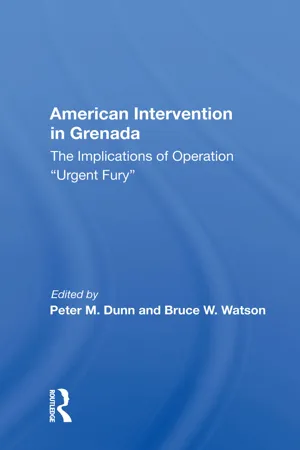
American Intervention In Grenada
The Implications Of Operation ""Urgent Fury""
- 200 pages
- English
- ePUB (mobile friendly)
- Available on iOS & Android
eBook - ePub
About this book
Why did the United States invade the sovereign state of Grenada in October 1983, risking world condemnation and the possible escalation of violence outside the borders of the tiny Caribbean island? According to the contributors to this book, the invasion-code-named "Urgent Fury"--was a product of the increasing concern with political instability in
1
The Setting
Courtney Glass
The island of Grenada lies in the Caribbean about 100 miles north of the Venezuelan coast. It is the most southerly of the islands in the Windward chain, and, although only about twice the size of Washington, D.C., it is the most densely populated of the Lesser Antilles. Known as the "Isle of Spice," Grenada is famous for its nutmeg, which it exports along with cacao, cinnamon, mace, sugar, rum, and a variety of other, agricultural products. Since 1955, when a hurricane destroyed almost ninety percent of the nutmeg crop, bananas have become an important part of the economy. Although more than a third of the island's population is engaged in agriculture, tourism has become Increasingly significant in recent years. Even though Grenada differs from the majority of its neighbors in that it does not depend upon one single crop as its only source of income, the island faces serious economic problems. It suffers from severe balance of payment problems, high annual inflation, and a high unemployment rate.
About ninety-five percent or the population is of African and mixed descent. There are also a few small enclaves of the descendants of early European settlers, as well as those of East Indians who were brought 1n to replace the slaves as farm labor when they were freed in the early 19th century. The population of the island is almost 100,000, about twenty to thirty percent of which is concentrated around St. George's, the capital. The annual population growth rate Is only about 0.5%, due primarily to a high emigration rate. Most of the population is Roman Catholic, and the offical language is English, although a French patois is still spoken by some of the older villagers.1
Grenada, originally called Concepdon, was discovered on August 15, 1498, by Christopher Columbus during his third voyage to the New World. Although the origin of the name "Grenada" is uncertain, 1t 1s believed that the Spanish renamed the island for their city of Grenada.
At the time of Grenada's discovery, it was inhabited by Carib Indians, a bellicose tribe of cannibals who had driven away the island's former, more peaceful inhabitants, the Arawaks. For the next 150 years, the Island continued to be dominated by the Caribs, who thwarted all efforts to settle the island, including an attempt by a group of British merchants to form a settlement in 1609. In 1650 the French finally established the first successful settlement at St. George's when, after several encounters with the Caribs, they brought in reinforcements from Martinique and destroyed them. In 1674 Grenada officially became a subject of the French crown. One hundred years later, the island was captured by the British during the Seven Years' War and was formally ceded to Great Britain in 1763. In 1778, the French recaptured the island for a brief period, but restored it to the British in 1783.
Like the rest of the West Indies, Grenada was originally used for sugar cultivation. Many slaves were brought in from Africa in the 18th century to work the sugar plantations. However, a series of events significantly changed the course of Grenada's history. In the late 18th century, several natural disasters, including a plague of ants followed by a hurricane in 1780, destroyed the island's sugar industry. This led to the introduction of new crops to the island, including nutmeg, which flourished in the island's volcanic soil, as well as cacao and other spices. Since Grenada was much closer to Europe than the Dutch East Indies, the traditional source of spices, the island gained new economic importance. Additionally, the cultivation of the new crops eventually led to the development of land tenantries much smaller than those of the large sugar estates. As peasant proprietorship became increasingly common, a yeoman farmer class developed, establishing the basis of the society found on the island today.
In 1795, a rebellion against British rule was sparked by the abolition of slavery on the neighboring French-ruled islands. The revolt, which was led by a French planter and supported by the French in Martinique, was eventually quelled, but not before the Governor of Grenada and fifty other British subjects had been massacred. Slavery was finally abolished in 1833 and, due to the rapid growth of peasant proprietorship, Grenada experienced far less economic and social turmoil than did its neighbors.
In 1833, Grenada became a part of the British Windward Islands Administration and, in 1855, became its headquarters. The Governor of the Windward Islands ruled Grenada until the end of the colonial period in 1974. The Administration was finally dissolved in 1958 when the Federation of the West Indies was formed. When it collapsed 1n 1962, another attempt at federation among Britain's remaining dependencies in the eastern Caribbean was made, but also failed. On March 3, 1967, under the Associated Statehood Act, Grenada became a self-governing state in association with the United Kingdom. The act granted Grenada, along with five neighboring islands, full autonomy over its internal affairs, while Great Britain remained responsible for external affairs and the defense of the islands.
In August of 1967, general elections were held in Grenada. The Grenada United Labour Party (GULP) won the election and their leader, Eric M. Gairy, became Prime Minister. Gairy had formerly been a school teacher, a cane cutter, and a laborer in the Aruba oil refineries. He entered politics in the 1950s as a labor organizer, and began his battle against British rule and the island's mulatto elite. Quickly rising to power he was elected to the Legislative Council in the British colonial adminstration in 1951 and again in 1954. He became Chief Minister in 1961. A little more than a year later, however, the British suspended the Constitution and dismissed Gairy and his administration for misuse of public funds. He quickly rallied support, however, and returned to power in 1967 when his party won the general elections and he was elected Prime Minister.
Eric Gairy was a handsome, flamboyant, charismatic, self-educated man. A populist, he found his support among the largely illiterate agricultural workers. Over time, however, he became known for his eccentricities, and his authoritarian style of rule. He was interested in mysticism and spent much of his time studying spiritualism, "psychic" events, extraterrestrial life, and unidentified flying objects. Formerly a Roman Catholic, Gairy believed he had been chosen by God to rule Grenada and attributed the strength of his government to his "relationship with the divine." He professed to have mystical powers and claimed to send out "love waves" to his political opponents. This supposedly kept them from eating and sleeping.2
When Gairy came to power, Grenada faced many economic and social problems. The economy, based primarily on the export of agricultural products, was vulnerable to price fluctuations and demand on the world market. The difficulty of finding enough gainful employment for the people on a small island under such economic conditions created serious social problems, including the emigration of skilled labor, growing social unrest, and increasing opposition to the government.
The situation worsened in the late 1960s when middle class youths returned to the island with college degrees from the U.S. and Great Britain, where they had witnessed the turmoil over the Vietnam War and the rise of black consciousness. When they returned to their homeland, they found that there was no place for them in society. They could not find jobs because they were overqualified. The country was led by "aging trade union leaders who sweated It out in European-style clothes and were in awe of the British royal family." These men, to whom the British would soon turn over the reigns of power, had no inclination to go beyond the removal of the colonial officials and the island's colonial status and make any real changes in the political or economic situation on the island.3 The response of the newly returned youths was increasing opposition to Eric Gairy and his government.
Gairy met this growing opposition to the government with repression. He created a secret police force, which became known as the Mongoose Gang, named after the animal known for the viciousness of its attacks. Many of its members were recruited from the Grenadian underworld. The secret police became the symbol of the brutal authoritarian hand with which Gairy ruled his island.
Meanwhile the economy deteriorated as a result of Gairy's inefficient and dishonest management of the spice and growing tourist industries. Gairy amassed quite a fortune for himself and had become a millionaire by the age of fifty-one. He owned several businesses on the island, including hotels, guest houses, a beauty salon, and a night club.4
Although opposition to Gairy continued to mount, he managed to retain power through skillful political maneuvering. He exploited the lack of organization and unity among his opponents, as well as the absence of any clear ideology or strong leader among them. The middle class official opposition party, the Grenada National Party (GNP), was led by the gentlemanly Herbert Blaize. The party was incompetent and ineffective, however, and followed civilized rules which Gairy refused to recognize.5 It was not surprising that Gairy won the 1972 elections. Although not mentioned during his campaign, Gairy subsequently declared he would lead the island to independence from Great Britain, which was to be granted in 1974. His opponents strongly objected to independence under the Gairy regime, however, which they labeled as despotic and bankrupt, claiming that it would only mean independence for Gairy. Strikes and protests broke out; the island was nearly brought to a standstill. But due to Gairy's political agility and his security police, he managed to survive this threat to his regime.
In spite of Gairy's victory, his support continued to deteriorate, particularly among the agricultural workers who formed the foundation of his following. Meanwhile, a group of dissatified young intellectuals began organizing an opposition movement. In March 1972, Unison Whiteman, a 32-year-old economist with a degree from Howard University, and Selwyn Strachan, a sugar factory clerk in his early twenties, founded a movement known as the Joint Endeavour for Welfare, Education and Liberation (JEWEL). They found enthusiastic support among school teachers and manual laborers. Several months later, Maurice Bishop, a 25-year-old barrister who had recently returned from seven years in England where he had worked among blacks in London; and Kendrick Radix, age 31, founded the Movement for Assemblies of the People (MAP), which advocated a Tanzanian-style grass roots democracy. In March 1973, the two groups merged to form the New Jewel Movement (NJM), and espoused pragmatic nationalism.6
When the NJM was first established, it had proclaimed itself to be a nationalistic movement, providing a radical, populist alternative to Gairy. It adopted a socialist manifesto which was based on a variety of socialist theories, with particularly large elements of Tanzanian Christian Socialism.7 Part of its goal was to educate the peasantry. The group espoused humanitarianism and promoted popular mobilization through grass roots organizations and decentralized village assemblies. In 1974, the NJM decided to move further toward the theories of Lenin, yet did not commit itself to a full Marxist-Leninist position.8 By 1976, there was pressure from some members for radicalizatlon of the party. For example, Bernard Coard, who was an Important figure in the party and would later emerge as Maurice Bishop's rival and eventual enemy, promoted a shift to "scientific socialism" and Leninization of the party.9
This ambivalence remained unresolved. By 1979, the NJM still had not formulated a clear and uniform Ideology, although at the time of the coup, the NJM described itself as nationalist and socialist-leaning (but not Marxist-Leninist). Maurice Bishop later declared that his government intended to establish "socialist democracy" on the island.
Since the New Jewel Movement was considered leftist by the labor unions and business community of St. George's, it was excluded from the organization of the anti-Gairy strikes and demonstrations during the next year. However, in February 1974, as the date for independence approached, the intensity of the strikes increased. In December 1973, the Committee of 22 Organizations, a broad opposition front composed of trade unions--including dock workers, utility workers, and civil servants, along with businessmen, clergy, and professional bodies--forced Gairy to agree to disband his secret police force. When he failed to carry out his promise, he was given an ultimatum to resign. When he refused to do so, the general strike was resumed. Demonstrations continued into 1974, and, in late January, Maurice Bishop's father was killed in a violent clash with the police. Gairy meanwhile rushed through Parliament a number of measures aimed at crushing the strike. Bending under government pressure, utility and government workers were forced to withdraw their support from what threatened to be a total shutdown of the island.
On February 7, 1974, Grenada was granted its independence from Great Britain thereby becoming a state within the Commonwealth of Nations with a parliamentary form of government. The event was not a completely joyful occasion, however, as the strikes and violence against the Gairy regime continued. Independence was celebrated by candlelight, because the electric power workers were on strike and Maurice Bishop was arrested by the police and spent independence day in jail. Additionally, due to the unrest on the island, the British cancelled the visit of Prince Richard of Gloucester, who had been scheduled to visit Grenada to participate in the independence celebrations.
Gairy continued as Prime Minister after independence, and, true to the islanders' fears, the political and economic situation continued to deteriorate and became critical. The banana industry was experiencing difficulties due to the declining value of Grenada's currency, and while the nutmeg and cacao exports were still bringing good prices, the once-thriving tourist industry had been crippled by the widespread unrest of 1973 and 1974. Additionally, Inflation was sky-rocketing and the country's deficit was enormous.10
The political situation also deteriorated as the 1976 general elections approached. The Mongoose Gang was increasingly active and was infamous for its brutality. It violently disrupted the political meetings of the opposition in an effort to intimidate them and beat up or shot anyone who opposed the Gairy regime. However, despite Gairy's efforts to prevent it, the various opposition groups finally managed to unite themselves into a coalition known as the Popular Alliance. This front included the left-leaning NJM and two conservative groups, the Grenada National Party (GNP) and the United People's Party (UPP). The alliance accuse...
Table of contents
- Cover
- Half Title
- Title
- Copyright
- Dedication
- Contents
- PREFACE
- ACKNOWLEDGMENTS
- 1 THE SETTING
- 2 U.S. POLICY TOWARD THE CARIBBEAN: CONTINUITY AND CHANGE
- 3 THE EFFECTS OF CULTURE ON CUBAN INFLUENCE IN GRENADA
- 4 SOVIET INVOLVEMENT IN THE CARIBBEAN BASIN
- 5 GRENADA: INDICATIONS, WARNING, AND THE U.S. RESPONSE
- 6 POLICY WITHOUT INTELLIGENCE
- 7 A DECISION THEORETIC ANALYSIS OF THE REAGAN ADMINISTRATION'S DECISION TO INVADE GRENADA
- 8 AMPHIBIOUS ASPECTS OF THE GRENADA EPISODE
- 9 URGENT FURY: THE U.S. ARMY IN GRENADA
- 10 GRENADA AND THE NEWS MEDIA
- 11 GRENADA IN RETROSPECT
- A CHRONOLOGY OF EVENTS CONCERNING GRENADA
- ABOUT THE EDITORS AND CONTRIBUTORS
Frequently asked questions
Yes, you can cancel anytime from the Subscription tab in your account settings on the Perlego website. Your subscription will stay active until the end of your current billing period. Learn how to cancel your subscription
No, books cannot be downloaded as external files, such as PDFs, for use outside of Perlego. However, you can download books within the Perlego app for offline reading on mobile or tablet. Learn how to download books offline
Perlego offers two plans: Essential and Complete
- Essential is ideal for learners and professionals who enjoy exploring a wide range of subjects. Access the Essential Library with 800,000+ trusted titles and best-sellers across business, personal growth, and the humanities. Includes unlimited reading time and Standard Read Aloud voice.
- Complete: Perfect for advanced learners and researchers needing full, unrestricted access. Unlock 1.5M+ books across hundreds of subjects, including academic and specialized titles. The Complete Plan also includes advanced features like Premium Read Aloud and Research Assistant.
We are an online textbook subscription service, where you can get access to an entire online library for less than the price of a single book per month. With over 1.5 million books across 990+ topics, we’ve got you covered! Learn about our mission
Look out for the read-aloud symbol on your next book to see if you can listen to it. The read-aloud tool reads text aloud for you, highlighting the text as it is being read. You can pause it, speed it up and slow it down. Learn more about Read Aloud
Yes! You can use the Perlego app on both iOS and Android devices to read anytime, anywhere — even offline. Perfect for commutes or when you’re on the go.
Please note we cannot support devices running on iOS 13 and Android 7 or earlier. Learn more about using the app
Please note we cannot support devices running on iOS 13 and Android 7 or earlier. Learn more about using the app
Yes, you can access American Intervention In Grenada by Peter M Dunn in PDF and/or ePUB format, as well as other popular books in History & Mexican History. We have over 1.5 million books available in our catalogue for you to explore.