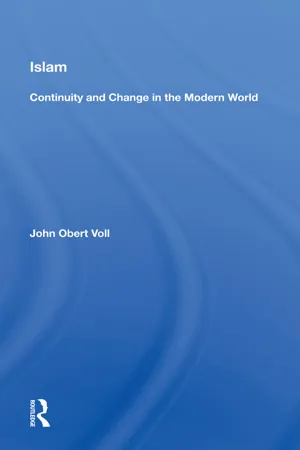
- 412 pages
- English
- ePUB (mobile friendly)
- Available on iOS & Android
eBook - ePub
About this book
This book goes beyond the headlines to explore the broad dimensions of Islam, looking at the vitality of the main elements of the faith across the centuries and finding the basis of today's Islamic resurgence in the continuing interaction of varying styles of Islam—fundamentalist, conservative, adaptationist, and individualist—and in the way each o
Information
1
Introduction
Islam is a dynamic force in the contemporary world, and in the 1980s, at the beginning of the fifteenth Islamic century, movements of Muslim revival have increasing visibility and influence. From the Islamic revolution in Iran to Southeast Asia and West Africa, the entire world of Islam is in active motion. Previously unnoticed currents of religious conviction have come to the surface and appear to be major elements in determining the course of events.
This situation comes as a surprise to many people, and it raises great issues about the future nature of society in the modern world and creates crises for policymakers. Until recently, the decline in the influence of religion was being described, and the eventual demise of the effectiveness of the historical religions seemed to be predicted. The decline was taking place in all of the major world religions, and it can be clearly noted in the discussions of Islam. In general terms, it was felt that the processes of modernization have undermined the basic foundations of traditional religion. In particular, it was felt that secularization, the separation of religion from politics and social institutions other than specifically religious ones, was an inherent part of the modernization process. As a result, it was believed that religion would play an increasingly limited societal role in the future.
The resurgence of Islam in the final third of the twentieth century creates a need for a reexamination of the modern history of the Islamic world. Perhaps, in the long run, the predictions of the demise of religion will be accurate. However, the assumptions and conclusions of such theories can no longer be accepted as readily as they once were. In a world in which a growing number of states are reexamining their legal structures in the light of the Quran and the requirements of traditional Islamic law, Islamic law cannot be described simply as an anachronism whose jurisdiction is being progressively limited. In a world in which radical Islamic social programs are being defined, it is no longer possible to state without significant qualifications that "the secularization of the polity is in many respects a prerequisite tor significant social change."1 In a world of militant Islamic activism, one cannot say quite so confidently that "in recent years Islam has so declined in authority and vitality that it has become a mere instrument for state policy, although it is still active as a folk religion."2
This book is based on the assumption that the currently visible resurgence of Islam is not simply the last gasp of a dying religious tradition. The general basis for this assumption results from an examination of the experience of the Islamic community in modern history, which broadly concludes that the Islamic world, like other societies in the contemporary world, is in the process of a major transformation. However, the result of that process will not be identically modernized, secularized societies. The shape of global, "postmodern" society is only beginning to emerge, but it seems clear that the special identities provided by the major religious traditions of the world will have an important role to play in that unfolding social order.
A fundamental issue is the nature of the religious traditions in the postmodern world. It is possible that fundamentally new ideas and institutions have been given a traditional appearance by the established religions. Using that point of view, one might see the current revival of Islam as a desire to provide familiar forms for basically non-Islamic ideas and institutions. Many commentators follow that line and believe that present Islamic activism is primarily nationalist or socialist or economically motivated movements dressed in the garb of religion. That viewpoint seems, at heart, to deny the possibility of a truly Islamic-inspired anti-imperialism or an Islamic-oriented desire for social transformation.
Another alternative, suggested by the analysis in this book, is that the Islamic community is entering a new phase, not the end, of its history. It is possible to see the current resurgence as a continuation of basic themes, even though those themes may be assuming new forms. To ignore religious desires and to concentrate only on the economic drives or secularized political motives is to limit unnecessarily the scope of our understanding. In the broader perspective of Islamic history, the dynamic vitality of the faith has assumed a variety of forms as historical conditions have changed. Any examination of Islam in the modern world must take that past experience into account if the present is to be adequately understood. It may be possible that part of the Islamic resurgence is putting modern sentiments into Islamic garb, but it may also be possible to discern new and modern forms of the continuing Islamic vitality.
Three-Dimensional Approach
If those new and modern forms are to be discerned, three dimensions of the Islamic experience in the modern world must be examined. Clearly, important individuals and groups must be identified. In the Islamic world, local conditions vary, and each movement is in some ways unique. It is therefore important to keep in mind the specific circumstances of each area and movement. One dimension of the study, then, must be to describe those separate groups and the local conditions in which they developed.
In discussing the causes of revivalist and fundamentalist movements, analysts often see those movements as emerging from a particular set of circumstances. Discussions of the Mahdist movement in the Sudan in the late nineteenth century, for example, focus on the sociopolitical conditions in the Sudan following the Egyptian conquest of that territory. More recently, the rise of the Ayatollah Khomeini in Iran has been seen in terms of the policies of Mohammad Reza Shah Pahlavi during the preceding decade, and the Islamic fundamentalist policies of General Zia al-Haqq of Pakistan have been examined in terms of the current political alignments in that country. Such interpretations are important for seeing events and movements in the context of the specific conditions in which they occur. However, since movements continue over time and expand, an understanding of their dynamics requires more than an examination of the policies of one ruler or the tensions within one society at a given moment.
When one seeks to define the basic nature of such movements and when one searches for the basic issues involved, the need for an additional analytical dimension becomes clear. Islamic activist movements have not occurred in isolation from the rest of the world; instead, they have been involved in the broader interactions of modern global history. Therefore, the second dimension to be examined is the relationship of the various Islamic movements to the basic dynamics of modern history. How that relationship is interpreted varies with the perspective of the analyst. The Islamic resurgence may be described as a part of the changing relationships among various regions in the world system of capitalism created by the emergence of an industrial society in the West. Other analysts may see the resurgence in the context of the changing natures of political legitimacy and social authority in the conditions created by modernization. Still others may see it as a theological and social reaction to the implications that modern ideas and institutions have for traditional societies. The common factor in all those approaches is the interaction of the Islamic tradition with the ideas and institutions of modern society. In this dimension, the major theme is the response of Islam to modernization and development.
That is the modern dimension of Islam in the modern world, and it provides a perspective that is broader than the one that is achieved by concentrating on the details of specific movements. However, even that broad dimension may miss key elements that are involved in the contemporary Islamic experience. In concentrating on the issue of the impact of modernization, analysts sometimes attempt to fit the Islamic experience into a model that is based on the experience of Western society rather than Islamic society. For example, it is often noted that Islam has not experienced a huge change similar to the Protestant Reformation in Europe, and some feel that such a change is needed if Islam is to adapt successfully to the challenge of modernity. Such a viewpoint is thought provoking, but it often ignores the fundamental differences between the structures of Western and Islamic societies. The separation of church and state may be a crucial aspect of secularization and modernization in Western society, but it is hard to translate the meaning of that issue to Islamic society, in which religious institutionalization has not involved the formal structure of a "church."
The necessary third dimension to be examined, therefore, is Islam itself. Islamic revival is not unique to the modem era, and throughout its history, the Islamic community has faced the challenge of changing conditions. For instance, militant activism has been one feature of the Islamic experience. Activist Islamic groups in the twentieth century can be seen as having underlying similarities because they are involved in modernization, but they also can be seen as part of a continuing tradition, and they must be viewed in their Islamic as well as their modern context. The forms the Islamic experience has taken maintain a continuity that spans the gap between premodern and modern so by recognizing the Islamic dimension, one stands a better chance of avoiding the pitfalls of using only an analytical model, which imposes alien categories upon the modern Islamic experience.
All three of these dimensions are important, and they form the basic framework of the analysis in this book. Islam in the modern era is seen as the interaction of the specific aims and goals of individuals and groups, which are affected by particular local conditions, with the factors of the dynamics of modern development and the continuity of the Islamic tradition.
Overview
The history of even modern Islam begins with the life of the Prophet Muhammad in the seventh century. The community (ummah) established by the Prophet at that time provided the actual historical foundation for the later Islamic empires and social institutions and also is the ideal against which later Islamic societies have been judged. At that time, the basic patterns were set. Chief among them is that the Islamic experience is one in which all aspects of life are seen as directly affected by and subject to the message of the faith. Muhammad was a religious guide, military commander, social organizer, and political leader. Through his leadership and that of his successors, this unity of roles and the comprehensive nature of the faith were firmly established. To use modern terminology, Islam is not just a religion, it is a total way of life.
The main outlines of the development of the Islamic community are the basis of the Islamic dimension of this study of modern Islam, and the evolution of the Islamic experience and the main themes that have emerged are examined in Chapter 2. A key element in this historical experience is the way (or ways) in which the Islamic community has met the challenges of social and historical change, and certain themes provide the foundation for a real continuity within the Islamic world. These themes have been presented in different ways, and the challenges of change have been met by the different styles of the Islamic experience.
The history of Islam in the past two and a half centuries shows the interaction of the different forms of the Muslim experience in the context of modern world history. The beginnings of the modern Islamic experience are in the eighteenth century, and those foundations are discussed in Chapter 3. A significant factor, and one that emphasizes the importance of the Islamic dimension, is that the eighteenth and early nineteenth centuries were times of active Muslim revival movements, whose emergence was affected only to a limited degree by the rise of modern society in the West. Many of the great movements of the time, like the Wahhabi movement in the Arabian Peninsula, were inspired by motivations that arose within Islam itself. The tired maturity of the great Islamic imperial systems of the day and the large number of departures from strict adherence to the Quran and the Traditions of the Prophet gave rise to an Islamic revivalist spirit that was already visible before the threat posed by the West was apparent to many Muslims.
That factor is significant because it created a momentum on which later revivalists could build. The tradition of an indigenous religious activism has been at times obscured by the more dramatic events of Western domination and Westernizing reforms. However, that tradition provides an illuminating backdrop for an understanding of the resurgence of Islamic activism in the last third of the twentieth century. By the beginning of the nineteenth century, the indigenous reformism began to be overshadowed by the modernizing reform programs instituted by leaders in the major Islamic states, especially Mehmet Ali in Egypt and Mahmud II in Istanbul. The more purely Islamic revivalist movements became increasingly confined to peripheral areas that were not yet significantly affected by Western expansion.
In Chapter 4, the increasing dominance of Islam by the Western powers will be traced. By the end of the nineteenth century, virtually no part of the Islamic world had avoided significant contact with Western economic and imperial power, and fundamental issues were raised by the visibly dominant power of the non-Muslim West. In addition to trying to create effective military institutions, Muslims began to deal with ideological questions in defending and redefining Islam in the new circumstances. A desire for independence from Western control grew, and a basic issue became how best to gain that independence. By the early part of the twentieth century, the last of the major nonmodernist religious activist movements had been defeated, and the best option seemed to be some form of Western-influenced nationalism and secular reformism.
The Islamic experience in the first two-thirds of the twentieth century is discussed in Chapters 5 and 6. In the first half of the century, there was a variety of programs, the major ones being the secular-reformist nationalism of people like Mustafa Kemal Ataturk in Turkey, liberal Islamic modernism as seen in the works of Muhammad Iqbal in India and some Arab writers, and neofundamentalism in a variety of formats, like the Saudi monarchy or the Muslim Brotherhood in Egypt.
After World War II, the political system of most Muslim countries was dramatically changed as the old European empires broke up, and most Muslim peoples gained their independence. One of the major themes of the period was the apparent subordination of Islam to other causes. Islam served as an important component of nationalism and helped to mobilize people in the cause of political independence. Islam also came in conflict with the modernist ideologies, especially the new forms of socialism advocated after independence.
Many people viewed fundamentalist Islam as a reactionary force, and militant fundamentalism was often in conflict with the leading socialist reforming movements. At the same time, there were also signs of fundamentalist activism as an underground opposition to established modernizing regimes. Although outlawed, the Muslim Brotherhood formed a basis for opposition to Nasser's regime in Egypt, for example, and religious leaders in Iran began to provide a focus for opposition to the shah.
By the end of the 1960s, militant Islam became more visible. The reemergence of activist fundamentalism is examined in Chapter 7, along with other developments in the 1970s. The more radical socialist states had failed to solve the major problems of development and political organization, and the new revolutionary movements illustrated that a fundamentalist Islamic government is not necessarily reactionary. The experiment in new forms of government initiated by the Libyan revolutionary regime is an example. The further possibilities of an Islamic radicalism have been explored by Ali Shariati, an Iranian sociologist, and those ideas have influenced the development of new militant groups. By the end of the 1970s, there were clear signs of a militant Islamic resurgence, which is taking many forms.
The final chapter explores the reasons for that resurgence in terms of the broader dimensions of the book. In the continuing interaction of Islam with modern ideas, new strengths have been discovered by the Muslims. The pluralist and morally confused world of the 1980s has major problems that perhaps cannot be solved by the old, standard modernist ideas, and it is not at all clear that the secular and rational solutions have worked even in Europe or the United States. The present and future pose both challenges and opportunities for Islam. The old lines of continuity have not been destroyed, and they may provide a basis for future Islamic societies.
2
The Islamic Dimension: Community and History
The history of the Islamic community is a dynamic part of the Islamic experience. The early and continuing success of Islam provided a confirmation for Muslims of the message of the revelation, and the starting point for an understanding of Islam in the modern world must be the historical experience of the ummah (the Muslim "community"). The long interaction between changing conditions and the permanently established Quranic message has set patterns and ideals, and the continuing impact of that interaction provides the basis for the Islamic dimension of an analysis of modern Islam. The foundation for the Islamic awareness of historical experience is set in the Quran itself, as it "lays great emphasis on the fact that the process of history is not neutral in respect of nations and communities for it says clearly, 'God is on the side of those who fear Him and do good.'"1
In the broader dimension of the Islamic heritage, there are many significant elements, which can be divided into two general themes: the common elements of the continuity of the Isl...
Table of contents
- Cover
- Half Title
- Title
- Copyright
- Dedication
- Contents
- Preface
- Note on Spelling
- 1 Introduction
- 2 The Islamic Dimension: Community and History
- 3 The Foundations of the Modern Experience: Revival and Reform in the Eighteenth Century
- 4 European Domination and Islamic Response
- 5 Twentieth-Century Islam: Dominant Majorities in the Middle East and Africa
- 6 Twentieth-Century Islam: Eastern World, Nondominant Majorities, and Minorities
- 7 The Resurgence of Islam: The Spirit of the New Century
- 8 Perspectives and Prospects
- Notes
- Glossary of Non-English Terms
- Bibliographical Comments and Suggestions for Further Reading
- Index
Trusted by 375,005 students
Access to over 1.5 million titles for a fair monthly price.
Study more efficiently using our study tools.
Frequently asked questions
Yes, you can cancel anytime from the Subscription tab in your account settings on the Perlego website. Your subscription will stay active until the end of your current billing period. Learn how to cancel your subscription
No, books cannot be downloaded as external files, such as PDFs, for use outside of Perlego. However, you can download books within the Perlego app for offline reading on mobile or tablet. Learn how to download books offline
Perlego offers two plans: Essential and Complete
- Essential is ideal for learners and professionals who enjoy exploring a wide range of subjects. Access the Essential Library with 800,000+ trusted titles and best-sellers across business, personal growth, and the humanities. Includes unlimited reading time and Standard Read Aloud voice.
- Complete: Perfect for advanced learners and researchers needing full, unrestricted access. Unlock 1.5M+ books across hundreds of subjects, including academic and specialized titles. The Complete Plan also includes advanced features like Premium Read Aloud and Research Assistant.
We are an online textbook subscription service, where you can get access to an entire online library for less than the price of a single book per month. With over 1.5 million books across 990+ topics, we’ve got you covered! Learn about our mission
Look out for the read-aloud symbol on your next book to see if you can listen to it. The read-aloud tool reads text aloud for you, highlighting the text as it is being read. You can pause it, speed it up and slow it down. Learn more about Read Aloud
Yes! You can use the Perlego app on both iOS and Android devices to read anytime, anywhere — even offline. Perfect for commutes or when you’re on the go.
Please note we cannot support devices running on iOS 13 and Android 7 or earlier. Learn more about using the app
Please note we cannot support devices running on iOS 13 and Android 7 or earlier. Learn more about using the app
Yes, you can access Islam by John Obert Voll in PDF and/or ePUB format, as well as other popular books in Social Sciences & Islamic Theology. We have over 1.5 million books available in our catalogue for you to explore.