Qualitative Metasynthesis presents a research method developed for upcycling and synthesis of qualitative primary studies, aimed at researchers within medicine and health sciences.
This book demonstrates how and why qualitative metasynthesis can be a method for reuse and expansion of medical knowledge. It presents the principles of metasynthesis as a qualitative research method, so that the reader can assess whether this is a research strategy that fits the aim of their study. The author offers practical advice for conducting research using this methodology. The presentation is illustrated by a study carried out by the author and collaborators, reflecting on real-life challenges and solutions as an example of meta-ethnography, one of the most frequently used strategies for qualitative metasynthesis. The author also looks at systematic reviews, a methodology developed within in the tradition of evidence-based medicine, discussing strengths, weaknesses and pitfalls of this methodology. Rooted in the interpretative paradigm, qualitative metasynthesis challenges several of the principles from the evidence-based medicine tradition, offering reflections on challenges when epistemologically very different methodologies intersect.
This book should be considered essential reading for anyone carrying out qualitative research within the fields of medicine, health and social care.
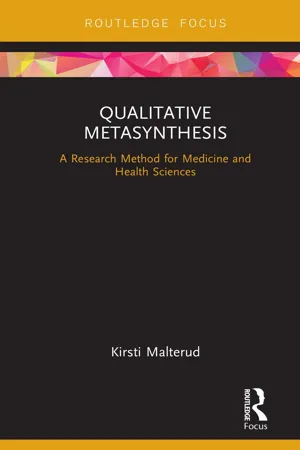
eBook - ePub
Qualitative Metasynthesis
A Research Method for Medicine and Health Sciences
- 128 pages
- English
- ePUB (mobile friendly)
- Available on iOS & Android
eBook - ePub
About this book
Information
1 Utilization and upcycling of existing research knowledge
We do not have to start from scratch
Research should build on the existing base of knowledge. As researchers we acquaint ourselves with, challenge and extend the understanding and insights mediated by those who have come before us. A thorough and critical literature review can constitute a point of departure for new projects and serve as the basis for independent and innovative research that upcycles existing knowledge by finding new uses for and value in that knowledge. Synopses and syntheses of existing research knowledge can also offer new insights beyond what we already know, for what we already know is what we generally notice in the evidence we encounter. Systematic reflection is therefore an important precondition for upcycling existing research knowledge to fulfil scientific criteria.
Qualitative studies – an open mind, but no blank slates
Qualitative research methods are often used to explore themes with limited research evidence. We draw conclusions by moving from the particular to the general, focusing on subjectivity during data collection and interpretation and analysis (Malterud, 2001b, 2017b). The field of epistemology focuses on knowledge about knowledge. The epistemological preconditions for qualitative research methods are rooted in the interpretative paradigm (see Chapter 4), but our interpretations are not arbitrary. They must be reached with professional reflexivity in order to become research knowledge (Alvesson & Sköldberg, 2009).
Qualitative methods are better suited to developing new questions than to repeating previous answers. As the explicit aim is to develop original and relevant knowledge, the qualitative researcher often takes up the position of explorer or traveller (Kvale, 1996), with a feeling of entering a jungle in which nobody has previously tread. This researcher identity is supported by using inductive approaches with qualitative research methods. Being researchers, however, we do not have blank slates when we enter the field and encounter empirical data.
To be sure, some qualitative methodology traditions argue that the best point of departure is to start the research project with an open mind and enter the field without any preconceptions. I disagree with this position. We certainly do not start with answers decided on in advance, but it is not possible to wipe the slate entirely clean and reset human imagination and experience (Morse, 1994). As human beings, we always take along inner images of how the world looks as to the questions we want to answer or elucidate. We always belong to some context or other of existing knowledge and understanding. The qualitative researcher might therefore need an extra reminder that we do not need to start from scratch every time we set off on a new research project.
Research waste or exploiting knowledge capital?
The concept of research waste has appeared on the academic agenda in recent years (Chalmers et al., 2014). We are wasting research if we do not sensibly use what is already there. Knowledge is power and should be shared. Within the academic community, research evidence is regarded as a joint asset, and we can contribute to the further development of knowledge capital by the best possible utilization of knowledge provided by other researchers. Instead of starting from scratch, we should therefore establish an overview of existing evidence, taking a qualified and critical perspective (Britten et al., 2017). Independent of a research aim or method, the project will benefit from a comprehensive literature search as a point of departure to identify the foundation and establish an appropriate starting point.
In this way, I can first pay due respect to my colleagues and prevent arrogance. Otherwise, my enthusiastic starting mood might seduce me into thinking that I am the first or the only or the best researcher to explore the topic in question. A reality orientation can support a calming, sobering counterbalance when I find my own research question to be amazingly original, and I will often discover that somebody already has been close to the issue I want to explore. Perhaps an excellent study has recently been published, illuminating my aim better than I could. Instead of seeing this as having lost a competition, I can rather imagine that I am participating in a relay race in which I recognize the teammate who passes me the baton as a great point of departure for my own leg.
Second, I am spared much unnecessary extra work by finding out what research has already been done about the issue. When I can stand on the shoulders of others, I do not have to start from zero myself (Moher et al., 2016). By means of a comprehensive literature search, it is likely that I will meet hitherto unknown like-minded colleagues – researchers from different parts of the world who share my interest and have already explored parts of the topic that are perhaps not exactly what I want to pursue myself. Hence, I can obtain good raw materials that help me to mould my research aim without simply repeating what is already known. I can also use my recently acquired insights to make connections for further collaboration. In this way, the potential for developing more original knowledge is enhanced, which will provide a bonus from the editors and reviewers who will assess the contributions as to readability and originality.
Third, a literature review can always give access to learning and new insights, even in a subject that I think I already know well. New publications may appear, presenting questions, perspectives, methods or results that push me forward with new ideas about my field of research or my plans. Such inspirations are more easily put into practice when they appear early in the research process. Closer to the end, more is needed to substantially change my mind or direction.
Recycling, upcycling and sustainable management of knowledge resources
Recycling, a concept developed and promoted by the environmental movement, means that items that have apparently become redundant or unnecessary are used again instead of simply being thrown away (Rosvold, 2012). Recycling is a logical response to waste and a measure to counteract the preventable destruction of valuable commodities and environmental contamination. Two students furnish their home with a couch and a dining table set aside by a middle-aged couple. Dresses from the 1980s become popular retro clothing among hipsters in 2018. Useful objects are being utilized in a new context, and instead of becoming garbage or contamination, old items are given new opportunities in new frames. Upcycling means “to upcycle (something) in such a way that the resulting product is of a higher value than the original item” (Merriam Webster Dictionary). This is something other than the transformation of garbage, where objects are dissolved into raw materials and reused in something completely different, as when soda bottles become a fleece sweater.
The idea of upcycling may also be applied to knowledge. Today, vast amounts of research evidence are produced that deserve upcycling instead of being laid aside or ignored. As researchers, we have a responsibility to ensure the best possible exploitation of the resources we control, be it research funding or knowledge capital. The environmental researcher and philosopher Robert Frodeman suggests that, in an era characterized by overproduction of knowledge which is insufficiently utilized (Frodeman, 2014), we should assess the development of knowledge as we do with environmental problems. He writes about sustainable knowledge as an essential precondition for crossdisciplinarity. With Frodeman’s notion in mind, we can regard knowledge as a renewable resource.
In this book, I will use such ideas as arguments for the sustainable upcycling of research evidence. I am not proposing a transformation of the original product into something totally different and unrecognizable. We are dealing with methods for the development of knowledge where research evidence is valued as a resource in such a way that the core of the knowledge is elaborated but still preserved. Qualitative metasynthesis – the subject of this book – is one of the several possible strategies to achieve this purpose (Malterud, 2017a).
Sustainable development is defined as development in which “harvesting or using a resource so that the resource is not depleted or permanently damaged” (Merriam Webster Dictionary). Sustainability implies accountability for the future through the responsible use of current resources. The concept of sustainability includes both overarching strategies for development and the preconditions for implementing them. The upcycling of sustainable knowledge that has relevance and quality can contribute to sound management, increase the surplus value of knowledge capital and prevent research waste (Malterud, 2019).
What will this book offer you?
When conducting a research project, your aim will determine which method is best suited to provide the answers you seek. By reading this book, you will learn about the hallmarks of the qualitative metasynthesis research method and how it developed. The book’s outline follows a traditional research process, with planning, literature search, review and assessment of primary studies to be included in your sample, analysis and synthesis and, finally, reporting your project. In addition, you will be exposed to discussions about the scientific challenges that emerge when qualitative research methods encounter methodology from evidence-based medicine (EBM) (Malterud, 2019).
Several of the metasyntheses that you will find in the research literature imply extensive efforts, with comprehensive searches, large numbers of hits and screening procedures requiring significant resources. The format I have used and still prefer deals with the interpretation and analysis of a limited and thus feasible number of primary studies (Larun & Malterud, 2007; Malterud & Ulriksen, 2011; Dahl et al., 2013; Fosse et al., 2014). This format is not typical of today’s qualitative metasyntheses, which often involve extensive searches. Throughout the book I therefore discuss the preconditions needed for this kind of research to be conducted sustainably, which choices will be encountered and what the consequences of these choices may be. At the same time, I emphasize the idea that research should be feasible in practice, with accountable use of research resources.
To understand the messages of this book, you will need some basic knowledge of qualitative research methods. If you are a novice, you should therefore start by learning the fundamental methodological principles from an introductory textbook. A novice also needs a supervisor or collaborator with a general competence in qualitative research methods. Subsequently, you can together decide whether you want to conduct a qualitative primary study or to synthesize existing evidence about the problem under investigation. If you choose the latter course, you will realize that there are several paths to reach your goal. Using examples from my own and other researchers’ publications, I present research questions where qualitative metasynthesis may be an appropriate strategy. This book will show you different options and offer some practical recommendations.
The role of the nursing home doctor in end-of-life care – a concrete example
Most Norwegians spend their last period of life in a nursing home, however long that period may be (Statistics Norway, 2013). The nursing home doctor (NHD) is responsible for the medical aspects of the stay, such as diagnosis, treatment and palliation of disease and loss of function. Their professional duties towards individuals in this life stage imply several existential, medical and organizational challenges. Sometimes, patients and relatives have distinct wishes and standpoints, while in other situations death can approach without important issues having been resolved. Dialogue between patients, relatives, caring professionals and the NHD during this stage is essential but not always easy to implement in a satisfactory manner (Aase et al., 2008; Jansen et al., 2016). To offer knowledge-based practice, we need an overview of the kind of research that can offer support and the results this research has provided.
Anette Fosse, who is a general practitioner and NHD in Mo i Rana in northern Norway, has long-time experience in end-of-life care. She wanted to conduct a research project as a contribution to her colleagues that would best support their encounters with this patient group. Fosse started exploring the relevant existing research about this topic by conducting a review of qualitative studies about end-of-life experiences and expectations among nursing home patients and their relatives (Fosse et al., 2014). She could have chosen to obtain an overview by means of a straightforward literature search. Instead, she took the opportunity to learn about meta-ethnography, one of the several available methods in qualitative metasynthesis (see Chapter 3) (Noblit & Hare, 1988). Fosse’s project serves as an example throughout this book.
From chaos and individual research reports to systematic reviews
The international research literature has become nothing less than enormous, especially in recent decades. You will need relevant tools, competence and resources to establish a general idea of the research that is already there. You will also need methodical and professional insight to assess the relevance and quality of the reports you find. A literature review based on transparent identification, selection and synthesis of primary studies embodies the research methodology used to develop systematic reviews (SRs). Qualitative metasyntheses are often presented as a specific kind of SR that employs the synthesis of qualitative studies. There are, however, important issues to be reflected upon regarding such a conceptualization. Below, we therefore start the presentation of this method by laying out certain principles that underlie any SR, independent of the method used in the primary studies.
Comprehensive and critical reading of the research literature
Literature reviews and other articles in which the research literature about a question is presented and summarized are an established genre in the medical publication tradition. This format has long been comparatively casual, with the author’s discretion prioritizing the publications that are selected and emphasized. My own publication list includes some articles of this kind. In hindsight, I must admit that my choice of references may have been motivated by a need to support my own arguments. Today, however, an acceptable review article should do more than just list previous knowledge – it should also offer an interpretation and appraisal of the evidence presented.
Scientific knowledge is supposed to be the outcome of systematic reflection as opposed to casual impressions or self-confirming arguments. This is also true of qualitative studies and of their syntheses (Malterud, 2001b). If I claim in the capacity of researcher that I have explored something, it is not acceptable to give a brief report about the first article that comes along. Qualitative research methods do not confer any authority to legitimize such superficial observations.
Knowledge, including overviews and upcycling of existing evidence, is always developed from a specific context that determines the perspectives and gazes of the researcher (Latour & Woolgar, 1986; Alvesson & Sköldberg, 2009; Saini & Shlonsky, 2012; Malterud, 2019). We read that research with our preconceptions and theoretical frames of references in mind, often with a tendency to focus our eyes on texts that confirm our own point of view (Kelly et al., 2015). Reflexivity is an active attitude, a position that the researcher must seek out and maintain (Malterud, 2002; Finlay, 2008). The skilful researcher establishes positions that challenge preconceptions and previous field knowledge, including searching and reading the existing literature.
Systematic knowledge management requires that the researcher makes the reader an informed companion who is given insight into the preconditions under which the knowledge has been developed (Malterud, 1993, 2001b; Stige et al., 2009). This is what we call intersubjectivity. A related academic ideal is transparency, which means that the process is visible to and can be contested by others. This kind of scientific presumption is applicable to all steps of the research process, not merely to the analysis of one’s own empirical data or to qualitative research methods. When our aim is...
Table of contents
- Cover
- HalfTitle Page
- Title Page
- Copyright Page
- Table of Contents
- List of abbreviations
- Preface
- 1 Utilization and upcycling of existing research knowledge
- 2 Project planning and literature management
- 3 Analysis and synthesis
- 4 Theoretical and methodological challenges
- 5 Final comments
- References
- Index
Trusted by 375,005 students
Access to over 1.5 million titles for a fair monthly price.
Study more efficiently using our study tools.
Frequently asked questions
Yes, you can cancel anytime from the Subscription tab in your account settings on the Perlego website. Your subscription will stay active until the end of your current billing period. Learn how to cancel your subscription
No, books cannot be downloaded as external files, such as PDFs, for use outside of Perlego. However, you can download books within the Perlego app for offline reading on mobile or tablet. Learn how to download books offline
Perlego offers two plans: Essential and Complete
- Essential is ideal for learners and professionals who enjoy exploring a wide range of subjects. Access the Essential Library with 800,000+ trusted titles and best-sellers across business, personal growth, and the humanities. Includes unlimited reading time and Standard Read Aloud voice.
- Complete: Perfect for advanced learners and researchers needing full, unrestricted access. Unlock 1.5M+ books across hundreds of subjects, including academic and specialized titles. The Complete Plan also includes advanced features like Premium Read Aloud and Research Assistant.
We are an online textbook subscription service, where you can get access to an entire online library for less than the price of a single book per month. With over 1.5 million books across 990+ topics, we’ve got you covered! Learn about our mission
Look out for the read-aloud symbol on your next book to see if you can listen to it. The read-aloud tool reads text aloud for you, highlighting the text as it is being read. You can pause it, speed it up and slow it down. Learn more about Read Aloud
Yes! You can use the Perlego app on both iOS and Android devices to read anytime, anywhere — even offline. Perfect for commutes or when you’re on the go.
Please note we cannot support devices running on iOS 13 and Android 7 or earlier. Learn more about using the app
Please note we cannot support devices running on iOS 13 and Android 7 or earlier. Learn more about using the app
Yes, you can access Qualitative Metasynthesis by Kirsti Malterud in PDF and/or ePUB format, as well as other popular books in Medicine & Alternative & Complementary Medicine. We have over 1.5 million books available in our catalogue for you to explore.