Twenty years after Gordon Sturrock and the late Professor Perry Else's 'Colorado Paper' introduced the Play Cycle, this theory of play now supports professional playwork practice, training and education. The Play Cycle: Theory, Research and Application is the first book of its kind to explain the theoretical concept of the Play Cycle, supported by recent research, and how it can be used as an observational method for anyone who works with children in a play context.
The book investigates the understandings of the Play Cycle within the playwork field over the last 20 years, and its future application. It addresses each aspect of the Play Cycle (metalude, play cue, play return, play frame, loop and flow and annihilation) and combines the theoretical aspect of the Play Cycle with empirical research evidence. The book also provides an observational tool for people to observe and record play cycles.
This book will appeal to playworkers, teachers, play therapists and professionals working in other contexts with children, such as hospitals and prisons. It will support practitioners and students in learning about play and provide lecturers and trainers with a new innovative teaching and training aide.
This chapter provides a brief overview of the Play Cycle as explained in the ‘Colorado Paper’. The Play Cycle is unpacked in relation to its six elements: metalude, play cue, play return, play frame, loop and flow and annihilation. Each element is considered in contexts prior to, and after, the ‘Colorado Paper’ was first presented to the playwork profession in 1998. A review of playwork-related texts identifies the various explanations for each element of the Play Cycle. The chapter concludes with a consideration of the adult role in the Play Cycle.
A (very) brief overview of the ‘Colorado Paper’
The ‘Colorado Paper’ (Sturrock & Else, 1998) is a very deep and complex paper, one of those cases where a reader can read and re-read it and something new will always appear. The paper proposes at the onset the “natural space for play (both physical and psychic) is steadily being eroded, where the playful habit – or more widely what we describe as the ludic ecology – is being curtailed or contaminated, we see increasing signs of breakdown and dis-ease” (p. 74). The ‘Colorado Paper’ considers playwork practice from a more “interpretive and analytical perspective … termed psycholudics, the study of the mind or psyche at play” (p. 76), where the playworker “develops insights and interpretative responses” (p. 77) to the content and meaning of children’s play. Sturrock and Else (1998) put forward that playworkers, as with therapists and analysts, are in a position to understand the content and meaning of children’s play from a therapeutic perspective. This therapeutic perspective is considered with reference to the work of the Czech psychiatrist Stanislav Grof, who was one of the founders of transpersonal psychology; the paediatrician and psychoanalyst Donald W. Winnicott, who introduced the concept of the transitional object; Ken Wilber, a philosopher and writer on transpersonal psychology; and the Swiss psychiatrist and psychoanalyst Carl Gustav Jung.
The result of all this was the construction of the Play Cycle. The Play Cycle considers the process of play, broken down into six elements: metalude, play cue, play return, play frame, loop and flow and annihilation. Sturrock and Else (1998) explain how the adult can support this process by “containing” (p. 87) the child’s play, where the playworker has a “holding function” (p. 86); that is, the playworker has the task in “recognising and preserving the meaning of the play at that time” (p. 87) within the play boundary set by the child. The key aspect is that the play content and boundary are set by the child. If the boundary or content of the play becomes dominated or controlled by the playworker for their own agenda, the Play Cycle is contaminated through what Sturrock and Else (1998) termed “adulteration” (p. 93).
Sturrock and Else (1998) suggest that playworkers can support the Play Cycle through a hierarchy of four interventions: play maintenance, simple involvement, medial intervention and complex intervention, where the level of involvement within the Play Cycle goes from more observation (play maintenance) to fully active participant (complex intervention). Whatever level of hierarchy, a reflective stance is taken, where the playworker is required “to give some thought and consideration to the responses that they issue within the play frame” (p. 96); that is, to contain but not adulterate. From any level of the hierarchy, the playworker can be “subjective about the playing child and objective about their practice” (p. 101). By remaining objective in their play practice, the playworker is in the “witnessing position” (p. 100); that is, responding to the child’s subjectivity in their play, rather than introducing their own subjectivity (adulterating the Play Cycle). The witness position allows the playworker to be reflective before, during and after the Play Cycle has taken place. As Sturrock and Else (1998) concluded in the ‘Colorado Paper’, “Playworkers could advance a new form of therapeutic endeavour that is not enshrined the privilege of the adult practices but abides in the play of the child” (p. 104).
Sturrock and Else (1998) were clear that this could apply to any adult to “include parent and other adults active in playing with children” (p. 73), although the background to the paper was the profession of playwork. A brief consideration of playwork is discussed here in relation to the Play Cycle.
Playwork and playworkers
Playwork has been explained and defined over the years in a number of different ways:
They [playworkers] manage the play environment and provide the resources which enable children’s play.
(Bonel & Lindon, 1996, p. 15)
The playworker’s role is complex. The playworker will make judgements about when and how to intervene in children’s play.
(National Playing Fields Association [NPFA], 1999, p. 17)
Analysing the child’s environment in order to identify and remove any barriers to the process of development through play. … Enriching the child’s play environment in order to stimulate the process of development through play.
(Brown, 2003a, p. 52)
To support play according to these characteristics (of play as a process that is freely chosen, personally directed and intrinsically motivated) rather than directing, controlling or teaching children.
(Russell, 2006, p. 246)
Playwork is a highly skilled profession that enriches and enhances provision for children’s play. It takes place where adults support children’s play but it is not driven by prescribed education or care outcomes.
(SkillsActive, 2010b, p. 3)
Playwork is unique. It is the role of facilitating children’s play.
(Play Wales, 2016)
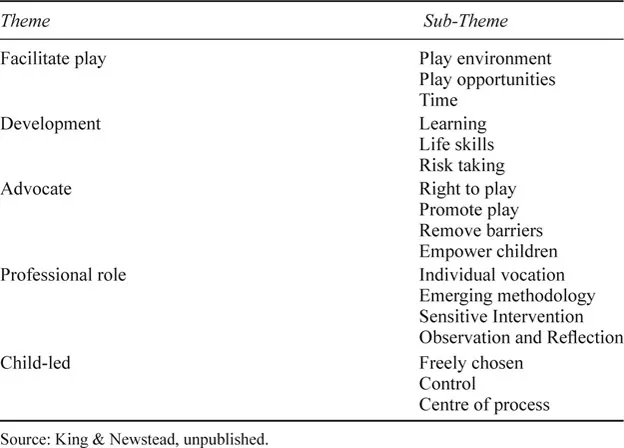
As part of an online survey on playworkers’ understanding of the Play Cycle (King & Newstead, 2019; see Chapter 2), playworkers were asked to write down their definition of playwork. Using the thematic framework devised by Braun and Clarke (2006) (see Chapter 2 for more detail), the following themes and sub-themes were developed, as shown in Table 1.1.
As with previous definitions of playwork, King and Newstead’s themes included managing and providing resources to enable play (Bonel & Lindon, 1996), removing barriers to support development through play (Brown, 2003a) and supporting the play process (Russell, 2006), as well as highlighting that playwork is a highly skilled profession that is not driven by outcomes (SkillsActive, 2010a) and is unique in facilitating children’s play (Play Wales, 2016). All these factors appear within the themes and sub-themes. However, other themes that also emerged were advocacy and defining children’s right to play, themes that also emerged from King’s (2015) thematic study from the ‘Possible Futures of Playwork Project’ and King and Waibel’s (2016) study on playworkers’ views of play.
What links all these definitions is that playwork, in one guise or another, supports children’s play. Prior to 2005, playwork practice was underpinned by the 2 Playwork Assumptions and 12 Playwork Values (Bonel & Lindon, 1996) that formed the NOS for Playwork. An initial review of the Playwork Values and Assumptions was undertaken by
Table 1.1 Playworkers Defining Playwork
Gordon Sturrock, Bob Hughes and Mick Conway, commissioned by Play Wales (Conway, 2008). The result was the publication of four papers: ‘A New Playwork Perspective’ (Conway, Hughes, & Sturrock, 2004a), ‘Job Descriptions and Personal Specifications’ (Conway, Hughes, & Sturrock, 2004b), ‘A Personal List of Events and Evolving Understanding That Have Led Playwork to Where It Is Today’ (Conway, Hughes, & Sturrock, 2004c) and ‘The Playwork Matrix’ (Conway, Hughes, & Sturrock, 2004d). Within ‘The Playwork Matrix’, we can first see how elements of the Play Cycle appear where playworkers need to be alert to play cues with regard to “our own role and identity” (p. 7) and “respond as needed by the child” (p. 8). The play frame is considered where the playworker needs to “Stay out of the child’s play frame unless invited into it” (p. 4) and also “Think about why the play frame seems ‘restricted’” (p. 6). Within “A Personal List of Events and Evolving Understanding That Have Led Playwork to Where It Is Today’, there is a specific reference to the ‘Colorado Paper’:
Although somewhat complex and compact, this was undoubtedly one of the most important and analytical papers to come of playwork to date. The Colorado Paper, written by Perry Else and Gordon Sturrock for the IPA/USA Triennial Conference in June 1998, under the title ‘The Playground as therapeutic space: playwork as healing’; explores both the play process and playwork at a depth unimagined a decade or even five years earlier. The paper introduces many terms that are commonplace with theorists and practitioners today, including ‘the ludic ecology’, play frame, containment, play cues (although the notion of meta-communication had been recognised for some time, it had not been put into such an all embracing context before), the metalude (although this had appeared in the International Play Journal earlier), issue and return (of play cues), termination or decay (of play cues), the ludic cycle, dysplay and adulteration. More than anything else, the Colorado Paper demonstrated that authoritative work regarding the relationship between playwork and the phenomenon of play could be written by and for playworkers without reference or apology to other more established disciplines.
(Conway et al., 2004c, p. 19)
These four papers formed the basis of the Play Values and Play Assumptions review, where a ‘Scrutiny Group’ was established, with Perry Else becoming a member of the group responsible for developing the eight Playwork Principles. In 2002, the Assumptions and Values were replaced by the eight Playwork Principles (PPSG, 2005; Conway, 2008). The eight Playwork Principles are as follows:
All children and young people need to play. The impulse to play is innate. Play is a biological, psychological and social necessity, and is fundamental to the healthy development and wellbeing of individuals and communities.
Play is a process that is freely chosen, personally directed and intrinsically motivated. That is, children and young people determine and control the content and intent of their play, by following their own instincts, ideas and interests, in their own way for their own reasons.
The prime focus and essence of playwork is to support and facilitate the play process and this should inform the development of play policy, strategy, training and education.
For playworkers, the play process takes precedence and playworkers act as advocates for play when engaging with adult led agendas.
The role of the playworker is to support all children and young people in the creation of a space in which they can play.
The playworker’s response to children and young people playing is based on a sound up to date knowledge of the play process, and reflective practice.
Playworkers recognise their own impact on the play space and also the impact of children and young people’s play on the playworker.
Playworkers choose an intervention style that enables children and young people to extend their play. All playworker intervention must balance risk with the developmental benefit and well being of children.
(PPSG, 2005)
Although there have been some who have argued against the Playwork Principles (Brown, 2008), they were endorsed by SkillsActive in 2005 and now underpin professional playwork practice.
When considering the Play Cycle as a process, aspects of it can be found within the eight Playwork Principles (PPSG, 2005), where the play process is stated within Playwork Principles 2, 3, 4 and 6. Sturrock and Else (1998) described the Play Cycle as a cyclic play process with “four key functional components” (p. 80) of metalude, termination or decay, active development and the loop and flow. These four key functional components are broken down further into six elements that, in addition to the metalude and loop and flow, also include the play cue, play return, play frame and annihilation. When considering Playwork Principle 1, which states ‘an impulse to play’, this would reflect the description of the metalude, the thought and drive to play where the play cue emerges. Playwork Principle 7 focuses on the role of the adult in relation to their position in the play space, which could relate to the play frame, as stated within ‘The Play-work Matrix’ (Conway et al., 2004d). The Play Cycle is clearly reflected within the eight Playwork Principles. The next section examines the six elements of the Play Cycle.
The six elements of the Play Cycle
The Play Cycle, as explained within the Introduction is divided into six elements: metalude, play cue, play return, play frame, loop and flow and annihilation, and is expressed as a formula as L = (M−L. T>. @. §). Else (1999) provides a concise description of how the equation works:
The play drive comes from the internal play source (ML) of the child, who issues play cues into the environment. Play cues will decay over time (T>) unless they interact (@) with another person or a stimulus in the environment. This play return is then process (§) by the child, who may choose to extend the play by issuing another play cue. This is the complete cycle.
(p. 107)
A diagram of this process is provided in Figure 1.1.
Figure 1.1 The Play Cycle
Source : Adapted from Sturrock & Else (1998).
The child has ‘two’ worlds: the inner world of their thoughts and the outer world they share with others (Sturrock & Else, 1998; King & Temple, 2018). From the metalude, the play cue is issued from the inner world to the outer world. The play cue has a limited time (decay) to be picked up. If the play cue is not picked up, the child may issue another cue, give up or react (e.g. frustration). The play cue is picked up by other people or applied to something related to the environment (e.g. a pen to draw with or a log to make into a den), and the combination of the play cue and play return (active development) is returned to the inner world of the child, that is, the loop and flow. This is the Ludic or Play Cycle, which takes place within a boundary, the play frame. The play frame can be a physical boundary (e.g. the table where a den is being made in the kitchen) or a psychological boundary, such as a narrative song. As long as the child wishes to maintain the Play Cycle, play cues and returns will continue until either the child or someone else or an environmental factor, such as nighttime looming, ends the Play Cycle, what Sturrock and Else (1998) termed annihilation.
As discussed in the next sections, it is possible for each element of the Play Cycle to be traced to other theories and concepts. What the ‘Colorado Paper’ provided was to bring the different theory and concepts together within the Play Cycle, something that was acknowledged in later publications. These concepts and theories are discussed below, in relation t...
Table of contents
Cover
Half Title
Series Page
Title
Copyright
Dedication
Contents
List of figures
List of tables
Foreword
Acknowledgements
Abbreviations
Introduction
1 A review of the Play Cycle
2 Playworker’s understanding of the Play Cycle
3 Beyond the intrinsic
4 Transactional analysis and the ludic third (TALT): a model of functionally fluent reflective play practice
5 The Play Cycle Observation Method (PCOM)
6 Conclusion
References
Index
Trusted by 375,005 students
Access to over 1.5 million titles for a fair monthly price.
Study more efficiently using our study tools.
Frequently asked questions
Yes, you can cancel anytime from the Subscription tab in your account settings on the Perlego website. Your subscription will stay active until the end of your current billing period. Learn how to cancel your subscription
No, books cannot be downloaded as external files, such as PDFs, for use outside of Perlego. However, you can download books within the Perlego app for offline reading on mobile or tablet. Learn how to download books offline
Perlego offers two plans: Essential and Complete
Essential is ideal for learners and professionals who enjoy exploring a wide range of subjects. Access the Essential Library with 800,000+ trusted titles and best-sellers across business, personal growth, and the humanities. Includes unlimited reading time and Standard Read Aloud voice.
Complete: Perfect for advanced learners and researchers needing full, unrestricted access. Unlock 1.5M+ books across hundreds of subjects, including academic and specialized titles. The Complete Plan also includes advanced features like Premium Read Aloud and Research Assistant.
Both plans are available with monthly, semester, or annual billing cycles.
We are an online textbook subscription service, where you can get access to an entire online library for less than the price of a single book per month. With over 1.5 million books across 990+ topics, we’ve got you covered! Learn about our mission
Look out for the read-aloud symbol on your next book to see if you can listen to it. The read-aloud tool reads text aloud for you, highlighting the text as it is being read. You can pause it, speed it up and slow it down. Learn more about Read Aloud
Yes! You can use the Perlego app on both iOS and Android devices to read anytime, anywhere — even offline. Perfect for commutes or when you’re on the go. Please note we cannot support devices running on iOS 13 and Android 7 or earlier. Learn more about using the app
Yes, you can access The Play Cycle by Pete King,Gordon Sturrock in PDF and/or ePUB format, as well as other popular books in Didattica & Didattica generale. We have over 1.5 million books available in our catalogue for you to explore.