In the course of a decades-spanning career as a filmmaker, Terrence Malick has carved out a distinctive cinematic aesthetic. Central to this style is the use of sound. James Wierzbicki offers the first comprehensive study of Malick's soundtracks, arguing that they create a distinctive sonic style throughout his oeuvre and exploring how that style functions. Considering voice, noise, and music as elements in the soundtrack, this concise book enriches our understanding of one of our most philosophical filmmakers, and of the interplay between the sonic and visual elements in film.
- 128 pages
- English
- ePUB (mobile friendly)
- Available on iOS & Android
eBook - ePub
Terrence Malick: Sonic Style
About this book
Information
1 Prologue
Shortly after the introduction to American movie theaters of the Dolby system of four-channel stereophonic sound, the critic Charles Schreger wrote an article for Film Comment in which he attributed to this new technology an almost Messiah-like promise. Schreger’s “The Second Coming of Sound” dealt with the efforts of thirteen “sound-conscious directors” who ranked among “the industry’s most successful, esteemed, and adventurous talents,” including some who had not yet made use of Dolby Stereo.1 Although he focused mostly on a range of films by Robert Altman, it was for Terrence Malick’s second feature film, exhibited in cinemas just weeks before he penned his article, that Schreger reserved his most unequivocal praise. Referring in particular to the film’s panoply of soft noises, Schreger wrote: “There’s no more intelligent use of sound than in Days of Heaven.”2
Almost forty years later, in a book devoted in general to changes experienced by American cinema throughout the 1970s, and in particular to the effect on cinema of Dolby Stereo late in that decade, film historian Jay Beck similarly called special attention to Malick’s 1978 Days of Heaven, citing it as the first of only three early Dolby films that stood apart from the crowd because they utilized sound not as a gimmick but as “a powerful device to aid in the storytelling process.”3
If Beck seems less excited about Dolby Stereo than Schreger was, doubtless this is because he is equipped both with a much broader field of comparison and with hindsight. Whereas Schreger was quite right to wonder enthusiastically about how Dolby’s subwoofers and ‘surround sound’ capabilities might affect the future course of filmmaking, Beck knows very well what in fact did happen after Dolby technology became ubiquitous. It was not long, Beck argues, before the technology’s “whiz-bang” effects and “regimented mixing strategies” resulted in a “new classicism” that in essence differed little from the so-called classical-style cinema that since the late 1930s had been Hollywood’s norm; like most of the vintage films, Beck suggests, the vast majority of Dolby-equipped films from the late 1970s and early 1980s were little more than escapist entertainments with unambiguous narratives, the significant difference between the old and the new being the latter group’s abundance of “acoustic attractions.” 4
Near the end of his penultimate chapter (titled “The Sound of Spectacle”), Beck deals almost dismissively with the two science-fiction films from 1977 whose extraordinary box-office success for all intents and purposes made the Dolby label synonymous with larger-than-life theatrical sound. He refers specifically only to the first flyover by a gigantic spacecraft in George Lucas’s Star Wars and the dust storm that opens Steven Spielberg’s Close Encounters of the Third Kind, but his summation applies easily to many of these films’ other scenes; basing his thought not on any empirical evidence but simply on common sense, he concludes that “the main impression left with the audience was not the subtlety of the sound editing but the all-encompassing surround sensation and the extreme volume of the event[s].”5 Thus inspired, Beck suggests, many filmmakers jumped on the Dolby bandwagon at least in part so that they could guarantee that their audiences got their money’s worth of aural thrills and chills.
Malick was not above using Dolby technology for ‘spectacular’ purposes. A scene near the end of Days of Heaven shows a wheat field going up in flames, with the conflagration’s noise driving almost everything else from the soundtrack; a scene very near the film’s start is set in a Chicago steel mill, where sounds connected with the act that sets the narrative in motion are obliterated by industrial din. Probably everyone who has experienced Days of Heaven, in Dolby Stereo or not, retains memories of these two scenes. But persons who recall these scenes perhaps should be reminded of how, in terms of sound, the scenes are framed.
The hellish roar from the burning wheat field, it should be remembered, occurs only at the peak of an extended episode that begins with gentle noises from wind and insects, and subsequently builds, with the help of slow-moving yet appropriately dire orchestral music, toward the commotion of farm workers trying to deal with an infestation of locusts and, with more urgency, toward the sheer chaos that erupts when flames from a bonfire spread to the crop. After the long moment during which the fire is pretty much all that the audience hears, the episode’s sonic pattern reverses course, moving downward through a more or less conventional mix of music and ‘realistic’ noises before settling into an almost ‘surreal’ mix that has a softening underscore give way to the stifled sounds of the still-raging, and still highly visible, fire.
In the earlier scene, the cacophony of the steel mill is framed in a very different way. There is no crescendo here; oppressive noise from machines and furnaces fairly explodes into the consciousness of filmgoers who before this had been exposed only to the lush music of the title sequence and a brief scene that shows female employees alongside a stream. The quick cut from the bucolic streamside to the mill’s inferno-like interior is an assault as much on the ears as on the eyes; the noise pounds relentlessly, even as the accidental murder takes place, and only after the murderer realizes what has happened does it recede to make room for the first instance of voice-over that will be the narrative’s constant companion.
The fire and factory scenes from Days of Heaven are arguably just as loud and sensational as the flyover and dust storm scenes from Star Wars and Close Encounters. Despite their similarities in affect and aural content, however, the scenes are not at all similar in their contexts.
With their forceful volume levels and obviously “all-encompassing” qualities, all of these scenes, one might say, are the sonic equivalents of what the industry in reference to visual phenomena has long called ‘special effects.’ But in Star Wars and Close Encounters the sonic ‘special effects’ end up being not really all that special. They are expertly crafted, to be sure, and ‘smart’ enough in design that their representations of even the most preposterous fictions seem credible. But they are too pervasive to carry much narrative weight. Instead of standing apart from their films’ sonic norms, they quickly become those films’ norms.
In Days of Heaven, stentorian scenes are not at all the norm. ‘Surround sound,’ it is true, is frequently in evidence here. Most often, though, the ‘surround sound’ figures in situations in which minimal noise supports a minimum of action. The two-dimensional image of girls strolling through breeze-blown prairie grass is made three-dimensional by occasional bird calls that come from all around; the loneliness of a snuggling couple is amplified by a pianissimo array of widespread wind noises; a late-night conversation between two persons who stand in a shallow river seems all the more intimate as its almost whispered covert talk is washed over on all sides by barely audible trickles. Scenes like this occur throughout Days of Heaven, often enough to ‘settle’ the audience into a thoughtful mode of listening, and often enough to make the two really loud scenes—one of them at the story’s violent onset, the other at its frightful climax—seem very ‘special,’ indeed (Figure 1.1).
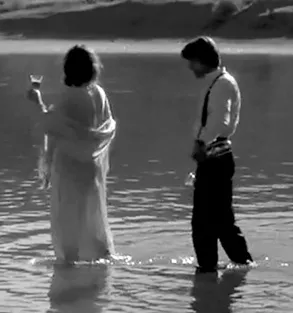
Figure 1.1 In Days of Heaven, a late-night conversation between Abby (Brook Adams) and Bill (Richard Gere) is made to seem all the more intimate as the couple’s almost whispered dialogue is washed over on all sides by barely audible trickles. The scene exemplifies what Michel Chion called a “quiet revolution” in cinematic sound.
Looking back from the perspective of 1987 on the first wave of popular films that made use of Dolby Stereo, the French sound theorist Michel Chion remarked that most of them were in effect “fairground phenomena”: gimmicky things that indeed presented audiences with “a whole new wriggling, swaggering, chirruping universe” but at the same time “shove[d] aside plot, construction, and psychology to make room for … pyrotechnics.”6 Yet at the start of his generally negative essay Chion acknowledged that the new technology, because of its ability to present cinema audiences with “a micro-rendering of the hum of the world,” had brought about “a quiet revolution.”7
Malick, whether he knew it or not, was a leading figure in this revolution. According to Ioan Allen, an engineer who throughout the 1970s was the prime liaison between the Dolby company and the film studios, “the problem we had, if there was a problem, was that we got associated with” a certain kind of film that made bold use of high volume levels and ‘surround sound’ effects.
It wasn’t until probably Days of Heaven … that I managed to get across this idea that every film can benefit [from using Dolby], that quiet, low-level stereo ambiences do as much to help a film as loud spatial sound effects.8
Allen says that “the real meat and potatoes” of ‘surround sound’ is to be found in environmental noises of the sort that permeate Malick’s film, and he admits that flyovers and the like represent only “the vulgar extreme” of what Dolby Stereo can do.9 Indeed, compared to Malick’s subtle sonic shadings, the ‘big bangs’ and ‘sonic booms’ that dominate Star Wars and Close Encounters—and such other early Dolby successes as Richard Donner’s Superman (1978), Philip Kaufman’s Invasion of the Body Snatchers (1978), Ridley Scott’s Alien (1979), Ken Russell’s Altered States (1980), and Steven Spielberg’s Raiders of the Lost Ark (1981)—come across like the garish colors of a comic book.
But this should be no surprise. The just-mentioned films in effect are comic books; they fall easily into the science-fiction, horror, or ‘action’ genres, and they are deliberately targeted at young audiences or audiences whose members, at least for the film-going moment, feel young at heart. In marked contrast, Days of Heaven—praised by one first-round reviewer for “its sounds and its silences” that will “stay in the mind forever,” for a “summoning up of the resources of sight and sound [that] is without parallel in this or many recent years”10—is very much a film for grown-ups.
****
All of Malick’s films are for grown-ups. Some of them feature plots that are more or less easily summarized, but even these are not so much about what the characters do as about what they think, or what they feel, or what they think/feel about what they feel/think. As has often been pointed out by reviewers who seem not to ‘get’ their message, the films of Terrence Malick hardly qualify as entertainments.
Malick was identified as a ‘philosophical’ filmmaker as early as 1979. At the time, the identification escaped the notice of most film critics, in part because it appeared in a new edition of a book that had been published eight years earlier, in part because Days of Heaven had had its chance in the marketplace and was no longer an object of current concern. But two decades later—as Malick was returning from a long self-imposed exile in Paris—just about everyone seriously engaged in the discussion of cinema was familiar with Stanley Cavell’s proposal that Days of Heaven “contain[s] a metaphysical vision of the world” and that it presents to its audience “the scene of human existence” in a way that had “never [been] quite realized … on film before.”11
It was Cavell who first reminded, or perhaps informed, critics that Malick, before he turned to filmmaking, had been a student of philosophy and that the prime object of his scholarly attention had been the work of Martin Heidegger, the twentieth-century German thinker who...
Table of contents
- Cover
- Half Title
- Series Page
- Title Page
- Copyright Page
- Dedication Page
- Table of Contents
- List of Figures
- Series Foreword
- Acknowledgements
- 1 Prologue
- 2 Overview
- 3 Voice
- 4 Noise
- 5 Music
- 6 Epilogue
- Bibliography
- Index
Trusted by 375,005 students
Access to over 1.5 million titles for a fair monthly price.
Study more efficiently using our study tools.
Frequently asked questions
Yes, you can cancel anytime from the Subscription tab in your account settings on the Perlego website. Your subscription will stay active until the end of your current billing period. Learn how to cancel your subscription
No, books cannot be downloaded as external files, such as PDFs, for use outside of Perlego. However, you can download books within the Perlego app for offline reading on mobile or tablet. Learn how to download books offline
Perlego offers two plans: Essential and Complete
- Essential is ideal for learners and professionals who enjoy exploring a wide range of subjects. Access the Essential Library with 800,000+ trusted titles and best-sellers across business, personal growth, and the humanities. Includes unlimited reading time and Standard Read Aloud voice.
- Complete: Perfect for advanced learners and researchers needing full, unrestricted access. Unlock 1.5M+ books across hundreds of subjects, including academic and specialized titles. The Complete Plan also includes advanced features like Premium Read Aloud and Research Assistant.
We are an online textbook subscription service, where you can get access to an entire online library for less than the price of a single book per month. With over 1.5 million books across 990+ topics, we’ve got you covered! Learn about our mission
Look out for the read-aloud symbol on your next book to see if you can listen to it. The read-aloud tool reads text aloud for you, highlighting the text as it is being read. You can pause it, speed it up and slow it down. Learn more about Read Aloud
Yes! You can use the Perlego app on both iOS and Android devices to read anytime, anywhere — even offline. Perfect for commutes or when you’re on the go.
Please note we cannot support devices running on iOS 13 and Android 7 or earlier. Learn more about using the app
Please note we cannot support devices running on iOS 13 and Android 7 or earlier. Learn more about using the app
Yes, you can access Terrence Malick: Sonic Style by James Wierzbicki in PDF and/or ePUB format, as well as other popular books in Media & Performing Arts & Music. We have over 1.5 million books available in our catalogue for you to explore.