- 198 pages
- English
- ePUB (mobile friendly)
- Available on iOS & Android
eBook - ePub
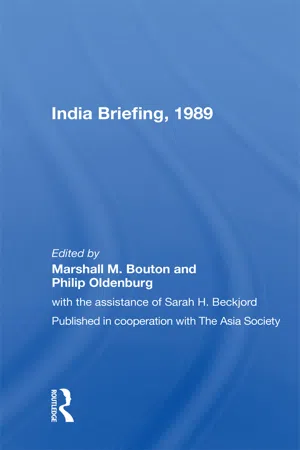
India Briefing, 1989
About this book
India Briefing, 1989 is the third in a series of annual assessments of key events and issues in Indian affairs prepared by the Contemporary Affairs Department of The Asia Society. It covers the year's developments in Indian politics, foreign policy, and the economy.
Information
1
The Faltering Novitiate: Rajiv at Home and Abroad in 1988*
Lloyd I. Rudolph
Rajiv Gandhi, grandson of Jawaharlal Nehru, son of Indira Gandhi, and spokesman for what Salman Rushdie called midnight's children, the generation born after August 1947, seemed for a time to be revitalizing his grandfather's vision of a "modern" 21st century India. It was to be an India of high-tech industry, efficient management, and "clean" and constitutional government. This was the vision that ushered in Rajiv's debut as prime minister in late 1984. By the end of 1988, Gandhi was four years into his five-year term. His first year had been perceived as a time of mastery, the succeeding three as a time of drift. Toward the close of 1989, India was scheduled to hold its ninth parliamentary election. For the prime minister who had begun his term so auspiciously, the portents of a second term were unfavorable.
What can 1988 tell us about India's contested past, contingent present, and uncertain future? More than in most years, politics in 1988 was in the making. The credibility and skill with which Rajiv Gandhi and his political rivals, led by V. P. Singh, conducted themselves would largely determine the outcome of the 1989 election. How did Rajiv Gandhi understand and deal with domestic politics and foreign policy in the run up to the electorate's judgment of him after five years in power?
Rajiv Gandhi is the fourth generation of what in Indian political parlance is referred to as the Nehru dynasty. As the heir to the dynasty's political capital, he was uniquely positioned to claim and be granted the mantle of national leadership. His great-grandfather, Motilal Nehru, was one of a handful of top leaders of the Indian National Congress, the movement and party that in 1947 brought independence to India. His mother, Indira Gandhi, and grandfather, Jawaharlal Nehru, were for seventeen and fifteen years respectively prime ministers of India. Like his mother, Rajiv benefited from Mahatma Gandhi's choice of Jawaharlal as his political heir, making him the founder of the modern Indian state and leader of the Congress party, and connecting him to the newly enfranchised village electorate and the political class that constituted the vanguard of the nationalist movement. Rajiv's political capital included the villagers who regarded the Congress government as their grandfathers' generation had regarded the British raj, as sarkar (government). Like the monsoon, sarkar was a natural part of life, sometimes generous, sometimes cruel, but always present. If Rajiv Gandhi had a problem, it was that his mother, by her personalistic political style, had eroded the Nehru dynasty's political capital, sapping the institutional strength of the nationalist movement under Gandhi.
Rajiv entered politics some months after the death of his younger brother Sanjay, the first heir apparent, in a daredevil plane crash in New Delhi. His entry had been reluctant, over the objections of his Italian wife, Sonia, and with misgivings about giving up his career as a pilot for Indian Airlines. Between 1981 and the December 1984 election, he became chief courtier and principal point man for his mother's brand of highly personalized, no-holds-barred politics, helping, for example, to "topple" recalcitrant state chief ministers. In 1984, two months after the assassination of his mother by her Sikh secessionist bodyguards, he won the greatest election victory in Congress history. During the December 1984 campaign, the "old" Rajiv, portrayed as the grieving son of a martyred mother, accused his opponents of subversion and rallied Hindus against minority communities.
Several months later, however, the victorious, "new" Rajiv Gandhi broke with his mother's supporters and legacies. His call to move a technologically advanced, well managed, world competitive India into the 21st century excited the imaginations and hopes of the urban, professional, and business classes whose life styles, consumption habits, and outlooks resonated with those of the youthful prime minister. Jeans replaced dhotis and sunglasses replaced Gandhi caps on front pages and in the corridors of power.1 Mrs. Gandhi's advisers were replaced, her policies revised. For about a year and a half, the new Rajiv became what Ashis Nandy, a keen interpreter and critic of the Indian scene, has characterized as "in-house opposition" to his mother's legacy of personalized power and centralized rule.2
By 1988, though, the Rajiv who could conjure the 21st century, the "Mr. Clean" who promised to sweep the Augean stable of Congress politics, was embattled and on the defensive. Two great issues tested the government in 1988: the Punjab and corruption. It was a year of political defeats which the party unsuccessfully sought to recoup in the important Tamil Nadu state election of January 1989. Not only was Congress defeated, but demoralized party members began to revolt and the party began to crumble in Madhya Pradesh, Bihar, and Rajasthan. Rajiv recalled the Indira loyalists whom he had shunted aside, ignored, or purged.
There were electoral defeats in parliamentary and state assembly elections in June 1988. Among the seven parliamentary and eleven state assembly seats, the contest for the Allahabad parliamentary constituency was particularly important. Allahabad is located in Uttar Pradesh, which, with more than 100 million persons, is India's most populous state. Its 85 seats constitute 16 percent of all parliamentary seats. Allahabad was the ancestral home of both the Nehru family and of V. P. Singh, erstwhile finance and defense minister and Rajiv's national rival. The seat became vacant after Amitabh Bachchan, India's premier film star, Rajiv's close friend, and victor in 1984 by an overwhelming margin, was forced to abandon it when his brother Ajitabh was charged with violating foreign exchange regulations.
The Congress (I) had accepted V. P. Singh's challenge to make the Allahabad election a test of the public's confidence in Rajiv's probity and competence. "For us," then-Uttar Pradesh Congress (I) Chief Minister Vir Bahadur Singh told the press, "Allahabad [provides] ... an opportunity to wipe Singh out from the political scene."3 But the result was a crushing defeat for the Congress (I). Six months later, in January 1989, the voters of Tamil Nadu dealt another blow to Rajiv Gandhi's reputation as the guarantor of Congress electoral success. Despite his eleven campaign trips to the southern state, the Congress (I) finished third behind both the victorious Dravida Munnetra Kazhagam (DMK), led by former chief minister Thirikovalai Muthuvel Karunanidhi, and the All India Anna Dravida Munnetra Kazhagam (AIADMK). Two months later, Rajiv recalled R. K. Dhawan, Indira Gandhi's powerful aide, the man most identified with the harsh and repressive tactics of the Emergency of 1975-77. Rajiv made Dhawan "Officer on Special Duty in the Cabinet Secretariat."
Even before Indira became prime minister, Dhawan had been her loyal, self-effacing servant. For twenty years he had served as devoted acolyte, rising from stenographer to eminence grise of the Emergency regime that ended in Gandhi's debacle in the sixth parliamentary election of 1977.
After Mrs. Gandhi's return to power in 1980, Dhawan again became her most trusted and powerful aide. Like J. Edgar Hoover, he had the files and the feel for dealing with party bosses and industrialists. "Whenever someone comes to see me or speaks about someone else, I can tell the motivation and what the person is trying to gain because I have watched them for so long. I know their strengths and weaknesses," he said.4 When Rajiv fired him immediately upon assuming office, his removal "... heralded a new style of governance, of ridding the party of fixers and deal makers and back room bargain hunters."5 Those who replaced him, persons from the bureaucracy, the corporate world, and the posh Doon School that Rajiv had attended, "showed a preppie standoffishness and disdain for the likes of Dhawan, dismissing him as an oily-haired Punjabi babu."6
Three years of disarray led Rajiv to recall Dhawan, three years in which the elegant amateurs and bureaucratic professionals had failed him. In that time, he had engaged in endless cabinet shuffles (thirteen by the end of 1988); restless rotations, transfers, and sackings of senior civil servants; a revolving-door relationship with close advisers and troubleshooters; and impatient and imperious replacement of state chief ministers and governors. The more he sought the right formula through change, the more isolated and inept he seemed to become.
Dhawan's appointment loosed a firestorm of accusations and protest. Bitter—and fearful—Rajiv loyalists faced the demise of their influence. Opposition party leaders, on the basis of the leaked Thakkar Commission report on Indira Gandhi's assassination, alleged that Dhawan was responsible for the egregious lapses that led to her death and even implicated him in her murder.7 "No matter what Rajiv does, no matter how well intentioned his moves," India Today opined of the Dhawan appointment, "things simply explode in his face,"8
Punjab
The Punjab crisis that Prime Minister Indira Gandhi helped to create and that ended her life remained to burden her son's political career. In the Punjab, the Sikh community's effort to preserve its cultural identity and insure an autonomous political voice in India's federal system had turned violent after Prime Minister Indira Gandhi, in June 1984, had ordered an assault by the Indian army on the holiest Sikh shrine, the Golden Temple in Amritsar, to flush out terrorists headquartered there. The apocalyptic events of October 31, 1984, the day of Indira Gandhi's assassination, and the succeeding three days of November, when 3,000 Sikhs were killed in Delhi, help to explain how an untested political novice like Rajiv could be chosen by India's vast electorate to lead the country: the events evoked sympathy for the son of a martyred mother as well as a Hindu backlash against minorities, perceived as unruly and pampered. Voters perceived the absence of a credible national alternative and expected the familiar Congress party and its dynastic family to somehow restore national unity.
Whatever the electorate's intentions or expectations, Rajiv Gandhi's victory in December 1984 transformed the national mood from despair to confidence. And for a time at least, it had transformed Rajiv from a successor uncertain about his legitimacy and talents into a bold and confident leader. Within six months, the "new" Rajiv negotiated the centerpiece of his early magic, the Punjab accord.9 The accord paved the way to the election of an Akali Dal (Sikh) government in Punjab and the prospect of the restoration of national unity.
But the success was short-lived. Having promised, as part of the accord, to deliver Chandigarh, hitherto the joint capital of Haryana and Punjab, for the exclusive use of the Barnala-led Akali Dal government in the Punjab, Rajiv failed to do so. The failure became both a symptom and a cause of the unravelling of the accord and of his reputation and image. Soon Rajiv's government was mired, as his mother's had been, in the seemingly intractable factional complexities of Sikh politics, and in a kaleidoscopic deployment of advisers, strategies, and tactics.
In May 1987, Rajiv restored his mother's policy of central management by replacing the moderate Akali Dal government of Surjit Singh Barnala with President's Rule. Many believe the decision was taken for an expedient and extraneous reason, to help the Congress (I) win the mid-June state assembly election in the neighboring state of Haryana by appeasing Hindu anti-Sikh sentiment there. In any event, the decision proved doubly costly. Not only did the strategy fail to prevent a Congress (I) rout in Haryana, but also, New Delhi was no longer able to rely on the moderate Sikhs of the Barnala government to cope with extremist violence and pursue political solutions. The central government had to resume the seemingly endless task of restoring law and order in the Punjab by force.10
Throughout 1988, the Punjab problem remained the greatest test of Rajiv Gandhi's leadership. A record 1,567 persons were killed in terrorist incidents in the state during the year, according to the Punjab state government. Among the casualties were 1,210 civilians, 283 terrorists, and 74 policemen.11 The center's Sikh strategy that year was two-pronged: more draconian use of force and negotiations with the Sikh militants. The first prong took the form of dissolving the Punjab assembly, in suspended animation since the dismissal of the Barnala government. It also involved legislating a 59th amendment to the constitution over the objections of the national opposition which was deeply concerned about its abuse inside the Punjab and its possible extension to other states. The amendment added to the panoply of powers already available to the police and army in the Punjab by enabling the central government to extend President's Rule there by up to three years and, more important, to impose an emergency due to "internal disturbances." The emergency provisions virtually eliminated civil rights and judicial safeguards in the Punjab.
The second prong was to reinstall militant leader Jasbir Singh Rode as chief among the five head priests in charge of the Akal Takht, the shrine within the Golden Temple housing the Granth Sahib, the Sikh's holy book. Rode was brought on with the expectation that he would persuade the extremists to shun violence,12 stop talk about an independent Khalistan, and facilitate negotiations between the militants and the central government. His strong connections to the extremists made him attractive to the Gandhi government. He is nephew to Jarnail Singh Bhindranwale, the martyred hero of the extremist Sikh movement. His brother-in-law is Gurjit Singh, leader of an important faction in the extremist All-India Sikh Student Federation (AISSF), backbone of Sikh violence; his cousin is Baba Joginder Singh, an important figure in the Bhindranwale-oriented (non-moderate) United Akali Dal.
The new Sikh policy was as unconventional as those who devised it. In early March, the government released Rode and four other high priests along with 40 other Akali leaders held in Jodhpur since Operation Bluestar. Home Minister Buta Singh and other cabinet hawks who opposed appeasement, much less negotiations with the militants, were partially pacified when, a few weeks after Rode's release, both houses of parliament approved the 59th amendment that gave the center ample scope to use force.
The Rode initiative quickly unravelled; not for the first time the prime minister seemed to have followed the advice of the last person to whom he spoke. Although Rode dissolved both f...
Table of contents
- Cover
- Half Title
- Title
- Copyright
- Contents
- Preface
- Map of South Asia
- Map of India
- 1 The Faltering Novitiate: Rajiv at Home and Abroad in 1988
- 2 Business and Economy: Reaching Out and Upward
- 3 Political Parties and Electoral Politics
- 4 India's Environment: More Diversity than Unity
- 5 The Indian Media
- 6 Indian Women: A Decade of New Ferment
- Suggestions for Further Reading
- 1988: A Chronology
- Glossary
- About the Contributors
- Index
Trusted by 375,005 students
Access to over 1.5 million titles for a fair monthly price.
Study more efficiently using our study tools.
Frequently asked questions
Yes, you can cancel anytime from the Subscription tab in your account settings on the Perlego website. Your subscription will stay active until the end of your current billing period. Learn how to cancel your subscription
No, books cannot be downloaded as external files, such as PDFs, for use outside of Perlego. However, you can download books within the Perlego app for offline reading on mobile or tablet. Learn how to download books offline
Perlego offers two plans: Essential and Complete
- Essential is ideal for learners and professionals who enjoy exploring a wide range of subjects. Access the Essential Library with 800,000+ trusted titles and best-sellers across business, personal growth, and the humanities. Includes unlimited reading time and Standard Read Aloud voice.
- Complete: Perfect for advanced learners and researchers needing full, unrestricted access. Unlock 1.5M+ books across hundreds of subjects, including academic and specialized titles. The Complete Plan also includes advanced features like Premium Read Aloud and Research Assistant.
We are an online textbook subscription service, where you can get access to an entire online library for less than the price of a single book per month. With over 1.5 million books across 990+ topics, we’ve got you covered! Learn about our mission
Look out for the read-aloud symbol on your next book to see if you can listen to it. The read-aloud tool reads text aloud for you, highlighting the text as it is being read. You can pause it, speed it up and slow it down. Learn more about Read Aloud
Yes! You can use the Perlego app on both iOS and Android devices to read anytime, anywhere — even offline. Perfect for commutes or when you’re on the go.
Please note we cannot support devices running on iOS 13 and Android 7 or earlier. Learn more about using the app
Please note we cannot support devices running on iOS 13 and Android 7 or earlier. Learn more about using the app
Yes, you can access India Briefing, 1989 by Marshall M. Bouton in PDF and/or ePUB format, as well as other popular books in Política y relaciones internacionales & Historia del mundo. We have over 1.5 million books available in our catalogue for you to explore.